Trichologists Stafford: Volume Products for Fine Hair
Volume on fine hair is mostly an optical job, not a growth job, and that is the first thing trichologists Stafford clients tend to hear. Fullness comes from lifting hair away from the scalp, separating strands so light scatters, and keeping length intact. No cosmetic product adds follicles. The products that work are the ones that create lift and separation without leaving weight, residue or damage behind.
Our heat protection spray
Protect Me® Heat Protection Spray, £13.95. A leave in spray that shields hair from heat styling, helps control frizz and keeps colour looking fresher for longer.
Key takeaways
- Volume is created by root lift, strand separation and intact length. None of those three needs a new follicle.
- Mousse and root sprays work by coating the strand with a light film. Dry texture sprays work by adding grip. They do different jobs and stack badly.
- Product build-up at the root flattens fine hair, so a clarifying wash often adds more visible volume than any styling product.
- Backcombing, high heat on damp hair and daily dry shampoo are the three habits most likely to trade tomorrow's length for today's volume.
- If volume keeps falling despite a good routine, check density rather than styling. The NHS puts normal daily loss at 50 to 100 hairs.
What actually makes fine hair look fuller?
Fullness is produced by three physical things: hair standing away from the scalp at the root, individual strands sitting apart rather than clumping, and ends that are still thick enough to hold a shape. Fine hair fails on all three easily, because a narrow strand bends under its own weight and lies flat against the scalp.
Density sets the ceiling, and styling decides how close you get to it. DermNet describes a healthy scalp as having roughly 85% of follicles actively growing and about 15% resting at any moment, and that ratio is what determines how many hairs are available to be lifted. Everything in a bottle is working on the hairs you already have.

Do volumising products add volume or just coat the hair?
Volumising products coat, and the coating is the point. Mousse, root lift sprays and thickening sprays deposit a thin film of polymer or protein on the outside of the strand, which stiffens it slightly and holds it away from the scalp. That film is genuinely useful on fine hair, and it is also the thing that builds up and flattens the root if it is never properly washed out.
The build-up problem is why a clarifying wash often outperforms a new styling product. Our guide to clarifying shampoo and build-up on fine hair covers when to do that and how often, and the piece on greasy roots between washes explains why oil returns faster on some scalps than others. Readers nearer Merthyr Tydfil may find our guide to planning a trichology trip from Merthyr Tydfil more useful.
The stacking mistake
Mousse, then dry shampoo, then texture spray, then hairspray, day after day, without a proper wash in between, ends with hair that is stiff at the root and flat by lunchtime. Pick two products, not four, and clarify once a fortnight.
Which volume products are worth using on fine hair?
Each category does one specific thing, and using the right one for the right problem beats buying more of them. Mousse builds body through the mid-lengths, a root spray lifts at the scalp only, a dry texture spray adds grip to clean hair, and a sea salt spray roughens the cuticle for surf texture at the cost of dryness.
| Product | What it does | Best for fine hair | Watch out for |
|---|---|---|---|
| Mousse | Light polymer film through mid-lengths and roots | Yes, in a golf-ball amount on damp hair | Crunchy hold and flaking if overapplied |
| Root lift spray | Targets the scalp area only, then heat-set | Yes, the most efficient single product | Residue at the parting if not washed out |
| Dry texture spray | Adds grip and separation to clean, dry hair | Yes, for day one styling | Not a cleanser, and it dulls colour over time |
| Dry shampoo | Absorbs oil, adds temporary root grip | Occasionally, not daily | Layering on an unwashed scalp causes itch and flaking |
| Sea salt spray | Roughens the cuticle for texture | Sparingly | Dryness and mid-length breakage on fine hair |
| Backcombing | Mechanically tangles hair at the root | Rarely, for one event | Cuticle damage and snapping when brushed out |

Get a discount on the fine hair range
Join the Watermans mailing list and we will email a discount code straight to your inbox, so you can try the fine hair range for less. Made in the UK, over 6.5 million bottles sold since 2012.
How does chasing volume cause breakage?
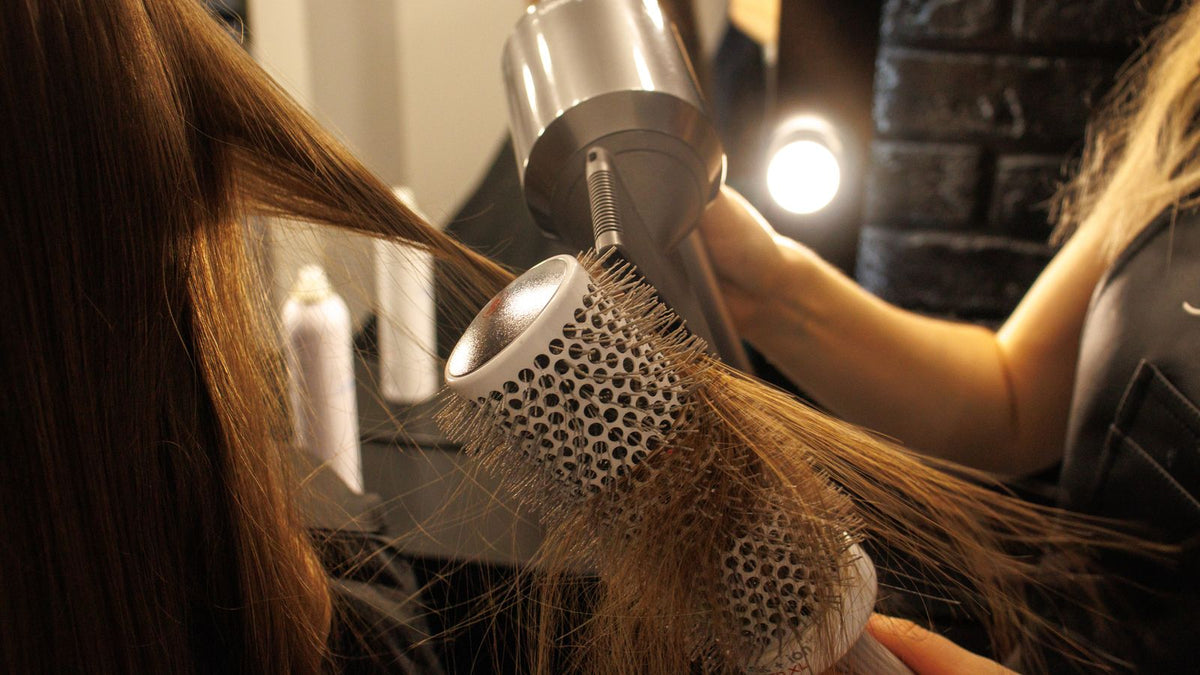
Breakage happens when the hair fibre is stressed beyond what it can recover from, and volume routines are full of that stress. High heat applied to damp hair boils water inside the shaft, backcombing lifts and tears the cuticle, and repeatedly brushing product out of dry, coated hair drags at the weakest points in the mid-lengths.
The result is short broken pieces that stand up along the parting. People read them as new growth and feel encouraged, or read them as thinning and panic, when they are usually neither. Our post on towel-drying wet hair without breakage covers the wettest and most vulnerable part of the routine, which is where a lot of fine hair is lost before styling even starts.
The fix is unglamorous. Let hair dry to about 80% before heat, keep the dryer moving, use the lowest setting that gets the job done, and always put a barrier between the tool and the fibre.

Protect Me® Heat Protection Spray, £13.95
A leave-in heat protection spray rated to 230°C, with panthenol, niacinamide, caffeine and hydrolysed lupine protein. Used before a blow-dry, it is the single cheapest way to keep the length you are styling.

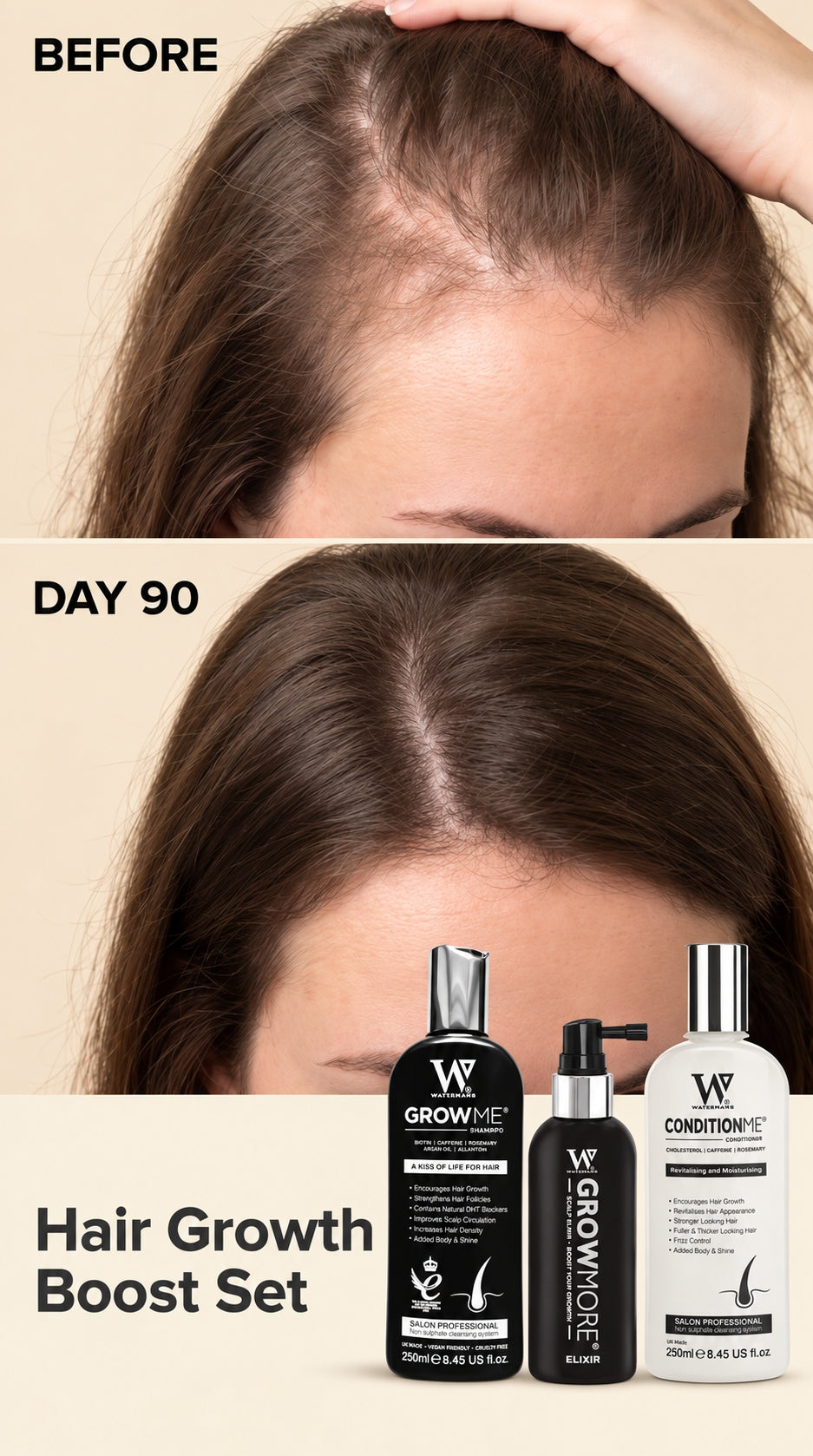
Grow Me® Hair Growth Shampoo, £14.95
A sulfate-free shampoo with biotin, caffeine, rosemary and ANAGELINE®, formulated to clean the scalp properly so fine hair starts the day with lift rather than residue.

Condition Me® Hair Growth Conditioner, £13.95
A breakage-defence conditioner for mid-lengths and ends only. Detangling with slip rather than force is what keeps fine hair long enough to hold a shape.
When does a volume problem turn out to be a density problem?
Styling stops working when there are fewer hairs to style, and that is a different problem with a different answer. Hair loss means follicles producing less or nothing, hair shedding means more hairs than usual releasing at once, and hair breakage means intact follicles with strands snapping mid-length. Volume products only ever help the third one.
The NHS gives 50 to 100 hairs a day as the normal range. DermNet describes excess shedding, telogen effluvium, as beginning 2 to 4 months after a trigger such as illness, surgery, stress or significant weight loss, and tapering back to normal over 6 to 9 months in most cases. If your ponytail circumference has genuinely shrunk over a year, that is density, and our explainer on how hair density is measured shows what that actually means.
2 to 4 months
the usual delay between a trigger and the shedding it causes, according to DermNet
What do trichologists Stafford clients ask about volume?
The most common question is whether a product can make hair grow back thicker, and the honest answer is no: cosmetic products work on the strand and the scalp environment, not on the genetics that set strand width. The second most common is whether a shorter cut helps, and there the answer is usually yes, because less weight means more lift.
Anyone comparing trichologists Stafford options should know the NHS order of events first. The NHS advises seeing a GP to get an idea of what is causing hair loss before thinking about going to a commercial hair clinic, because a blood test for iron or thyroid problems is cheaper and faster than a product programme. Stafford sits in Staffordshire, with County Hospital in the town and NHS dermatology run from Royal Stoke University Hospital roughly 17 miles north, both under University Hospitals of North Midlands.

What should you ask a stylist about a fine-hair cut?
A cut changes volume more reliably than any bottle, because it removes the weight that drags fine hair flat. Ask for blunt ends rather than heavy texturising, because thinning shears on already-fine hair create short pieces that will not hold a shape and read as breakage a month later. For everything else that flattens fine hair, our guide to why hair falls flat runs through thirteen causes and the fix for each.
Three questions get you a better result. Will this cut keep the ends blunt, where exactly will any layers start, and how short does the shortest layer go? Layers that begin at the jaw add movement without hollowing out the ends, while layers starting at the crown on fine hair usually remove the density that made the ponytail look full.
Length has a ceiling too. Past roughly collarbone length, fine hair carries enough weight to flatten at the root no matter what is sprayed on it, so the same head of hair often looks noticeably fuller two inches shorter. That is a trade rather than a rule, and it is worth discussing before the scissors move.
How do you keep volume without damaging fine hair?
A workable fine hair routine is short and repeatable. Wash the scalp rather than the ends, condition from mid-length down, use one volume product rather than four, dry most of the way before heat, and clarify every week or two so nothing accumulates at the root.
Two habits matter more than any purchase. Change where you fasten your hair so the same spot is not under tension every day, and give yourself one heat-free day a week. Neither costs anything, and both show up in how much length survives to the end of the year.
What are the frequently asked questions about trichologists Stafford?
Can any product make fine hair permanently thicker?
No cosmetic product changes the width of the hair fibre your follicles produce, because strand diameter is largely inherited. Products can coat the strand for the day, reduce breakage so more length survives, and keep the scalp clean, and hair looks fuller as a result.
Is dry shampoo bad for thinning hair?
Occasional use is fine. Daily use without proper washing leaves starch and propellant residue on the scalp, which for many people leads to itch, flaking and scratching, and scratching causes breakage. Treating it as an occasional extra rather than a substitute for washing avoids most of that.
Do trichologists Stafford clients need a GP referral?
No, because trichology sits outside the NHS and is paid for privately. The NHS still advises seeing a GP first to get an idea of what is causing hair loss before going to a commercial hair clinic, which is sensible if shedding is sudden or came with other symptoms. If your question is about products or a routine rather than a medical one, you can talk to Gail Waterman, our co-founder, as an AI avatar on the Watermans homepage.
Does washing hair more often make it flatter?
Usually the opposite. Clean hair at the root has more lift, and most flatness at the parting comes from product and oil build-up rather than from washing itself. Shampoo targeted at the scalp with conditioner kept to the ends is the combination that holds volume.
Is backcombing really that damaging?
Backcombing works by deliberately tangling the cuticle so hairs catch on each other, and brushing that out tears cuticle scales. Once or twice for an event is manageable. As a daily technique on fine hair it produces exactly the mid-length snapping that makes hair look thinner.
How long before a new routine shows a difference?
Breakage improvements show within a few weeks, because you stop losing length immediately. Anything involving the growth cycle takes far longer, since scalp hair grows about a centimetre a month, so photographs three months apart are the shortest fair test.
Should I use mousse and root spray together?
Pick one. They do the same job with the same kind of film, so using both doubles the residue without doubling the lift. Root spray at the scalp on damp hair, heat-set with a dryer, is the more efficient choice for most fine hair.
What is the bottom line on trichologists Stafford?
Volume on fine hair comes from lift, separation and intact length, and it is lost far more often to build-up and breakage than to anything happening in the follicle. Use one styling product rather than a stack, clarify regularly, keep heat off damp hair, and photograph the parting monthly. If density is genuinely falling, that belongs with a GP before it belongs with a product, and that is the sequence trichologists Stafford clients benefit from most.
If one purchase is going to protect the volume you already have, make it a heat protection spray, because every blow-dry without one costs length you cannot style back. Protect Me® heat protection spray is £13.95, made in the UK, from a brand that has sold over 6.5 million bottles since 2012.
Watermans products are 100% cosmetic and do not treat medical hair loss. Individual results may vary.