Trichologist Wellingborough: Female Pattern Hair Loss
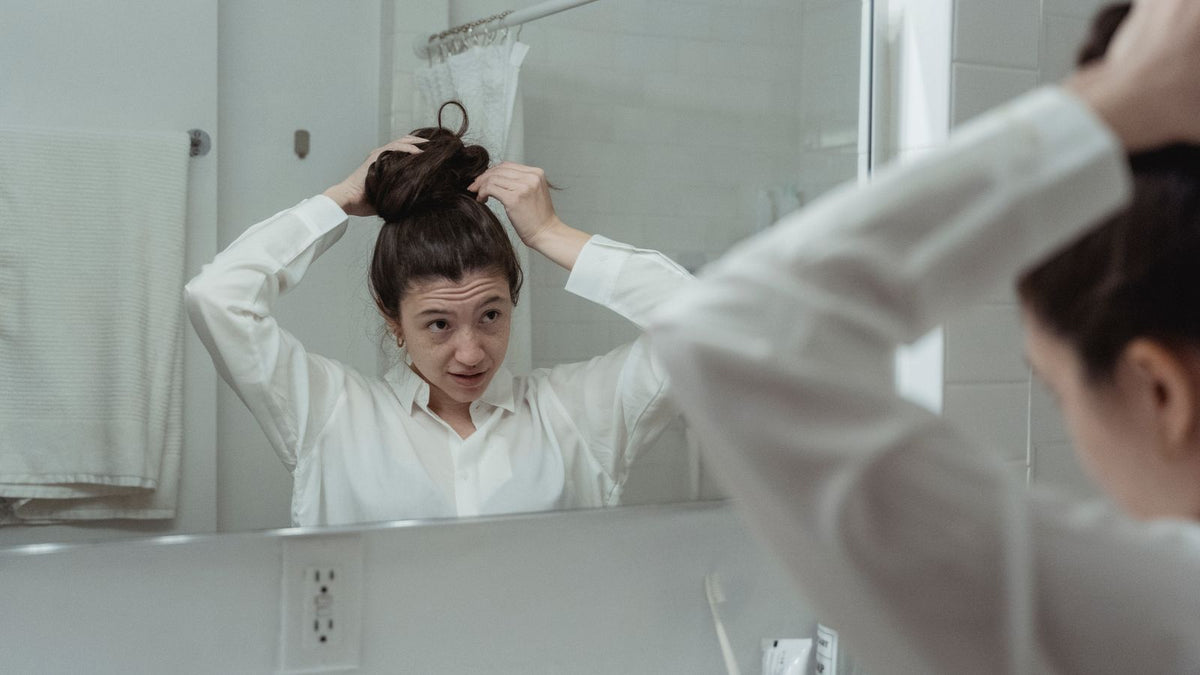
Most women notice it in the same way: the parting in the mirror looks wider than it used to, the ponytail feels thinner in the hand, and scalp shows through under bright light. That pattern, thinning across the top and crown while the hairline stays put, is female pattern hair loss. If you have been searching for a trichologist Wellingborough locals use, this guide sets out what is actually happening, what your GP can check, and where hair care genuinely helps.
Our hair growth shampoo
Grow Me® Hair Growth Shampoo, £14.95. A sulphate free daily shampoo that supports a healthy scalp environment and helps reduce breakage, so lengths hold on and look fuller.
A trichologist Wellingborough residents can consult will usually be looking for one distinction: pattern loss or shedding. Female pattern hair loss thins the top and crown gradually over years, widens the parting and leaves the front hairline intact. Shedding comes on over weeks, drops hair from all over, and recovers. Both can happen at once, which is why the timeline of when you first noticed matters more than the amount in the brush.
Key takeaways
- Female pattern hair loss widens the parting and thins the crown while the frontal hairline usually stays where it is.
- The Ludwig scale grades it in three stages, from a slightly widened parting to visible scalp across the whole top.
- Follicles miniaturise rather than die, producing finer, shorter, paler hairs each cycle until they stop being cosmetically useful.
- Scalp hair grows roughly 1 cm a month, so any change you make takes three to six months before you can judge it.
- Cosmetic hair care can make hair look fuller and reduce breakage. It cannot switch a miniaturising follicle back to full size, and we will not pretend otherwise.
What does female pattern hair loss look like at the start?
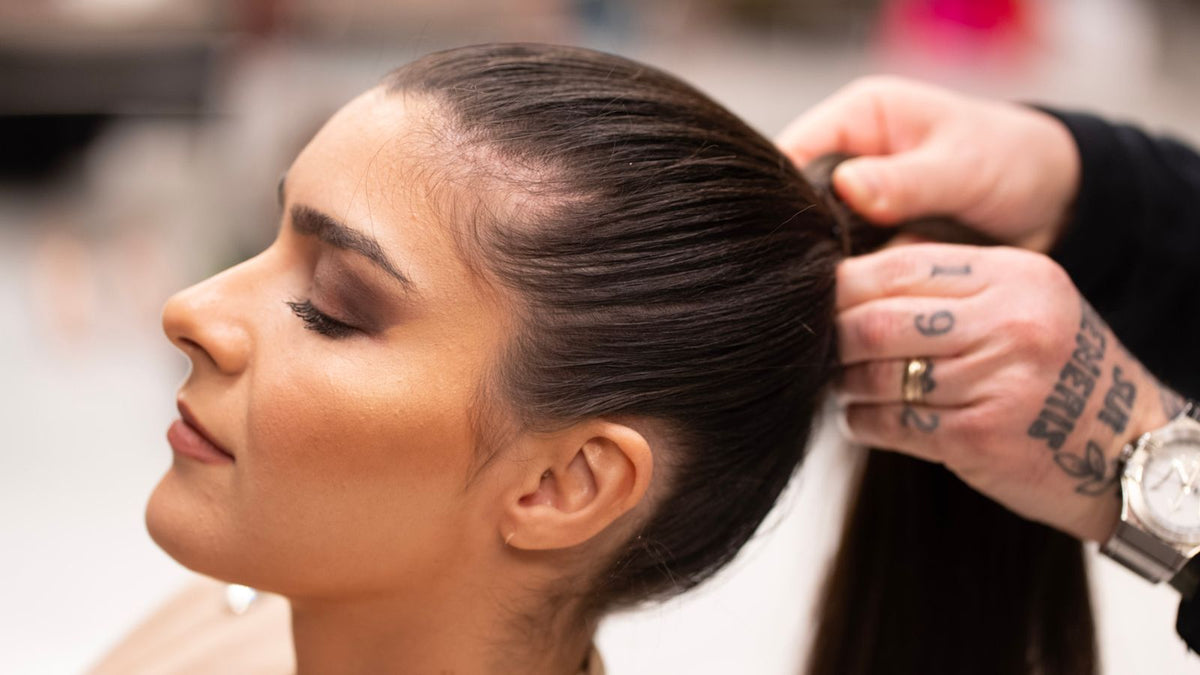
Female pattern hair loss starts as a widening of the central parting rather than a receding hairline. The usual sequence is that the parting looks a little broader under a bathroom light, then the crown starts to show through when hair is tied back, then the ponytail circumference drops. The front hairline typically stays intact, which is one of the clearest differences from the male pattern most people picture when they hear the word baldness.
Underneath, follicles are miniaturising. Each growth cycle produces a hair that is a little finer, shorter and lighter than the last, until the hair being produced is too fine to contribute to the way your hair looks. The follicle is still there, which is why density changes are gradual and why the scalp does not go smooth and shiny the way it does in scarring conditions. DermNet describes pattern loss as the commonest cause of thinning in women, becoming more common after the menopause.

What is the difference between hair loss, hair shedding and hair breakage?
Hair loss, hair shedding and hair breakage describe three different failures, and mixing them up is the main reason people buy the wrong product. Hair loss means follicles are producing less hair or none, which is what makes scalp visible. Hair shedding means an unusual number of hairs leave the scalp at the root over a short period, usually three months after an illness, operation, crash diet or major stress. Hair breakage means the fibre snaps along its length while the follicle is entirely healthy.
| Question | Pattern loss | Shedding | Breakage |
|---|---|---|---|
| How fast did it start? | Over years | Over a few weeks | Gradually, with styling |
| Where is it worst? | Parting and crown | All over, evenly | Mid-lengths and ends |
| Hairs in the brush | Normal amount | Far more than usual | Short snapped pieces |
| Is scalp visible? | Yes, through the parting | Sometimes, temporarily | No |
| Does it recover on its own? | No | Usually, within 6 to 9 months | Yes, once handling changes |
Our self-check guide to why hair is thinning, in three clues runs through the same comparison step by step if you want to work through it with your own hair in front of you.
What is the Ludwig scale and why does it matter?
The Ludwig scale is the standard three-grade description of female pattern hair loss, and it matters because it gives you and a GP the same vocabulary. Grade I is a mildly widened parting with thinning on the top that is easy to hide. Grade II is a clearly widened parting with noticeable thinning across the crown. Grade III is diffuse thinning with scalp visible across the whole top of the head. The frontal hairline is preserved in all three grades, which is part of the definition.
The practical use of grading is tracking. A grade recorded today, with a photograph, tells you in six months whether anything has changed, and that is far more reliable than memory. Our full explainer on the Ludwig scale stages includes what each grade looks like in practice.
Get a discount on the thinning hair range
Join the Watermans mailing list and we will email a discount code straight to your inbox, so you can try the thinning hair range for less. Made in the UK, over 6.5 million bottles sold since 2012.
What causes female pattern hair loss?
Female pattern hair loss is driven mainly by inherited sensitivity of the follicle to androgens, the hormones present in everyone at different levels. Family history on either side matters, which is why the question about mothers, aunts and grandmothers comes up early in any consultation. Age is the second factor, and the change in hormone balance around and after the menopause is why many women first notice it in their forties and fifties, although it can begin much earlier.
Other conditions can accelerate or mimic it. Polycystic ovary syndrome, thyroid disorders and iron deficiency all affect hair, and all three are checkable. NICE guideline NG23 covers menopause management, which is the relevant reference point if your thinning began alongside other menopausal changes. Our guide to what starts and speeds up androgenic alopecia goes through the accelerating factors in more depth.

How do you tell pattern loss from telogen effluvium?
Pattern loss and telogen effluvium are separated by timeline and distribution more than by volume. Telogen effluvium is heavy, diffuse shedding that starts roughly two to three months after a trigger such as a serious illness, surgery, childbirth, a crash diet or a period of severe stress, and it usually settles within six to nine months of the trigger being removed. Pattern loss has no sudden onset, no obvious trigger and no natural recovery. There is more on hair recovery after stress in a separate guide.
The test that actually helps
Take a photograph of your parting in the same bathroom light, same position, every eight weeks. Comparing two photographs three months apart answers a question that day-to-day mirror checks never will, and it is the single most useful thing you can bring to a GP or hair specialist.
The complication is that the two coexist more often than people expect. A woman with early pattern loss who then has a stressful year can shed heavily on top of gradual thinning, and the shedding is what finally makes the underlying pattern visible. That is not two separate disasters, it is one becoming noticeable because of the other, and the shedding half usually settles.
What blood tests are worth asking a GP about?
Blood tests are worth asking about because several reversible causes look identical to pattern loss in the mirror. NHS information on iron deficiency anaemia explains the tests involved, and ferritin, which measures iron stores, is the one most often relevant to hair. Thyroid function is the second common check, since both underactive and overactive thyroid affect hair growth. If there are other signs such as irregular periods or unwanted facial hair, hormone levels may be checked as well.
- Full blood count and ferritin, to look at iron stores rather than just haemoglobin
- Thyroid function, since thyroid problems commonly show up in hair first
- Vitamin D, which is frequently low in the UK and easy to correct
- Hormone profile if there are other symptoms suggesting PCOS
- A review of any medication started in the six months before the thinning began
NHS advice is to see a GP if hair loss is sudden, patchy, comes with an itchy or scaly scalp, or is causing distress. Gradual thinning in a pattern also deserves an appointment, if only to rule the checkable things out before you spend money on anything else.
What can cosmetic hair care honestly do for a widening parting?
Cosmetic hair care works on two things: how much hair you keep, and how full what you have looks. Keeping hair matters because a fine, miniaturising hair is also a fragile hair, and losing it to breakage on top of everything else makes the parting look worse faster. Gentle detangling, conditioning the mid-lengths and ends, keeping heat down and avoiding tight styles all reduce that avoidable loss. That is a modest contribution but it is a real one.

Grow Me® Hair Growth Shampoo £14.95
A daily shampoo formulated to reduce breakage, for fuller-looking hair and a clean scalp. Cosmetic care that helps you hold on to what you have, not a medicine.

Condition Me® Hair Growth Conditioner £13.95
Conditioner is where breakage is won or lost, because combing conditioned wet hair pulls out far fewer strands. Concentrate it on the mid-lengths and ends.

Grow More® Leave-In Scalp Elixir £25.50
A leave-in scalp elixir for people who want an extra step in the routine, applied to a clean scalp and left on. Cosmetic, and used alongside rather than instead of a GP visit.
The second half is appearance, and it is not a consolation prize. Moving the parting a couple of centimetres exposes hair that has not been flattened by being parted the same way for years. A cut with layers that stop short rather than thinning the ends out keeps more weight through the lengths. Volumising styling, root lift and even a change of colour that reduces the contrast between hair and scalp all make a visible difference on the same head of hair.

What does a trichologist Wellingborough consultation add?
A trichologist adds a close look at the scalp, an experienced eye on the pattern, and practical routine guidance. In the UK the Institute of Trichologists holds a public register of qualified members, and checking it is the simplest way to avoid someone who has bought a certificate. A good consultation will examine the scalp under magnification, assess the pattern against a recognised scale, ask about family history and any triggers, and be direct about which parts belong to a doctor.
What a trichologist Wellingborough based cannot do is order NHS blood tests, make a medical assessment or refer you to dermatology. Trichology is not an NHS service, so a consultation is a private arrangement, typically from around 50 to 150 pounds for a first visit. If a practitioner opens with a package of own-brand products before anything has been examined or checked, that is a reason to leave. There is more detail on which hormone change is actually driving hair loss on HRT.
What are the frequently asked questions a trichologist Wellingborough hears most?
Is female pattern hair loss permanent?
The follicles miniaturise rather than disappear, so the change is gradual and long term rather than sudden. It does not resolve by itself, which is why tracking it with photographs and getting the checkable causes ruled out early is worth doing.
How much hair loss per day is normal?
Losing somewhere around 50 to 100 hairs a day is normal and nothing to act on. What matters is a clear change from your own baseline that lasts more than a few weeks, and whether you can see more scalp than you could six months ago.
Can the menopause cause hair thinning?
Hair thinning is commonly reported around the menopause, and NICE guideline NG23 is the reference point for menopause care generally. Discuss it with a GP alongside your other symptoms rather than treating it as a separate cosmetic issue.
Will a shorter cut make thin hair look thicker?
Often yes. Shorter hair carries more weight per centimetre, so it holds volume better at the root, and a blunt line looks denser at the ends than a heavily layered or thinned finish.
Do hair supplements work for pattern loss?
Correcting a real deficiency helps hair. Taking supplements when your levels are already normal does not, and some nutrients cause problems at high doses. Get bloods done first, then supplement what is actually low.
Does washing my hair less often help?
No. Hairs that were going to come out are shed whenever you next wash, so washing less just gathers them up for one alarming day. A clean scalp is better for hair than an unwashed one.
Can stress alone cause a wider parting?
Stress causes diffuse shedding rather than a pattern, so it thins everything evenly rather than widening a parting specifically. If your parting has widened, there is usually a pattern component underneath.
Is it worth seeing a trichologist Wellingborough way before a GP?
Go to the GP first if anything is sudden, patchy, itchy or sore. For gradual pattern thinning, seeing both is reasonable, and the GP visit is the one that gets iron and thyroid checked.
Sources & references
- NHS: Hair loss
- NHS: Iron deficiency anaemia
- DermNet: Female pattern hair loss
- NICE guideline NG23: Menopause management
- NHS: Iron in vitamins and minerals
- The Institute of Trichologists
What is the bottom line on trichologist Wellingborough?
If you are searching for a trichologist Wellingborough has nearby because your parting has widened, the sequence that saves the most time is: photograph it, see a GP to get ferritin and thyroid checked, then decide whether a private hair consultation adds anything. Female pattern hair loss is common, it is gradual, and the follicles are miniaturising rather than dying, which is why nothing about it happens quickly in either direction. If your question is about products or a routine rather than a medical one, you can talk to Gail Waterman, our co-founder, as an AI avatar on the Watermans homepage.
Hair care has a genuine job in the middle of that: keep what you have by reducing breakage, and make it look as full as it can with cut, colour, parting and styling. Those are honest cosmetic gains and they are worth taking. They are not a substitute for the blood tests, and no shampoo is going to undo miniaturisation.
To reduce the everyday breakage that makes a widening parting look worse, start with a hair growth shampoo and condition every wash. Cosmetic care for the hair you still have.
Please note: Watermans products are 100% cosmetic and do not treat medical hair loss. Individual results may vary.