How to Prevent Split Ends: The Habits That Actually Work
How to prevent split ends comes down to one idea: a split is mechanical wear at the oldest part of the strand, so you prevent it by reducing friction, heat and tension rather than by buying a repair product. Condition every wash, detangle damp hair from the ends upward, keep straighteners off and trim every ten to twelve weeks. Once a split has formed, nothing closes it. Scissors are the only fix. Since conditioner is the tool that does most of this work, it is worth understanding what a matched shampoo and conditioner set actually does before you spend anything.
Our hair growth conditioner
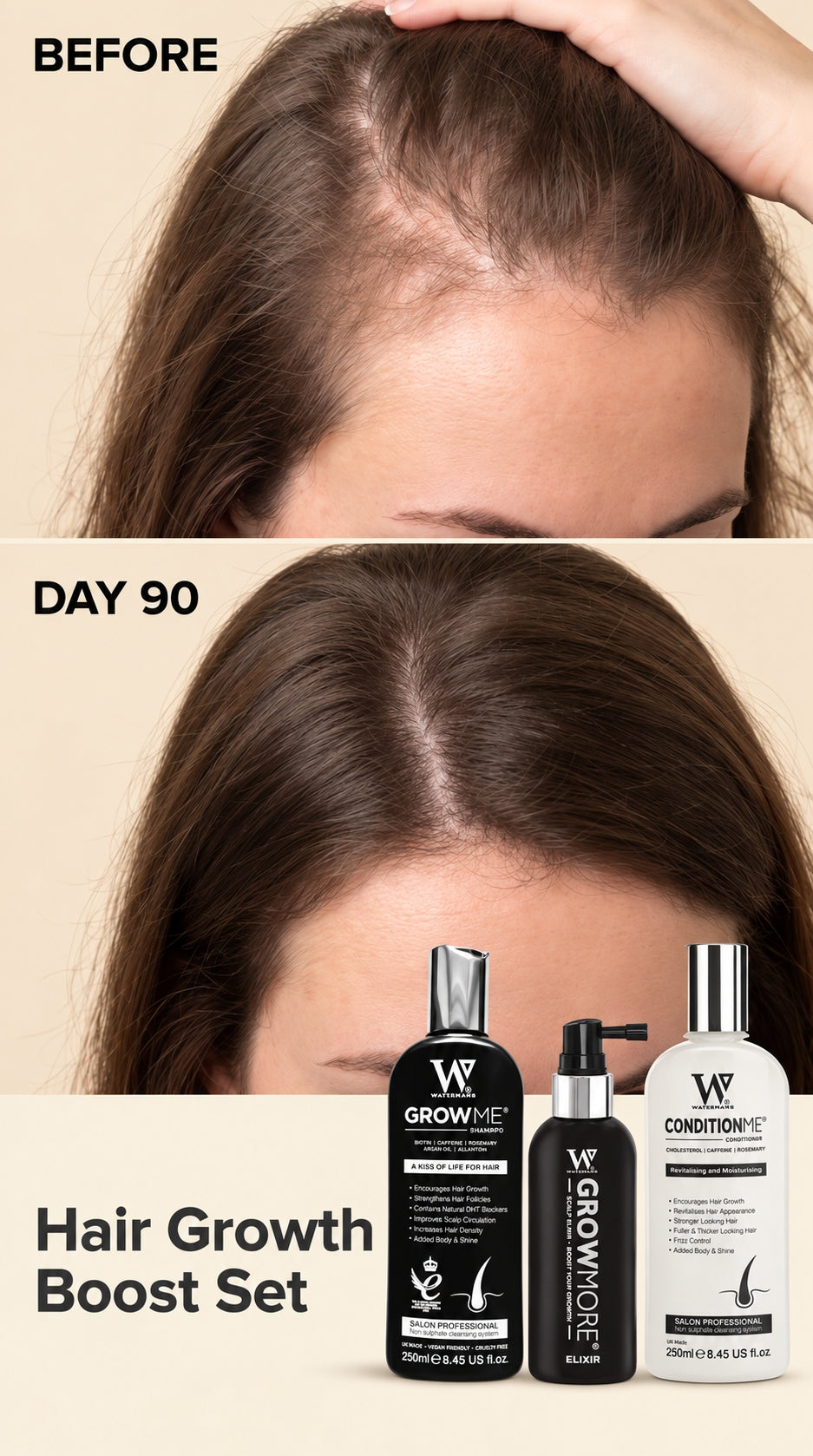
Condition Me® Hair Growth Conditioner, £13.95. Detangles and strengthens the hair fibre so lengths snap less on the brush and look thicker through the ends.
Key takeaways
- Learning how to prevent split ends starts with understanding them: they are the cuticle worn away until the inner cortex frays, so they are damage rather than a deficiency.
- No product mends a split. Anything claiming to seal them is gluing them together temporarily.
- The ends of shoulder length hair are roughly two years old and have survived hundreds of washes and brushes.
- Wet hair is at its weakest, so how you detangle after a shower matters more than almost anything else.
- A trim every ten to twelve weeks stops a split travelling up the shaft and costing you real length.

What exactly is a split end?
A split end is the point where the hair's protective outer layer has worn through and the fibres underneath have separated. Dermatologists call it trichoptilosis. A hair is built like a rope inside a sleeve: the cortex is the bundle of keratin fibres that gives hair its strength, and the cuticle is a sleeve of overlapping scales wrapped around it. When breakage keeps coming back despite regular trims, our Coventry guide to breakage and when a trichologist helps explains the point at which an expert look is worth paying for. If heat styling is the main cause, our Luton guide to straighteners, colour and breakage sets out safer temperatures and a simple weekly routine.
The cuticle has no blood supply and no way to rebuild itself. Every wash, comb, brush, blow dry and night on a pillow chips a little more off it, and because the ends have been through the most of everything, they wear through first. Once the sleeve is gone, the rope frays, and that fraying is the split. Our guide to mineral build-up from hard water covers another common reason hair turns rough and starts snapping at the ends. For more on this, see what hair shaft diameter tells you about strength.
Knowing that is the whole basis of how to prevent split ends, because you cannot rebuild a cuticle, you can only stop wearing it down. Splits come in more than one shape and the shape tells you something. A simple Y split is ordinary wear. A tree with several branches means the damage has been going on a while. A white node partway up the shaft, or a hair that looks like a tiny paintbrush at the end, means it is about to snap there.
Why do the ends split before the rest of the hair?
The ends split first because they are by far the oldest part of the strand. Hair grows at roughly one centimetre a month, so the ends of shoulder length hair have been on your head for around two years, and the ends of waist length hair for four or more.
Do the arithmetic on what those two years contain. Perhaps two hundred washes, a thousand brush strokes, a few hundred blow dries and seven hundred nights of rubbing against a pillowcase. The hair at your scalp has experienced almost none of that. This is why split ends are a wear problem rather than a health problem, and why the answer is about reducing the wear rather than feeding anything.
It also explains why long hair is harder to keep in good condition than short hair. Nothing is wrong with it. It has simply been alive longer, which is why how to prevent split ends becomes a bigger question the longer you grow it.
What causes split ends?
The causes are all forms of physical or chemical stress, and most people are doing several at once without registering them as damage. Working out how to prevent split ends means recognising which of these apply to you.
- Brushing wet hair from the top down. The biggest single avoidable cause. Wet hair stretches and is at its most fragile, and dragging a brush from root to tip pushes every tangle into one knot at the ends.
- Heat styling. Straighteners and tongs run hot enough to boil residual water inside the shaft. Research on heat damaged hair shows structural change well below the temperatures many irons reach.
- Bleach and permanent colour. These work by lifting the cuticle to get inside. Repeated lifting is repeated damage, and the ends have been through every session you have ever had.
- Towel rubbing. Vigorous towel drying roughs up the cuticle across the whole head at once.
- Tight styles and friction. Work on natural African hair has quantified how much braiding and repeated combing cost the fibre, and the effect is measurable, not theoretical.
- Cotton pillowcases. Seven or eight hours of friction, every night, on the section of hair that is already the most worn.
- Sun, chlorine and salt. All strip lipids from the cuticle and leave the surface rougher.
- Leaving it too long between trims. A split does not stay put. It travels up the shaft, so waiting costs you more length than the trim would have.

How to prevent split ends: what is the daily routine?
Preventing split ends is a set of small habits, and the ones around washing and drying matter most because that is when hair is weakest. Work through these in order.
1. Detangle before you wash, not after
Comb through dry hair with a wide tooth comb before you get in the shower. Tangles that go into the water get tighter, and unpicking them wet is where a great deal of damage happens.
2. Shampoo the scalp, not the lengths
Work shampoo into the scalp with your fingertips and let the suds rinse down through the ends on their own. The ends are the driest part of your hair and scrubbing detergent through them is the opposite of what they need.
3. Condition every wash, mid lengths to ends
This is the single highest value habit on the list. Conditioner lays the cuticle flat and puts a slip layer between strands so they stop catching and snapping. Apply from the ears down, leave it a couple of minutes, rinse with cool water. Our step by step on how to use conditioner properly covers the placement. Split ends are an early stage of the same process, and what causes hair breakage and how to stop it covers where it ends up.
4. Squeeze, do not rub
Press the water out with a towel or an old cotton t shirt rather than scrubbing. A microfibre towel or a t shirt has a smoother surface than terry towelling and does noticeably less roughing up.
5. Detangle wet hair from the ends upward
Start at the very bottom, work out the last two inches, then move up two inches and repeat. It takes an extra minute and it is the difference between easing tangles apart and ripping through them.
6. Air dry as far as you can
Let hair get to about eighty percent dry before any heat. If you must blow dry, use a lower setting, keep the nozzle moving and hold it a hand's width away.
7. Turn the straighteners down, or off
Most hair does not need the highest setting. Use the lowest temperature that does the job, never on damp hair, and never twice over the same section.
8. Change what you sleep on
A satin or silk pillowcase, or loosely plaiting your hair at night, removes hours of nightly friction. This is one of the few changes that costs nothing ongoing and works while you are asleep.
Get a discount on the split ends range
Join the Watermans mailing list and we will email a discount code straight to your inbox, so you can try the split ends range for less. Made in the UK, over 6.5 million bottles sold since 2012.
How often should you trim to keep split ends away?
Trim every ten to twelve weeks for most hair, and every six to eight weeks if you bleach, use heat daily or have very fine hair. The point of a trim is not maintenance for its own sake. It is removing the split before it climbs.
| Your hair | Trim every | Take off |
|---|---|---|
| Virgin, no heat, growing it out | 12 to 16 weeks | Half an inch |
| Average, some heat | 10 to 12 weeks | Half to one inch |
| Bleached or highlighted | 6 to 8 weeks | One inch |
| Daily heat styling | 6 to 8 weeks | One inch |
| Curly or coily | 10 to 12 weeks | Half an inch, cut dry |
Trimming is the one part of how to prevent split ends that removes existing damage rather than avoiding new damage. There is a real trade off here and it is worth naming. Trimming does not make hair grow faster, and cutting too often will hold you at the same length forever. Trimming too rarely lets splits travel and costs you more in the end. Ten to twelve weeks is the compromise that keeps ends tidy while still gaining length.
Can any product actually repair split ends?
No product repairs a split end, and it is worth being blunt because a lot of marketing implies otherwise. A split is a physical separation of a fibre that has no living cells and no self repair mechanism. Once it is open, it is open.
What good products genuinely do falls into two honest categories. Some bond the frayed pieces together temporarily with polymers or silicones, so the hair looks and feels smooth until the next wash. That is camouflage, and camouflage is useful. Others reduce the friction and moisture loss that would have caused the next split, which is prevention, and prevention is where the real value is. For a closer look at how coastal air and hard water affect hair, see our guide to how coastal air and hard water affect hair.
So the sensible strategy is: cut off the splits you already have, then spend your effort making sure the next ones take much longer to appear. Our guide to what causes hair damage covers the wider mechanics, and our piece on argan oil for hair explains where a finishing oil fits.
Which products help keep ends in good condition?
Products play a supporting role in how to prevent split ends, and the ones that matter are those you use every wash rather than the occasional rescue mask. Consistent conditioning does far more than anything applied once a month.

Condition Me® Strengthening Conditioner
The most relevant product on this page. It strengthens and detangles, which is exactly the combination that stops ends catching and snapping. Made in the UK.

Grow Me® Shampoo & Conditioner Set
Pairing a non stripping shampoo with the conditioner is the practical answer, because a harsh cleanse undoes what the conditioner just did.

Grow Me® Strength & Retention Shampoo
A daily shampoo with biotin, caffeine, niacinamide, lupin protein and argan oil, formulated to clean the scalp without stripping the lengths.
Watermans products are 100% cosmetic and do not treat medical hair loss. Individual results may vary.
Are split ends the same as hair loss or shedding?
Split ends are none of those things, and mixing them up sends people looking for the wrong solution. The three are genuinely separate:
- Hair breakage, which includes split ends, is the fibre failing along its length. The hair snaps and you find short pieces with no bulb on the end. This is a haircare problem.
- Hair shedding is the cycle releasing hairs early after a trigger such as illness, childbirth or crash dieting. Fallen hairs are full length with a small pale bulb at the root. It settles by itself.
- Hair loss is the follicle producing progressively finer hair or stopping. It develops over years and shows as a widening parting or a receding hairline. This is one for a GP.
Heavy breakage can make hair look and feel like it is falling out, which is why the distinction matters. If your hair is not gaining length but your parting looks unchanged, you have a breakage problem and this page is the right one. If the parting is widening, read our explainer on what causes thinning hair instead. Split ends are one form of breakage, and our guide to reducing hair breakage sets out the whole routine from washing to sleep. If your question is about products or a routine rather than a medical one, you can talk to Gail Waterman, our co-founder, as an AI avatar on the Watermans homepage.

Frequently Asked Questions About How to Prevent Split Ends
Can split ends be repaired without cutting?
No. A split end is a physical separation in a fibre with no living cells and no repair mechanism, so it cannot close. Products that claim to seal splits bond the frayed pieces together temporarily and wash out. Cutting is the only permanent fix.
How often should I trim to prevent split ends?
Every ten to twelve weeks suits most hair, dropping to six to eight weeks if you bleach or use heat daily. Trimming more often than that will hold you at the same length, while leaving it much longer lets splits travel up the shaft and costs you more in the end.
Do split ends stop hair growing?
Growth happens at the follicle and is unaffected by what is going on at the ends. What splits do is make hair snap off at roughly the same rate it grows, so length stalls. That feels identical to hair that has stopped growing, but the cause is at the bottom of the strand, not the top.
Is it bad to brush hair when it is wet?
Wet hair stretches and is at its most fragile, so brushing it roughly is one of the most damaging things in a routine. If you need to detangle wet, use a wide tooth comb and work from the ends upward in short sections rather than dragging from the roots down.
What temperature should I use on straighteners?
Use the lowest setting that does the job, and never on damp hair. Studies of heat damaged hair show measurable structural change well below the maximum temperature many irons reach, so turning it down is one of the easiest wins available.
Does a silk pillowcase really help?
It reduces friction over seven or eight hours a night on the oldest, most worn section of your hair. It is not a dramatic change on its own, but it costs nothing ongoing and works while you sleep, which makes it one of the better value habits on the list.
Why does my hair never get past a certain length?
Because it is snapping at the ends as fast as it grows at the roots. This is called terminal length, and for most people it is set by breakage rather than by any limit on growth. Reducing heat, tension and friction is what moves it.
Are split ends a sign of poor diet?
Not usually. Splits are mechanical wear on hair that is already dead, so they reflect what has happened to the strand rather than what you are eating. Diet affects the new hair being formed at the follicle, which will not reach your ends for a year or more.
What is the bottom line on how to prevent split ends?
How to prevent split ends is genuinely simple, it is just not glamorous. The ends of your hair are the oldest part of it, they have no way to repair themselves, and everything you do to them is cumulative. So condition every single wash, detangle from the ends upward with a wide tooth comb, squeeze rather than rub with the towel, keep the heat low and infrequent, sleep on something smooth, and book a trim every ten to twelve weeks. Do those six things and you will not need a rescue product, because the splits will simply take much longer to arrive. And when they do arrive, reach for the scissors rather than a bottle, because that is the only thing that actually removes them. If bleach or colour is behind the splitting, the repair routine is slightly different and we set it out in our guide to repairing bleach and colour damage.
Sources & References
- International Journal of Cosmetic Science (2021), quantifying the impact of braiding and combing on the integrity of natural African hair, for the measured cost of repeated mechanical grooming.
- Journal of Cosmetic Dermatology (2019), heat damaged evaluation of virgin hair, for structural change from thermal styling.
- Journal of Cosmetic Science (2011), Hair breakage index: an alternative tool for damage assessment of human hair, for how breakage is measured.
- Rele and Mohile, Journal of Cosmetic Science (2003), Effect of mineral oil, sunflower oil, and coconut oil on prevention of hair damage, for the role of conditioning oils in limiting damage.
- NHS, Hair loss, for the distinction between breakage, everyday shedding and hair loss that warrants a GP visit.
If the lengths are what keep letting you down, the Condition Me hair growth conditioner is built to cut the snapping. Made in the UK.