Reishi Mushroom for Hair Growth: An Honest Look
Reishi mushroom for hair growth is one of the least supported ideas in the supplement aisle. No human study has measured hair density, shedding or thickness in people taking reishi, and the whole story rests on a handful of laboratory experiments on isolated compounds in test tubes. Applying it to the scalp has nothing behind it at all. The only honest angle is an indirect one, through stress and sleep.
Our hair growth shampoo
Grow Me® Hair Growth Shampoo, £14.95. A sulphate free daily shampoo that supports a healthy scalp environment and helps reduce breakage, so lengths hold on and look fuller.
Key takeaways
- There are no human trials of reishi for hair. None. The marketing has run a very long way ahead of the science.
- The one thread of laboratory evidence involves isolated compounds acting on an enzyme in a dish, which is a long way from a scalp.
- Reishi is not a licensed medicine in the UK, so what is in the jar varies enormously between brands.
- Liver injury has been reported with reishi products, which is a real reason to be careful rather than a scare story.
- If stress is genuinely driving your shedding, the useful interventions are sleep, load and support, not a powdered fungus.
What is reishi, and why is it sold for hair?
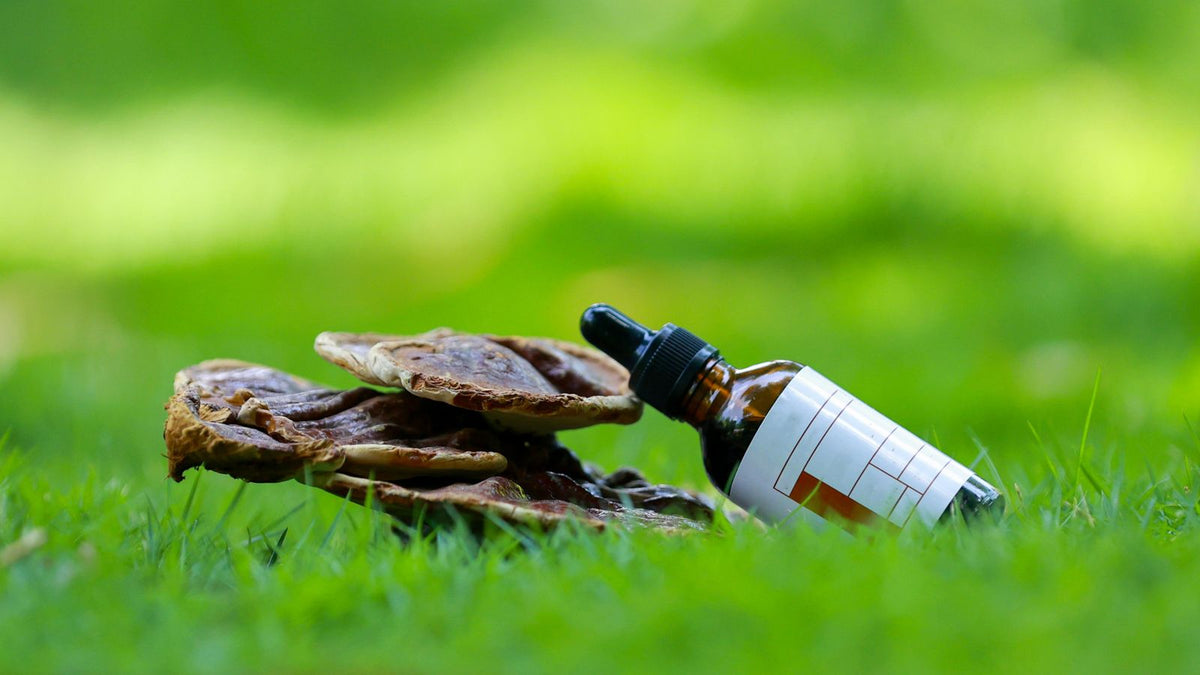
Reishi is Ganoderma lucidum, a hard, glossy, kidney shaped bracket fungus that grows on hardwood and has a long history in Chinese and Japanese traditional medicine, where it is known as lingzhi. It is not a culinary mushroom. It is woody and bitter, so it is sold as an extract, a powder, a tincture or a capsule rather than something you fry.
The reason it turned up in hair marketing is a chain of associations rather than a finding. Reishi is marketed as an adaptogen, adaptogens are marketed for stress, stress is genuinely linked to hair shedding, so reishi ends up on a hair supplement label. Each link in that chain is doing a lot of work, and the last one snaps under any weight at all.
Does reishi mushroom for hair growth have any evidence?
Reishi mushroom for hair growth has no supporting evidence in humans. There is no randomised trial, no controlled study, and not even a decent case series measuring hair outcomes in people taking it. That is a stronger statement than saying the evidence is weak. There is nothing to be weak.
For contrast, this is not because reishi has never been studied. It has, quite seriously, in other fields. A 2016 Cochrane systematic review examined reishi in cancer care and concluded that the available studies were of poor methodological quality and did not justify its use as a first line option. That is the largest, most rigorous look at reishi in humans anyone has done, and it is in a completely different area of medicine. Nobody has run the equivalent for hair.
So when a product page tells you that reishi mushroom for hair growth is backed by science, ask which study. There is not one to point at.
What did the laboratory studies actually show?
There is a real thread here, and it is worth understanding precisely, because it is the seed from which the whole claim grew. In 2005, researchers publishing in the Journal of Ethnopharmacology screened a large number of mushroom extracts for anti-androgenic activity and reported that Ganoderma lucidum was among the more active. A follow up in 2006 identified specific triterpenoids in reishi that acted on 5-alpha-reductase, the enzyme that converts testosterone into DHT, in a laboratory assay.
That is genuinely interesting, and it is also a very long way from your head. These were isolated compounds, at concentrations chosen by the experimenter, acting on an enzyme preparation in a dish. Nothing in that work tells you what happens when a person swallows a capsule of variable extract, how much of the active compound survives digestion, whether any of it reaches a hair follicle, or whether hair changes as a result. Plenty of substances behave impressively in a test tube and do nothing in a person.
Treating an enzyme assay as if it were a hair result is the single most common trick in supplement marketing. Once you can spot it, half the internet's ingredient claims fall apart.

Hair loss, hair shedding or hair breakage: what is this even aimed at?
Before spending money on any ingredient, work out which of these three you have, because they behave differently and respond to different things.
- Hair loss is follicular. The follicle produces finer, shorter hairs over successive cycles or stops producing altogether. Androgenetic hair loss and alopecia areata sit here, and you notice a widening parting or a thinner ponytail rather than hair in the plughole.
- Hair shedding is a cycle event. A trigger such as illness, surgery, childbirth, a crash diet or a sustained period of stress pushes a large batch of follicles into the resting phase at once, and they release together two to three months later. This is telogen effluvium, and it is alarming, heavy and usually self limiting.
- Hair breakage is damage to the fibre. Bleach, heat, friction and tight styling snap the strand along its length, so you see short broken pieces and hair that never gains length.
The anti-androgen laboratory story points at the first category. The stress story points at the second. Neither touches the third. If you are not sure which you have, our guide to the triggers and timeline of telogen effluvium will usually settle it in five minutes.
Which reishi claims survive contact with the evidence?
| The claim you will see | What is actually behind it | Verdict |
|---|---|---|
| Reishi supports hair growth | No human hair study of any design | Unsupported |
| Reishi acts on the hormone pathway behind pattern thinning | Two laboratory papers on isolated compounds and an enzyme assay | Interesting in a dish, unproven in a person |
| Reishi helps with stress, and stress causes shedding | The stress and shedding link is real; reishi's effect on stress in humans is thinly studied | Half true, and the weak half is the reishi half |
| A reishi scalp mask or rinse feeds the follicle | Nothing | Skip it |
| It is natural, so it is safe | Documented reports of liver injury linked to reishi products | False, and the one claim worth arguing with |
Get a discount on the thinning hair range
Join the Watermans mailing list and we will email a discount code straight to your inbox, so you can try the thinning hair range for less. Made in the UK, over 6.5 million bottles sold since 2012.
Is the stress angle worth taking seriously?
The stress angle is the one part of this that is not nonsense, but the useful half of it has nothing to do with mushrooms. Sustained physiological or emotional stress is a well recognised trigger for telogen effluvium, which is why so many people find their hair falls out in handfuls two or three months after a bereavement, an operation, a serious infection or a brutal stretch at work.
What genuinely moves that needle is unglamorous. Sleep, eating properly, reducing the load where you can, treating the underlying cause and getting support. The NHS stress pages set out practical steps, and none of them cost twenty pounds a month. If reishi tea is a calming evening ritual you enjoy, that is a fine reason to drink it. Enjoying a ritual is not the same as an active ingredient working, and it is worth being clear with yourself about which one you are buying.

Does putting reishi on your scalp do anything?
Topical reishi is the weakest part of an already weak proposition. There is no published research on reishi applied to human scalp skin for hair outcomes, and the practical objections stack up quickly. The compounds identified in the laboratory work are large triterpenoid molecules with no established route through the skin barrier, extract strength in cosmetic products is unregulated and usually tiny, and a mushroom powder mask mostly just sits there.
If a reishi hair mask leaves your hair feeling better, that is the oils, butters and conditioning agents it is mixed with doing the work. You can get the same effect from a conditioner without paying a premium for a fungus.
Is reishi actually safe?
Mostly, but not automatically, and this is where the natural-therefore-harmless assumption deserves pushing back on. Reishi is not authorised as a licensed herbal medicine in the UK, so products are sold as food supplements with no requirement to prove strength or consistency. What is in the jar genuinely varies between brands. Horsetail is the other traditional hair herb people ask about, and our guide to horsetail for hair covers its oil, rinse and extract forms and what the evidence supports.
- Liver injury. The US National Institutes of Health LiverTox database records cases of liver injury associated with reishi products, particularly powdered preparations. Anyone with existing liver disease should avoid it.
- Blood thinning. Reishi may affect platelet function. If you take any blood-thinning medication, or you have surgery coming up, speak to your pharmacist first.
- Blood pressure and blood sugar medicines. Additive effects are plausible, so flag it if you take either.
- Pregnancy and breastfeeding. There is not enough safety data. Leave it alone.
- Immune modulating medicines. Reishi is marketed for immune effects, which is exactly why it should not be combined casually with immunosuppressants.
None of that makes reishi dangerous for most healthy adults. It does mean that taking an unproven supplement with real interaction potential, for a hair benefit that has never been demonstrated, is a bad trade. We look at mangosteen powder benefits separately, with the practical steps.
What is a better use of the money?
Hair grows at roughly one centimetre a month, and you cannot speed that up. What you can change is how much of it you keep. Retention is where visible improvement actually comes from, and it is the part almost everyone neglects while hunting for an ingredient.
Gentler washing, proper conditioning through the mid lengths and ends, much less heat, looser styling and detangling from the ends upwards will do more for how your hair looks in three months than any mushroom. Two of ours support that, and both are cosmetic rather than medicinal.

Grow Me Hair Growth Shampoo, £14.95
Sulphate free, vegan and made in the UK, with caffeine, rosemary, niacinamide and hydrolysed lupine protein. It cleanses without stripping, which matters most during a heavy shed when hair is fragile and you are washing it nervously.

Condition Me Hair Growth Conditioner, £13.95
Breakage defence with cholesterol, shea butter and glycerin. The slip is the point: it is what lets a comb pass through fine new hairs without dragging them out, which matters enormously when new growth is coming through.
Over 6.5 million bottles sold since 2012. Made in the UK.
If you want the same evidence-first treatment applied to a supplement people ask about far more often, read our piece on what biotin genuinely does for hair. For the visible side of things, how to make hair look thicker, and what cannot be changed is more useful than any ingredient page, and looking after the scalp itself is the habit most people skip.

When to see your GP. Speak to your GP if hair comes out in patches, if the scalp is sore, scaly, red or itchy, if heavy shedding has continued for more than six months, if it began after a new medicine, or if it comes with tiredness, weight change or heavy periods. Iron deficiency and thyroid problems are common, easily tested and far more likely to be the answer than anything on a supplement shelf. If your question is about products or a routine rather than a medical one, you can talk to Gail Waterman, our co-founder, as an AI avatar on the Watermans homepage.
Frequently asked questions
Does reishi mushroom for hair growth work?
There is no human evidence that reishi mushroom for hair growth works. No trial has measured hair density, shedding or thickness in people taking it, and the claim rests entirely on laboratory experiments with isolated compounds.
What about the studies showing reishi affects the hormone pathway?
Those were enzyme assays in a dish using purified compounds. They show a plausible mechanism, not a result in a person. A great many substances look powerful in vitro and do nothing at all when swallowed.
Is a reishi hair mask worth making?
No. There is no research on topical reishi for hair, and the large molecules involved have no established route through the skin. Any nice feeling afterwards comes from the oils and conditioners it was mixed with.
How long would I need to take it to know?
Hair takes three to six months to show any change, so an honest trial would be long. Given there is nothing to suggest it works, that is a lot of months and money to spend on a maybe.
Is reishi safe to take every day?
For most healthy adults, short term use appears well tolerated, but liver injury has been reported with reishi products and it may affect platelet function. Avoid it in pregnancy, with liver disease, or alongside anticoagulants without pharmacist advice.
Can reishi help hair loss caused by stress?
Stress related shedding is real, but the things that reliably help are sleep, nutrition, reducing the load and dealing with the cause. Reishi's own effect on stress in humans is barely studied.
Are lion's mane or chaga any better for hair?
No. The human hair evidence for every functional mushroom currently sold is the same: none. Lion's mane has more interesting research in other areas, but not for hair.
My hair snaps mid-length. Would reishi help?
No. Snapping along the strand is hair breakage, a fibre problem caused by heat, bleach, friction and tension, and it responds to conditioning and gentler handling rather than to any supplement.
Sources & References
- Wachtel-Galor S, Yuen J, Buswell JA, Benzie IFF. Ganoderma lucidum (lingzhi or reishi): a medicinal mushroom. In: Herbal Medicine: Biomolecular and Clinical Aspects, 2nd edition. NCBI Bookshelf. ncbi.nlm.nih.gov
- Jin X et al. Ganoderma lucidum (Reishi mushroom) for cancer treatment. Cochrane Database of Systematic Reviews, 2016. PubMed 27045603
- Fujita R et al. Anti-androgenic activities of Ganoderma lucidum. Journal of Ethnopharmacology, 2005. PubMed 16029938
- Liu J et al. 5-alpha-reductase inhibitory effect of triterpenoids isolated from Ganoderma lucidum. Biological and Pharmaceutical Bulletin, 2006. PubMed 16462054
- LiverTox: clinical and research information on drug-induced liver injury. Reishi mushroom. NCBI Bookshelf. ncbi.nlm.nih.gov
- MHRA. Herbal medicines granted a traditional herbal registration. gov.uk
- NHS. Stress. nhs.uk
- NHS. Hair loss. nhs.uk
The laboratory papers here are positive and the systematic review is not. We have shown both rather than quoting only the encouraging one, because that disagreement is the whole story.
What is the bottom line on reishi mushroom for hair growth?
Reishi mushroom for hair growth is a claim without a study behind it. Two laboratory papers found interesting activity in a dish, one Cochrane review of reishi in a different field found the human research poor, and nobody has ever measured hair in people taking it. Add real interaction risks and documented liver injury reports, and the case for spending money on it collapses. Work out whether you are seeing hair loss, hair shedding or hair breakage, protect your sleep, look after the hair you already have, and see your GP if the shedding is heavy, patchy or persistent.
If you are changing one thing this month, make it the wash: Grow Me hair growth shampoo is sulphate free and built for the scalp. Vegan and made in the UK.
Watermans products are 100% cosmetic and do not treat medical hair loss. Individual results may vary.