HRT Hair Retention: How to Keep the Hair You Have
Retention is about keeping the length and density you already grow.
HRT hair retention means keeping the hair you already grow rather than waiting for hormones to produce more of it. It matters during hormone therapy because hair often turns finer, drier and more porous first, which makes snapping the visible problem long before density changes. Retention is a washing, drying, styling and night time job, and unlike the hormonal side it shows results within weeks.
Looking for a shampoo for thinning hair?
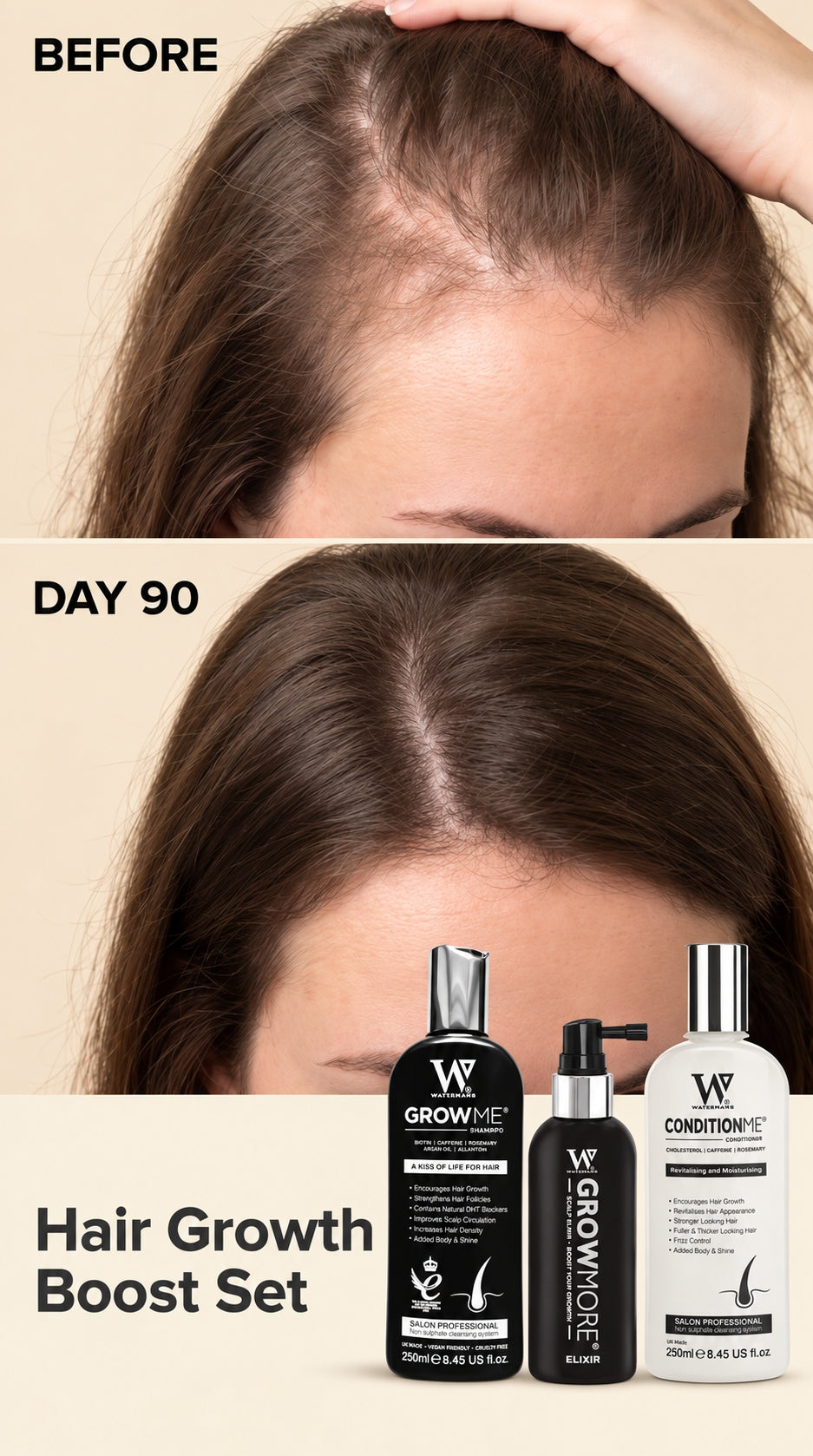
Grow Me® Shampoo, £14.95 is the everyday wash. Sulphate free, with caffeine, rosemary, biotin and niacinamide. It is a cosmetic product: it supports a healthy scalp environment and reduces breakage for fuller looking hair, and it does not act on your hormones.
Key takeaways
- Hair on hormone therapy usually changes texture before it changes density. Finer, drier hair breaks more easily.
- Breakage is the fastest win available, because it responds to what you do rather than to what your hormones do.
- Wet hair is the most fragile hair. Detangle conditioned, never dry, and never scrub with a towel.
- Friction at night is a genuine and overlooked cause of mid length snapping.
- Sudden heavy shedding, patchy loss or a sore scalp is a GP matter, not a routine matter.
This page is the care routine. For what hormone therapy actually does to hair over the first year, read our month by month HRT hair timeline.
What does HRT hair retention actually mean?
HRT hair retention is the practice of protecting the hair already on your head so that more of it survives to full length. It is deliberately a modest goal. Density is decided at the follicle, and the follicle is governed by inherited reactivity, age and hormones. Length and condition are decided in the bathroom, and that is the half you control completely.
The distinction matters because it sets expectations correctly. Someone doing retention well will not grow new follicles. They will stop losing two centimetres of length a year to snapping, keep ends that are not frayed, and end up with hair that looks considerably fuller than it did without anything changing hormonally.
Why does hair feel different on hormone therapy?
Two changes usually stack. The hair shaft tends to get finer with age and with falling oestrogen, so each strand has less bulk and breaks at a lower load. The scalp and the fibre also hold moisture less well, so hair feels drier, rougher and more static, and a rough cuticle snags on itself during brushing.
Neither of those is a hormone problem you can fix with hormones. They are fibre problems with fibre answers: condition every wash, reduce heat, reduce tension, and add a weekly deep conditioning step once hair starts feeling straw like at the ends.
Is this hair loss, hair shedding or hair breakage?
Three separate problems get called thinning. Hair loss means follicles miniaturising or scarring, which is pattern hair loss and alopecia territory. Hair shedding means whole hairs leaving at the root in greater numbers, which is the hair cycle responding to a trigger. Hair breakage means the fibre snapping along its length, so the hair is still rooted but shorter, frayed and rough to the touch.
Look at what comes out. A shed hair is full length with a small pale bulb at the root end. A broken hair has no bulb and is a short, blunt or split fragment. Losing 50 to 100 hairs a day is normal, as the NHS notes. Retention work targets the breakage third completely, has no effect on the first two, and is worth doing regardless because breakage is nearly always part of the picture in midlife hair.
Our three clue self check takes you through the self check properly.

Washing technique matters more than wash frequency for HRT hair retention.
Which washing habits support HRT hair retention?
Four washing habits do most of the work. Use lukewarm rather than hot water, because heat roughens the cuticle and dries the scalp. Shampoo the scalp with fingertips and let the run off clean the lengths, rather than piling and scrubbing hair on top of the head. Condition every single wash, mid length to ends. And detangle in the shower with conditioner in, using a wide tooth comb, working from the ends upwards.
Wash frequency matters far less than people think. Washing two or three times a week suits most midlife hair, but a scalp that gets oily or itchy is better washed more often with something gentle than left alone. A sulfate free formula cleans without stripping, which is the practical point.
The single biggest avoidable mistake
Brushing hair dry when it is tangled, or rubbing it hard with a towel straight out of the shower. Wet hair stretches and snaps at a far lower load than dry hair, and rough towel drying is where a great deal of mid length breakage begins. Squeeze with a towel or an old cotton t shirt instead.
How should you dry and style hair for HRT hair retention?
Air dry to roughly eighty per cent before any heat touches the hair, and when you do use heat, use a protectant every time and turn the temperature down. Most styling can be done well below the maximum setting, and the difference between 180 and 210 degrees is invisible in the result and very visible in the ends after six months.
Tension is the other half. Tight ponytails, tight buns and repeated pulling at the same spot cause traction damage at the hairline, which is the one kind of hair loss that is entirely self inflicted and entirely avoidable. Vary where you tie, use a soft fabric tie rather than an elastic with a metal join, and wear it loose.
| Habit | What it costs you | What to do instead |
|---|---|---|
| Hot water washing | Rougher cuticle, drier scalp, more snagging. | Lukewarm water, fingertip scalp wash. |
| Towel rubbing | Mid length breakage at the most fragile moment. | Squeeze with a towel or cotton t shirt. |
| Dry brushing tangles | Snapped fibres and split ends. | Detangle with conditioner in, wide tooth comb, ends first. |
| Heat with no protectant | Cumulative cuticle damage, frayed ends. | Protectant every time, lower temperature. |
| Tight ponytails | Traction damage at the hairline. | Loose, soft tie, varied position. |
Get a discount on the thinning hair range
Join the Watermans mailing list and we will email a discount code straight to your inbox, so you can try the thinning hair range for less. Made in the UK, over 6.5 million bottles sold since 2012.

A wide tooth comb on conditioned hair prevents more breakage than any product.
What night time habits help most?
Six to eight hours of friction against a rough pillowcase is a real and overlooked source of damage, especially for finer, drier midlife hair. A smooth pillowcase in silk or satin reduces that friction. Loosely plaiting long hair, or tying it in a soft, low and deliberately slack knot, stops it tangling against itself overnight.
Never go to bed with soaking wet hair that will be slept on and twisted while it is at its weakest. Dry it most of the way first, or wash earlier in the evening. These are small habits with a cumulative effect measured over months, which is exactly the timescale hair works on anyway.

Smooth bedding and a loose plait cut overnight friction, a real cause of mid length snapping.
Which products suit this job?
Three products cover the job, and none of them is a hormone. A conditioner used at every wash makes wet detangling survivable, which is where most avoidable snapping happens. A heat protectant is the cheapest insurance in hair care. A weekly mask restores condition on lengths that have gone dry and porous, which is very common on midlife hair.
Notice what is absent from that list. Nothing here claims to change a hormone or a follicle, because a cosmetic product cannot and should not. The claim is narrower and genuinely deliverable: less breakage, better condition, more length kept.

Condition Me® Hair Growth Conditioner £13.95
Breakage defence conditioner with cholesterol, shea butter, glycerin and silica. Makes wet detangling easier, which is where a lot of avoidable snapping happens.
Condition Me uses cholesterol, shea butter, glycerin, silica and hydrolysed lupine protein for breakage defence, and it makes wet detangling much easier. That is the single most valuable moment to improve.

Protect Me® Heat Protection Spray £13.95
Leave in spray rated to 230C with niacinamide, panthenol, caffeine and rosemary. The single cheapest way to stop heat styling doing the damage.
Protect Me is a leave in spray rated to 230C. If you use any heat at all, this is the highest return item on the list.

Masque Me® Hair Mask £24.95
Weekly deep conditioning mask with rosemary, caffeine, provitamin B5 and argan oil, for lengths that have gone dry, rough or porous.
Masque Me is the weekly step for lengths that have gone rough and porous, with rosemary, caffeine, provitamin B5 and argan oil.
When should you speak to a GP instead?
Care routines are for ordinary thinning and ordinary breakage. Some signs need medical assessment and should not be managed with shampoo. Sudden heavy shedding, smooth circular bald patches, a sore, scaly, itchy or scarred scalp, hair loss alongside fatigue, weight change or heavy periods, and any hair loss in a child all warrant a GP appointment that you arrange.
Hormone therapy decisions also belong with a GP. NICE guideline NG23 frames menopause care in the UK around symptoms and quality of life, and hair is not a reason hormone therapy is started or stopped. We sell cosmetics and do not run clinics or assess scalps. If your question is about products or a routine rather than a medical one, you can talk to Gail Waterman, our co-founder, as an AI avatar on the Watermans homepage. For the hair side of stopping rather than continuing, see our guide to HRT discontinuation and shedding. If you are unsure how your hair is responding, our HRT responsiveness guide explains how to track it and when to judge it.
Frequently asked questions about hrt hair retention
How long before a retention routine shows results?
Four to eight weeks is realistic for how hair feels and how much breaks, because you are changing what happens to hair that already exists. Visible length gain takes longer, since scalp hair grows roughly one centimetre a month and you are simply keeping more of it. Take a monthly photograph to judge it fairly.
Does hormone therapy make hair drier?
Many people report drier, finer, more static hair in midlife, and falling oestrogen along with normal age related shaft thinning both contribute. It is a fibre change rather than a follicle change, which is why conditioner, a weekly mask and less heat make a noticeable difference where hormones do not.
Is washing hair less often better for retention?
Not really. Scalp health matters, and leaving an oily or itchy scalp alone helps nobody. What matters is how you wash: lukewarm water, fingertips on the scalp, conditioner every time, and detangling while conditioned. A gentle sulfate free shampoo used three times a week beats a harsh one used once.
Do silk pillowcases actually help?
For friction, yes, and that is a modest but real mechanism rather than a miracle. Smoother bedding means less snagging over six to eight hours a night, which matters most for longer, finer or chemically processed hair. It will not affect shedding or density at all.
Can I still colour my hair?
Yes, with adjustments. Colour does not cause shedding, but it raises porosity and makes breakage more likely, which is the thing you are trying to reduce. Stretch the interval between full head applications, keep bleach off already fragile lengths, and use a weekly mask on coloured hair.
Are supplements part of retention?
Only where there is a genuine shortfall. Iron deficiency is a well recognised cause of diffuse shedding and correcting it helps, but supplementing on a hunch does not. NHS guidance on vitamins and minerals is the sensible reference, and a blood test arranged by a GP beats guesswork.
What about hair oils?
A light oil used before washing, or a small amount on dry ends, reduces roughness and makes combing easier. Applied heavily to the scalp it mostly creates a need for harsher washing, which works against you. Use it on the lengths, sparingly, and judge by whether combing got easier.
Does trimming help retention?
Trimming does not change growth rate, but it removes split ends before a split travels up the shaft and costs you more length. A small trim every ten to twelve weeks is usually enough when the rest of the routine is gentle.
What is the bottom line on HRT hair retention?
HRT hair retention is the half of the problem you can actually change, and it changes within weeks rather than months. Hormones decide how much hair the follicles produce. Your washing, drying, styling and night habits decide how much of it survives to be seen. On finer, drier midlife hair that second half counts for more than most people expect.
Get the routine right first, then judge the hormonal side fairly against a six month photograph. Read HRT and hair loss for the timeline, and our everyday hair protection guide for the seven habits that reduce breakage most.
If you buy one thing for retention, make it the hair growth conditioner. Wet detangling is where most avoidable snapping happens, and that is the moment it fixes.
Sources & references
- NHS, Hair loss, on normal daily shedding of 50 to 100 hairs and when to see a GP
- NHS, Menopause and perimenopause, on midlife symptoms and their course
- NHS, Hormone replacement therapy (HRT), on what hormone therapy is offered for
- NICE guideline NG23, Menopause, the UK guideline that frames menopause care around symptoms and quality of life
- DermNet, Female pattern hair loss, on the diffuse midlife pattern and shaft thinning
- DermNet, Telogen effluvium, on shedding triggers and the usual recovery
- NHS, Vitamins and minerals, on when supplementation is and is not useful
Watermans products are 100% cosmetic and do not treat medical hair loss. Individual results may vary.