DHI vs FUE: An Honest Hair Transplant Comparison
DHI vs FUE is usually framed as a contest between two operations, and that framing is misleading. Is DHI better? Not inherently. DHI is not a rival operation to FUE, it is a variation on the implantation step of one. Both take individual follicular units from the back and sides of the head. The difference is that DHI loads each graft into a pen shaped implanter that makes the site and places the hair in one movement, while classic FUE makes the sites first and places grafts into them afterwards.
Our hair building fibres
InstaHair Hair Building Fibres, £19.95. Cosmetic fibres that cling to the hair you already have, covering a visible parting or thin patch in seconds. They wash out.
Key takeaways
- DHI stands for Direct Hair Implantation. It uses a Choi type implanter pen, and extraction is still done follicular unit by follicular unit, exactly as in FUE.
- Framing the two as a head-to-head is a bit like asking whether a particular brand of scalpel is better than surgery. The tool is not the operation.
- DHI tends to suit smaller, denser, precision work such as hairlines, temples and eyebrows, and it can often be done with little or no shaving.
- Classic FUE tends to suit large sessions covering a big area, because it is faster per graft and usually cheaper.
- The surgeon's judgement on angle, density and hairline design predicts your result far more than the tool does.
- Neither method stops the underlying pattern loss in the hair you did not transplant, which is why planning for the next ten years matters more than the acronym.
DHI vs FUE: is it a different operation, or the same one with a different tool?
Follicular Unit Excision, usually still written FUE, describes how grafts are harvested. A small punch, typically between 0.7mm and 1.0mm, cuts around each naturally occurring group of one to four hairs in the donor area, and that unit is lifted out. Nothing about the acronym FUE describes how those units then go back in.
Direct Hair Implantation describes the second half. Grafts are loaded into a hollow needle inside a pen shaped implanter, and the operator uses that device to create the recipient site and deposit the graft in a single action. Because the tool controls depth, angle and direction at the moment of placement, it is a genuinely different feel to work with. But the harvesting is still FUE. Any clinic presenting DHI as a fundamentally separate operation is marketing, not surgery.
That is why the honest response to DHI vs FUE is a question back: better for what, on whom, and in whose hands. A skilled team gets excellent results with either. A rushed team gets poor results with either, and the pen does not save them.

What actually happens during a classic FUE session?
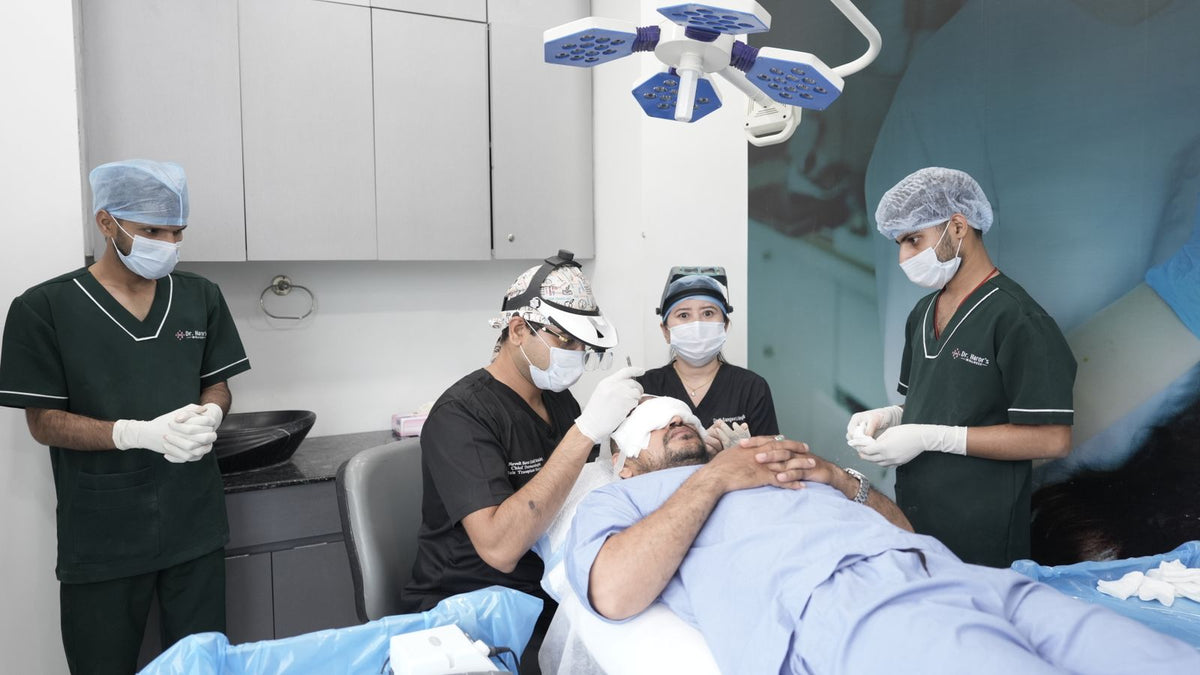
The sequence is straightforward even if the execution is not. The donor area at the back and sides is shaved and numbed with local anaesthetic. Grafts are punched out one by one and collected into a chilled holding solution, because time out of the body matters for survival. A technician then sorts them under magnification into singles, doubles and triples, since single hair units go at the hairline and larger units go behind for density.
The surgeon then makes the recipient sites, using tiny blades or needles, deciding the angle, direction and density of every one. This is the step that determines whether the result looks natural, and it is where experience shows most clearly. Hair does not grow straight out of a scalp, it lies at an acute angle that changes across the head, and getting that wrong produces the doll like look people fear. Finally, the grafts are placed into those prepared sites, usually by technicians working with fine forceps.
A typical session runs six to nine hours and moves anywhere from 1,500 to 4,000 grafts depending on the plan and the donor supply available.
What does the implanter pen change?
With DHI, the site making and placement steps merge. A loaded implanter is pressed into the scalp, the plunger is depressed, and the graft is delivered at the depth and angle the operator chose. Several implanters are usually in rotation so loading and placing can happen continuously.
Three practical consequences follow. Grafts spend slightly less time outside the body between sorting and placement, which is theoretically good for survival, although the evidence that this produces a measurably better final result is weaker than clinic websites imply. Bleeding at the recipient area tends to be a little less, because sites are not sitting open. And very high placement density is easier to achieve in a small area, which is why the technique is favoured for hairlines and eyebrows.
The costs are equally practical. It is slower per graft, so large sessions take longer or get split across days. Implanter tips are consumables and add cost. It also demands a specific skill set from the whole team, and a team that has done ten thousand cases with forceps and a hundred with a pen will very likely give you a better result with forceps.
How does DHI vs FUE compare, row by row?
| Factor | Classic FUE | DHI with implanter pen |
|---|---|---|
| Extraction method | Punch, follicular unit by unit | Identical, punch, follicular unit by unit |
| Placement | Sites made first, grafts placed with forceps | Site made and graft placed in one action |
| Typical session size | Comfortable up to 3,000 to 4,000 grafts | Usually better suited below 2,000 to 2,500 |
| Shaving | Donor and often recipient area shaved | Often partial or unshaved recipient area possible |
| Best suited to | Large area coverage, crown, advanced pattern loss | Hairlines, temples, eyebrows, smaller refinements |
| Relative cost in the UK | Lower per graft | Commonly 20 to 40 percent higher per graft |
| Scarring | Scattered pinpoint donor marks | Identical, since extraction is the same |
| Recovery time | Broadly the same | Broadly the same, sometimes marginally less crusting |
Look down that table and the pattern is clear. Most rows are identical or near identical, and the ones that differ are about suitability rather than superiority. That is the real answer to DHI vs FUE. It is better at some jobs and worse at others, and for a large crown it is usually the wrong choice.
Get a discount on the thinning hair range
Join the Watermans mailing list and we will email a discount code straight to your inbox, so you can try the thinning hair range for less. Made in the UK, over 6.5 million bottles sold since 2012.
Where does the implanter pen genuinely earn its premium?
For a narrow set of jobs the answer to DHI vs FUE is a qualified win for the pen. There are situations where the technique choice is not marketing. Hairline design work benefits, because single hair units placed at very shallow angles in a tight, irregular pattern are exactly what the pen controls well. Eyebrow work benefits for the same reason, and more so, since brow hairs need to lie almost flat against the skin.
Unshaven or partially shaven procedures are more practical with an implanter, which matters enormously to someone who cannot take two weeks away from a visible job. Smaller refinement sessions of a few hundred to fifteen hundred grafts, filling temples or softening a previous result, also sit naturally in its range. And in tightly curled or coily hair, careful direct placement can help control the curl direction, though extraction in that hair type is its own separate skill and matters more.
Where does classic FUE still win?
For anyone needing broad coverage, classic FUE remains the sensible default. A crown is a large surface with a whorl pattern, it swallows grafts, and speed per graft translates directly into how much can be done safely in one sitting. Advanced pattern loss where the donor supply must be spread thoughtfully across a big area is the same story.
Cost is a real factor too, not a vulgar one. If the same donor supply is going to be needed for a second session in eight years, spending 30 percent more per graft now on a technique that gives no measurable advantage over a broad area is money that would have been better kept in reserve. If you are weighing extraction methods rather than placement methods, our guide comparing FUE and FUT hair transplants covers that separate decision.
What matters far more than DHI vs FUE?
If you take one thing from this article, take this. The variables that predict a good outcome are almost entirely not the acronym, and once you have worked through them the DHI vs FUE question will feel like a footnote on the quote.
Who does the work, and which parts. Ask specifically whether the surgeon makes the recipient sites and designs the hairline, or whether technicians do it. In many high volume clinics the surgeon appears briefly and technicians do most of the operation, and that is the single biggest hidden variable in the industry. Ask how many cases the team does per day, because a clinic running four simultaneous cases is dividing attention.
Donor supply and long term planning. You have a finite number of grafts available for life. A good practitioner plans a hairline you will still be happy with at 55, not the one you had at 22, and refuses work that will look absurd once the pattern advances behind it. A hairline placed too low in your twenties is the most common permanent regret in this field.
Regulation and recourse. In England, providers carrying out surgical procedures should be registered with the Care Quality Commission, and surgeons should be on the GMC register. Travelling abroad for a cheaper price is a legitimate choice many people make well, but understand that follow up, revision and any complaint route become considerably harder, and the aftercare period is exactly when problems appear.

Watermans is a cosmetic hair care brand. We do not run clinics, we do not carry out procedures and we cannot advise on your suitability for one. Everything in this section is context for a conversation you should have with a qualified surgeon. If your question is about products or a routine rather than a medical one, you can talk to Gail Waterman, our co-founder, as an AI avatar on the Watermans homepage.
What does the recovery timeline realistically look like?
The timeline is broadly the same for both techniques, and it is longer than most people expect.
In the first week there is crusting at the recipient area and some swelling, often around the forehead and eyes on days two to four. Washing follows whatever protocol the clinic gives, and their instructions override anything you read online, including this article. By two to three weeks the crusts have gone and the transplanted hairs shed. This is normal and expected, and it catches people badly if nobody warned them. The graft stays in place, the visible shaft simply falls.
Between one and three months the scalp looks much as it did before surgery, and this is the low point emotionally. Some people also experience shock loss, a temporary shedding of existing native hair around the operated area, which recovers over subsequent months. From three to six months new hairs start emerging, fine at first. Real thickening runs from six to twelve months, and the final assessment point is twelve to eighteen months, with the crown often the slowest area of all.
What is the difference between hair loss, hair shedding and hair breakage?
These get conflated constantly in transplant conversations, and mixing them up leads to bad decisions.
Hair loss is follicular. Androgenetic alopecia miniaturises susceptible follicles progressively, and a transplant relocates unsusceptible hair from the donor area into the affected zone. It does not alter what happens to the native hair still sitting between the grafts, which is why pattern loss can continue behind a good result and leave a gap a few years later.
Hair shedding is cyclical. The post procedure shed at two to three weeks, and shock loss of native hair, are both of this type. The follicle is intact, the cycle has been disturbed, and time resolves it.
Hair breakage is mechanical, and it is the one nobody discusses in this context even though it is relevant. Once new hair is growing, the way you handle it determines how much length you keep. Aggressive brushing, tight styling and daily heat will snap fine new fibres well before they reach a useful length. Our article on crown thinning covers the coverage problem from the non surgical side.
What cosmetic care makes sense around a procedure?
Two honest points. First, follow your clinic's aftercare instructions to the letter, and do not introduce any product into that window without asking them. Nothing sold as cosmetic hair care is designed for a freshly operated scalp. Second, once you are well past that window and washing normally again, ordinary sensible hair care applies: cleanse without stripping, keep the scalp comfortable, and be gentle with fine new hair.
Many people also want coverage during the months when nothing much is visible. That is a legitimate cosmetic need and it is worth saying plainly that fibres are a styling product, not anything that affects the outcome, and should not be used until the clinic confirms the scalp has fully settled. It is worth understanding how donor density is assessed first, because the hair available at the back and sides sets the ceiling on what any procedure can achieve.

Static charged keratin fibres that cling to existing hair for instant cosmetic coverage on camera or at an event. Purely a styling product, washes out, and only once your clinic confirms your scalp has fully settled.

A sulphate free daily cleanse for once you are back to normal washing and your clinic is happy. Gentle on fine hair, leaves the scalp comfortable. Vegan, made in the UK, over 6.5 million bottles sold since 2012. Before comparing techniques at all, it is worth reading our guide to who does what between a GP, a trichologist and a transplant clinic, because donor supply and pattern stability decide more than the extraction method does.
Frequently Asked Questions
What is the main difference in DHI vs FUE?
The main difference in DHI vs FUE is the implantation step. Both extract grafts one follicular unit at a time. Classic FUE opens all the recipient sites first and places grafts afterwards, while DHI loads each graft into an implanter pen that makes the site and places the hair in one movement.
Is DHI better than FUE?
Neither is universally better, and any clinic that tells you otherwise is selling. DHI describes how grafts are placed, using an implanter pen, while the extraction is FUE in both cases. DHI suits hairlines, eyebrows and smaller sessions where a shaved head is not an option. Classic FUE suits large areas such as the crown and costs less per graft.
Does DHI leave less scarring?
No, and this is one of the more common myths. Donor scarring is produced during extraction, and extraction is identical in both approaches. You will have the same scattered pinpoint marks in the donor area either way, and how visible they are depends on punch size, extraction pattern and how short you wear your hair.
Is DHI more expensive?
Usually yes. In the UK it commonly runs 20 to 40 percent higher per graft, because it takes longer per graft and the implanter tips are single use consumables. Whether that premium buys you anything depends entirely on whether your case is one the technique actually suits.
Can it be done without shaving my head?
Often the recipient area can be left unshaved or only partially shaved, which is a genuine practical advantage for anyone who cannot disappear from work for a fortnight. The donor area still normally needs shaving so grafts can be extracted accurately.
How long until I see the final result?
Transplanted hairs shed at two to three weeks, which alarms people who were not warned. New hairs start appearing from three to six months, thickening runs through six to twelve months, and the honest assessment point is twelve to eighteen months. The crown consistently takes longest.
Will a transplant stop the rest of my hair thinning?
No. A transplant moves hair from a donor area that is not susceptible to androgens into an area that is. The native hair sitting between those grafts carries on following its own course, which is exactly why a surgeon who plans for your fifties rather than your twenties is worth more than any technique preference.
What should I ask a clinic before committing?
Ask who designs the hairline and who makes the recipient sites, how many cases the team runs simultaneously, how many grafts your donor area can realistically supply across a lifetime, what happens if you are unhappy, and in England whether the provider is registered with the Care Quality Commission. Vague answers are themselves an answer.
Is it safe to travel abroad for a cheaper procedure?
Many people do it and are pleased. The trade off is real though: follow up, revision and any formal complaint route become much harder from another country, and the aftercare weeks are precisely when problems surface. If you go, plan for how you will get help at home if something goes wrong.
What is the bottom line on DHI vs FUE?
In DHI vs FUE, the pen is better at some jobs, worse at others, and identical for most of what actually determines your result. DHI is a placement technique, extraction is FUE in both, and the pen suits hairlines, eyebrows, unshaven work and smaller refinements while classic FUE remains the practical choice for broad coverage of a crown. Spend your energy on the questions that genuinely predict outcomes: who is doing the work, how the hairline is designed, whether your donor supply is being planned across decades, and what recourse you have if it goes wrong. The acronym on the invoice is close to the least important line on it. The method matters less than the candidacy and the donor area, and we work through both in our guide to what to do before a hair transplant.
If you take one thing from this, make it the wash step, and our sulphate free hair growth shampoo is built for exactly that.
Watermans products are 100% cosmetic and do not treat medical hair loss. Individual results may vary.
Sources and References
- NHS, Hair transplant. What the procedure involves, recovery, risks and what to check before going ahead.
- NHS, Cosmetic procedures. UK guidance on choosing a practitioner and questions to ask.
- British Association of Hair Restoration Surgery. UK professional body for hair restoration surgeons.
- Care Quality Commission. Regulator that registers providers carrying out surgical procedures in England.
- NHS, Hair loss. Background on pattern hair loss and why it continues after surgery.