FDA-Approved Hair Growth Products: A UK Reality Check
Three letters on a bottle do a great deal of work, and most of it is not the work you think.
FDA-approved hair growth products are medicines, not cosmetics, and the phrase belongs to a United States regulator with no authority over a shampoo sold in Britain. The Food and Drug Administration approves medicines after reviewing safety and efficacy data. It does not approve cosmetics at all. So a shampoo, conditioner or scalp serum cannot honestly be described as FDA approved, in the UK or anywhere else, and any bottle claiming otherwise is telling you something about the seller. If you want the detail on that, our guide to hair growth serum walks through it step by step.
Our hair growth shampoo
Grow Me® Hair Growth Shampoo, £14.95. A sulphate free daily shampoo that supports a healthy scalp environment and helps reduce breakage, so lengths hold on and look fuller.
Key Takeaways
- Approval applies to medicines. FDA-approved hair growth products are a small group of licensed medicines, overseen by clinicians, and they are a different category from anything on a haircare shelf.
- The FDA does not approve cosmetics. That is not a loophole or an oversight. It is how the law is written, and the FDA says so plainly on its own site.
- In Britain the relevant bodies are different. Medicines sit with the MHRA, cosmetics sit under UK cosmetic product law, and advertising claims sit with the ASA.
- "FDA approved" on a UK cosmetic is a marketing flourish, and a reason to read the rest of the label harder rather than to relax.
- Judge a cosmetic on fit, formulation and honesty, because those are the things it can actually deliver on.
What does FDA approval actually mean?
FDA approval means a medicine has been through a formal review in which a company submitted safety and efficacy data and the agency judged that the benefits outweigh the risks for a specific use in a specific group of people. It is a long, expensive process built around clinical studies, and it produces a licence for a defined use rather than a general endorsement. That is the standard behind FDA-approved hair growth products, and it is worth respecting precisely because it is demanding.
Two things follow that people often miss. First, approval is granted for a stated use, so it says nothing about a product used differently. Second, approval is about a medicine, so it is not a quality rating that can be borrowed by a shampoo made in a different category under different law. The word is doing regulatory work, not marketing work, and it loses all meaning when it is lifted onto a bottle that was never assessed. For what is genuinely worth buying once that word is set aside, our guide to hair growth products that actually work goes through the categories honestly.
Are FDA-approved hair growth products relevant to a UK shopper?
FDA-approved hair growth products are only indirectly relevant in Britain, because the FDA is a United States agency and its decisions do not licence anything for sale here. In the UK, medicines are assessed and licensed by the Medicines and Healthcare products Regulatory Agency, and clinical guidance for GPs comes through NICE. A medicine available in the United States may or may not be available here, and it may be sold under different rules when it is. We look at is redensyl fda approved more closely in a related article.
What this means in practice is simple. If you want a medicine for hair loss, the route is your GP, who can explain what is available in the UK and whether it is suitable for you. If you want a cosmetic product, the FDA is irrelevant to that decision, and the questions worth asking are entirely different ones.
| A licensed medicine | A cosmetic hair product | |
|---|---|---|
| Who assesses it | MHRA in the UK, FDA in the United States | The company, under UK cosmetic product law, with a safety assessment held on file |
| What it may claim | Specific medical effects, within its licence | Appearance, condition and feel of hair and scalp only |
| Where you get it | Through a clinician or pharmacy, depending on the medicine | Any shop, no consultation involved |
| Who polices the advertising | MHRA plus the ASA | The ASA, under the CAP Code |
| Honest expectation | A medical effect, with medical trade offs and monitoring | Better condition, less breakage, fuller looking hair |
Why can a shampoo never be one of the FDA-approved hair growth products?
A shampoo cannot join the list of FDA-approved hair growth products because approval is a process for medicines and a shampoo is legally a cosmetic. The FDA states on its own website that cosmetics are not FDA approved, although they are FDA regulated for safety and labelling. The moment a product claims to change the structure or function of the body, it stops being a cosmetic in the eyes of the regulator and becomes an unlicensed medicine, which is a far worse position for a brand to be in than simply not having approval.
The same logic applies in Britain, where the MHRA publishes guidance on how to tell whether a product has crossed the line from cosmetic into medicine. The test is largely about the claims made and the effect presented. This is why a well run cosmetic brand speaks about fuller looking hair, reduced breakage and a comfortable scalp, and why a brand promising to undo hair loss is either making a medicine without a licence or making it up.

Which claims on a bottle should make you suspicious?
Certain phrases are reliable signals that a seller is either careless or hoping you will not check. Read the following as prompts to slow down and check the small print.
- "FDA approved" on a cosmetic. Not possible. The most common version of this is a brand borrowing the status of an unrelated ingredient or facility and hoping the distinction goes unnoticed.
- Proof language with no study you can find. A real study has named authors, a stated method and a number of participants. If none of that is available anywhere on the site, the phrase is decoration.
- Before and after photographs with different lighting, parting and camera angle. Hair looks dramatically different when it is dry, styled and lit from the front rather than damp and lit from above.
- Cast iron promises and fixed timelines. Hair grows at roughly one centimetre a month and no product changes that.
- Endorsement by unnamed professionals. "Recommended by experts" with no named expert is not a recommendation.
If you want a practical filter for the shelf rather than the courtroom, our guide to choosing a hair growth shampoo on what is actually in it works through the ingredient list from the top down.
Get a discount on your next order
Join the Watermans mailing list and we will email a discount code straight to your inbox. Made in the UK, over 6.5 million bottles sold since 2012.
How do UK rules protect you instead?
UK rules protect a cosmetic shopper through three separate systems rather than a single approval stamp. Cosmetic product law requires a responsible person, a safety assessment held on file, an ingredient list in a standard international format, and notification before a product goes on sale. Medicines law, enforced by the MHRA, catches products that claim medical effects without a licence. Advertising rules, enforced by the Advertising Standards Authority under the CAP Code, govern what a brand may say in its marketing, and the section covering health related products is deliberately strict. The rules matter even more if you plan to sell, which we cover in starting a hair growth oil business in the UK.
That is a weaker promise than approval, and it is an honest one. Nobody has reviewed a shampoo for efficacy, because nobody reviews cosmetics for efficacy. What the system does is require the product to be safe, correctly labelled and truthfully advertised. Understanding that distinction is more useful than hunting for a stamp that cannot exist.
What should you judge a hair product on, if not approval?
Judge a cosmetic on four things, in this order. First, the match between the product and your actual problem, which means separating hair loss from shedding from breakage before you buy anything. Second, the formulation, meaning what is present and roughly where it sits in the ingredient list. Third, the honesty of the claims, because a brand that overclaims on the label has told you how much to trust the rest. Fourth, whether you will realistically use it, because a routine you abandon in three weeks does nothing at all.
Those three problems are worth spelling out, because they need different answers. Hair loss in the pattern sense is follicles shrinking over years, which no cosmetic addresses. Shedding is hair released early after illness, stress or a nutritional shortfall, which resolves on its own timetable once the trigger passes. Breakage is the fibre snapping along its length from heat, colour, tension or rough handling, and it is the one where good cosmetic care genuinely earns its place. If you are not sure which you have, start with our honest breakdown of what helps which kind of hair problem.

Where do clinician led options fit?
Clinician led options sit alongside cosmetic care rather than competing with it, and the earlier you ask about them the better your choices are. If your parting is widening, your hairline is moving or you are losing density in a defined pattern, a GP appointment is the sensible first step. A GP can check for the common medical contributors, including iron and thyroid problems, and can explain which UK licensed options might suit you and what they involve. Watermans does not run clinics, cannot assess your scalp and has no view on which medicine anyone should take. If your question is about products or a routine rather than a medical one, you can talk to Gail Waterman, our co-founder, as an AI avatar on the Watermans homepage.
What we can say is that people frequently spend a year buying bottles before they ask that question, and that year matters, because density lost over a long period is harder to do anything about than density that is only just starting to change. Our overview of what women should realistically expect from the available options sets out how those conversations usually go.
One useful habit: before buying anything marketed against hair loss, write down the single sentence describing what you want to be different in six months. If the product on the shelf cannot honestly promise that sentence, it is not the right purchase, however good the packaging is.
What can a cosmetic hair range honestly offer?
A cosmetic range can offer condition, retention and appearance, and that is a genuinely worthwhile set of things. Hair that is not snapping mid length looks thicker at the ends. A comfortable scalp is a better environment for the hair you have. Products that do not strip leave fine hair looking fuller. None of that is approval and none of it is a medical outcome, but it is real and it is what we sell.

Grow Me® Hair Growth Shampoo
A sulfate free daily shampoo with biotin, caffeine, rosemary and niacinamide. A cosmetic product, sold as one, for fuller looking hair and a comfortable scalp.

Grow More® Leave In Scalp Elixir
An overnight leave on elixir for areas where density looks lower. Cosmetic, applied to the scalp, and honest about being a routine rather than a fix.

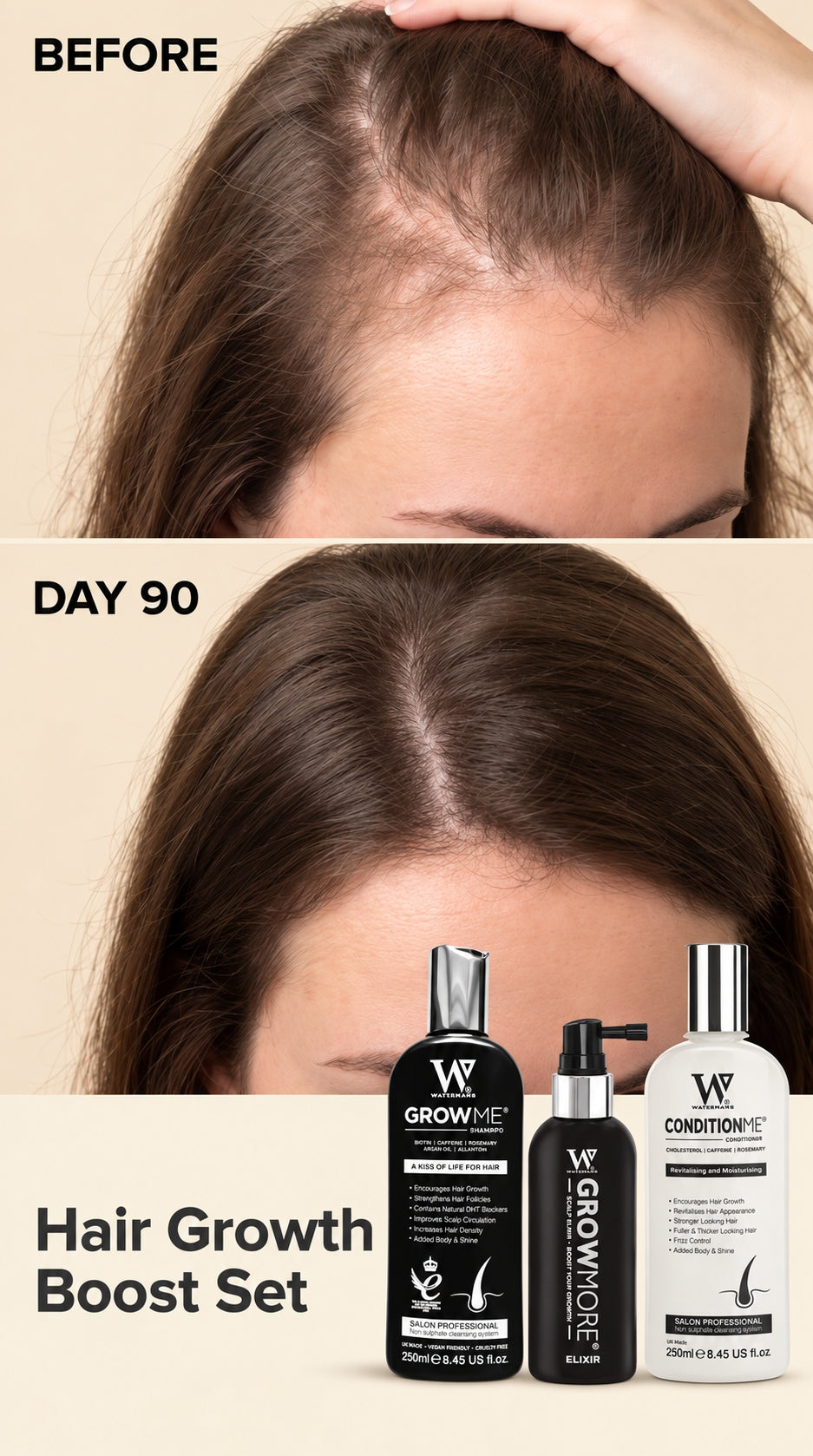
Hair Growth Boost Set
The three step routine together, for people who would rather change the whole wash routine at once than add one bottle to a shelf of others.
Watermans products are 100% cosmetic and do not treat medical hair loss. Individual results may vary. Over 6.5 million bottles sold since 2012, made in the UK.
Frequently Asked Questions About FDA-Approved Hair Growth Products
How many FDA-approved hair growth products are there?
Very few, and they are licensed medicines rather than cosmetics. Because approvals are specific to a use and to a group of people, the honest answer to which one might suit you comes from a clinician who knows your history, not from a list on a website.
Is an FDA-approved product automatically better than a cosmetic?
It is better evidenced for a medical purpose, which is a real advantage if you have that medical problem. It is not better at conditioning your hair or reducing breakage, and it comes with medical considerations a shampoo does not have. They answer different questions.
Can a UK brand say its product is FDA approved?
Not if it is a cosmetic, because cosmetics are not approved by the FDA. A brand saying so is describing something that does not exist, and under UK advertising rules that is a claim it would struggle to defend.
What does FDA registered mean, then?
Registration usually refers to a facility being listed with the agency, which is an administrative step rather than an assessment of the product. It is frequently used in marketing to sound like approval. It is not the same thing.
Does the MHRA approve hair growth shampoos?
No. The MHRA licenses medicines. Cosmetic products are covered by separate UK cosmetic legislation, which requires safety assessment, labelling standards and notification, rather than an efficacy review.
Are natural ingredients exempt from these rules?
No. A botanical extract in a cosmetic is governed by exactly the same rules, and a plant origin does not permit a medical claim. Rosemary, caffeine and biotin appear in plenty of cosmetics, including ours, and none of that makes the product a medicine.
Should I buy hair medicines online without seeing a clinician?
We would not recommend it. Buying medicines from unverified sellers means no oversight of suitability, no check for interactions and no certainty about what is in the box. If a medicine is the right route for you, use a proper UK route to get it.
If cosmetics are not approved, why buy them at all?
Because they do a different job well. Condition, retention, comfort and appearance are worth having, and for a great many people breakage is the actual problem rather than the follicle. Buying the right category for your problem is the whole point of this article.
What is the bottom line on fda-approved hair growth products?
FDA-approved hair growth products are licensed medicines assessed by a United States regulator, and no shampoo, conditioner or scalp serum belongs on that list. In Britain the relevant bodies are the MHRA for medicines, UK cosmetic product law for cosmetics, and the ASA for advertising claims. Any cosmetic advertising itself as FDA approved is misrepresenting what approval is. Work out whether your problem is hair loss, shedding or breakage, take the first of those to your own GP early, and judge cosmetics on formulation, fit and honesty rather than on a stamp that was never available to them.
The routine side of this starts at the shampoo, and our sulphate free hair growth shampoo is where we would point you. Vegan and made in the UK.
Sources & References
- FDA, FDA authority over cosmetics: how cosmetics are not FDA approved but are FDA regulated, the agency's own statement that it does not approve cosmetics.
- FDA, How drugs are developed and approved, for what the approval process actually involves.
- GOV.UK and MHRA, Borderline products: how to tell if your product is a medicine, for where the cosmetic line sits in the UK.
- GOV.UK, Cosmetic Products Enforcement Regulations 2013, for the UK cosmetic framework referred to above.
- ASA and CAP Code, section 12, medicines and health related products, for the advertising rules that apply to these claims.
- MHRA, the UK medicines regulator referred to throughout.
- NHS, Hair loss, for when to seek advice about hair changes.
Sources checked on 21 August 2026. Regulatory positions change, and the availability of any given medicine differs between the United States and the UK, so check the current position with a UK clinician rather than assuming an American source applies here.