Low Level Laser Therapy for Hair: An Honest Guide
Looking for laser therapy for pain relief? Please speak to your GP or call NHS 111. This page is about hair and scalp.
Low level laser therapy devices are sold as caps, combs and helmets for home use.
Low level laser therapy is the use of low powered red light devices, sold as caps, combs and helmets, on the scalp at home or in a salon. In the UK these sit outside NHS hair loss care because they are consumer devices rather than medicines. The published research is mixed, small and short, and the light does not change the inherited follicle sensitivity behind pattern hair loss.
Our hair growth shampoo
Grow Me® Hair Growth Shampoo, £14.95. A sulphate free daily shampoo that supports a healthy scalp environment and helps reduce breakage, so lengths hold on and look fuller.
Key takeaways
- The devices shine red light, usually around 650 nanometres, at the scalp. It does not cut, burn or heat tissue.
- It is sold in the UK as a consumer device, so it must carry a UKCA or CE mark, but that mark is a safety and conformity mark and not proof that it works.
- Published studies are mostly small and short, so read confident marketing claims sceptically.
- Hair loss, hair shedding and hair breakage are three different problems. A laser device is aimed at the first, and does nothing for the third.
- Sudden shedding, patchy bald spots, scalp pain or scarring need a GP, not a gadget.
What is low level laser therapy?
Low level laser therapy is the application of low powered light, usually red light at roughly 650 nanometres, to the skin or scalp using laser diodes or LEDs. The power is deliberately low, so the device does not cut or heat tissue the way a surgical laser does. Researchers often call the same idea photobiomodulation.
The hair versions of these devices look like a baseball cap, a helmet or a handheld comb. A cap holds dozens of diodes against the scalp and runs for a set session, commonly between six and thirty minutes depending on the model, several times a week. The user does nothing except wear it. That convenience is a large part of the appeal, and it is also why the category attracts confident marketing.
Light based devices have a long history in clinics for other purposes, including wound care and physiotherapy, which is where the "low level laser therapy" phrase came from. The scalp application is a newer and much smaller field.

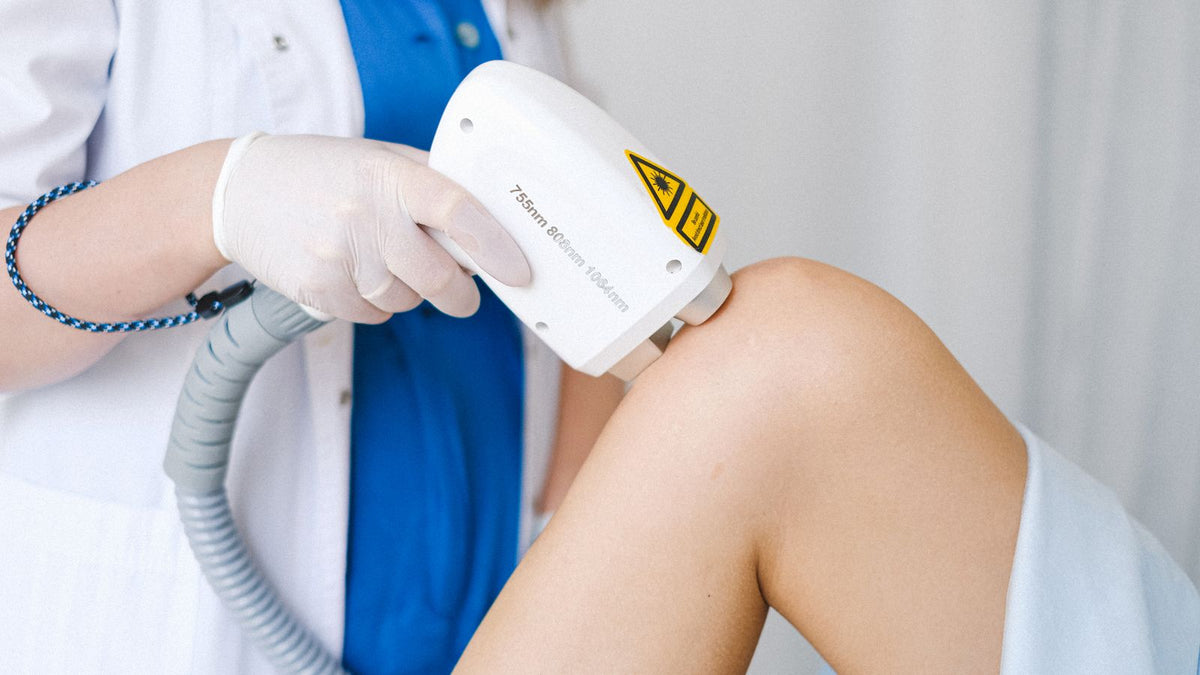
In clinic sessions use higher specification equipment than most home caps.
How are these devices meant to work on the scalp?
The proposed mechanism is that red light is absorbed by mitochondria inside follicle cells, which increases cellular energy production and nudges follicles out of the resting telogen phase and back into the growing anagen phase. That is the theory device makers publish. It is plausible biology, and it is not the same thing as a proven outcome in humans.
Two facts are worth holding on to. First, the hair cycle is slow: anagen runs for years while telogen lasts roughly three months, so any real change takes months to become visible and no honest device promises a difference in weeks. Second, pattern hair loss is driven by inherited follicle sensitivity to androgens, which light does not alter. A device can only ever act on the margins of a genetic process.
What does the evidence say about low level laser therapy for hair?
The evidence base is real but thin. Most published trials of low level laser therapy for hair run for 16 to 26 weeks and enrol small numbers of people. Several report a modest increase in hair count in the study area. Long term trials are scarce, results across devices vary widely, and findings from one device do not transfer to another.
Good sources disagree here, and it is more useful to say so than to pick a side. Dermatology references list light based devices among the options people try for pattern hair loss, while noting the limits of the data. The NHS takes a narrower line and says hair loss care is not usually available on the NHS because it is considered cosmetic. Neither position tells you that a specific cap on a specific head will do anything.
How to read a device study
Check three things before you believe a graph: how many people took part, how long the study ran, and whether anyone else has repeated it. A 16 week study of 40 people is a starting point for research, not a result you should spend hundreds of pounds on.
What do UK rules require from one of these devices?
Any scalp laser device sold legally in the UK must meet medical device conformity rules and carry a UKCA or CE mark, with the manufacturer holding technical documentation behind it. The Medicines and Healthcare products Regulatory Agency oversees that framework. The mark tells you the maker has followed a conformity route on safety, not that a clinical benefit has been demonstrated.
Advertising is policed separately. Under the CAP Code, a UK advertiser must hold evidence for every objective claim it makes, and the Advertising Standards Authority has repeatedly ruled against hair devices and supplements whose claims outran their data. If a listing says a device will definitely work, that is a claim the seller has to be able to prove, and most cannot.
| What the label means | What it does tell you | What it does not tell you |
|---|---|---|
| UKCA or CE mark | The maker has followed a conformity assessment route for a device of that class. | That hair will change. |
| 650 nanometre diodes | The wavelength is in the range used in published research. | That this unit delivers a useful dose to your scalp. |
| Clinical study cited | Some research exists on the device or the category. | How long it ran, how many people took part, or whether it has been repeated. |
| Money back period | You can return it inside the window. | Anything at all about effectiveness. |
Get a discount on the thinning hair range
Join the Watermans mailing list and we will email a discount code straight to your inbox, so you can try the thinning hair range for less. Vegan, made in the UK, over 6.5 million bottles sold since 2012.
Is your problem hair loss, hair shedding or hair breakage?
These three problems look similar in the mirror and have completely different answers, so separating them is the most useful thing on this page. Hair loss means follicles are miniaturising or scarring, as in pattern hair loss or alopecia areata. Hair shedding means more hairs than usual are leaving the scalp at the root, as in telogen effluvium after illness, surgery, childbirth or a crash diet. Hair breakage means the fibre is snapping along its length, so the hair is still rooted but shorter and frayed.
Losing between 50 and 100 hairs a day is normal, a figure the NHS publishes. A shed hair has a small pale bulb at the root end. A broken hair does not, and it tends to be a short, blunt or split fragment. A scalp laser is aimed only at the follicle, so it has no relevance whatsoever to breakage, which is caused by heat, tension, friction and chemistry. If your hairbrush is full of short fragments rather than full length hairs with bulbs, a laser cap is the wrong purchase.

Full length hairs with a pale bulb are shedding. Short blunt fragments are breakage.
For a fuller walk through of the differences, read the three mechanisms behind thinning hair and how much daily shedding is actually too much.
Who tends to consider a laser cap, and who should see a GP first?
The people who buy these devices are usually in the early stages of pattern hair loss: a widening parting, thinning at the crown, or a receding temple line that has been creeping for years. That slow, symmetrical pattern is the scenario the research has looked at, so it is the only one where the question is even reasonable.
Some situations need a GP appointment booked by you rather than a gadget. Patchy circular bald spots, hair loss with a sore, scaly or scarred scalp, sudden heavy shedding, hair loss alongside fatigue or weight change, and any hair loss in a child all need proper medical assessment first. A device bought online delays that, and in scarring conditions delay costs you follicles permanently.
If you want a qualified opinion outside the NHS, the Institute of Trichologists holds a public register of members in the UK. We do not run clinics and cannot assess a scalp. If your question is about products or a routine rather than a medical one, you can talk to Gail Waterman, our co-founder, as an AI avatar on the Watermans homepage.
What should you check before buying a device?
Five checks separate a considered purchase from an expensive impulse. Confirm the UKCA or CE mark and the named UK responsible person. Find the diode count and the session protocol, because a comb you have to hold for twenty minutes will be abandoned by week three. Read the return window and diary the date. Look for independent reviews rather than affiliate roundups. And set a review point at six months, since anything shorter than a full hair cycle tells you nothing.
Photograph your parting in the same light, at the same angle, on the first day of each month. Memory is a terrible instrument for slow change, and a phone photo is a good one. Our guide to measuring hair growth explains how to track progress properly.
How does low level laser therapy compare with everyday hair care?
A laser device and a good routine are answering different questions, so the comparison is not really a contest. A device is a bet on the follicle, at high cost, with mixed evidence and a six month wait. A careful routine is cheap, works on the fibre, and shows up in the mirror inside a few weeks because there is simply less snapping.
Most people arriving at a laser cap actually have both problems at once: some genuine thinning and a lot of avoidable breakage sitting on top of it. Fixing the breakage half is the faster, cheaper and more certain win, and it is where cosmetic products honestly belong.

A gentle wash, dry and detangle routine reduces the breakage sitting on top of genuine thinning.

Grow Me® Hair Growth Shampoo £14.95
Sulfate free daily shampoo with caffeine, rosemary, niacinamide, biotin and hydrolysed lupine protein. Cleanses without stripping and reduces breakage, so hair looks fuller along the lengths.
A sulfate free wash matters here because the scalp gets handled a lot during device sessions, and stripping it daily helps nobody. Grow Me uses caffeine, rosemary, niacinamide, biotin and hydrolysed lupine protein, and it is a cosmetic shampoo, so it cleanses, conditions and reduces breakage rather than changing hormones.

Grow More® Leave In Scalp Elixir £25.50
Overnight leave on scalp serum with caffeine, rosemary, niacinamide and hydrolysed lupine protein, for lower density areas such as the parting and temples.
If the visible problem is a wider parting or thinning temples, an overnight scalp serum is the part of a routine that goes where a cap goes. Grow More is a leave on elixir, applied to the scalp and left, which suits the same areas people point a device at.
Frequently asked questions about low level laser therapy
Does low level laser therapy hurt?
No. The devices use light at a power too low to heat tissue, so a session feels like nothing at all, or at most mild warmth from the device housing. Eye protection matters with any laser product, so follow the manufacturer instructions and never look directly into the diodes.
How long before you would see anything?
Six months is the realistic review point, because the hair cycle is measured in months and telogen alone lasts about three. Any device or product promising visible change in two or three weeks is describing marketing, not biology. Take monthly photographs in fixed lighting so you are comparing like with like.
Are these devices available on the NHS?
No. The NHS says hair loss care is not usually available on the NHS because it is considered cosmetic, so devices, caps and salon sessions are paid for privately. A GP will still investigate hair loss where there is an underlying medical cause to look for, such as a thyroid problem or iron deficiency.
Do laser combs work as well as caps?
There is no good head to head evidence, and the practical difference matters more than the theory. A cap runs hands free, so people finish the course. A comb has to be held and moved for the whole session, so it tends to be abandoned. The device you actually use beats the device with the better brochure.
Can a laser cap be combined with shampoos and serums?
Yes, and they are aimed at different things. A device targets the follicle. A cosmetic shampoo, conditioner or scalp serum works on the fibre, the scalp surface and the amount of breakage, which is why a routine shows up faster. Neither is a substitute for medical assessment if something has changed suddenly.
Is a scalp laser safe for coloured or chemically processed hair?
The light itself does not affect hair colour, and the devices do not heat the fibre. The practical risk with processed hair is the handling around a session, since coloured and relaxed hair is more porous and snaps more easily when combed or tied while damp.
What about a laser device for a receding hairline?
Temple recession is the hardest area for any approach, device or cosmetic, because those follicles are usually the most androgen sensitive and the furthest along. Read our honest look at temple thinning before spending money on this specific pattern.
What is the bottom line on low level laser therapy?
Low level laser therapy is a plausible, safe and expensive option with modest evidence behind it. It is not a cure, it is not on the NHS, and it cannot touch the genetics of pattern hair loss. If you buy one, buy it with a six month review date, monthly photographs and clear eyes about what the marketing can and cannot prove.
Before spending several hundred pounds on a device, it is worth removing the breakage that is making thinning look worse than it is. That part is cheap, fast and certain. If you want the honest comparison of every option, read our comparison of hair growth options.
If you are going to change one thing this week, make it the wash. A sulfate free hair growth shampoo cleans without stripping the scalp you are trying to look after, and it costs less than a single salon laser session.
Sources & references
- NHS, Hair loss, on normal daily shedding of 50 to 100 hairs, and on hair loss care not usually being available on the NHS
- DermNet, Male pattern hair loss, on androgen driven follicle miniaturisation and the options people try
- DermNet, Female pattern hair loss, on the diffuse pattern and its slow course
- GOV.UK, Medical devices: conformity assessment and the UKCA mark, on what a UKCA or CE mark does and does not certify
- MHRA, the UK regulator responsible for medical devices
- The Institute of Trichologists, public register of qualified trichologists in the UK
Watermans products are 100% cosmetic and do not treat medical hair loss. Individual results may vary.