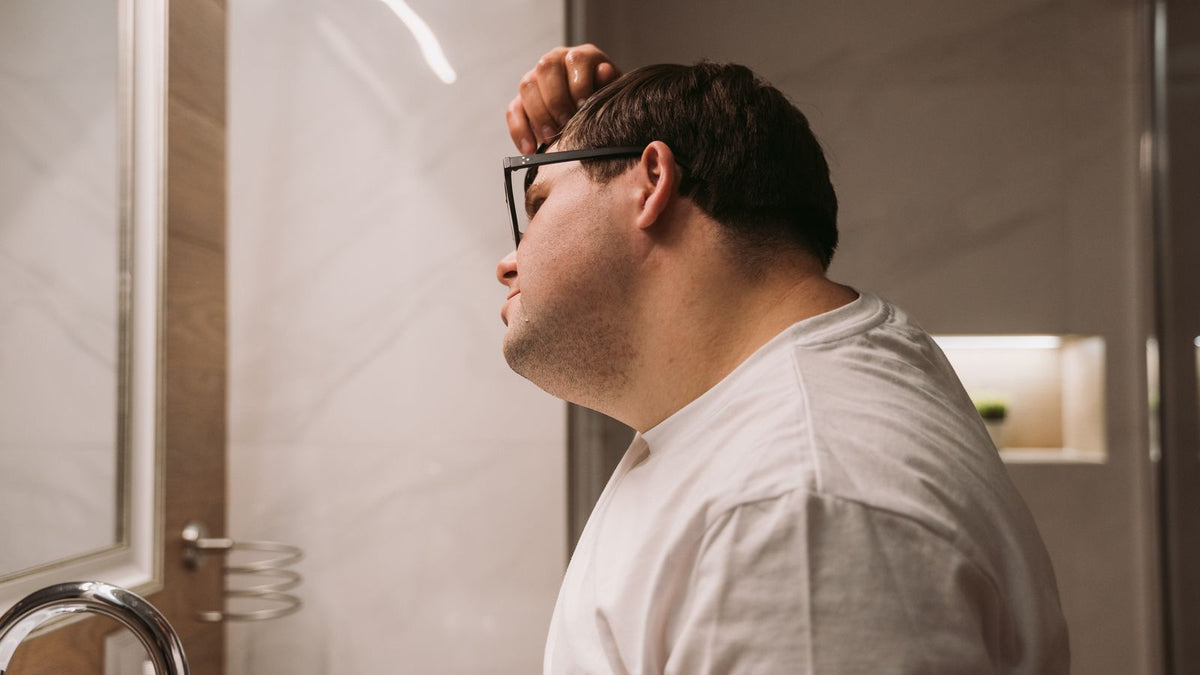
How to Tell if Hairline Is Receding: 5 Signs to Check
How to tell if hairline is receding comes down to shape rather than shedding. A receding hairline changes its outline over months and years: the corners at the temples move back further than the middle, the hairs at the front edge grow finer and shorter, and more scalp shows at the front than at the back. Counting hairs in the shower will not answer the question. Comparing the shape of your hairline against a photograph taken six months ago will.
Our hair growth shampoo
Grow Me® Hair Growth Shampoo, £14.95. A sulphate free daily shampoo that supports a healthy scalp environment and helps reduce breakage, so lengths hold on and look fuller.
Key takeaways
- How to tell if hairline is receding is a question about shape over time. A single mirror check tells you almost nothing.
- A mature hairline is normal. Most men lose the soft juvenile hairline in their late teens or twenties and then stay stable for decades.
- The reliable test is two photographs of the same hairline, in the same light, six months apart, with hair dry and pushed back.
- Finer, shorter, paler hairs at the front edge are the strongest early sign, because they show follicles making thinner hair rather than simply shedding it.
- Recession, shedding and breakage look similar in the mirror and have completely different answers, so identify which one you have before spending anything.
What actually counts as a receding hairline?
A receding hairline is a lasting backward movement of the front hair margin, driven by follicles at the frontal edge producing progressively finer and shorter hairs until they stop producing visible hair at all. Dermatologists call this process miniaturisation, and in pattern hair loss it happens at the temples and the front before it happens anywhere else.
That is different from three things it is regularly confused with:
- A mature hairline. The soft, straight, low hairline of childhood is not the adult one. Somewhere between the late teens and the late twenties most men lose roughly one to two centimetres at the temples and settle into a slightly higher, more angular shape. That is maturation, not loss, and it usually stops there.
- Seasonal or stress shedding. Shedding empties follicles temporarily across the whole scalp. It does not carve a new outline at the front.
- Breakage at the hairline. Tight styling, headbands, caps and constant brushing snap short front hairs. The follicle is intact and the hair grows back once the pulling stops.

How to tell if hairline is receding: which 5 signs should you check?
1. The temples move back faster than the middle
Pattern recession is almost never symmetrical with the centre. The corners retreat, leaving a peak or an island of hair in the middle and a V or M shape emerging. Run a finger from the middle of your forehead outwards on each side and feel where the dense hair starts. If those two points sit noticeably further back than they did in old photographs while the centre has barely moved, that is the classic pattern.
2. The front hairs are finer, shorter and paler
This is the single most informative sign, and the one people miss. Pull the front section forward under good light and look at the individual hairs rather than the mass. In a stable hairline they are broadly the same calibre as the hairs behind them. In a receding one they are visibly thinner, shorter, often lighter in colour, and they never seem to grow past a certain length. Those are miniaturised hairs, and they indicate a follicle changing rather than a follicle emptying.
3. More scalp shows at the front than at the back
The back and sides of the scalp are generally spared in pattern loss, which makes them a built in control. Photograph the front and the back in the same session and the same light. If the front shows noticeably more scalp than the back, the difference is meaningful. If both look similarly sparse, you may be dealing with diffuse thinning or shedding instead, which is a different problem with a different answer.
4. Styling has quietly changed
People adapt before they notice. If you have started wearing a fringe forward, stopped pushing your hair back, avoided certain lighting, or begun choosing hats you would not have bothered with two years ago, your behaviour has already registered a change your conscious eye has not. That is worth taking seriously as evidence.
5. The change is slow and steady, not sudden
Recession takes years. A change you can date to a specific month is far more likely to be shedding after a trigger such as illness, a crash diet or a stressful period. A change you can only see by comparing this year to three years ago is the profile of genuine recession.
The one test worth doing. If you take one thing from this page about how to tell if hairline is receding, take this. Stand in the same spot, same light, hair clean, dry and pushed straight back. Take three photos: straight on, and 45 degrees from each side. Save them with the date. Repeat in six months. Two dated photographs settle the question better than any amount of mirror staring, and better than any online quiz.

What is the difference between hair loss, hair shedding and hair breakage?
Working out how to tell if hairline is receding really means separating these three, because they look alike in a mirror and respond to completely different things.
| Hair loss (recession) | Hair shedding | Hair breakage | |
|---|---|---|---|
| What is happening | Frontal follicles miniaturise and make finer, shorter hairs each cycle | Many follicles enter the resting phase together and release their hairs | The hair fibre snaps while the follicle keeps working |
| The pattern | Temples first, front worse than back, shape changes | All over the scalp, front and back equally | Wherever the tension or heat is: hairline, ponytail, midlengths |
| Timescale | Years | Weeks to months, usually 2 to 4 months after a trigger | Builds gradually with the habit, improves quickly once it stops |
| The giveaway | Miniaturised hairs at the front edge | Full length hairs with a white bulb, in unusual numbers | Short broken pieces with no bulb on either end |
| What to do | Speak to your GP, and protect the hair you still have | Fix the trigger and wait. It usually settles | Less tension, less heat, better conditioning. Quick to improve |
Our companion guide on what a receding hairline is and what genuinely helps covers the options once you have your answer, while the guide to why hair sheds and how long it lasts is the one to read if the pattern turns out to be all over rather than frontal.
Get a discount on the receding hairline range
Join the Watermans mailing list and we will email a discount code straight to your inbox, so you can try the receding hairline range for less. Made in the UK, over 6.5 million bottles sold since 2012.
Does a receding hairline look different in women?
Usually, yes. Female pattern hair loss more often widens the parting and thins the crown while the frontal hairline holds its position, which is why the sign to watch in women is the parting rather than the temples. Part your hair in the middle, photograph straight down, and look at how wide the visible line of scalp is compared with a year ago. There is more on widening parting in women in a separate guide.
There are exceptions worth knowing about. Frontal fibrosing alopecia moves the hairline back in a band, often taking the eyebrows with it, and it can leave a pale, smooth, slightly shiny strip of scalp behind. That one is a scarring condition, the follicles are genuinely destroyed, and it needs medical attention early rather than a shopping decision. Traction alopecia from tight braids, weaves and ponytails also thins the front edge, and it is reversible in its early stages if the pulling stops.
What are the common causes of a receding hairline?
- Androgenetic alopecia. The commonest cause by a wide margin. Frontal and temple follicles are sensitive to androgens and miniaturise over successive cycles. Family history on either side is relevant.
- Age. Hairline maturation in the late teens and twenties is normal and is not the start of pattern loss for most people.
- Traction. Years of tight braids, buns, weaves, extensions or a tight cap pull follicles out at the edge. Early traction alopecia recovers, late traction alopecia does not.
- Scarring conditions. Frontal fibrosing alopecia and lichen planopilaris destroy follicles. Redness, scaling, itching, burning or a shiny scarred look are the warning signs.
- Thyroid and nutritional problems. These more often cause diffuse thinning or shedding than true frontal recession, but they can make an existing recession look worse.
What genuinely helps once you know?
Once you have worked out how to tell if hairline is receding and confirmed that it is, be clear about what is and is not on the table. No shampoo, serum or supplement changes how many follicles you own or restores a hairline that has already gone. Anyone promising that is selling you something they cannot deliver. What good care can honestly do is protect the hair you still have, so the hairline you still have looks as full as it can.
Stop making it worse
Cut tension at the front edge. That means no tight man buns, no tight braids, no headbands worn all day, and caps that are not gripping the hairline. Turn down the heat on any styling tool and use a heat protectant every time. The front hairs are the shortest and the most exposed, which makes them the most vulnerable to snapping, and snapped front hairs make a hairline look worse than it is.
Look after the scalp
An irritated, flaking or oily scalp encourages scratching and harsh washing, which adds mechanical damage in exactly the wrong place. Peer reviewed work links poorer scalp condition and oxidative stress at the scalp with worse hair growth and retention, so a gentle, effective cleanse used often enough to keep build up down is a sensible foundation rather than a luxury.
See your GP if the picture is not straightforward
Book time with your GP if you see redness, scaling, pain or a shiny scarred look, if the hairline is moving back in a clean band, if your eyebrows are thinning too, if there is sudden heavy shedding that has not settled after around six months, or if hair changes come alongside fatigue, weight change or other symptoms. Your GP can arrange blood tests and refer you on where appropriate. That is a health conversation, not a shopping one.
Products that support a hairline you want to keep
These are cosmetic products for everyday care. They do not act on the follicle, and they are not a substitute for the GP conversation above.

Grow Me Hair Growth Shampoo, 14.95 pounds
A sulphate free daily cleanse with biotin, caffeine, rosemary and niacinamide. Cleans the scalp without stripping, which matters if you are washing often to keep product build up off the hairline.

Grow More Scalp Elixir, 25.50 pounds
A leave on serum applied to the scalp rather than the lengths, which suits a targeted area like the temples and the front edge you are photographing each month.

Hair Growth Boost Set, 53.40 pounds
Shampoo, conditioner and scalp elixir together, if you would rather run one consistent routine than assemble it yourself. Consistency is what makes a six month photo comparison meaningful.
Watermans products are 100% cosmetic and do not treat medical hair loss. Individual results may vary.

How do you track it properly from here?
- Take the baseline today. Three photos, clean dry hair pushed back, same room, same light, dated.
- Add a control shot. Photograph the back of your head too. The back is generally spared in pattern loss, so it tells you whether a change at the front is real or just a bad lighting day.
- Leave it six months. Hair grows around one centimetre a month and follicles change phase slowly. Checking weekly will only make you anxious and will not tell you anything.
- Compare like with like. Same distance, same angle, same expression. Raised eyebrows lift the hairline and have convinced a lot of people they were losing hair when they were not.
- Write down what changed. New products, a stressful stretch, a diet, an illness. Without that context a photo comparison tells you what happened but never why.
If you want the full method, our guide to measuring hair growth properly covers the lighting and consistency mistakes that ruin most home tracking, and is alopecia permanent explains which types recover and which do not.
Frequently asked questions about how to tell if hairline is receding
At what age do hairlines start receding?
Hairline maturation, the normal shift from the soft juvenile hairline to a slightly higher adult one, usually happens between the late teens and the late twenties in men, and it typically stops there. Pattern recession beyond that can begin at almost any adult age, and family history on either side is relevant to how early it starts.
How do I know it is recession and not just shedding?
Look at pattern and timescale. Recession changes the shape of the front hairline over years and affects the temples more than the back of the head. Shedding releases full length hairs with a white bulb across the whole scalp over weeks, usually two to four months after an illness, a crash diet or a stressful period, and it usually settles on its own.
Can a receding hairline come back?
Where the cause is traction from tight styling and it is caught early, hair at the front edge often recovers once the pulling stops. Where follicles have miniaturised through pattern hair loss or been destroyed by a scarring condition, the change is not undone by any cosmetic product. Identifying which one you have, with your GP if the picture is unclear, matters more than choosing a bottle.
Does wearing a hat cause a receding hairline?
A normally fitting hat does not cause pattern hair loss. A hat or headband tight enough to grip the hairline all day can contribute to traction damage and to breakage of the short front hairs, which makes an existing hairline look worse than it is. The fix is fit, not abstinence.
Does stress cause a receding hairline?
Sustained stress is a well recognised trigger for shedding across the whole scalp, which is a temporary cycle change rather than recession. Stress does not carve a new outline at the temples. If your hairline shape has genuinely changed, stress is unlikely to be the whole story.
Why does my hairline look worse in some mirrors?
Overhead lighting throws shadow into the hairline and exaggerates any gap, while diffuse or side lighting hides it. Wet hair also clumps and shows more scalp than dry hair. This is exactly why a dated photograph in fixed conditions beats a mirror check.
Do hair growth shampoos work on a receding hairline?
A shampoo is a cosmetic. It can clean the scalp well, support scalp comfort and reduce the breakage that makes short front hairs look sparser, and those things are worth having. It cannot change how many follicles you own or restore a hairline that has already receded, and no honest brand should tell you otherwise.
Should I see a GP or go straight to a clinic?
Start with your GP. They can check for the causes that need medical attention, arrange blood tests such as ferritin, thyroid function and vitamin D, and refer you to a dermatologist where appropriate. Going straight to a commercial clinic means paying for an opinion from someone who also sells the answer.
Sources & References
- NHS, Hair loss. Common causes, what is normal, and when to see a GP.
- StatPearls via NCBI Bookshelf, Androgenetic Alopecia. Follicular miniaturisation, the frontotemporal pattern, and staging.
- DermNet, Frontal fibrosing alopecia. The scarring band of recession that also affects the eyebrows.
- DermNet, Traction alopecia. How tight styling thins the front edge and when it is still reversible.
- DermNet, Female pattern hair loss. Why women more often widen at the parting than recede at the temples.
- Scalp Condition Impacts Hair Growth and Retention via Oxidative Stress, via PubMed Central. Peer reviewed evidence on scalp condition and hair retention.
Sources do not agree on everything here. The exact age range for normal hairline maturation is described differently across dermatology references, which is one reason a personal dated photograph beats any published norm.
What is the bottom line on how to tell if hairline is receding?
How to tell if hairline is receding is a question about shape and time, not about how much hair is in the sink. Look for temples moving back further than the centre, finer and shorter hairs at the front edge, more scalp at the front than at the back, and a change you can only see across years rather than weeks. Then prove it with two dated photographs taken six months apart in identical light.
Separate the three problems before you spend anything. Recession is follicular and belongs in a conversation with your GP. Shedding is a temporary cycle change that usually settles. Breakage at the hairline is mechanical, it is the most common cause of a front edge looking thinner than it is, and it is the fastest of the three to improve. If your question is about products or a routine rather than a medical one, you can talk to Gail Waterman, our co-founder, as an AI avatar on the Watermans homepage.
Watermans is made in the UK, and has sold over 6.5 million bottles since 2012. If you want to protect the hairline you have while you watch it properly, the Grow Me shampoo and the Grow More scalp elixir are the sensible pair to run alongside your six month photo.