HRT Hair Density: What Hormone Therapy Can and Cannot Do
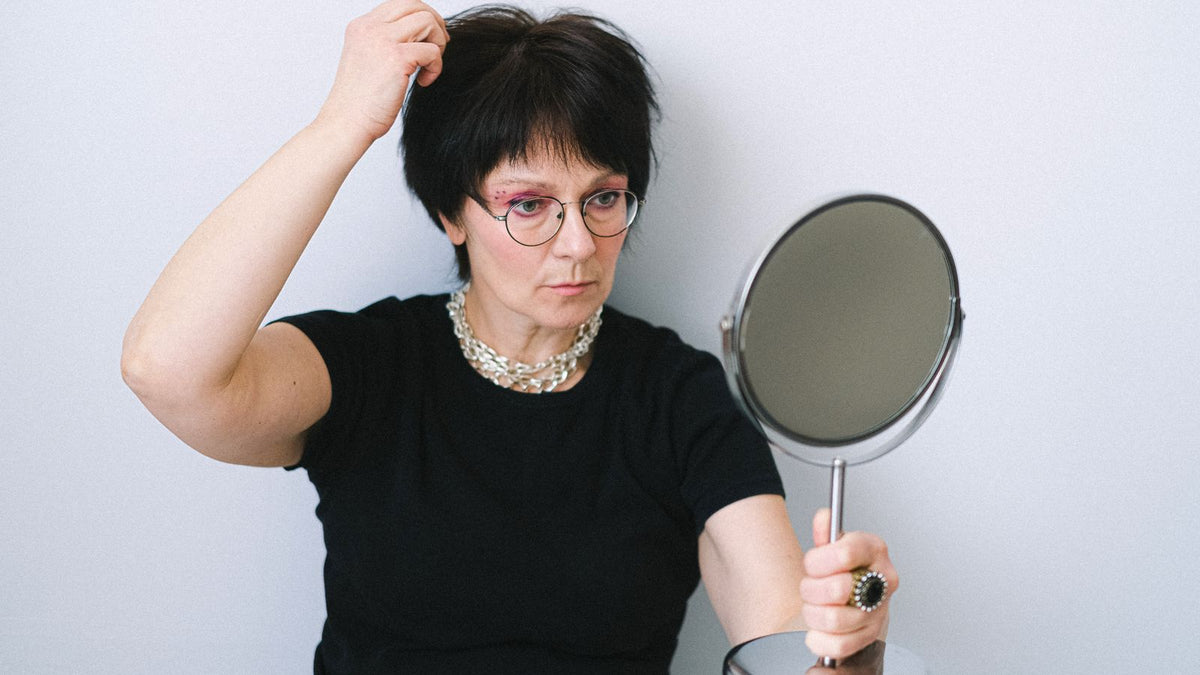
The parting is usually where it shows first. Same hair, wider line.
HRT hair density is one of the most asked about and least settled questions in menopause care. Hormone therapy is intended for symptoms such as hot flushes and night sweats, and NICE guideline NG23 does not list hair among them. Some women find their hair steadies, some notice a wave of shedding in the first few months, and many notice nothing either way. Measure it properly before you judge it.
Our menopause hair care kit
Menopause Hair Care Kit, £69.99. A complete hair, skin and wellbeing routine put together for the hair changes that arrive around the menopause.
Key takeaways
- NICE guideline NG23 sets out what hormone therapy is intended to help with, and hair density is not on that list.
- A wave of shedding two to three months after starting is a recognised adjustment, not usually a failure.
- Female pattern thinning widens the central parting while the frontal hairline is preserved.
- Two home measures beat any impression: ponytail circumference, and a monthly parting photo in fixed light.
- Give any change six months minimum, because hair grows around one centimetre a month.
- Watermans products are cosmetic. They reduce breakage and support a healthy scalp environment.
What does the evidence actually say about HRT hair density?
The evidence on HRT hair density is far weaker than the confidence with which it gets discussed online, because hormone therapy is licensed and studied for menopausal symptoms such as hot flushes, night sweats and sleep disruption, and hair density has not been a primary outcome in the trials that shaped the guidance.
NICE guideline NG23 covers menopause care in England and Wales and sets out what hormone therapy is for. Hair is not on that list. That does not mean hair never changes on HRT, and plenty of women report that theirs steadied. It means nobody can promise it, and anyone who does is going beyond what the guidance supports. The honest position is that hormone therapy is a decision about menopausal symptoms and long term health, taken with your doctor, and any effect on hair is a possible side note rather than the reason to start.
Two views worth knowing
Some specialists argue that restoring oestrogen should in principle favour the growing phase of the hair cycle. Others point out that hair density has rarely been measured properly in the trials. Both positions are defensible, which is exactly why the guidance stays quiet on it.
Why does hair change around the menopause at all?
Hair changes around the menopause because the hair cycle is hormonally sensitive, and the falling oestrogen of the perimenopause shortens the growing phase for some women while the relative influence of androgens on the follicles at the top of the scalp increases.
The visible result is usually a gradual reduction in the diameter of individual hairs rather than whole follicles disappearing. That is why the parting widens while the total number of hairs looks broadly similar: each one is finer than it was, so the same count covers less scalp. DermNet describes this female pattern as a loss of density over the crown and mid scalp with the frontal hairline preserved, which is the detail that separates it from the male pattern.
| Pattern | Where it shows | Typical timescale | Hairline |
|---|---|---|---|
| Female pattern | Central parting and crown | 2 to 10 years, gradual | Usually preserved |
| Male pattern | Temples then crown | 2 to 10 years, gradual | Recedes |
| Shedding (telogen) | All over, from the roots | Starts 2 to 3 months after a trigger | Unchanged |
| Breakage | Mid lengths and ends | Builds over months of handling | Unchanged |
The NHS notes that this kind of gradual thinning is common and is not usually a sign of illness, which is accurate and rarely comforting. NICE guideline NG23 frames the menopause as a transition lasting several years rather than a single event, which is the timescale any change in hair has to be judged against.

Is it hair loss, hair shedding or hair breakage?
Hair loss, hair shedding and hair breakage are three separate problems that all present as less hair, and mixing them up is the reason so many women spend a year on the wrong solution during the menopause transition.
- Hair loss is the follicle making finer hair or stopping. It arrives slowly over a year or more and shows as a widening parting. This is the one that hormones speak to.
- Hair shedding is far more than the usual 50 to 100 hairs a day coming out with a white bulb attached, typically two to three months after a trigger such as illness, surgery or a hormone change.
- Hair breakage is the fibre snapping mid length, leaving short pieces with no bulb. Menopausal hair is often drier and more fragile, so breakage quietly increases at the same time as everything else.
Breakage is the part you can change today, with no medical input at all, and it is frequently the largest single contributor to how thin the ends look. Our article on the shedding wave that can follow a hormone change covers the middle case in more detail.
Get a discount on the menopausal hair range
Join the Watermans mailing list and we will email a discount code straight to your inbox, so you can try the menopausal hair range for less. Made in the UK, over 6.5 million bottles sold since 2012.
How do you measure hair density at home?
Two measures are worth keeping and everything else is noise: the circumference of your ponytail taken with a tape measure at a fixed distance from the scalp, and a photograph of your parting taken on the first of each month in the same bathroom under the same light.
Ponytail circumference is the closest thing to an objective home number. Gather all the hair at the crown, wrap a soft tape around it 2 cm from the band, and write the figure down with the date. A change of 0.5 cm over 6 months is real. A change you noticed in the mirror on a Tuesday is not.
For the photo, stand in the same spot, part the hair in the same place, and use the same overhead light with the flash off. Bathroom downlights flatter or destroy a parting depending on the angle, so consistency matters far more than quality. Twelve photos a year make a comparison that no memory can match, and the NHS advice to see a GP about sudden or patchy loss is far easier to act on when you can show the change rather than describe it.


How long does it take to see any change after starting hormone therapy?
Any honest answer starts at six months and runs to a year, because hair grows at roughly 1 cm a month and the growing phase itself lasts 2 to 6 years, so the scalp simply cannot show a hormonal change on a shorter timescale than that.
The sequence usually runs in this order: shedding rate settles first, around 3 to 6 months. Hair diameter, if it changes at all, follows over the next six. Visible density at the parting is last, and often too gradual to see without the photo set. Anyone judging at eight weeks is judging noise. For the calibre side of this, our guide to how hair miniaturisation is measured explains what to look for on your own scalp.
That timeline is also why a shedding wave in month three feels so alarming and so often resolves. The hairs coming out were pushed into the resting phase weeks earlier, and the resting phase itself runs about 3 months before the hair releases. What you are watching in the plughole is a decision the follicles made before anything you are doing now had a chance to work.
What else affects HRT hair density besides hormones?
Several things affect HRT hair density that have nothing to do with hormones at all, and they are worth ruling out first because they are cheaper to fix: iron stores, thyroid function, vitamin B12, rapid weight loss, and the ordinary mechanical damage of heat and styling.
Ferritin, thyroid function and vitamin B12 are all common and correctable in this age group and all available free from your GP. NICE Clinical Knowledge Summaries put the iron deficiency threshold at a serum ferritin below 30 micrograms per litre. Getting those checked before, or at the same time as, starting hormone therapy means you are not left guessing which change did what. Our guide to what actually keeps a follicle healthy goes through the wider picture.
What can you do cosmetically while you wait?
Concentrate on keeping the length you already grow, because the fastest visible improvement available to anyone during the menopause transition is a reduction in breakage rather than any change at the follicle.
Conditioner on every wash without exception. Wide tooth comb on wet hair. Heat tools lower and less often, with a protective spray when you do use them. Avoid the same tight ponytail position day after day. None of this changes what the follicle is doing, and all of it changes how much hair survives to be seen.
Styling can do a surprising amount of the rest. A blunter cut holds the appearance of weight far better than long layers on finer hair, and a parting moved two centimetres to one side covers a widened line immediately. Neither is a solution to anything, and both buy you the six to twelve months you need before any real judgement is possible.

Menopause Hair Care Kit £69.99
The five step menopause routine: Grow Me shampoo, Condition Me conditioner, the Grow More scalp elixir, plus the Allevi8 supplement and Moisturise Me cream. Cosmetic care built around this life stage rather than a medical alternative to it.

Grow Me® Hair Growth Shampoo £14.95
A sulfate free hair growth shampoo with biotin, caffeine, rosemary, niacinamide and hydrolysed lupine protein, for gentle daily cleansing that supports a healthy scalp environment.

Grow More® Leave-In Scalp Elixir £25.50
A leave in overnight scalp elixir for the crown and parting, where menopausal thinning shows first. Applied to a dry scalp at night and left in.
If you are weighing up what to expect from hormone therapy more broadly, our article on what women actually report about hair on HRT gathers the range of experiences.
What are the frequently asked questions about HRT hair density?
Does HRT improve hair density?
The honest answer is that the evidence is much thinner than the confidence with which the question gets answered online, because NICE guideline NG23 on menopause lists the symptoms hormone therapy is intended to help and hair density is not among them. Some women notice their hair feels steadier after starting, and others notice nothing at all. Treating a change in hair as a likely benefit rather than a possible side effect is where most disappointment starts. Density is one measure and growth is another, which we separate in hormone therapy hair growth, what it can and cannot do.
Can starting HRT make hair shed at first?
It can. Any change in hormones is a change the hair cycle has to adjust to, and a wave of shedding two to three months after starting is a recognised pattern rather than a sign something has gone wrong. It usually settles. Tell the doctor who looks after your hormone care rather than stopping on your own.
How do I measure HRT hair density at home?
Use two fixed measures and nothing else. Measure the circumference of your ponytail with a tape at the same distance from the scalp, and photograph your parting under the same bathroom light on the first of each month. Both take thirty seconds and both are far more reliable than how your hair looked this morning.
How long before I would notice any difference?
Hair grows roughly one centimetre a month, so give it six months minimum before drawing conclusions and a year before deciding nothing changed. Shedding rates move first, visible density much later.
Is thinning at the menopause the same as male pattern hair loss?
The mechanism overlaps but the pattern differs. Female pattern hair loss usually widens the central parting while the frontal hairline stays, whereas the male pattern recedes at the temples and crown. DermNet sets out both patterns, and the distinction matters because the female pattern is easy to mistake for general thinning.
Should I take a supplement for menopausal hair changes?
Only for something that is actually low. Ask your GP about ferritin, thyroid function and vitamin B12, because those are common and correctable in this age group. If everything comes back normal, a supplement has nothing to correct. If your question is about products or a routine rather than a medical one, you can talk to Gail Waterman, our co-founder, as an AI avatar on the Watermans homepage.
Can hair changes be the first sign of the perimenopause?
For some women, yes. Hair that suddenly feels finer, drier or slower to grow can arrive alongside changes in periods and sleep, sometimes before anyone has used the word perimenopause. It is worth raising with a GP rather than putting down to age.
What is realistic to expect from cosmetic products?
Cosmetic products change how hair looks and behaves, not what the follicle does. A good shampoo and conditioner reduce breakage, which keeps more of the length you already grow, and a scalp serum supports a healthy scalp environment. None of that is medical care, and none of it should be sold as though it were. Our companion piece on the three reasons hair density falls takes the mechanism angle rather than the expectations one. If you want the detail on that, our guide to medical reasons hair wont grow walks through it step by step.
Sources & references
- NICE guideline NG23, Menopause: identification and management
- NHS, Hormone replacement therapy (HRT)
- NHS, Menopause
- DermNet, Female pattern hair loss
- NICE Clinical Knowledge Summaries, Anaemia: iron deficiency
- NHS, Hair loss
What is the bottom line on HRT hair density?
Decide about hormone therapy on the symptoms it is actually intended for, with your doctor, and regard any effect on HRT hair density as a possible bonus rather than the reason. Get ferritin, thyroid and B12 checked, start the ponytail measurement and the monthly photo now, and judge at six months rather than six weeks.
For the part you control, the Watermans menopause hair care kit is a cosmetic routine built around this stage, reducing breakage so more of what you grow stays on your head. Made in the UK, over 6.5 million bottles sold since 2012.
Please note: Watermans products are 100% cosmetic and do not treat medical hair loss. Individual results may vary.