Hormone Therapy Hair Growth: What It Can and Cannot Do
Hormone therapy hair growth changes are real but slow and partial: correcting a hormonal shift can stop a hormonally driven shed and let density recover over six to twelve months, but it does not add follicles you have already lost, and it is not a hair remedy. Hair responds to hormones as a side effect of what the hormone is doing elsewhere in the body, which is why the honest answer is usually "some improvement, eventually, if the hormone was the problem".
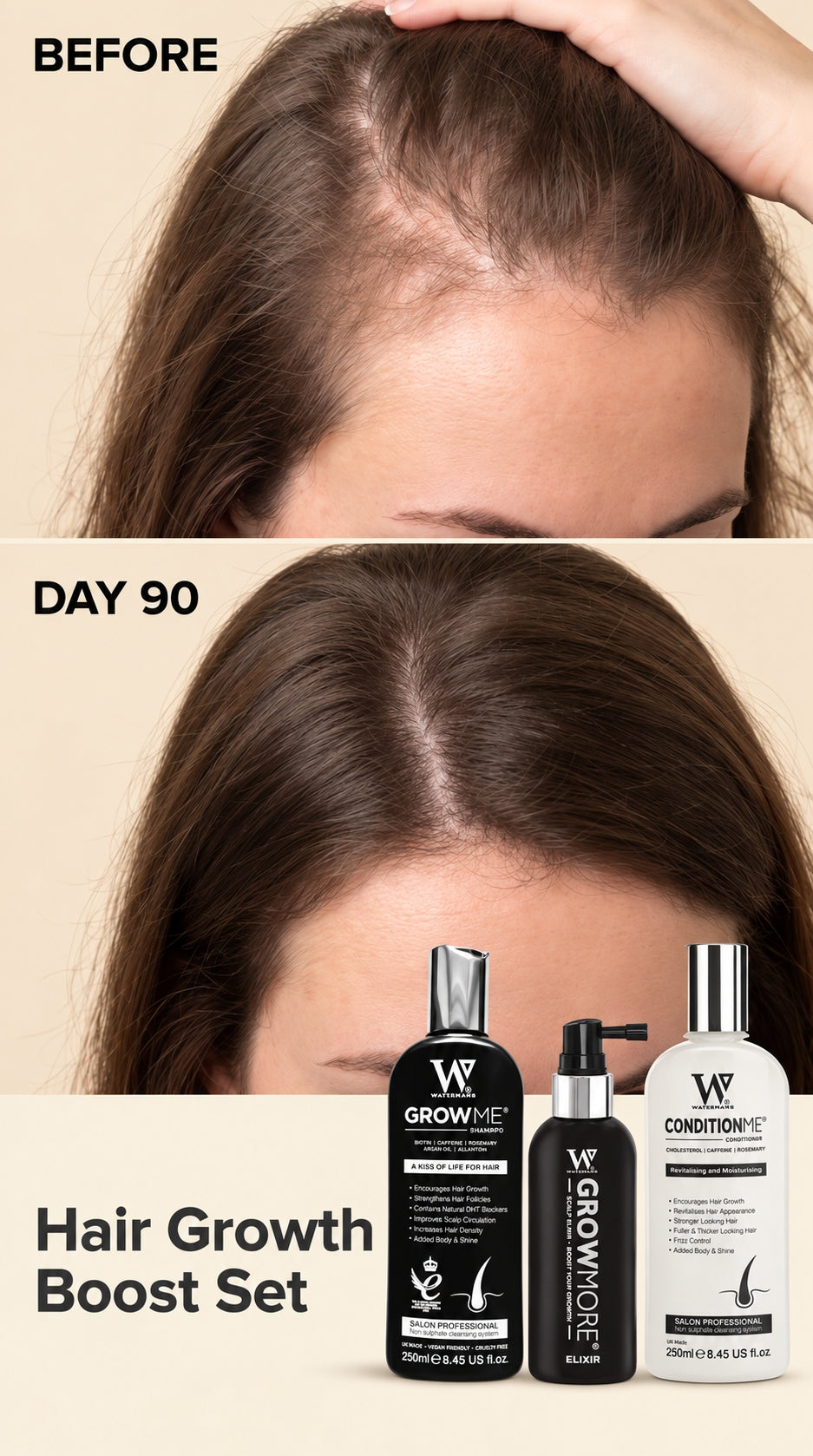
Our hair growth shampoo
Grow Me® Hair Growth Shampoo, £14.95. A sulphate free daily shampoo that supports a healthy scalp environment and helps reduce breakage, so lengths hold on and look fuller.
Key takeaways
- Hair is a lagging indicator. Nothing you do to your hormones shows on your head for at least three months.
- Hormonal shifts usually cause shedding, which recovers, rather than pattern thinning, which does not.
- A shed in the first few months after any hormonal change is common and often temporary. It is not a sign the change is failing.
- Thyroid function and iron stores explain a large share of "hormonal" hair complaints and are checkable with a blood test.
- Every decision about hormone medicines belongs with your GP or specialist. We make cosmetic hair care and nothing more.
What does hormone therapy hair growth actually mean?
The phrase covers four very different situations that get lumped together, and telling them apart is the whole game.
- Hormone replacement therapy in menopause. Replacing declining oestrogen, usually for hot flushes, sleep and bone health. Hair effects are a side benefit rather than the goal.
- Androgen lowering medicines. Used in some women where androgen levels are driving scalp thinning or unwanted facial hair. Specialist territory, and never something to source outside the NHS.
- Thyroid hormone correction. Both an underactive and an overactive thyroid disturb the hair cycle, and correcting the level is what settles it.
- Gender affirming hormone therapy. Feminising or masculinising therapy changes the hormonal signals reaching the follicle, with real and predictable effects on both scalp and body hair.
What none of these are is a hair product. In every case the hormone is being adjusted for a reason that has little to do with your scalp, and the hair response is downstream of that.

How do hormones change the hair growth cycle?
Hormones control how long each follicle spends growing before it rests, and that single variable decides both how long your hair gets and how much of it is on your head at once.
Every follicle cycles independently through a long growing phase lasting two to six years, a brief transition, and a resting phase of around three months before the hair releases and a new one starts. At any moment roughly nine in ten of your follicles are growing and about one in ten is resting. That ratio is what density is.
Two hormonal levers move it. Oestrogen tends to extend the growing phase, which is why hair often feels thicker in pregnancy and thinner after menopause. Androgens, acting on follicles that are genetically sensitive to them, do the opposite on the scalp: they shorten the growing phase cycle after cycle so each replacement hair is finer and shorter. That progressive shrinking is androgenetic alopecia, and our guide to what triggers androgenic alopecia covers it in depth.
The important consequence: a hormone change large enough to shift that ratio pushes a wave of follicles into resting at once. You see the result about three months later as a shed. This is telogen effluvium, and it happens whether the hormonal change was welcome or not.
Does HRT help with menopausal hair thinning?
Hormone replacement therapy can help hair indirectly, but it is not given for hair and should not be started for hair. Women on HRT often report that shedding settles and texture improves over the first year, which is consistent with oestrogen supporting a longer growing phase.
Three honest caveats sit alongside that.
First, the evidence for hair specifically is thin. Hair is rarely a primary outcome measure in HRT research, so most of what is said about it comes from observation rather than well designed trials. Second, some women shed more in the first three to four months of starting or changing HRT, for the same cycle synchronisation reason described above. That is usually temporary. Third, HRT does not undo pattern thinning that has already happened, because the follicles that have miniaturised do not un-miniaturise because oestrogen returned.
If menopause is the context, our guide to menopause hair loss and what actually helps and our detailed piece on HRT and hair loss go further than we can here.
What about androgen lowering medicines for hair?
Medicines that reduce androgen activity are used in UK practice for some women with androgen driven scalp thinning, and that conversation belongs entirely with a GP or a dermatologist. We are not going to name medicines, discuss doses or suggest what you should be on, because we are a cosmetics company and it would be wrong of us to. For when shedding starts and how long it usually lasts, see the timeline of hormone therapy hair loss, month by month.
What is worth knowing before that conversation is the shape of it. These medicines are considered where there is evidence of androgen excess or where thinning is progressing quickly, they take six to twelve months to show any effect on hair, they have side effects that need monitoring, and they are usually stopped if they have not helped within a year. They are also not suitable in pregnancy or when trying to conceive, which materially changes the discussion for many women.
Get a discount on the hormonal hair changes range
Join the Watermans mailing list and we will email a discount code straight to your inbox, so you can try the hormonal hair changes range for less. Made in the UK, over 6.5 million bottles sold since 2012.
How does gender affirming hormone therapy affect hair?
Gender affirming hormone therapy changes scalp and body hair in fairly predictable directions, and the timelines differ sharply between the two.
| Change | Feminising therapy | Masculinising therapy |
|---|---|---|
| Scalp hair | Existing thinning usually slows or halts. Density lost before starting rarely comes back. | Temple and crown thinning can begin or accelerate where there is a family history. |
| Body and facial hair | Becomes finer and slower over one to three years. Facial hair usually needs separate removal. | Coarsens and spreads over one to five years, with wide individual variation. |
| Realistic timeline | Scalp changes are protective and slow. Judge at twelve months, not three. | Scalp changes may appear within the first year and continue. |
The single most useful thing anyone starting feminising therapy can know is that acting early protects more than acting later, because slowing further thinning is achievable while restoring lost density largely is not. Our guide to hair care during transition covers the cosmetic side.

What should you get checked before blaming hormones?
Ask your GP about thyroid function and iron stores first, because between them they explain a large share of hair complaints that people assume are hormonal.
- Thyroid function. Both underactive and overactive thyroid disturb the hair cycle, and both are common and easily missed. Hair often recovers once levels are stable.
- Ferritin, not just haemoglobin. Iron stores can be low enough to affect hair while a standard anaemia check still reads normal. This is one of the most frequently overlooked contributors in menstruating women.
- Vitamin D and B12. Worth including where diet is restricted or sun exposure is minimal.
- Androgen markers, where indicated. Relevant if thinning arrives with irregular periods, acne or unwanted facial hair, which together suggest PCOS.
- A timeline of the last year. Illness, surgery, a new or stopped medicine, pregnancy, significant weight change. Bring dates. It is more useful than any single result.
How long does hormone therapy hair growth take to show?
Expect nothing visible for three months, meaningful change at six, and a fair verdict at twelve. Hormone therapy hair growth runs on the hair cycle's clock, not yours, and there is no way to hurry it.
The sequence is consistent. A hormonal change first pushes follicles into resting, which you notice as a shed roughly two to three months later. Those follicles then re-enter growth, but new hair grows at about one centimetre a month, so it takes another three to four months before that new length is long enough to contribute to how full your hair looks. Six months is the earliest honest checkpoint and twelve months is where a genuine assessment can be made.
This is exactly why the first few months feel like the change is making things worse. In most cases it is the opposite: the shed is the cycle resetting.

What supports hair alongside hormone therapy?
Protecting the hair you already have is the part of hormone therapy hair growth you fully control, and on a scalp going through a hormonal shift it matters more than usual because you cannot afford to lose length to breakage on top of a shed.
Separating the three things people call hair loss makes this concrete. Hair loss in the follicular sense is miniaturisation, and nothing cosmetic changes it. Shedding is the cycle, and it resolves when the trigger resolves. Breakage is the fibre snapping mid length, and it is entirely within your control. During a hormonal shed, breakage is the difference between thinner hair and thinner, shorter, frizzier hair.
- Eat enough, with enough protein and iron. Restriction shows on your scalp about three months later, and a hormonal shed plus a crash diet compound each other badly.
- Handle wet hair gently. Wide tooth comb, ends first, squeeze rather than rub with the towel.
- Lower the heat and always use protection. Fine, shedding hair breaks at temperatures thicker hair shrugs off.
- Loosen the tension. Tight ponytails and repeated pulling at the same point cause traction damage that can become permanent.
- Wash with something light, more often rather than less. Clean, dry roots stand away from the scalp, and that is what reads as density.

Sulfate free, so it cleans the roots without the stripped feeling that drives rebound oiliness. Biotin, caffeine, rosemary, niacinamide and hydrolysed lupine protein support a healthy scalp environment and leave finer hair feeling fuller at the root rather than coated. For a related angle, see our guide to rebound alopecia.

Condition Me® Conditioner, £13.95
Breakage defence with cholesterol, shea butter and hydrolysed lupine protein, on the mid lengths and ends only. Keeping length on your head is the one lever that works immediately while you wait out a hormonal shed.
Being straight about this: nothing in a shampoo bottle influences your hormones or what a follicle decides to do. Cosmetic care reduces breakage, keeps the scalp comfortable and improves how hair looks and behaves. That is genuinely worth having during a shed, and it is a different claim from changing the underlying cause. A companion piece, what changes on oestrogen, what changes on testosterone, and what is permanent, covers the timeline in detail.
Frequently asked questions
Can hormone therapy bring hair back?
It can allow hair that was pushed into resting to return, which often reads as recovery. It does not restore follicles that have already miniaturised through pattern thinning. The realistic outcome is that a hormonally driven shed settles and density improves toward, but rarely all the way back to, where it was.
Will HRT stop my hair falling out?
It may reduce a hormonally driven shed over six to twelve months, and some women notice better texture within the first year. HRT is given for menopausal symptoms rather than for hair, and starting it for hair alone is not a decision the evidence supports. Discuss it with your GP on its own merits.
Does hormone therapy ever cause hair loss?
Yes, temporarily and commonly. Any significant hormonal change can synchronise follicles into resting and produce a shed two to three months later. Masculinising therapy can also unmask genetic pattern thinning, which is a different and lasting effect rather than a temporary shed.
How long before hormone therapy hair growth becomes visible?
Three months before anything changes at all, six months before it is worth assessing, and twelve months before a fair verdict. New hair grows around one centimetre a month, so even a perfect response takes half a year to show up as visible fullness.
Why did my hair shed more after starting therapy?
Because the change reset the cycle. A batch of follicles entered their resting phase together and released together about three months later. It is disconcerting and it is usually the system rebalancing rather than a sign of failure. Tell your GP if it is heavy or continues past six months.
Do I need a trichologist or an endocrinologist?
Start with your GP, who can order the blood tests and refer onward. An endocrinologist is the right specialist where hormone levels themselves are in question. A trichologist is useful for scalp specific assessment, but is not a substitute for the medical checks. Watermans is neither, and we do not offer either service.
Can I use a hair supplement alongside hormone therapy?
Check with whoever manages your medicines first, because supplements can interact and high dose biotin in particular interferes with several common blood tests, including thyroid and hormone panels. If a test is planned, mention any supplement you are taking.
Does thyroid medication help hair?
Getting thyroid levels back into range usually settles thyroid related shedding, though the improvement lags the blood result by several months. If your levels are stable and your hair is still shedding, something else is contributing and is worth investigating. If the question is coverage rather than growth rate, our guide to what changes hair density on hormone therapy is the better starting point.
What is the bottom line on hormone therapy hair growth?
Hormone therapy hair growth is real, modest and slow. Correcting a hormonal problem can end a hormonally driven shed and let density recover over six to twelve months, but it cannot rebuild follicles already lost to pattern thinning, and hair should almost never be the reason a hormone medicine is started or stopped. Get thyroid and iron checked before assuming hormones are the cause, expect the first few months to look worse before they look better, and spend the waiting period protecting the hair you have with gentle handling and a light routine. Every decision about the medicines themselves belongs with your GP. If your question is about products or a routine rather than a medical one, you can talk to Gail Waterman, our co-founder, as an AI avatar on the Watermans homepage.
If you would rather start small, swap the wash first and see how the scalp feels on Grow Me hair growth shampoo. Vegan and made in the UK.
Watermans products are 100% cosmetic and do not treat medical hair loss. Individual results may vary.