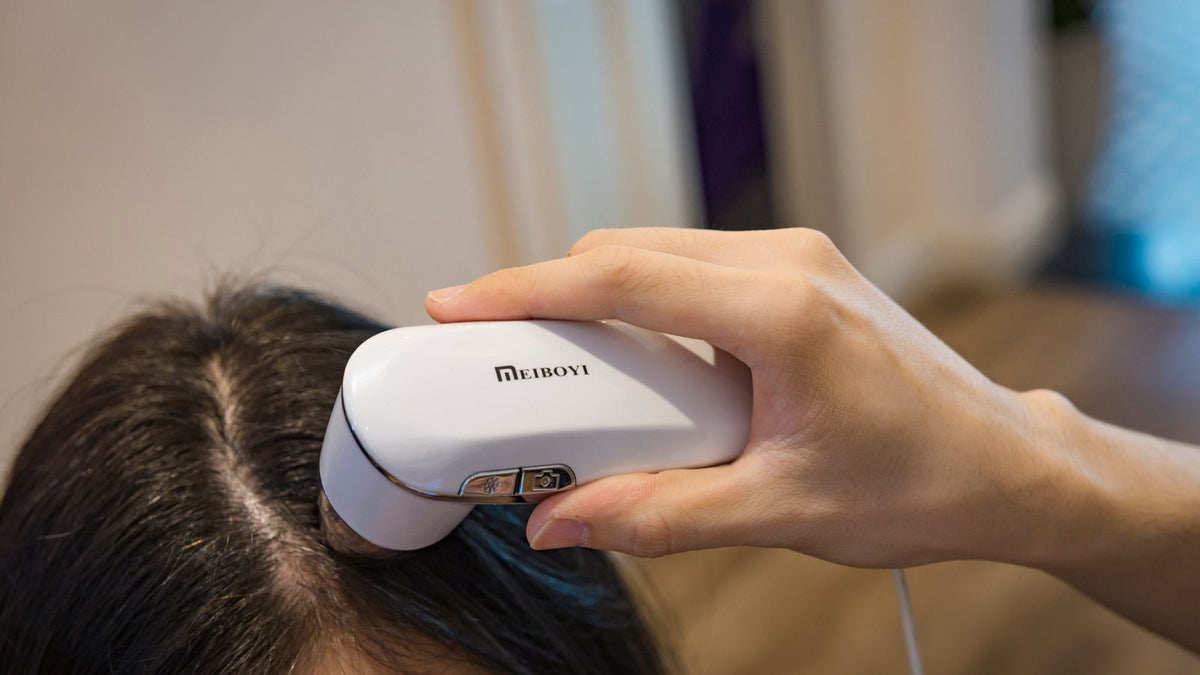
Trichologist in Aylesbury: How Fast Does Hair Really Grow?
Hair grows at a steady, modest pace, and very little you can buy changes that pace.
Scalp hair grows about 1 cm a month, according to DermNet, and each hair keeps growing for several years before it rests and falls out. If you are searching for a trichologist in Aylesbury because your hair seems slow, the honest answer is that trims, supplements and scalp products do not change that pace unless something is holding it back, such as low iron or a thyroid problem. What you can change is how much length you keep, by reducing breakage at the ends.
Our hair, skin and nails gummies
GrowPro® Hair, Skin & Nails Gummies, £22.95. Sugar free daily gummies for people who would rather chew than swallow a tablet, supporting hair care from the inside out.
Key takeaways
- DermNet puts scalp hair growth at about 1 cm a month, which works out at roughly 12 cm in a year.
- Each scalp hair grows for years, then rests for a few months before it is pushed out; the NHS says losing 50 to 100 hairs a day is normal.
- Trimming does not speed growth, because new hair is made in the bulb at the base of the follicle, not at the tips.
- A 2017 review of biotin found every reported benefit came from people with an underlying problem, and not enough evidence to support it in healthy people.
- Give any change to your routine at least three months, and closer to six for thickness, because the growth cycle runs slowly.
- Sudden heavy shedding, patches or other symptoms: speak to your own GP first, then consider a registered trichologist in Aylesbury for hair and scalp concerns that remain.
How fast does hair grow on the scalp?
Scalp hair grows at roughly 1 cm a month on average, which DermNet explains is driven by cell division in the hair bulb at the base of each follicle, so a typical head gains around 12 cm of length a year before any breakage at the ends is taken into account.
That figure is an average, not a promise. The largest study of growth rate so far, published by Loussouarn and colleagues in 2016, measured 2,249 young adults aged 18 to 35 from 24 ethnic groups across five continents, all without hair loss. Growth rate, density and the share of resting hairs varied with scalp area, sex and geographic origin. African hair tended to have lower density and a slower growth rate, while Asian hair was thicker in diameter and grew faster. So two people following an identical routine can see quite different results over the same year, and neither of them is doing anything wrong.
Growth also carries on quietly while you are shedding. The NHS says it is normal to lose between 50 and 100 hairs a day, often without noticing, because older hairs are released as new ones come through. A brush full of hair does not mean your hair has stopped growing. If you want the practical side of getting longer hair, our deep-dive on how to grow hair fast sets out the daily habits in more detail.
What are the anagen, catagen and telogen phases of the hair cycle?
Anagen is the growing phase, catagen is a short transition of two to three weeks when growth stops and the follicle shrinks, and telogen is the resting phase of one to four months before the old hair is pushed out, and DermNet notes that how long anagen lasts is what sets the maximum length your hair can reach.
Each follicle runs its own clock, so the phases are not in step across the scalp. That is why you shed a little every day rather than all at once. The sources broadly agree on the shape of the cycle but differ on the numbers, and it is worth seeing them side by side.
| Phase | What happens | How long | Share of scalp hairs |
|---|---|---|---|
| Anagen | The bulb makes new hair and the shaft lengthens | Up to 6 years or longer (DermNet); about 4 years (DermNet, telogen effluvium page) | Around 85% (BAD) |
| Catagen | Growth stops and the follicle shrinks | 2 to 3 weeks | 1 to 3% (DermNet) |
| Telogen | The hair rests, then a new hair forming below pushes it out | 1 to 4 months (DermNet); 2 to 4 months (BAD) | Up to 10% (DermNet); around 15% (BAD) |
The small gap between the 10% and 15% resting figures reflects different sources describing a normal range, not an error in either. The practical point is the same. Short hairs such as eyelashes and eyebrows have an anagen phase of around a month, which is why they never grow long, while scalp hair can grow for years. Simple arithmetic shows what that means: at about 1 cm a month, four years of anagen gives a natural ceiling of roughly 48 cm, and six years gives roughly 72 cm, before any losses at the ends. If your hair seems to stall at a particular length, that ceiling is one explanation; breakage is the more common one, and our guide to split ends and hair that stops growing past a certain length covers it in depth.
What changes how fast your hair grows or how long it gets?
Genetics, age, general health, nutrition and the state of your ends are the main factors, and only some of them change the actual rate of growth, because the length you see in the mirror is the result of how fast the follicle produces hair minus how much snaps off along the way.
- Genetics. The Loussouarn study found clear differences in growth rate and density between groups of healthy young adults. You inherit your baseline, and no routine rewrites it.
- Age. The NHS describes most hair loss as either temporary or a normal part of getting older. DermNet explains that pattern hair loss (androgenetic alopecia) is due to genetic programming or hormonal influences, and that it converts thick hairs into finer, shorter ones over time.
- Health and nutrition. DermNet lists illness with fever, surgery, psychological stress, weight loss, an unusual diet or nutritional deficiency such as iron deficiency, and thyroid disorders among the triggers that push growing hairs into rest.
- Breakage at the ends. The ends are the oldest part of the hair. Heat, colouring and rough handling wear them down, so hair can be growing normally at the root while the overall length stays put.
If you are in your twenties and worried about any of this, the pattern of causes looks a little different, and our guide to hair worries in your twenties goes through them.
Does trimming your hair make it grow faster?
Trimming does not make hair grow faster, because DermNet explains that new hair is produced by cell division in the bulb at the base of the follicle, under the skin, and cutting the dry ends several centimetres away has no way of signalling to that bulb to work any harder.
The myth survives because trims genuinely help hair look longer and healthier over time. A split end that is left alone can keep splitting up the strand, so you eventually lose more length than you would have trimmed. Removing a small amount regularly keeps the ends intact, which means more of what the root produces stays on your head. So the benefit is real, but it is about retention, not growth.

A related myth is that shaving or cutting hair short makes it grow back thicker. The thickness of each hair is set by the follicle that makes it, and a blunt cut end can feel coarser than a naturally tapered tip, which is probably where the idea comes from. How often to trim depends on how quickly your ends wear, which is why hairdressers suggest different intervals for fine, coloured or heat-styled hair.
Myth check: three claims you will hear
"Trim it to make it grow." Growth happens at the root, so a trim only protects length. "Take a hair vitamin and it will grow faster." Supplements help when you are short of a nutrient, not when you already have enough. "This serum speeds up growth." A cosmetic product can keep the scalp clean and the lengths in good condition, which helps hair look and feel healthier, but that is a different thing from changing the growth rate.
Do hair supplements speed up growth if you are not deficient?
Hair supplements are unlikely to speed up growth in people who are not short of any nutrient, because a 2017 review of biotin found that all 18 reported cases of benefit involved an underlying problem, and the authors concluded there was not enough evidence to support supplementation in healthy people.
That review, by Patel and colleagues in Skin Appendage Disorders, is a useful reality check because biotin is the most heavily marketed hair nutrient of all. A wider 2019 review by Almohanna and colleagues looked at vitamins A, B, C, D and E, iron, selenium and zinc. The authors said these nutrients play an important but not entirely clear role in the hair cycle, that deficiency may be a modifiable risk factor, and that large double-blind placebo-controlled trials are still needed. In other words, correcting a shortfall matters, but topping up a full tank does nothing extra.

Food comes first. The British Association of Dermatologists (BAD) suggests a balanced diet including iron, protein, fresh fruit and vegetables, and says supplements are worth considering if your diet is restricted, for example if you are vegan or vegetarian. If you have cut out whole food groups, eat very little red meat or have had a run of crash diets, a supplement can fill a genuine gap.

Sugar-free vegan gummies, two a day, with biotin, zinc, MSM, bamboo silica, horsetail, vitamins C, A, D3, E, B3 and B12, folic acid, pantothenic acid, copper and iodine, £22.95 in September 2026. Biotin and zinc contribute to the maintenance of normal hair. To be plain about it: a supplement helps people who are short of a nutrient, not people who already get enough from their food.
Get a discount on the hair growth range
Join the Watermans mailing list and we will email a discount code straight to your inbox, so you can try the hair growth range for less. Vegan, made in the UK, over 6.5 million bottles sold since 2012.
Can a shampoo or scalp product make hair grow faster?
No shampoo, serum or scalp product sold as a cosmetic can honestly claim to change the rate at which your follicles make hair, but a good wash routine keeps the scalp clean and comfortable and the lengths in better condition, which the BAD notes can give the appearance of greater thickness when a volumising shampoo is used.
That BAD point comes from its leaflet on telogen effluvium, where camouflage fibres and volumising shampoos are described as ways to make hair look thicker while the cycle settles. It is a fair summary of what cosmetic products do well: they change how hair looks and feels today, while the follicle carries on at its own pace underneath. Be wary of any product, from any brand, that promises centimetres of extra growth in a set number of weeks.
Where a shampoo earns its place is in the everyday basics. A gentle, sulfate-free formula cleans without stripping, so the lengths are less dry and less prone to snapping, and a comfortable, flake-free scalp is simply a nicer place for hair to grow from.

A sulfate-free 250ml shampoo with biotin, caffeine, rosemary, niacinamide (B3), hydrolysed lupine protein, argan oil, allantoin and silica, £14.95 in September 2026. Use it for a gentle everyday cleanse that supports a healthy scalp environment and helps hair look fuller.
What is the difference between hair growth and length retention?
Hair growth is the new hair your follicles produce at the root, while length retention is how much of that hair you manage to keep at the ends, so someone with average growth and very little breakage can end up with longer hair than someone who grows faster but loses the ends to heat and friction.
Think of it as a simple sum. If your roots add about 1 cm a month and the ends lose a fraction of that to snapping, you still gain length. If the ends lose as much as the roots add, your hair looks stuck, even though the follicles are working perfectly well. Most of the "my hair won't grow" worries we hear are really retention problems.

The habits that protect length are unglamorous. Detangle from the ends upwards with a wide-tooth comb, blot hair with a towel rather than rubbing it, turn heat tools down to the lowest setting that works, and avoid tying hair tightly in the same place every day. A weekly deep conditioning mask adds slip and softness to the oldest part of the hair, which makes combing gentler.

An 8-in-1 deep conditioning mask with rosemary, caffeine, hydrolysed lupine protein, niacinamide (B3), provitamin B5, argan oil and vitamins B6, B7, C and E, £24.95 in September 2026. Leave it on the lengths once a week for softer, stronger-looking ends that reduce breakage.
How long should you wait before judging a new hair routine?
Wait at least three months before judging a new routine for breakage and length, and closer to six months for thickness, because hair gains only about 1 cm a month and the BAD says shedding after a trigger can start around three months later, so changes in either direction take a long time to show.
The same slow clock works both ways. DermNet explains that extra shedding after a shock to the system usually appears two to four months afterwards, then gradually tapers back to normal over six to nine months in most cases. The BAD describes the shedding phase lasting three to six months, and says it can take many months for hair to return to its normal volume. A change you made last week cannot be responsible for shedding you notice today, and a product you started last month cannot yet show you anything meaningful.
A simple way to track progress is to take a photo of your parting and the ends of your hair in the same light once a month, and note any trims. After three months you should be able to see roughly 3 cm of new growth at the roots. If the ends look healthier and you are finding fewer short snapped pieces in your brush, your retention is improving. DermNet also notes that a fingernail takes about five months to grow out fully, which is a handy reminder of how slowly the body renews these structures. If those photos show short, fuzzy hairs along the parting, our Dartford guide to telling new growth from breakage explains what the tips can tell you.
How do you tell hair loss, shedding and breakage apart?
Shedding means whole hairs released at the end of their cycle, each with a small white bulb at the root; breakage means the hair has snapped along its length and has no bulb; and hair loss means the follicles are making less hair, which shows as thinning areas, a widening parting or patches rather than hairs in the plughole.
| What you see | Shedding | Breakage | Hair loss |
|---|---|---|---|
| The hair itself | Full length, with a club-shaped bulb at the root (DermNet) | Short pieces, no bulb, often from the ends | Fewer or finer hairs growing in an area |
| Normal amount | 50 to 100 hairs a day (NHS) | A few fragments after brushing | Some change with age is common (NHS) |
| Effect on growth | None; a new hair is already on its way | None at the root, but length is lost | Shorter, finer hairs over time |
| Sensible next step | Look back two to four months for a trigger | Gentler handling, conditioning, regular trims | Speak to your own GP |
Shedding often rises and falls with the seasons, and our guide to whether autumn shedding is normal explains why many people notice more hair on the brush in September and October.
When should you speak to your GP or a trichologist in Aylesbury?
Speak to your own GP first if shedding is sudden or heavy, you notice patches or a widening parting, or you feel unwell in other ways, and think about a registered trichologist in Aylesbury once medical causes have been looked at, for hair and scalp concerns such as breakage, dryness or slow-looking length that remain.
The NHS advises seeing a GP to get an idea of what is causing your hair loss before thinking about going to a commercial hair clinic. The BAD says a blood test may be carried out to rule out other causes, such as thyroid conditions and iron deficiency. The NHS lists hair loss, noticing more hair coming out when brushing or washing, among the symptoms of iron deficiency anaemia, so tiredness, feeling breathless or looking pale alongside extra shedding is a good reason to raise it. GP care is free on the NHS, which makes it the sensible starting point for anyone in Aylesbury Vale.
A trichologist is a private hair and scalp specialist. They are not doctors, and a good one will send you back to your GP if something needs medical attention. Before paying for a visit, check that the person you choose is listed on a professional register, such as the UK Register on the Institute of Trichologists' Find a Trichologist directory. Watermans does not run clinics or offer consultations; we make cosmetic hair care. A trichologist in Aylesbury can look closely at your scalp and hair shaft, talk through your routine, and tell you whether you are dealing with breakage, shedding or something that needs your GP. If your question is about products or a routine rather than a medical one, you can talk to Gail Waterman, our co-founder, as an AI avatar on the Watermans homepage.
- Speak to your GP promptly for round bald patches, a sore, scaly or weeping scalp, sudden heavy shedding, or shedding with tiredness, weight change or other symptoms.
- Consider a trichologist for persistent breakage, dry or brittle lengths, or hair that seems stuck at one length after GP checks are clear.
- Manage at home ordinary daily shedding within the NHS range and ends that simply need a trim.
What are the most frequently asked questions about how fast hair grows?
How many centimetres does hair grow in a year?
At the average rate of about 1 cm a month that DermNet describes, scalp hair grows roughly 12 cm a year. Your own rate may be a little faster or slower, and the length you keep also depends on how much breaks off at the ends.
Does biotin make hair grow faster?
Only, as far as the evidence shows, when you are short of it. A 2017 review found every reported benefit came from people with an underlying problem and found too little evidence for healthy people. Most people get enough biotin from a normal diet.
Can stress slow down hair growth?
Stress does not usually slow the rate of growth, but DermNet lists psychological stress as a trigger that can push many growing hairs into the resting phase at once. The result is extra shedding two to four months later, which usually settles on its own.
Will cutting my hair short make it grow back thicker?
No. The thickness of each hair is set by the follicle. A blunt cut end can feel coarser than a natural tapered tip, which is why hair growing back after a short cut sometimes seems thicker, but the follicle is making the same hair as before.
Why does my hair seem stuck at the same length?
Usually because the ends are breaking off about as fast as the roots grow. Less often, your natural growing phase is short, so each hair falls out before it gets very long. Gentler handling and regular small trims help you keep more length.
Is it worth seeing a trichologist in Aylesbury just to grow longer hair?
Only once simpler steps have had a fair trial. Give a gentler routine at least three months, speak to your own GP about heavy shedding or other symptoms, and then consider a registered trichologist in Aylesbury if breakage or slow-looking length persists.
Sources & references
- NHS, Hair loss
- NHS, Iron deficiency anaemia
- DermNet, Hair loss
- DermNet, Telogen effluvium
- British Association of Dermatologists, Telogen effluvium
- Loussouarn G et al. Diversity in human hair growth, diameter, colour and shape. Eur J Dermatol, 2016
- Patel DP, Swink SM, Castelo-Soccio L. A review of the use of biotin for hair loss. Skin Appendage Disord, 2017
- Almohanna HM et al. The role of vitamins and minerals in hair loss: a review. Dermatol Ther (Heidelb), 2019
- The Institute of Trichologists, Find a Trichologist
What is the bottom line on trichologist in Aylesbury?
Hair grows about 1 cm a month, and the growth cycle sets a natural ceiling that no trim, supplement or shampoo can rewrite in someone who is healthy and well nourished. Put your effort into keeping the length you grow, give any change three to six months, and speak to your own GP about sudden shedding or patches. A registered trichologist in Aylesbury is worth considering for breakage and scalp concerns that remain after that.
For a gentle wash day while you wait out a full cycle, a sulfate-free shampoo such as Grow Me cleans the scalp without stripping the lengths, so more of your hair reaches the ends in good condition.
Watermans products are 100% cosmetic and do not treat medical hair loss. Individual results may vary.