Trichologist in Dartford: New Growth, Breakage or Flyaways?
Short, fuzzy hairs standing up along a parting can be good news, bad news or just static.
If you are searching for a trichologist in Dartford because short, wispy hairs keep standing up along your parting, hairline or crown, look at the tips before anything else. New hairs end in a fine, tapered point; snapped hairs end bluntly, split or with a tiny pale bump; flyaways are longer hairs lifted by static. Scalp hair grows about 1 cm a month, so wisps take many months to blend in. Speak to your own GP about bald patches or heavy shedding.
Key takeaways
- A new hair has a pointed, tapered tip, which DermNet describes as the mark of an actively growing (anagen) hair; a broken hair ends bluntly, frayed or split.
- DermNet puts scalp hair growth at about 1 cm a month, so a 5 cm wisp is roughly five months old and has a long way to go before it matches the rest of your hair.
- After childbirth, illness or a stressful spell, extra shedding usually shows 2 to 4 months later, and a fine fringe of new hair along the hairline often follows.
- Heat, bleach, tight styles and rough brushing snap hair into short pieces of mixed lengths, usually where the stress lands.
- Static lifts flyaways, and conditioner lowers the charge, as a 2015 review in the International Journal of Trichology explains.
- Save a trichologist in Dartford for wisps that keep snapping after a gentler routine, and speak to your own GP first about patches or heavy shedding.
What is the difference between hair loss, hair shedding and hair breakage?
Hair loss means the follicles are producing less hair or none at all, hair shedding means whole hairs are released at the end of their growth cycle, and hair breakage means the fibre has snapped somewhere along its length while the follicle underneath carries on growing as normal.
The difference matters for wisps, because each of the three leaves a different kind of short hair behind.
- Hair shedding. The NHS says losing 50 to 100 hairs a day is normal, and the British Association of Dermatologists (BAD) gives a wider everyday range of 30 to 150. Each shed hair is replaced by a new one growing up from the same follicle, and those replacements are where most fine, even wisps come from.
- Hair breakage. The shaft snaps under heat, chemicals, tension or friction. The follicle is untouched, but everything above the snap is lost, leaving short stubs of different lengths.
- Hair loss. The scalp itself changes, with a widening parting, a receding hairline or patches. The NHS notes that pattern hair loss usually runs in the family, while other types can be temporary and caused by illness, stress, weight loss or iron deficiency.
Most people with wisps have a mix of the first two. If your worry is the hair in your brush rather than the hair on your head, our Coventry guide to breakage or real hair loss walks through a simple bag test for sorting shed hairs from snapped pieces.
How can you tell new growth from broken hairs at home?
New growth and broken hairs are easiest to tell apart by the tip: a new hair has never been cut, so it tapers to a fine point, while a broken hair ends bluntly, splits into two or more strands, or finishes in a small pale bump where the fibre frayed before it snapped.
DermNet notes that a growing anagen hair has a pointed or tapered tip. That tip survives until the hair is first trimmed, so a short hair with a fine, almost invisible end is almost certainly growing in. Broken hairs look different up close. DermNet uses the term trichoptilosis for splitting and damage at the end of the shaft, and says it is seen in people using damaging styling tools such as straighteners. It describes trichorrhexis nodosa as a nodular thickening where the shaft splits lengthways into many fibres, seen after physical, chemical or thermal trauma, and those nodes are the weak points where hair finally snaps. Short snapped hairs that gather at the back of the neck have their own culprits, from coat collars to low buns, and our guide to nape breakage for Bebington readers covers them.
Where the hairs sit is the second clue, and whether they move together over the following weeks is the third.
| What to check | New growth | Broken hair | Flyaways |
|---|---|---|---|
| Tip | Fine, tapered point | Blunt, split or frayed, sometimes with a pale bump | Normal tip; the hair is simply lifted |
| Length | Similar lengths, in an even band | Mixed lengths, often in clusters | Mid length to full length |
| Where | Hairline, temples, parting or crown, spread fairly evenly | Wherever heat, elastics, clips or brushing hit hardest | The top layer all over, worse after washing |
| Over 4 to 8 weeks | The band lengthens together and starts to lie down | Fresh stubs keep appearing and the ends stay blunt | Come and go with the weather and your products |
| Feel | Soft and fine | Rough, dry or brittle | Smooth but floaty |

How do you check short hairs with a magnifier or phone camera?
A magnifier or phone camera check means photographing the same patch of short hairs in good daylight once a week for a month, zooming in on the tips and noting their length against a ruler, so you can see whether the ends are tapered or blunt and whether the band is moving together.
Hair professionals use the same idea with better equipment. DermNet explains that trichoscopy examines the hair and scalp at 20 to 160 times magnification, and that hair is best left unwashed for 2 to 3 days beforehand, because washing can remove useful signs. A phone cannot match that, but its zoom or macro setting is usually enough to see what a tip is doing.
- Pick one patch. Choose the spot that bothers you most: the parting, the temples or the crown.
- Use daylight. Stand near a window with a clean lens, and hold a hand mirror or ask someone to take the photo.
- Add a ruler. Lay a ruler or tape measure flat beside the hairs so every photo has a scale.
- Zoom on the tips. Look for a fine point, a blunt end, a split or a pale bump.
- Repeat weekly. Take the same photo on the same day each week for four weeks, in the same light.
- Compare. An even band that lengthens together points to new growth; ragged lengths with fresh stubs point to breakage.
Length alone does not settle the question. A break leaves the follicle untouched, so a snapped hair keeps growing from the root at the same speed as a new one. What the photos really show is whether the tips stay fine and whether the short hairs rise as one even group.
A quick fingertip test
Hold one wisp lightly near the root and slide your fingertips out to the end. A new hair narrows to almost nothing. A broken one stops at a blunt or rough end that you can often feel before you see it. Keep it gentle: tugging on a growing hair only adds to the problem.
How fast do wispy new hairs grow, and when will they blend in?
Wispy new hairs grow at the same speed as the rest of your scalp hair, which DermNet puts at about 1 cm a month, so a wisp that is 3 cm long today is around three months old and will need many more months to reach the length of the hair around it.
That figure is an average, and people differ. In a 2001 phototrichogram study in the British Journal of Dermatology, Loussouarn measured a mean growth rate of 396 micrometres a day in Caucasian volunteers and 256 micrometres a day in 38 young adults born in central and western Africa, roughly 1.2 cm and 0.8 cm a month. Individual rates in the African group ranged from 150 to 363 micrometres a day.
| Length of the hair around the wisp | Rough time to catch up at 1 cm a month |
|---|---|
| Short crop, about 5 cm | About 5 months |
| Chin length, about 15 cm from the root | About 15 months |
| Shoulder length, about 25 cm | About 2 years |
| Mid back, about 45 cm | Nearly 4 years |
In practice wisps look less obvious long before they catch up, once they are heavy enough to lie flat and be smoothed into a style. The bigger risk is losing that length along the way, which is why gentle handling matters as much as time. Our Aylesbury guide to how fast hair really grows covers the growth cycle and what does and does not change the rate.
Why does a fringe of new hair appear after shedding, childbirth or illness?
A fringe of new hair appears after shedding, childbirth or illness because a shock to the system pushes many growing hairs into the resting phase at once, those hairs fall out a few months later, and the new hairs that pushed them out come through together as a band of short, even wisps.
DermNet explains that increased hair fall is noticed 2 to 4 months after the triggering event, and that as the new hair comes up through the scalp a fine fringe of new hair is often visible along the forehead hairline. The shedding peaks after several months and then tapers back to normal over 6 to 9 months in most cases.
The American Academy of Dermatology describes a similar pattern after childbirth: extra shedding often starts about two months after giving birth, peaks at around four months, and within six to nine months hair tends to return to its normal fullness. The BAD says that in telogen effluvium the share of hairs in the resting phase rises from around 15% to 30% or more, and that the shedding phase lasts 3 to 6 months before new hair starts to grow.
The StatPearls chapter on telogen effluvium lists common triggers, including a high fever or severe infection, major surgery, postpartum hormonal changes, crash dieting, low protein intake and iron deficiency. If you can date a shedding phase to one of those and the rest of your hair is filling back in, a fringe of even wisps is mostly good news that asks for patience rather than products. The BAD advises seeing your doctor if shedding does not get better, so speak to your own GP if it carries on beyond six months or you feel unwell.
What causes short broken hairs along the parting and hairline?
Short broken hairs along the parting and hairline are usually caused by heat, bleach or colour, tight styles and rough handling, because the front and top of the head take the most straightening, blow drying, brushing and pulling, and each hair eventually snaps at its weakest point.
- Heat. In a 2011 study in the Annals of Dermatology, Lee and colleagues washed and dried hair tresses 30 times and found the hair surface became more damaged as the drying temperature rose, while a dryer held 15 cm away and kept moving caused less surface damage than drying naturally. The American Academy of Dermatology advises low or medium heat settings and a product that protects hair from heat.
- Colour and bleach. Chemical processing leaves the fibre more porous and easier to snap. Our Rotherham guide to bond builders, protein masks and breaking hair covers what those products can and cannot do.
- Tension. Elastics, clips and tight ponytails snap hair where they grip, and they can do more harm than that. The BAD says tight ponytails cause traction alopecia at the front and side margins of the scalp, and tight buns at the sides and back; caught early it can get better once the pulling stops, but long-term pulling can damage follicles permanently. That is hair loss rather than breakage, and it is a job for your GP rather than a new product.
- Split ends. A split can travel up the shaft before the hair finally gives way, leaving a short, frayed stub. Our Stockport guide to split ends goes into trims and the habits that keep ends intact.
- Brushing. Dragging a brush through wet knots snaps hair near the scalp as well as at the ends, so detangle from the ends upwards, one small section at a time.
A 2017 review in the Journal of Dermatological Treatment on acquired trichorrhexis nodosa, one of the commonest patterns of breakage, puts a hair care routine that protects the shaft from daily grooming at the heart of the approach, with the right cleansing and conditioning products doing much of the work.


Protect Me® Heat Protection Spray
A leave-in conditioning spray with niacinamide, panthenol, caffeine, rosemary and sunflower oil that protects hair from heat up to 230°C, £13.95 in September 2026. Mist it over the hairline and parting before any hot tool, to reduce breakage and calm frizz.
Get a discount on the hair breakage range
Join the Watermans mailing list and we will email a discount code straight to your inbox, so you can try the hair breakage range for less. Vegan, made in the UK, over 6.5 million bottles sold since 2012.
Are flyaways just static, and how do you calm them?
Flyaways are mostly static and dryness rather than new growth or breakage: they are ordinary mid length or full length hairs whose surface carries a negative charge after washing, so neighbouring strands push away from each other and lift off the head, especially in dry air or under a hat or scarf.
A 2015 review of hair cosmetics in the International Journal of Trichology explains the chemistry. Most shampoos clean with anionic surfactants, which leave strands negatively charged, and the static that follows is a side effect of lifting away oil and residue. Conditioning agents are included to reduce flyaway and make hair easier to disentangle, and the review notes that less flyaway comes from lubricating the fibre surface and lowering its static charge. It also warns that grooming hair that has not been lubricated can lead to breakage.
- Condition every wash. The American Academy of Dermatology suggests conditioner on the ends for fine or straight hair, and along the full length for dry or curly hair.
- Mist, then smooth. A light leave-in spray on damp lengths, smoothed down with your palms, settles the top layer without weighing it down.
- Blot, do not rub. The AAD advises wrapping hair in a towel or T-shirt to absorb water, because rubbing it roughly can cause damage.
- Use less, more often. A tiny amount of cream or serum on your fingertips, pressed over the crown, calms flyaways better than a heavy layer that makes roots look flat.
If the lifted hairs are long and smooth with normal tips, they are flyaways and need moisture rather than worry. If they are short and rough with blunt ends, go back to the breakage section above.
How should you style and handle wisps without snapping them?
Wisps are best styled by working with them rather than against them: smooth them with a little product and your fingers, loosen anything that pulls at the hairline, keep heat low, and resist the urge to pluck, cut or hard brush them flat while they grow.
- Smooth, do not scrape. Press a dab of conditioner, leave-in or light cream over the wisps with your palms. A soft brush can guide them into place, but never tug against the direction they grow.
- Loosen the base. Wear ponytails and buns loose, choose fabric-covered ties without a metal join, and move your parting and ponytail from week to week so the same hairs are not gripped every day.
- Keep heat low. Use the lowest setting that works, keep a dryer moving, and put a heat protection product on first, as the AAD recommends.
- Leave new growth uncut. Trimming a fringe of new hair removes its tapered tips and makes it look blunter and more obvious. A regular trim of the lengths is different: it removes split ends before they travel further up the shaft.
- Condition the lengths weekly. A deep conditioning mask once a week keeps older, drier lengths smoother, so they snap less while the new hairs catch up.


An 8-in-1 deep conditioning mask with argan oil, provitamin B5, rosemary, caffeine and niacinamide, £24.95 in September 2026. Leave it on the mid-lengths and ends once a week so dry, snap-prone hair looks and feels smoother.
Can a shampoo or mask make new hairs grow faster?
No shampoo, mask or scalp product sold as a cosmetic can make new hairs grow faster than your follicles already allow, but a gentle, sulfate-free wash keeps the scalp clean and comfortable and a conditioning mask keeps the lengths smoother, which gives both the new wisps and the older hair the best chance of looking healthy.
The BAD says telogen effluvium usually settles completely on its own, and that medication does not speed up the process of hair growing back. That is a useful reality check for any product that promises faster growth, ours included. What a good wash routine can do is less dramatic and still worth having: keep the scalp free of build-up, avoid stripping the lengths, and leave hair looking fuller while the cycle runs its course.

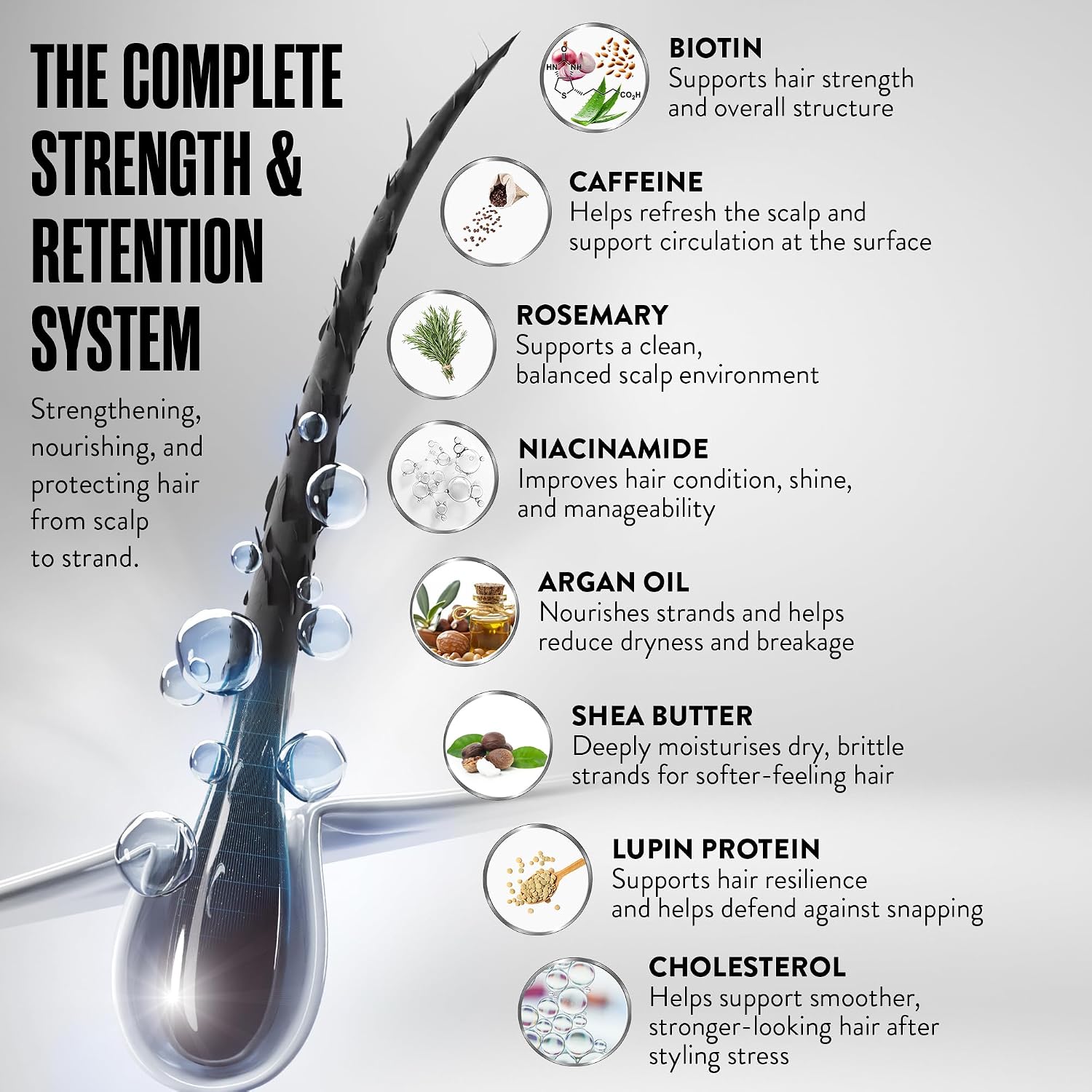
A sulfate-free 250ml shampoo with biotin, caffeine, rosemary and niacinamide, £14.95 in September 2026. Massage it into the roots for a gentle clean while new wisps come through, to help hair look and feel fuller.
When is a trichologist in Dartford or your own GP the right next step?
Your own GP is the right next step when short hairs come with bald patches, a widening parting, a sore or scaly scalp or heavy shedding, and a trichologist in Dartford is worth considering when breakage keeps happening after a few months of gentler handling and you want the hair shaft looked at closely.
The NHS advises seeing a GP to get an idea of what is causing hair loss before thinking about a commercial hair clinic, and lists illness, stress, weight loss and iron deficiency among the causes of temporary hair loss. The GP can often tell a lot simply by looking at your hair, and can arrange blood tests if something needs checking.
Speak to your own GP first if
You have smooth, round bald patches; your hairline or parting is receding where hair is tied back; the scalp is sore, red, scaly or weeping; you are losing handfuls of whole hairs, or shedding has lasted more than six months; or the short hairs arrive alongside tiredness, weight change or other changes in your health.
A trichologist is a private hair and scalp practitioner. Most are not medical doctors and cannot give you medicines, but a good one will look at the tips and shafts of your short hairs under magnification, go through how you wash, dry and style, and send you back to your GP if something needs medical attention.
How do you find a qualified trichologist in Dartford?
Finding a qualified trichologist in Dartford starts with the Institute of Trichologists register, which the Institute says is accredited under the Accredited Registers scheme run by the Professional Standards Authority, so search it by area and confirm a practitioner's membership before you pay for a visit.
The Institute says its members train through a two and a half year Level 5 distance learning course. Dartford sits in north-west Kent on the edge of Greater London, so if nobody on the register lists the town itself, widen the search to nearby Kent towns and south-east London. When you call, ask three questions:
- Will you look at the tips and shafts of these short hairs under magnification and go through my styling routine?
- If this looks like shedding with a medical cause or traction alopecia, will you tell me to speak to my GP?
- Are you recommending products you sell, and can I keep using my own?
Watermans sells hair care and runs no clinics, so weigh our view accordingly. Grow Me shampoo is vegan, our range is made in the UK, and we have sold over 6.5 million bottles since 2012. Our products are cosmetic: they help hair look and feel healthier and reduce breakage, but they cannot change how a follicle behaves.
What are the most frequently asked questions about wispy hairs and new growth?
Should I see a trichologist in Dartford about short hairs at my parting?
Not straight away for most people. Check the tips first and photograph the patch weekly for a month. Tapered tips rising together as a band are new growth and need patience. Blunt or split ends point to breakage, so try a gentler routine for a few months. Speak to your own GP first about patches, a sore scalp or heavy shedding.
Are the fine hairs along my hairline new growth?
Often, yes. DermNet notes that a fine fringe of new hair is often visible along the forehead hairline a few months after a shedding episode. New hairs have a tapered tip and lengthen together. Hairs of mixed lengths with blunt ends in the same spot are more likely to be breakage from heat, brushing or tight styles.
How long do new hairs take to blend in?
Scalp hair grows about 1 cm a month on DermNet's figure, so wisps look less obvious within a few months but can take more than a year to match chin-length hair and around two years to reach shoulder length. Rates vary between people, and gentle handling helps you keep the length that grows.
Should I cut off short broken hairs?
Leave new growth alone, because cutting removes its tapered tip and makes it look blunter. Broken hairs will grow out, but a regular trim of the lengths removes split ends before they travel further up the shaft. Deal with the cause first, whether that is heat, elastics or rough brushing, or the stubs keep coming back.
Why do short hairs stick up after I wash my hair?
Mostly static and dryness. Shampoo leaves the hair surface negatively charged, so strands push away from each other and lift. A 2015 review in the International Journal of Trichology says conditioning agents reduce flyaway by lubricating the fibre and lowering static charge, so condition after every wash and smooth a little leave-in over the top layer.
Can a hair product make new hair grow faster?
No cosmetic product can honestly claim to change the rate at which follicles make hair. The BAD says shedding after a trigger usually settles on its own and that medication does not speed up the process. A gentle shampoo and a conditioning mask keep the scalp comfortable and the lengths smoother while new growth comes through.
Can tight ponytails cause short hairs at the hairline?
Yes, in two ways. Elastics can snap hair into short broken pieces, and constant pulling can cause traction alopecia, which the BAD links to tight ponytails at the front and sides of the scalp. Caught early it can get better once the tension stops, so loosen your styles and speak to your own GP if the hairline recedes.
Sources & references
- NHS, Hair loss
- British Association of Dermatologists, Telogen effluvium
- British Association of Dermatologists, Traction alopecia
- DermNet, Hair loss
- DermNet, Telogen effluvium
- DermNet, Trichoscopy
- American Academy of Dermatology, Hair shedding
- American Academy of Dermatology, Tips for healthy hair
- Loussouarn G. African hair growth parameters. Br J Dermatol, 2001
- Lee Y et al. Hair shaft damage from heat and drying time of hair dryer. Ann Dermatol, 2011
- Gavazzoni Dias MF. Hair cosmetics: an overview. Int J Trichology, 2015
- Haskin A, Kwatra SG, Aguh C. Breaking the cycle of hair breakage: pearls for the management of acquired trichorrhexis nodosa. Journal of Dermatological Treatment, 2017
- Hughes EC, Syed HA, Saleh D. Telogen Effluvium. StatPearls
- The Institute of Trichologists
- The Institute of Trichologists, Find a Trichologist
What is the bottom line on trichologist in Dartford?
Short, wispy hairs are usually new growth, breakage or flyaways, and the tip tells you which: tapered for new growth, blunt or split for breakage, full length and floaty for static. New hairs grow about 1 cm a month, so give them time, handle them gently and keep heat low. Save a trichologist in Dartford for breakage that persists after a few months of a gentler routine, and speak to your own GP first about patches, a receding hairline or heavy shedding.
Before a flat iron or hot brush goes anywhere near your hairline, a heat protection spray such as Protect Me adds a light conditioning layer and protects hair from heat up to 230°C, so the wisps you are growing are less likely to snap.
Watermans products are 100% cosmetic and do not treat medical hair loss. Individual results may vary.