Trichologist in Crawley: Haircuts, Colour and Styling for Thinning Hair in Women
A good haircut cannot change how many hairs grow from your scalp, but it can change how full they look.
If you are looking for a trichologist in Crawley because your hair is thinning, the salon chair is often the quickest place to look fuller: a blunt cut around collarbone length, a few long layers rather than many choppy ones, soft lowlights or fine highlights that narrow the contrast with your scalp, and root lift from a moving dryer held well back. Sudden, patchy or sore thinning goes to your own GP first, and a registered trichologist helps when you want to understand why your hair is changing.
Key takeaways
- Breakage, shedding and hair loss all look thin; a cut only disguises them. The NHS says 50 to 100 hairs a day is normal.
- A blunt jaw to collarbone length usually looks fullest. DermNet says hair grows about 1 cm a month, so long ends are old and sparse.
- Colour that narrows the hair to scalp contrast hides gaps; bleach is the harshest option.
- Hold a dryer about 15 cm away and keep it moving: a 2011 study measured 47°C at the hair there, against 95°C at 5 cm.
- Tight ponytails and buns are high-risk styles for traction alopecia. See your own GP about sudden or patchy loss.
Should you see a trichologist in Crawley before you change your haircut?
Seeing a trichologist in Crawley before a new haircut is worth it when you do not yet know whether your hair is breaking, shedding or thinning at the root, because a cut disguises all three but only the first responds to gentler styling, and sudden or patchy loss belongs with your own GP first.
Hair breakage is the fibre snapping along its length. Hair shedding is whole hairs, each with a pale bulb, falling at the end of their cycle. Hair loss means the follicles themselves are changing: in female pattern hair loss, the British Association of Dermatologists (BAD) explains that affected follicles make hairs that become progressively finer, shorter and lighter in colour.
The NHS says most people lose between 50 and 100 hairs a day without noticing. The BAD telogen effluvium leaflet puts the usual share of scalp hair in the shedding phase at around 15%, rising to 30% or more after physical or mental stress on the body, often about 3 months after the trigger. The NHS advises seeing a GP about the cause before a commercial hair clinic, and the same order suits a salon: medical questions first, haircut second.
| What you notice | Hair breakage | Hair shedding | Hair loss |
|---|---|---|---|
| What comes away | Short, snapped pieces | Full-length hairs with a pale bulb | Little on the pillow; finer hair on top |
| What a new cut can do | Remove damaged ends, densify the outline | Look fuller while shedding settles | Disguise the pattern, not change it |
| Speak to first | Your hairdresser | Your GP if heavy or lasting months | Your own GP, then a registered trichologist |
Which haircut length makes thin hair look fullest?
For most women with thinning hair, a cut that finishes somewhere between the jaw and the collarbone looks fullest, because shorter lengths weigh less, so the roots lift more easily, and the ends stay closer to the density of the roots instead of trailing into a thin, see-through hem.
Long hair looks thinner partly because of age. DermNet says a hair shaft grows about 1 cm per month, so the ends of hair that reaches the shoulder blades are several years old and have survived countless washes and blow-dries. Taking the length up to where most strands still reach puts the fullest part of your hair on show.
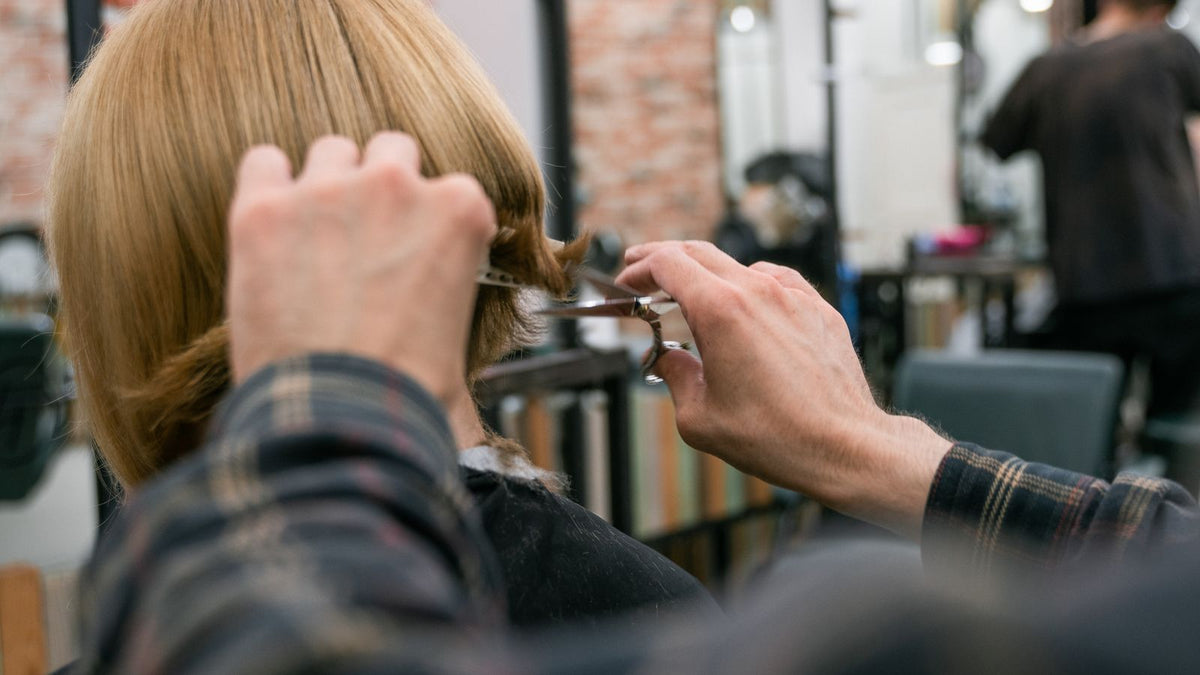
A blunt, one-length line or a softly graduated bob reads as thicker than a feathered edge. Ask for any point-cutting to be kept light, and avoid heavy thinning scissors, which take out bulk fine hair cannot spare.
| Length | Why it can help | Watch out for |
|---|---|---|
| Textured crop or pixie | Short hair stands away from the scalp | Leaves a widening parting on show |
| Chin-length bob | Blunt edge at its densest; easy root lift | Very fine hair can flick out |
| Collarbone length | Long enough to tie back and move the parting | Keep layers long so the outline stays solid |
| Below the shoulders | Fine while density holds all the way down | Weight flattens roots; ends look sparse |
Men face a different set of choices, covered in our guide to haircuts for men with thinning hair.

Should thin hair have layers, a fringe or a new parting?
Thin hair usually looks best with a few long layers rather than many short ones, a soft fringe if the front is still full, and a parting moved or zigzagged away from the usual line, because each change puts the densest hair where people look and hides the most worn path.
On fine hair every short layer is hair taken away from the outline, so ask for layers that start at or below the chin and stay around the front and crown, where they help lift.
The fringe question depends on where you are thinning. The BAD describes female pattern hair loss as diffuse thinning mainly over the top of the scalp, where the middle parting becomes more visible and wider, while the front hairline often remains normal. With that pattern, a side-swept or curtain fringe borrows hair from the fullest area. If the front is the thinner area, a heavy fringe can draw the eye instead, so ask your hairdresser to look closely first.
A parting that has sat in one place for years looks widest partly because that line has been flattened and exposed for so long. Moving it a finger's width to one side, or zigzagging it with the tail of a comb, lays fresh hair over the old path. If the parting is your main worry, our Brighton guide to a widening parting in women explains what it can mean.
Which hair colours make the scalp show less?
Colours that sit close to your scalp tone at the roots, broken up with soft lowlights or fine highlights through the top, make the scalp show less, because the eye reads thin hair as the contrast between strands and skin, and narrowing that contrast makes the same number of hairs look denser.
Very dark, solid colour on a pale scalp is the hardest combination to disguise, because each gap shows as a light line. Warm mid-tones and highlights woven finely around the parting blur those lines. On darker skin the principle can run the other way: a root shade close to the skin tone with slightly richer lengths. Blending grey with fine highlights also grows out more gently than solid cover.
The BAD notes that hairs from follicles affected by female pattern hair loss become lighter in colour as well as smaller in diameter, so a gentle all-over tone can help those paler, finer strands blend in rather than vanish against the scalp.

On days when colour is not enough, a concealer fills the gap: a 2017 review of hair camouflage by Saed and colleagues lists concealing powders and sprays among the options. Our Plymouth guide to covering thin areas with fibres, sprays and toppers goes through the choices.

A 23g shaker of coloured fibres made from wool-derived keratin, £19.95 in September 2026. The fibres cling to the hairs you already have to disguise a see-through parting or crown, and wash out with your next shampoo. Pick the shade closest to your roots.
Get a discount on the thinning hair range
Join the Watermans mailing list and we will email a discount code straight to your inbox, so you can try the thinning hair range for less. Vegan, made in the UK, over 6.5 million bottles sold since 2012.
Is bleach or permanent dye safe on thinning hair?
Permanent dye and bleach can both be used on thinning hair, but bleach is the harsher of the two, because peroxide lightening reaches the inner cortex and pulls protein out of the fibre, so fragile, fine strands are more likely to snap afterwards; semi-permanent glosses and fewer, finer highlights are the gentler route.
In a 2018 study in the International Journal of Cosmetic Science, Grosvenor and colleagues progressively bleached hair with alkaline peroxide and found that protein loss increased with bleaching severity, came from the cortex as well as the outer cuticle, and that melanin granules broke down even after the mildest bleach. Fine hair has less fibre to lose, and the BAD telogen effluvium leaflet advises people who are shedding to avoid bleaching and other harsh chemical processes, so a gloss or root touch-up is the safer choice for a few months.
Permanent dye brings a different concern: allergy. The NHS says many permanent and some semi-permanent hair dyes contain PPD (paraphenylenediamine), which can irritate skin or cause allergic reactions. It advises testing the dye at least 48 hours before use, following the packet instructions, wearing gloves, and choosing a non-permanent dye if a permanent one has caused a reaction before.
How do you add root lift to thin hair without damage?
Root lift on thin hair comes mostly from technique rather than heat: rough-dry the roots first against the direction they fall, keep the dryer about 15 cm away and moving, set the lift with a cool shot, and use a light mousse or spray at the roots instead of heavy creams through the lengths.
The 15 cm figure comes from a 2011 study in Annals of Dermatology by Lee and colleagues, who washed and dried hair samples 30 times under five conditions. A dryer held 15 cm away produced 47°C at the hair, against 95°C at 5 cm, and surface damage rose with temperature. The authors concluded that drying at 15 cm with continuous motion caused less damage than drying naturally.
- Start with clean roots. Oil and leftover product weigh fine hair down.
- Dry the roots first. Flip the hair against its fall and dry the root area with your fingers.
- Lift with a round brush. Raise each section straight up and aim the nozzle along the hair, not onto the scalp.
- Finish cool. A cool shot sets the shape; a couple of self-grip rollers on the crown add lift with no extra heat.


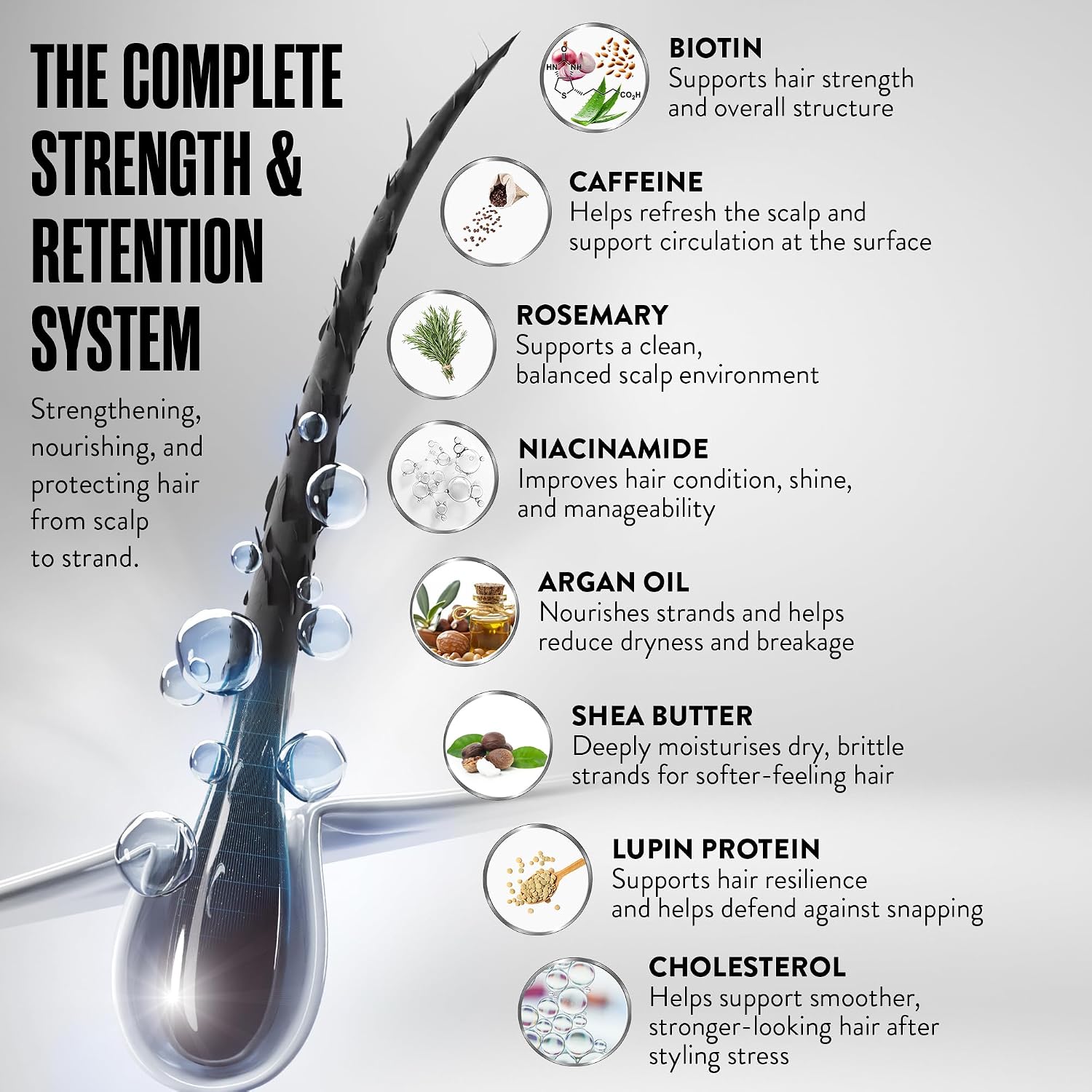
A sulfate-free shampoo with caffeine, biotin, rosemary, niacinamide, lupine protein and argan oil, £14.95 in September 2026. Massage it into the scalp and leave it for 3 to 4 minutes for a clean, light base that helps hair look fuller and reduces breakage.
How much heat can thin, coloured hair take?
Thin, coloured hair copes best with the lowest straightener or tong setting that still holds the style, one slow pass per section on completely dry hair, and a heat protection spray applied first, because damage builds with temperature and repetition, and fine strands have less fibre to absorb it. Our Hemel Hempstead guide to using heat protection sprays properly explains how to section, apply and dry a protectant before the iron goes on.
In the same Lee study, drying at 95°C, and air drying too, appeared to lighten hair colour after just 10 rounds, which matters when you pay for a tone you want to keep. The BAD telogen effluvium leaflet also advises limiting hairdryers, straighteners and curlers while hair is shedding.
- Never iron damp hair. Wet hair is weaker under hot plates.
- Straighten only what shows. The parting, front and ends are often enough.
- Choose shape over sleekness. Loose waves hide gaps better than poker-straight hair lying flat on the scalp.
- Plan days off. A loose plait or claw clip gives hair a break between blow-dries.

Protect Me® Heat Protection Spray
A leave-in spray that helps guard strands against heat up to 230°C, with niacinamide, panthenol, caffeine and rosemary extract, £13.95 in September 2026. Mist it through towel-dried lengths before the dryer or straighteners to reduce breakage and help coloured hair keep its shine.
Which everyday styles put strain on thin hair?
Tight ponytails, high buns, heavy clip-in extensions, and elastics or clips worn in the same spot every day put the most strain on thin hair, because constant pulling at the root can lead to traction alopecia, a form of hair loss that can become permanent if the tension carries on for years.
DermNet notes that traction alopecia was first described in 1907, in people from Greenland who had lost hair along the hairline after years of tight ponytails, and lists tight chignons, braids, extensions, rollers and even the weight of very long hair among its causes. A 2018 review by Billero and Miteva adds that tight buns or ponytails, extensions and tight braids are believed to be the highest-risk styles, and that later stages may become irreversible scarring if the styling continues. Wedding and party updos raise the same issue on a bigger scale, and our Dewsbury guide to wedding hair when your hair is fine or thinning sets out low-tension styles and a gentle take-down.
- Tie low and loose. A low ponytail at the nape pulls far less than one on the crown.
- Swap the fastening. Spiral coil ties, scrunchies and claw clips spread the grip.
- Move it around. Change where the ponytail or clip sits each day.
- Watch the hairline. Soreness, small bumps or short broken hairs mean the style is too tight.
What should you tell your hairdresser about thinning hair?
Tell your hairdresser where the hair feels thinnest, how long you have noticed it, what you have already heard from your GP or a trichologist in Crawley, how much time you spend styling each morning, and what you cannot give up, so the cut, colour and aftercare suit your hair rather than a photograph.
You will not be the first client to raise it. DermNet reports that around 40% of women show signs of hair loss by the age of 50, so a hairdresser who takes the conversation seriously is worth keeping. Bring photos of your hair from a year or two ago, ask to see their cuts on fine hair, mention any past colour reaction before anything is mixed, and ask them to show you the blow-dry so you can repeat it at home.
For the wider view of what can and cannot make hair thicker, from diet to daily care, our guide on how to get thicker hair is the most complete on the site.
How does a trichologist in Crawley fit into your hair plan?
A trichologist in Crawley fits in between your hairdresser and your GP: a registered trichologist can look at your scalp and hair under magnification, talk through your history and routine, and suggest cosmetic and styling changes, while anything that looks medical is sent back to your GP for tests.
Check registration before you pay. The Institute of Trichologists says its register is the only UK trichology register accredited by the Professional Standards Authority, and that its registered trichologists must follow a Code of Professional Practice and Ethics. The Trichological Society is the other main UK body. Search both directories for members near Crawley and the rest of West Sussex before your first visit.
| Who | When | What they can do |
|---|---|---|
| Hairdresser or colourist | Any time you want hair to look fuller | Cut, colour and styling that disguise thin areas |
| Your GP | Sudden, patchy or heavy loss, or a sore, scaly scalp | Look for a cause, arrange blood tests, refer on |
| Registered trichologist | Gradual thinning, breakage or shedding you want explained | Magnified look at scalp and hair, advice to share with your hairdresser |
We make hair care and run no clinics, so we cannot look at your hair, and you should weigh our view accordingly. Our products are made in the UK, with over 6.5 million bottles sold since 2012. They are cosmetic: they help hair look fuller and reduce breakage, but they are not a remedy for a medical cause of thinning.
What are the most frequently asked questions about haircuts and colour for thinning hair?
Can a trichologist in Crawley recommend a haircut for thinning hair?
A registered trichologist can suggest the length, layering and styling that put less strain on your hair, and explain it so you can share it with your hairdresser. The cut itself is the hairdresser's job. Check the trichologist is on the Institute of Trichologists or Trichological Society register first.
What hair colour makes thin hair look thicker?
A colour that narrows the contrast between hair and scalp. Soft lowlights or fine highlights around the parting and a root shade close to your skin tone make gaps less obvious than a very dark, solid colour on a pale scalp.
Is it safe to bleach thinning hair?
Bleach is the harshest colour option. A 2018 study found protein loss rose with bleaching severity and reached the inner cortex. Fine highlights or a semi-permanent gloss are gentler, and the BAD advises avoiding bleaching while hair is shedding.
Can tight ponytails cause hair loss?
Yes. Constant pulling can lead to traction alopecia, and a 2018 review lists tight buns or ponytails, extensions and tight braids among the highest-risk styles. Tie hair low and loose and change where it sits each day.
When should I see my GP instead of changing my hairstyle?
Speak to your own GP if hair comes out suddenly, in patches or in handfuls, if your scalp is sore, red or scaly, or if you are simply worried. The NHS advises seeing a GP about the cause before going to a commercial hair clinic.
Sources & references
- NHS, Hair loss
- NHS, Hair dye reactions
- British Association of Dermatologists (skinhealthinfo.org.uk), Female pattern hair loss
- British Association of Dermatologists, Telogen effluvium
- DermNet, Female pattern hair loss
- DermNet, Hair loss
- DermNet, Traction alopecia
- Lee Y et al. Hair shaft damage from heat and drying time of hair dryer. Ann Dermatol, 2011
- Grosvenor AJ et al. The physical and chemical disruption of human hair after bleaching: studies by transmission electron microscopy and redox proteomics. Int J Cosmet Sci, 2018
- Billero V, Miteva M. Traction alopecia: the root of the problem. Clin Cosmet Investig Dermatol, 2018
- Saed S, Ibrahim O, Bergfeld WF. Hair camouflage: a comprehensive review. Int J Womens Dermatol, 2017
- The Institute of Trichologists, About us
- The Institute of Trichologists, Find a Trichologist
- The Trichological Society
What is the bottom line on trichologist in Crawley?
Thin hair looks fullest with a blunt cut between the jaw and the collarbone, a few long layers, a parting moved off its old line and colour that narrows the contrast with your scalp. Keep the dryer 15 cm away and moving, and go easy on bleach, heat and tight ties. Speak to your own GP about sudden, patchy or sore thinning, and use a registered trichologist in Crawley to understand why your hair is changing, then take that advice to your hairdresser.
Before your next blow-dry or straightening session, a heat protection spray such as Protect Me gives fine, coloured hair a light layer of cover against styling heat.
Watermans products are 100% cosmetic and do not treat medical hair loss. Individual results may vary.