Trichologist in Hemel Hempstead: Do Heat Protection Sprays Work?
Straighteners every morning and a spray you hope is working? Here is what heat protectants can and cannot do for your hair.
If you are looking for a trichologist in Hemel Hempstead because your hair feels dry, frizzy or snaps when you style it, heat is a likely suspect. Heat protection sprays do reduce heat damage in lab tests on hair fibres, mainly by coating the surface, but they cannot make a hot tool harmless. Low settings, completely dry hair before a straightener and fewer passes matter just as much. Sudden shedding or bald patches are a different problem and need your own GP first.
Key takeaways
- In a 2011 University of Manchester study, repeated use of heat protection sprays reduced chemical damage to hair from straightening irons, whether the spray was water based or alcohol based.
- The same study found that hot irons on wet hair caused considerably more structural damage than on dry hair, so let hair dry completely before a straightener touches it.
- Keratin in untreated hair denatured at 237°C in a 2019 lab study, and every volunteer's hair in a 1994 experiment formed gas bubbles once it was heated enough.
- The American Academy of Dermatology advises low or medium heat, a heat protecting product, and hot tools about once a week or less.
- Short snapped pieces point to breakage, while full-length hairs released from the root point to shedding. A trichologist in Hemel Hempstead or your GP can help when you cannot tell which.
What does heat actually do to the hair fibre?
Heat from straighteners, curling irons and hair dryers damages the hair fibre from the outside in, first roughening and lifting the protective cuticle scales, then driving water out of the strand, and at the highest temperatures breaking down the keratin protein that gives each hair its strength and stretch.
A hair is a dead fibre, so you feel none of this at the time, and a damaged section stays damaged until it grows out or is cut off. The outside of each strand is the cuticle, a few layers of overlapping scales. Underneath sits the cortex, a bundle of keratin that carries most of the strength. When the cuticle is intact, the hair looks shiny and feels smooth. When heat lifts and chips those scales, light scatters, the hair feels rough, and the cortex is more exposed to the next round of styling.
Researchers at the University of São Paulo measured what happens as a flat iron heats untreated hair. In their 2019 study, water left the fibres between 25°C and 170°C, gases such as carbon dioxide and hydrogen sulphide appeared from 200°C as the protein began to break down, and the keratin denatured at 237°C. Electron microscope images showed heat damage to the cuticle, and the Asian hair samples lost more protein than the Caucasian ones.
You do not need straightener temperatures to leave a mark. When Korean dermatologists washed and dried hair tresses 30 times, the hair surface became more damaged as the air temperature rose, although the inner cortex was never damaged in any group.
| Heat source | Temperature measured | What the researchers saw | Source |
|---|---|---|---|
| Air drying at room temperature | 20°C | The only group with damage to the cell membrane complex, the layer that glues cuticle cells together | Lee and colleagues, 2011 |
| Hair dryer 15 cm away, kept moving | 47°C | The least surface damage of the heated groups | Lee and colleagues, 2011 |
| Hair dryer 5 cm away | 95°C | The most surface damage; colour lightened after just 10 drying sessions | Lee and colleagues, 2011 |
| Flat iron on untreated hair | 25°C to 170°C | Water driven out of the fibre | Lima and colleagues, 2019 |
| Flat iron on untreated hair | From 200°C | Gases released as the protein starts to break down | Lima and colleagues, 2019 |
| Flat iron on untreated hair | 237°C | Keratin denatures, losing its natural structure | Lima and colleagues, 2019 |

Why is heating wet hair more damaging than heating dry hair?
Heating wet hair is more damaging than heating dry hair because water held inside the fibre turns to steam faster than it can escape, which can blow gas-filled cavities through the cortex, a defect dermatologists call bubble hair, and it weakens the strand far more than the same heat applied to dry hair.
A University of Manchester team tested this directly in 2011. They straightened hair after applying either a water-based or an alcohol-based heat protection spray. With repeated use, both sprays reduced chemical damage to the hair protein, and neither beat the other on that measure. The water-based spray, and plain water, left considerably more structural damage, which showed up in tensile tests as a measurable loss of stiffness in the fibre. The researchers named rapid evaporation of water from the hair as the likely cause.
Bubble hair shows what that looks like at its worst. In 1994, US dermatologists reporting only the fourth known case traced one woman's brittle hair to an overheating hair dryer. They then heated normal hair from 16 volunteers: every person's hair formed bubbles once it was heated enough, and the cavities held gas. A 2023 review of 11 published case reports found most cases were in middle-aged women who had used a heated tool to dry or style wet hair, and the answer in each was simply to stop using that tool. In a 2017 case from Atlanta, a 61-year-old woman with breakage over her crown turned out to have been blow-drying damp hair.
The sizzle check
If your straightener hisses, steams or leaves a faint burnt smell as it passes, the hair underneath is not dry. Stop, finish drying that section on a medium setting, and only then go back in with the iron.
How do heat protection sprays actually protect hair?
Heat protection sprays protect hair mainly by leaving a thin film on the surface of each strand, which spreads the heat from a styling tool more evenly, cuts friction as plates and brushes glide over the cuticle, and holds conditioning ingredients against the fibre so it loses less moisture and protein during styling.
Most formulas combine several families of ingredients, and the label usually tells you which ones are doing the work:
- Film formers and polymers. Ingredients such as polyquaterniums and similar polymers set as a light coating as the spray dries, so the hot plate meets the coating before it meets the cuticle.
- Silicones. Dimethicone and its relatives add slip and shine, help the tool glide instead of drag, and spread heat across the surface.
- Humectants. Glycerin and panthenol attract and hold water, which helps hair feel less dry once styling is over.
- Conditioning agents and oils. Ingredients such as niacinamide and plant oils soften the feel of the hair and add gloss.
- Proteins. Hydrolysed proteins are small enough to sit on the surface and help rough, chipped areas of cuticle look and feel smoother.
The evidence that coatings help comes from lab work. In the Manchester study, repeated applications of heat protection spray reduced damage to tryptophan, an amino acid in hair protein used as a marker of chemical damage. In 2026, chemists at Jiangnan University in China built an experimental silicon-modified keratin designed to form a film when heated. On heat-damaged hair it restored water repellency, improved gloss by 30.26% and reduced frizz by 39.33% in their tests, and under heat the coated fibres were 6.58% stronger in tensile testing.


Protect Me® Heat Protection Spray
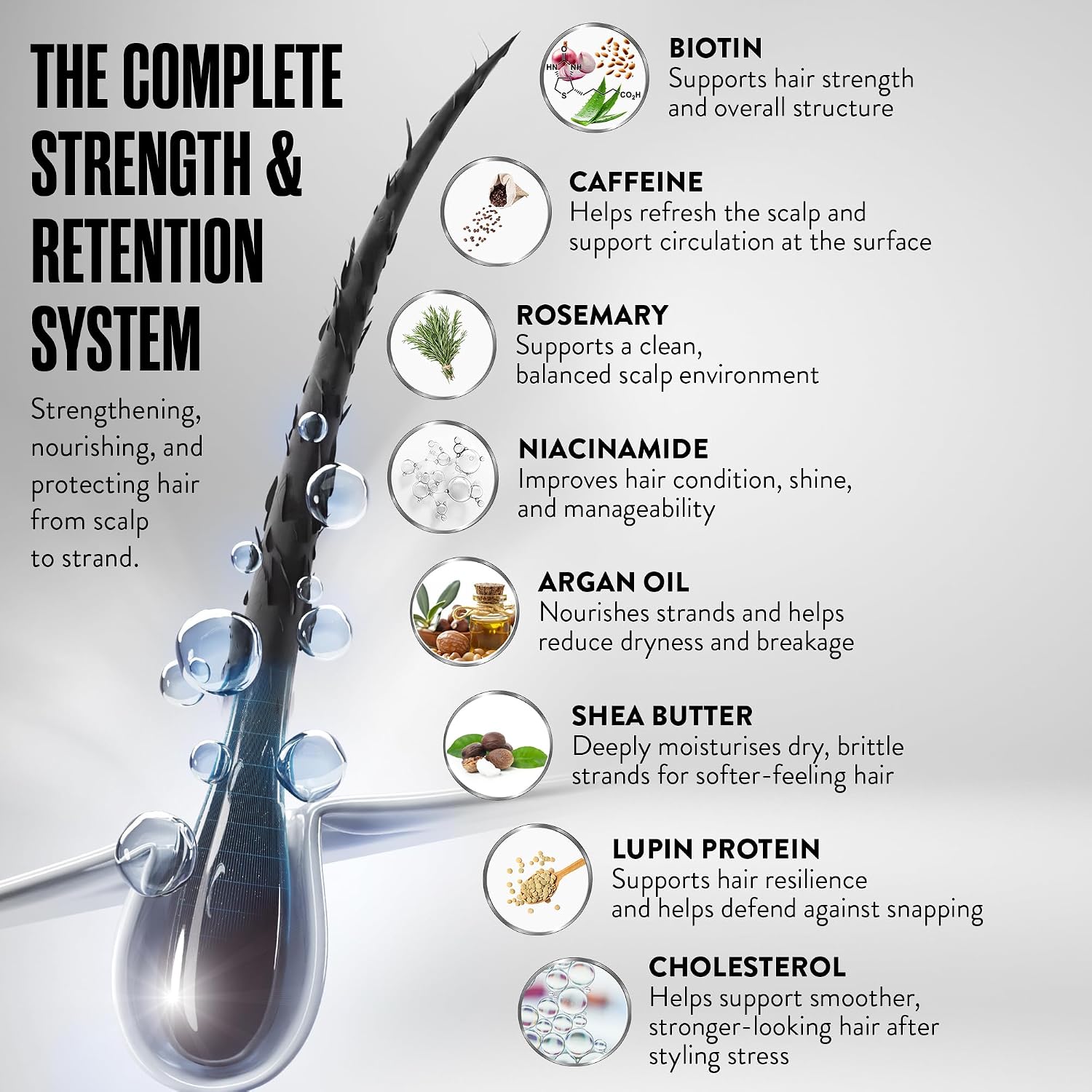
A £13.95 leave-in spray with niacinamide, panthenol (provitamin B5), caffeine, rosemary extract and sunflower oil, made to help protect hair from styling heat up to 230°C and to reduce frizz and breakage. Mist it over towel-dried or dry mid-lengths and ends, comb it through and leave it in.
What can lab studies on hair fibres tell you, and what can they not?
Lab studies on hair fibres can show whether a protectant reduces measurable damage, such as lost protein, a rougher cuticle or weaker tensile strength, under controlled heat, but they cannot tell you how your own hair will behave after months of daily styling at home with your own tools, settings and habits.
Most of the research in this article used tresses of donated hair, clamped and heated a fixed number of times. The Korean hair-dryer study dried each tress 30 times. Researchers do this so the damage is large enough to measure and the only thing that changes is the product or the temperature. That makes the results clean, but it leaves real gaps:
- One formula is not every formula. A result for one experimental coating says little about the spray in your bathroom.
- A tress is not a head. Lab hair has no scalp oil, no daily brushing and no pillow friction.
- Nobody measured breakage over a year. We found no study that followed real people's heat breakage for months with and without a protectant.
- Fibre studies say nothing about growth. Heat acts on the strand you can see, not on the follicle under the skin.
Good sources also disagree. The American Academy of Dermatology suggests adding a heat protecting product to wet hair before styling, while the Manchester study found that water on the hair made straightening irons more damaging. The two fit together if you blow-dry first: apply to damp hair before the dryer, then make sure hair is completely dry before any iron. Air-drying is not a free pass either. The AAD says let hair air dry when possible, yet in the Korean study natural drying was the only method that damaged the cell membrane complex. Our Grimsby guide to blow-drying versus air-drying fine hair goes through that debate in detail.
How do you use a heat protectant properly?
Using a heat protectant properly means applying it evenly, section by section, to towel-blotted or dry hair, concentrating on the mid-lengths and ends, letting it dry fully before any hot tool touches the hair, and then styling at the lowest setting that works with as few passes as possible.
- Blot, do not rub. The AAD warns that rubbing hair dry with a towel can damage it and cause it to break. Wrap it in a towel to soak up the water instead.
- Match the product to the tool. For a blow-dry, apply to damp hair. For a straightener or curling iron, the hair must be completely dry, so dry it first and let any product dry before the iron goes near it.
- Section the hair. Clip hair into four or more sections so the underneath layers get product too, not just the top.
- Mist, do not soak. Hold the bottle far enough back that the spray spreads as a fine mist over each section. Fine hair needs less than thick hair, a point the AAD makes about leave-in products.
- Focus on mid-lengths and ends. The AAD calls the ends the oldest and most fragile part of the hair. Keep product light at the roots, because leave-in products on the scalp can build up and irritate it.
- Comb it through. A wide-tooth comb spreads the product evenly without dragging.
- Keep the dryer moving. In the Korean study, a dryer held 15 cm away and kept moving caused less damage than one held close.
- Use fewer passes. The AAD advises limiting the time a hot comb or curling iron touches your hair. Take thin sections and aim for one or two controlled passes instead of going over the same strip again and again.
- Reapply for every styling session. The Manchester results came from repeated applications, so a spray used on Monday does not cover a restyle on Wednesday.

The five-second dry test
Before the straightener comes out, take a section from the back and underneath, close to the scalp, and hold it between your fingers. If it feels cool or slightly damp, it is not ready. That hidden layer is where steam and bubble damage start.
Get a discount on the heat protection range
Join the Watermans mailing list and we will email a discount code straight to your inbox, so you can try the heat protection range for less. Vegan, made in the UK, over 6.5 million bottles sold since 2012.
What temperature should fine or thinning hair be styled at compared with thick hair?
Fine or thinning hair should be styled at the lowest temperature that still gives you the look you want, with fewer passes and heat on fewer days, while thicker, coarser hair may genuinely need a higher setting to hold its shape, which matches the approach the American Academy of Dermatology recommends. If you would rather skip hot tools altogether, our Wokingham guide to heatless curls on fine hair covers damp setting, loose rollers and pillow friction.
We found no NHS or British Association of Dermatologists guidance that sets a single safe number, and straightener dials vary between brands, so be wary of any temperature chart you see online. What the AAD does say is specific: use low or medium heat settings with a product to protect the hair, choose a straightening device with a dial so it is not too hot, use the lowest temperature that gives you the style you want, and accept that a higher temperature may be necessary for thicker, coarser hair. For hot combs and curling irons it suggests aiming for once a week, or even less often.
Colour matters as much as thickness. A 2026 study from the University of São Paulo found that hair which had been bleached and acid straightened changed more when heated than untreated hair, because it had already lost important surface components. Fine hair that is also bleached or highlighted is the most fragile combination of all. Styling fine hair for a wedding means heat at the trial and again on the day, which our Dewsbury guide to wedding hair for fine or thinning hair plans around.
| Hair type | Where to start | Extra care |
|---|---|---|
| Fine, thinning or bleached | The lowest setting on your tool, raised in small steps only if the style will not hold | One pass per section, a light mist of protectant, heat on as few days as you can manage |
| Medium, uncoloured | A low or medium setting, as the AAD advises | Dry hair fully first and keep the dryer moving |
| Thick, coarse or tightly curled | A higher setting may be needed, but only as high as the style requires | A protectant before styling, and the AAD suggests pressing or straightening only once a week |
If your hair is thinning and you want styles that give lift without extra heat, our Crawley guide to haircuts, colour and styling for thinning hair covers cuts, partings and root lift in depth.

Are heat protection sprays, creams or serums better?
Heat protection sprays, creams and serums can all coat the hair before styling, and we found no head-to-head study showing one format protects better, so the right choice depends mostly on your hair: sprays suit fine hair and even coverage, creams suit thick or curly hair, and serums suit dry ends.
| Format | Best for | Watch out for |
|---|---|---|
| Spray or mist | Fine, thinning or oily-rooted hair; quick, even coverage | Easy to miss the underneath layers; a water-based mist must dry before an iron |
| Cream or lotion | Thick, coarse, curly or very dry hair | Can weigh fine hair down; the AAD suggests rubbing a small amount between your palms first |
| Serum or oil | Dry, frizzy ends | Looks greasy near the roots; use the smallest amount that works |
| Leave-in conditioner labelled heat protectant | Long, coloured or regularly heat-styled hair | Check the label says heat protectant, as the AAD notes only some leave-ins do |
A dermatologist quoted by the AAD makes the point that some leave-in conditioners also protect against heat from tools like blow dryers, and that the words heat protectant on the container are what to look for. Whatever the format, the rules in the step list above still apply: even coverage, dry hair before an iron, and the lowest setting that works. Before any heat goes near it, read squeezing, blotting and combing wet hair safely.
What are the most common heat protectant mistakes and myths?
The most common heat protectant mistakes are straightening hair that is still damp, spraying only the top layer, choosing the highest setting because the bottle mentions a temperature, going over the same section again and again, and expecting a protectant to undo damage that has already happened to the lengths.
- Myth: the bottle says 230°C, so 230°C is fine. A rating tells you the heat a formula is designed to cope with, not the setting your hair needs. In the São Paulo study keratin denatured at 237°C, only a few degrees higher, and the AAD still says low or medium heat.
- Myth: more product means more protection. Extra product on fine hair weighs it down, and on the scalp it builds up. A light, even mist does more than a soaking.
- Mistake: spray on and straighten straight away. The Manchester study found water on the hair made irons more damaging, so give the product time to dry.
- Myth: a protectant fixes split ends. A protectant can make damaged ends look and feel smoother, but the fibre is dead and a split cannot knit back together. A trim is the only way to remove it.
- Myth: air-drying is always damage free. The Korean study found natural drying was the only method that damaged the cell membrane complex, even though it caused the least surface damage.
- Myth: heat protectant is only for straighteners. The AAD includes blow dryers in its heat advice, and the Korean study found surface damage from a dryer rose as the air got hotter.
Heat also stacks on top of chemical processing. If your hair has been relaxed or keratin smoothed, our Southend-on-Sea guide to relaxers, keratin smoothing and scalp burns explains how those processes change the fibre before a hot tool ever touches it.

A £24.95 deep conditioning mask with niacinamide, provitamin B5, rosemary and caffeine. Smooth it through heat-stressed mid-lengths and ends after washing to help them look glossier, feel softer and reduce breakage between trims.
Is it heat breakage, shedding or genuine hair loss?
Heat breakage, shedding and genuine hair loss can look alike in a hairbrush but have different causes: breakage is the fibre snapping somewhere along its length, shedding is whole hairs released from the root by the growth cycle, and hair loss means the follicles are producing fewer, finer hairs over time.
- Hair breakage. Short pieces of different lengths, often on the bathroom floor after straightening, with blunt or frayed ends and no root. Heat, colour and rough handling are the usual culprits, and the follicle is unaffected.
- Hair shedding. Full-length hairs coming out from the root. The British Association of Dermatologists says most people lose between 30 and 150 scalp hairs a day, and the NHS puts the normal range at 50 to 100. In telogen effluvium the share of resting hairs rises from about 15% to 30% or more, often around 3 months after a trigger such as illness, childbirth or major stress.
- Hair loss. The follicles change and produce finer, shorter hairs, as in female or male pattern hair loss, or hair stops growing in patches. The NHS notes that pattern hair loss usually runs in families.
The clues are where you find the hair and what it looks like. Snapped pieces concentrated where you use the iron most, such as around the face or the crown, point to breakage. Remember the 2017 case in which breakage over the crown came from blow-drying damp hair: heat breakage can easily be mistaken for thinning. Our Luton guide to heat and colour breakage that looks like hair loss goes deeper into telling them apart. If you still cannot decide, collect a few days of fallen hairs in a bag and take them to a trichologist in Hemel Hempstead or to your GP.

A £14.95 sulfate-free 250ml shampoo with biotin, caffeine, rosemary and niacinamide. A gentle cleanse for fine or thinning hair that you also heat style, to help it look and feel fuller before the protectant goes on.
When should you see a trichologist in Hemel Hempstead or your own GP?
Speak to your own GP first if hair is coming out from the root in handfuls, you notice bald patches, your scalp is burned, sore or scaly, or you feel unwell, and consider a trichologist in Hemel Hempstead when breakage or thinning carries on after you have changed your heat routine for a few months.
The NHS advises seeing a GP to get an idea of what is causing your hair loss before going to a commercial hair clinic. A GP can arrange blood tests and a referral to NHS dermatology where needed. Heat breakage on its own rarely needs either, because the fix is the routine above.
Trichologist is not a protected title in the UK, so check before you pay. The Institute of Trichologists runs a UK register called Find a Trichologist, whose registrants subscribe every year, have completed education programmes to qualify, and follow its code of professional practice and ethics. The Trichological Society is the other main UK professional body. If you want a trichologist in Hemel Hempstead for heat damage, take along:
- The names of your heat protectant, shampoo and any colour or smoothing products.
- Your tools and the settings you use, plus how many days a week you style with heat.
- Photos taken a few weeks apart and a small bag of the hairs you are finding.
Watermans does not run clinics or offer hair assessments. We make cosmetic hair care, so weigh our view accordingly.
Speak to your own GP first if
You have smooth bald patches; sudden, heavy shedding from the root; a scalp burn from a styling tool that blisters, weeps or is slow to settle; an itchy, scaly or painful scalp; or hair changes alongside tiredness, weight change or irregular periods.
What are the most frequently asked questions about heat protection sprays?
Do heat protection sprays actually work?
In lab tests they reduce heat damage. A 2011 University of Manchester study found repeated applications of heat protection spray reduced chemical damage to hair from straightening irons. They cannot make a hot tool harmless, so low settings, dry hair and fewer passes still matter.
Should I put heat protectant on wet or dry hair?
Put it on damp hair if you are about to blow-dry, and on dry hair before a straightener or curling iron. The same Manchester study found irons caused considerably more structural damage to wet hair, so the hair and the product should both be dry before an iron touches them.
How long should heat protectant dry before straightening?
Wait until the hair feels completely dry to the touch, including the underneath layers near the scalp. If the straightener hisses, steams or smells burnt as it passes, the hair is not dry yet, so finish drying that section first.
What temperature should I straighten fine or thinning hair at?
Use the lowest setting that gives you the style you want. The American Academy of Dermatology advises low or medium heat with a heat protecting product, and says only thicker, coarser hair may need a higher temperature. Bleached fine hair is the most fragile, so start at the bottom of the dial.
Can I use a heat protectant every day?
Yes, if you heat style every day, use it every time, because the lab benefit came from repeated applications. Keep it to a light mist on the mid-lengths and ends. The bigger win is cutting heat days: the AAD suggests hot combs and curling irons once a week or less.
Is my hair breaking or falling out?
Short snapped pieces with no root, found where you use the iron most, point to breakage. Full-length hairs coming out from the root point to shedding. The NHS says losing 50 to 100 hairs a day is normal, so see your GP if it is far more, sudden, or in patches.
Should I see a trichologist in Hemel Hempstead about heat damaged hair?
Try a gentler heat routine for a few months first, because heat breakage usually settles once the damaged lengths are trimmed. See your own GP first for bald patches, sudden shedding or a burned or sore scalp. Choose a trichologist from a recognised register, such as the Institute of Trichologists.
Sources & references
- Christian P, Winsey N, Whatmough M, Cornwell PA. The effects of water on heat-styling damage. J Cosmet Sci, 2011
- Lee Y et al. Hair shaft damage from heat and drying time of hair dryer. Ann Dermatol, 2011
- Lima CRRC et al. Heat-damaged evaluation of virgin hair. J Cosmet Dermatol, 2019
- Lima CRRC et al. Thermal induced changes in cuticle and cortex of bleached and acid-straightened hair. Biopolymers, 2026
- Li C et al. Organic silicon-modified keratin and hair heat damage. Molecules, 2026
- Detwiler SP et al. Bubble hair: case caused by an overheating hair dryer and reproducibility in normal hair with heat. J Am Acad Dermatol, 1994
- Li YM et al. A review of bubble hair deformity. Int J Dermatol, 2023
- Albers LN, Maley AM, MacKelfresh JB. Blowing bubbles: dermoscopy of bubble hair. Int J Trichology, 2017
- American Academy of Dermatology, Tips for healthy hair
- American Academy of Dermatology, Hair care habits that can damage your hair
- American Academy of Dermatology, Caring for Black hair
- American Academy of Dermatology, Leave-in conditioner tips
- American Academy of Dermatology, Everyday hair care habits
- NHS, Hair loss
- British Association of Dermatologists, Telogen effluvium
- The Institute of Trichologists, Find a Trichologist
- The Trichological Society
What is the bottom line on trichologist in Hemel Hempstead?
Heat protection sprays are worth using on every styling day: in lab tests on hair fibres they reduce chemical damage from straighteners and dryers by coating the strand, but they are one layer of protection, not a licence to style at maximum heat. Dry hair completely before an iron, style at the lowest setting that works, keep passes and heat days to a minimum, and trim what is already damaged. If hair is coming out from the root, in patches or suddenly, speak to your own GP first, and look for a registered trichologist in Hemel Hempstead if breakage or thinning continues after a few months of gentler styling.
To add that protective layer before every styling session, a heat protection spray such as Protect Me mists evenly through towel-dried or dry hair and helps protect it from styling heat up to 230°C, with niacinamide, panthenol and sunflower oil to reduce frizz and breakage.
Watermans products are 100% cosmetic and do not treat medical hair loss. Individual results may vary.