Trichologist Dewsbury: Wedding and Big-Event Hair When Your Hair Is Fine or Thinning
A wedding day asks more of fine hair than almost any other day: hours of pins, spray and photographs, then a late-night take-down.
If you have typed trichologist Dewsbury into a search bar because your hair is fine or thinning and a wedding, Eid, Diwali or milestone birthday is coming, the most useful step is a plan that starts three to six months out: soft, low-tension styles such as a loose low bun, a half-up style or a relaxed braid; two trial runs; fibres or a headpiece over a visible parting; moderate heat; and a slow take-down afterwards. Sudden patches or heavy shedding are worth raising with your own GP first.
Our hair building fibres
InstaHair Hair Building Fibres, £19.95. Cosmetic fibres that cling to the hair you already have, covering a visible parting or thin patch in seconds. They wash out.
Key takeaways
- Start three to six months ahead. The British Association of Dermatologists (BAD) says stress-related shedding often shows around 3 months after a trigger, and new growth may start around 3 months after tight styling stops.
- Choose soft, low-tension styles. The BAD links tight buns, tight ponytails, hair extensions, hair clips and tight head scarves with traction alopecia.
- Cover a visible parting on the day with a new parting line, hair building fibres, a root spray or a headpiece, and test every one of them at your trial.
- Keep heat moderate. In a 2011 study, a hair dryer held 15 cm away produced 47°C at the hair, against 95°C at 5 cm.
- Take the style down slowly, pin by pin, and wash hairspray out gently. Book a trichologist Dewsbury search for problems that last beyond the event, after your GP has looked at anything sudden or patchy.
How far ahead should you plan wedding hair when your hair is fine or thinning?
Planning wedding hair for fine or thinning hair works best when it starts three to six months before the day, because that leaves time to sort out shedding or breakage, book two trial runs, test fibres and accessories, and let any tight styling habit settle before the photographs, rather than cramming everything into the final week.
Two timescales from the British Association of Dermatologists explain why the long run-up matters. Its telogen effluvium leaflet says a burst of shedding can occur around 3 months after a trigger, so whatever happens to your hair in spring may only show in summer. Its traction alopecia leaflet says new growth may start around 3 months after tight hairstyles stop, as long as the follicles have not been permanently damaged. Neither process can be hurried in the last fortnight.
| When | What to do | Why it helps fine hair |
|---|---|---|
| 6 months or more | Work out whether you are seeing breakage, shedding or thinning; speak to your own GP about patches or heavy shedding; loosen everyday ponytails and buns | Gives the hair cycle time to settle before the day |
| 3 to 4 months | First trial run; bring photos of the outfit, headpiece, veil, hijab or dupatta; decide on colour and on whether you want any extensions at all | Shows how your hair holds a style and where the scalp shows |
| 4 to 6 weeks | Second trial with the real accessories; test fibres or root spray in flash photos; practise scarf or dupatta pinning | No surprises on the morning |
| 1 to 2 weeks | Light trim of the ends; no new products, big colour changes or first-time chemical smoothing | Fresh ends look fuller and nothing new can irritate the scalp |
| The day | Soft style, heat protection first, fibres last; pack a small touch-up kit | Less pulling and less heat over a long day |
| The morning after | Pins out by hand, conditioner through the set, gentle wash | Avoids snapping strands stiff with spray |
Ask your stylist at the first trial whether they would rather work on freshly washed hair or second-day hair, since fine hair can be too slippery to hold pins straight after a wash. Their answer sets your wash schedule for the week of the event.
Is it hair loss, shedding or breakage before a big event?
Hair loss, shedding and breakage before a big event need telling apart, because hair loss means follicles producing finer or fewer hairs, shedding means whole hairs leaving the growth cycle early and in larger numbers, and breakage means strands snapping along their length, and each one points to a different plan for the day.
- Hair shedding. Whole hairs fall out, each with a small pale bulb at the root. The NHS says we can lose between 50 and 100 hairs a day, often without noticing. The BAD explains that around 15% of scalp hairs are normally in the shedding phase, rising to 30% or more in telogen effluvium.
- Hair breakage. Short, uneven pieces with no bulb, often left on the brush or pillow. The fibre has snapped and the follicle is untouched, which points to heat, pins, elastics or rough detangling.
- Hair loss. The follicles themselves change: a wider parting, a thinner crown or a receding hairline. The NHS notes that some types, such as male and female pattern baldness, are permanent and usually run in the family, while others are temporary.
Each answer changes the plan. Breakage calls for gentler styling and a trim. Shedding usually settles on its own, so the job is disguise and patience. Thinning at the root is where fibres, a new parting and a clever style do the most work. If you cannot tell which one you are seeing, that uncertainty is the best reason to look up a trichologist Dewsbury residents can reach before the trial runs, or to start with your own GP.
Can wedding planning stress make your hair shed?
Wedding planning stress can make hair shed, because the British Association of Dermatologists lists stressful or major life events among the common triggers of telogen effluvium, a temporary increase in shedding, although not everyone under pressure will notice any change and a busy few months does not automatically mean your hair will thin.
The timing is what catches people out. The BAD says the extra shedding can occur around 3 months after a trigger, and DermNet describes hair fall peaking after several months and then gradually tapering back to normal over 6 to 9 months in most cases. So the stress of booking venues in January may show as extra hair in the shower around the time of the wedding itself, or on honeymoon.
NHS Every Mind Matters describes stress as the body's reaction to feeling threatened or under pressure, offers a personalised plan of self-care tips and says to see a GP about symptoms that worry you. Nobody can promise a calmer run-up will keep every hair in place, but it is worth doing for its own sake. Sudden handfuls of hair, patches or a sore scalp are a reason to speak to your own GP rather than wait for the wedding to pass. If a friend or relative is the one getting ready for the big day, our Shrewsbury guide to kind gifts for thinning hair suggests presents that feel like pampering rather than a hint.
Which wedding hairstyles add volume without pulling on fine hair?
Wedding hairstyles that add volume without pulling on fine hair are the soft, loosely pinned ones: a low bun at the nape, a half-up style, a loose side braid, a relaxed chignon or soft waves worn down, because they spread the weight across more hair and keep constant tension off the hairline and parting. For soft waves set the night before without hot tools, see our Wokingham guide to heatless curls on fine or thinning hair.
Where a style pulls matters as much as how hard. The BAD leaflet on traction alopecia links tight ponytails with hair loss at the front and side margins of the scalp, and tight buns with loss at the sides and back. A soft, low style anchored at the nape keeps most of that pull away from the hairline, which is usually where fine hair is most fragile.

| Style | Why it suits fine or thinning hair | Ask your stylist for |
|---|---|---|
| Soft low bun or chignon | Sits at the nape, away from the hairline; looser loops look fuller | A loose base, few pins, face-framing pieces left out |
| Half-up, half-down | Hides a thin crown under the pinned section; the lengths stay free | A small, light anchor rather than one tight elastic |
| Loose side or fishtail braid | Gently widened loops add visible width to thin lengths | Braid started below the ears, loops eased out by hand |
| Soft waves worn down | No pins at all, and movement disguises gaps | Larger barrel, lower heat, waves brushed out with fingers |
| Very tight high bun or sleek ponytail | Pulls hard on the hairline and shows every gap | A softer, lower version instead |
A review by Zoe Draelos of Duke University notes that careful styling, mild shampoos and body-building conditioners can make thinning scalp hair look fuller, while a lot of manipulation only adds to the problem. For the day, that translates into a texture spray or a little dry shampoo at the roots so pins grip without being jammed in tight, and a style that has been built once rather than taken down and redone three times.

Which big-event styling habits put fine or thinning hair at risk?
The big-event styling habits that put fine or thinning hair most at risk are very tight updos, heavy clip-ins or glued and bonded extensions, repeated backcombing, dozens of pins pulling on the same small patch, and hot tools used on their highest setting, because each one either tugs at the root or snaps the fibre.
A 2018 review by Billero and Miteva in Clinical, Cosmetic and Investigational Dermatology names tight buns or ponytails, weaves or hair extensions and tight braids as the hairstyles believed to carry the highest risk of traction alopecia, and says the risk rises with how hard and how long the hair is pulled. The BAD adds hair clips and tight head scarves to the list, and notes that the weight of very long hair can contribute.
- Very tight updos. If the style aches or feels tender, it is too tight. Ask for the pin causing it to be moved there and then.
- Heavy clip-ins or glued extensions. Extra weight hangs off a small number of your own hairs. A 2012 report in the Journal of the American Academy of Dermatology described weft extensions causing a distinctive horseshoe pattern of traction alopecia. If you want extra length, keep it to a few light pieces and remove them the same night.
- Repeated backcombing. Backcombing ties strands into knots that later have to be teased out, and every tangle is another chance to snap fine hair. Use it sparingly, only at the crown, and smooth the top layer over it.
- Lots of pins in one place. Many pins anchored into one small patch put the day's weight on very few hairs. Spread the anchors, or pin into a small padded base.
- Hot tools on high heat. A second pass over the same section on the highest setting is where fragile ends snap.
DermNet lists itching, redness, scaling and multiple short broken hairs among the signs of traction alopecia, and the BAD mentions soreness and increased flaking. A tender scalp the day after an updo is a signal to keep the next few styles loose. If you are weighing up extensions for the day, our Peterborough guide to thinning and breakage after hair extensions goes through the types and the warning signs in more depth.
Get a discount on the thinning hair range
Join the Watermans mailing list and we will email a discount code straight to your inbox, so you can try the thinning hair range for less. Made in the UK, over 6.5 million bottles sold since 2012.
How can you hide a visible parting or thin patch on the day?
You can hide a visible parting or thin patch on the day by moving the parting, adding hair building fibres or a tinted root spray to the gap, choosing a style that lays hair over the thinnest area, and placing a headpiece, flowers or a hair vine where the scalp shows most, all tested at a trial first.
Fibres are the most studied of these options. In a 2022 study in the International Journal of Trichology, 40 adults with hair loss, 20 women and 20 men, used a keratin hair fibre product for 90 days. 92.5% reported a high level of satisfaction with how well it matched their hair colour and covered the thin areas, and no serious adverse effects were reported. Fibres cling to the hairs you already have, so they work best where there is still some hair to hold them, such as a widening parting or a thin crown. For everyday volume rather than event volume, see our guide to volume products for fine hair.
- Move the parting. A parting that has sat in one place for years looks widest. Moving it a finger's width, or zigzagging it with the tail of a comb, lays fresh hair over the old line.
- Fibres, then spray. Shake fibres over the dry, styled area, pat gently and set with a light mist of hairspray. Keep a small pot in your bag for touch-ups before the evening photographs.
- Root spray or powder. A tinted spray blurs the contrast between scalp and hair on a very fine parting. Test it on a light-coloured collar at the trial.
- Headpieces and flowers. A comb, hair vine, tiara or flowers can sit exactly over a thin patch at the crown or temple. Ask for it to be anchored into the style rather than pinned tight against the scalp.
- Check the photos. Take a photo with flash from above and behind at the trial, since that is how the day will be recorded and where a parting shows most.


InstaHair® Hair Building Fibres
Natural keratin fibres made from wool-derived keratin that cling to existing hairs to disguise a visible parting or thin crown, in six shades, 23g, £19.95 in September 2026. Shake over the area, pat, set with hairspray and shampoo out afterwards. A cosmetic concealer for the day.
Colour and cut can make the scalp show less long before the day itself. For those choices, see our Crawley guide to haircuts, colour and styling for thinning hair in women.
How do you style a hijab or dupatta over fine hair without tension?
Styling a hijab or dupatta over fine hair without tension means keeping the hair underneath in a loose, low twist rather than a tight high bun, using a soft underscarf instead of a tight elasticated band, pinning into the fabric rather than into the hair, and changing where the weight sits between events.
The BAD says hair clips and tight head scarves have been associated with traction alopecia, and the 2018 Billero review notes that traction alopecia can also occur with religious and occupational hairstyling. The risk comes from tension held for long periods, not from covering the hair, so the fix is in how the layers underneath are set up.
- Under the scarf. A loose, low twist or plait at the nape gives the scarf shape without dragging the hairline back. Avoid the tight top-knot some styles use for height, or build height with a soft volumiser scrunchie worn loosely.
- The underscarf. Choose one that stays put without leaving a deep line on your forehead. A red mark that lasts after you take it off means it is too tight.
- Pins. Pin the hijab or dupatta to itself, to the underscarf or to the outfit at the shoulder, not into your hair. A heavy embroidered dupatta should be carried by the shoulders, with only a light pin at the head.
- Multi-day celebrations. Weddings with a mehndi, nikah and walima, or several days of Eid visits, mean many hours of covering on consecutive days. Change the position of the twist each day and give your scalp an evening off before the next event.
Our Stevenage guide to hair care under a hijab or headscarf covers everyday fabrics, underscarves and washing routines in more detail.
How much heat can fine hair take on the day?
Fine hair takes heat best on the lowest setting that still holds the curl or wave, with a heat protection spray on completely dry hair, one slow pass per section and a dryer kept moving at a distance, because surface damage builds with temperature and repeated passes on fragile strands.
A 2011 study in Annals of Dermatology by Lee and colleagues at Yonsei University washed and dried hair tresses 30 times under different conditions. A dryer held 15 cm away produced 47°C at the hair, 10 cm produced 61°C and 5 cm produced 95°C, and the hair surface tended to become more damaged as the temperature rose. The authors concluded that a dryer used at 15 cm with continuous motion caused less damage than letting hair dry naturally, so the answer is not to avoid the dryer but to hold it back and keep it moving.
Heat on a wedding counts more than once: a trial or two, the day itself and often a second-day look. Ask your stylist which temperature they plan to use, and whether a larger barrel could give the same wave in fewer passes. If you want coverage for the day itself, read how hair fibres, toppers and wigs compare.

Protect Me® Heat Protection Spray
A leave-in conditioning spray with niacinamide, panthenol, caffeine, rosemary and sunflower oil that helps guard hair against heat up to 230°C from straighteners, wands and dryers, £13.95 in September 2026. Mist through dry lengths before the trial and again on the day.
What should grooms and male guests with thinning hair do before the day?
Grooms and male guests with thinning hair get the best results by booking a trim one to two weeks before the day, choosing a matte paste or clay rather than a shiny gel, using fibres over a thin crown or temples, and skipping hard-hold products that clump fine strands into separate sections that show more scalp. Related reading: our guide to hair gel hold shine.
The NHS notes that male pattern baldness is one of the permanent types of hair loss and usually runs in the family, so for most men the goal for a wedding is a style that makes the most of the hair there is. The 2022 fibre study included 20 men alongside 20 women, and a thin crown is exactly the kind of area fibres were used on.
- The cut. A trim a week or two before lets the hair settle, and enough length on top lets it move over a thin area.
- The product. A small amount of matte clay or paste worked in with the fingertips adds texture. Wet-look gel and glossy pomade separate strands and reflect flash, which shows more scalp.
- The crown. Fibres on a dry, styled crown, set with a light hairspray, blur the area most visible from behind at the ceremony.
- Headwear. A turban, pagri or topi sits for hours, so the same rule applies as for a hijab: firm enough to stay put, never tight enough to leave a deep line.
How do you take down wedding hair and wash out hairspray without breakage?
Taking down wedding hair without breakage means removing every pin by hand before any brush goes near it, loosening the set with your fingers, softening hairspray with conditioner or a leave-in before detangling, and washing the scalp with a gentle shampoo, often twice, rather than dragging a brush through a lacquered style at midnight.
The Draelos review recommends gentle handling of fragile fibres as the best approach for thinning hair, and the take-down is the moment most people forget it. Hairs that would have shed during the day can stay trapped in a set style and come out together at the first wash, so a handful in the plughole the morning after is not a sign that the style has damaged you. Short, snapped pieces with no bulb are the ones to notice.

Take-down checklist
- Find and remove every pin and grip by feel before touching a brush. Count them in if your stylist tells you how many went in.
- Take out any clip-in pieces and the headpiece next.
- Loosen the set with your fingers, working from the ends up.
- Mist a leave-in or smooth conditioner through stiff sections and wait a few minutes for the spray to soften.
- Detangle with a wide-tooth comb from the ends, holding hair above each knot.
- Wash the scalp, rinse, and wash again if it still feels coated, then condition the lengths.
Build-up from several days of spray, fibres and dry shampoo can leave the scalp feeling tight or flaky. The American Academy of Dermatology suggests washing your hair based on how often it gets dirty or oily, and notes that flakes can come from not shampooing often enough. A second lather after a big event is simply matching the wash to what is on your scalp. If the scalp is red, sore or weeping after an event, stop using styling products and speak to a pharmacist or your own GP.

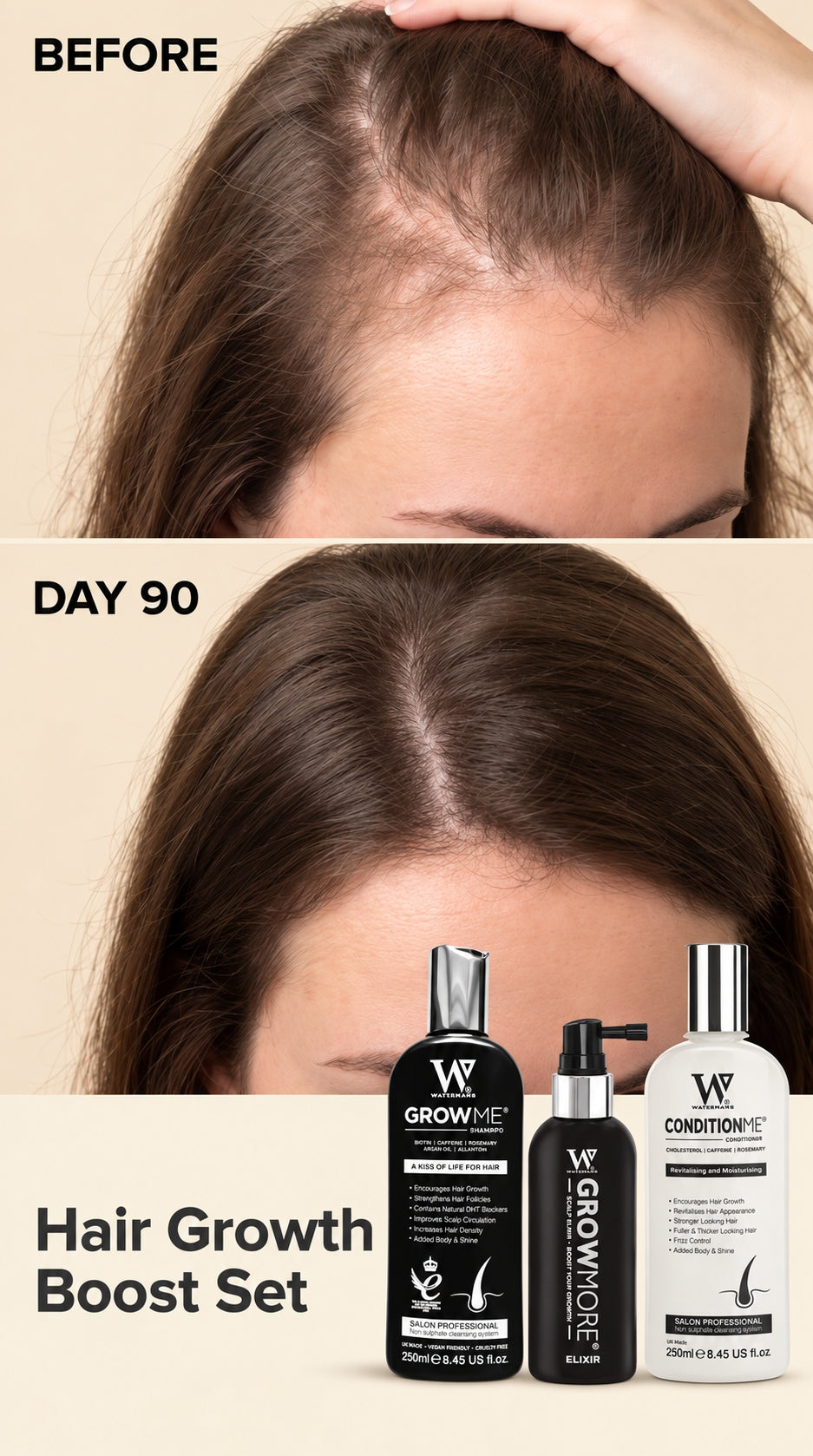
A sulfate-free shampoo with caffeine, biotin, rosemary, niacinamide and argan oil, 250ml, £14.95 in September 2026. Massage into the scalp and leave for 3 to 4 minutes before rinsing, in the months before the event and to lift spray and fibres afterwards, for fuller-looking hair and less breakage.
When is a trichologist Dewsbury search worth doing before a big event?
A trichologist Dewsbury search is worth doing before a big event when your own GP has already looked at patches or heavy shedding, when breakage or thinning has not settled after a few months of gentler styling, or when you want an expert look at your scalp and hair before committing to extensions or a heavy updo.
The NHS advises seeing a GP to get an idea of what is causing hair loss before thinking about going to a commercial hair clinic, and that order matters here. A trichologist is a hair and scalp specialist rather than a doctor, so the GP visit comes first for anything sudden, patchy or painful. The Institute of Trichologists runs a UK register you can search through its Find a Trichologist page, and says all its registrants have undergone education programmes to qualify as a trichologist. The Trichological Society is the other main UK professional body. If your question is about products or a routine rather than a medical one, you can talk to Gail Waterman, our co-founder, as an AI avatar on the Watermans homepage.
Whether the celebration is in Dewsbury, Batley, Mirfield or elsewhere in Kirklees, the checks are the same. If you have searched trichologist Dewsbury and found a name, confirm their registration on the professional body's own website, then take your trial photos and a list of the products you plan to use. Useful questions to ask:
- Is what I am seeing breakage, shedding or thinning at the root?
- Is my planned style, or the extensions my stylist suggested, likely to put too much tension on my hair?
- If this looks like something medical, will you send me back to my GP?
We sell hair care, so weigh our view accordingly. Watermans runs no clinics and cannot look at your hair. Our range is made in the UK, with over 6.5 million bottles sold since 2012, and it is cosmetic: it helps hair look and feel fuller and reduces breakage, but it cannot change what a follicle is doing.
What are the most frequently asked questions about wedding hair for fine or thinning hair?
Should I see a trichologist Dewsbury practitioner before my wedding?
Only if something has not settled. See your own GP first for patches, a sore scalp or handfuls of hair. A registered trichologist is most useful when breakage or thinning continues after a few months of gentler styling, or when you want an expert view before extensions or a heavy updo. Check registration with the Institute of Trichologists or the Trichological Society.
How far in advance should I have a hair trial if my hair is thin?
Book the first trial three to four months ahead and a second one four to six weeks before the day, with the real headpiece, veil, hijab or dupatta. Two trials show how your hair holds a style, where the scalp shows in flash photos and whether fibres or a root spray are needed.
Can stress before a wedding cause hair shedding?
It can. The British Association of Dermatologists lists stressful or major life events among the triggers of telogen effluvium, a temporary rise in shedding that often shows around 3 months after the trigger. Not everyone is affected, and DermNet says shedding usually tapers back to normal over 6 to 9 months in most cases.
Are clip-in extensions safe for fine hair on a wedding day?
A few light clip-in pieces worn for one day and removed that night put far less strain on fine hair than heavy wefts or glued and bonded extensions. The BAD links attached extensions and weaves with traction alopecia, so keep the weight low and take them out if your scalp feels sore.
Do hair fibres stay put through a long wedding day?
Fibres cling to the hairs you already have, and setting them with a light mist of hairspray helps them stay in place. Test them at your trial, including a photo with flash, and carry a small pot for a touch-up before the evening. They wash out with shampoo afterwards.
What is the gentlest wedding updo for thinning hair?
A soft, low bun or chignon at the nape, or a half-up style, is usually gentlest, because the anchor sits away from the hairline and the weight is spread across more hair. Avoid a very tight high bun or sleek ponytail, which the BAD links with hair loss at the hairline and sides.
Can I wear a hijab all day at my wedding if my hair is thinning?
Yes, with a loose, low twist underneath, a soft underscarf that does not leave a deep line, and pins placed into the fabric rather than your hair. The BAD associates tight head scarves with traction alopecia, so the aim is steady coverage without tension, and a change of position between events.
Sources & references
- NHS, Hair loss
- NHS Every Mind Matters, Stress
- British Association of Dermatologists, Traction alopecia
- British Association of Dermatologists, Telogen effluvium
- DermNet, Traction alopecia
- DermNet, Telogen effluvium
- American Academy of Dermatology, Tips for healthy hair
- Billero V, Miteva M. Traction alopecia: the root of the problem. Clin Cosmet Investig Dermatol, 2018
- Haskin A, Aguh C. All hairstyles are not created equal: black hairstyling practices and the risk of traction alopecia. J Am Acad Dermatol, 2016
- Ahdout J, Mirmirani P. Weft hair extensions causing a distinctive horseshoe pattern of traction alopecia. J Am Acad Dermatol, 2012
- Babadjouni A et al. Satisfaction and adverse effects following the use of topical hair fiber fillers. Int J Trichology, 2022
- Draelos ZD. Hair care and dyeing. Curr Probl Dermatol, 2015
- Lee Y et al. Hair shaft damage from heat and drying time of hair dryer. Ann Dermatol, 2011
- The Institute of Trichologists, Find a Trichologist
- The Trichological Society
What is the bottom line on trichologist Dewsbury?
Fine or thinning hair can look full and polished on a wedding day, Eid or milestone birthday when the plan starts three to six months ahead: two trial runs, a soft low-tension style, a new parting, fibres or a headpiece over the thinnest area, moderate heat and a slow, pin-by-pin take-down. Stress shedding is real but temporary and often lags by around 3 months. Save a trichologist Dewsbury search for problems that outlast a gentler routine, and speak to your own GP first about anything sudden, patchy or sore. For the everyday routine rather than the big day, see our simple solutions for thinning hair.
For the day itself, hair building fibres such as InstaHair® cling to the hairs you already have, so a widening parting or thin crown looks fuller in the photographs and shampoos out afterwards.
Watermans products are 100% cosmetic and do not treat medical hair loss. Individual results may vary.