Rosemary Oil and Thinning Hair: The Evidence Before a Trichologist in Poole
Rosemary oil is probably the most shared hair tip online, and the research behind it is far smaller than its reputation.
If you are weighing up rosemary oil before you see a trichologist in Poole, the honest answer is that the human evidence is thin: one six-month trial in 100 adults with pattern hair loss, one Scottish trial of a four-oil blend, and a few mouse and test-tube studies. That is not strong enough to support any claim that rosemary changes how hair grows. Diluted and patch tested, rosemary is a pleasant cosmetic ingredient, but it can irritate or sensitise skin, so persistent thinning belongs with your GP first. We look at lions mane hair loss separately, with the practical steps.
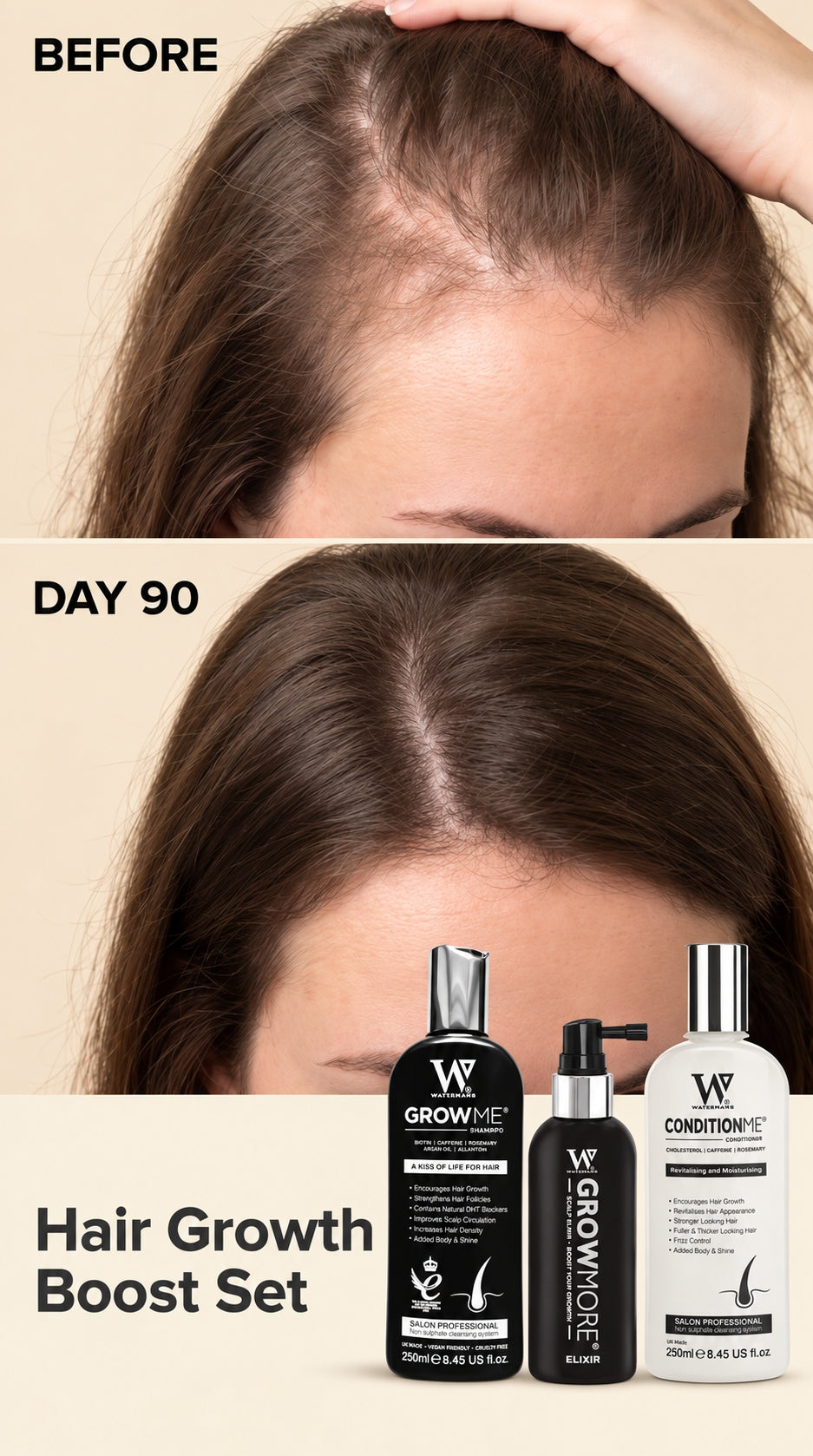
Our hair growth shampoo
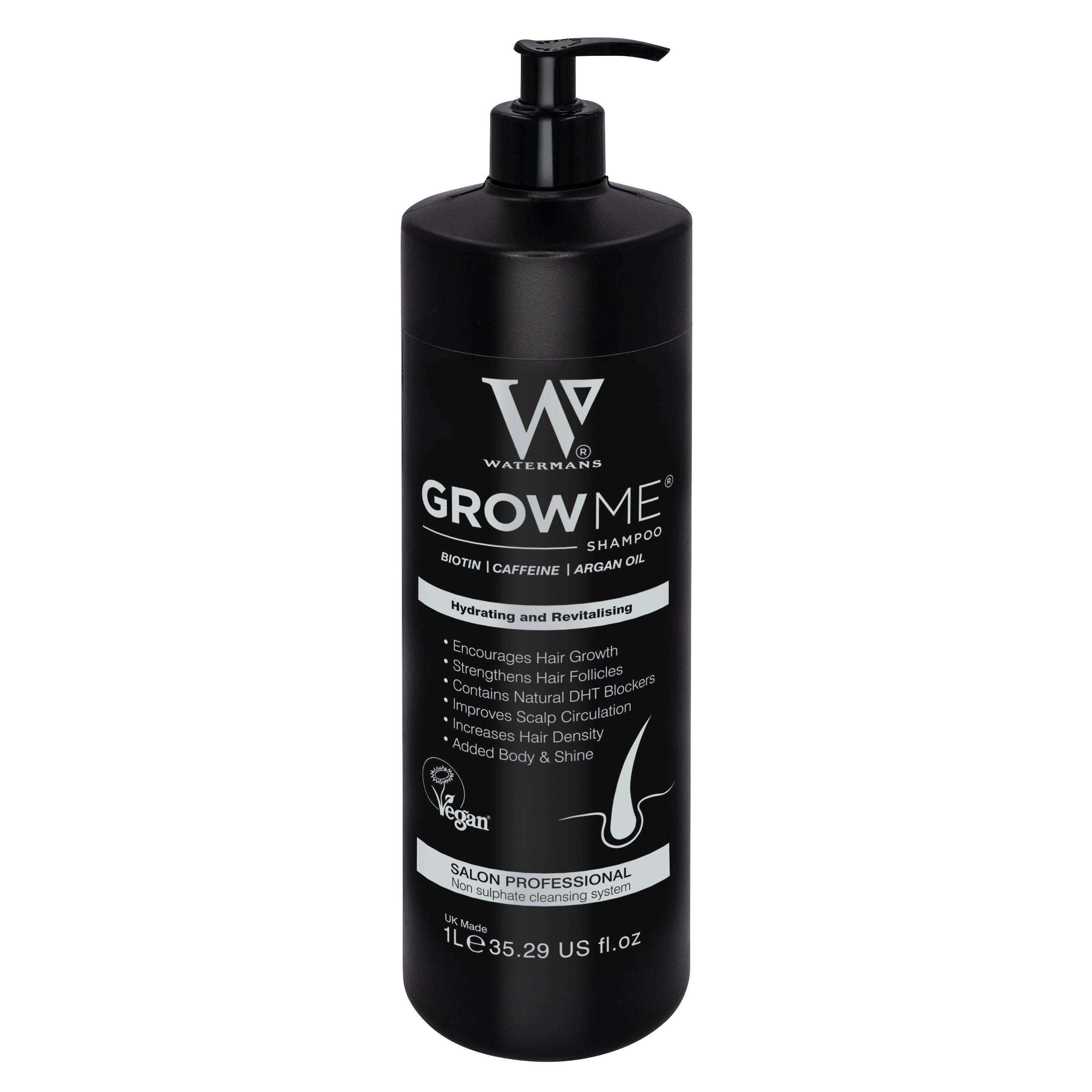
Grow Me® Hair Growth Shampoo, £14.95. A sulphate free daily shampoo that supports a healthy scalp environment and helps reduce breakage, so lengths hold on and look fuller.
Key takeaways
- Rosemary essential oil, rosemary leaf extract and rosemary in a shampoo are different things: the essential oil is concentrated and must be diluted, while a rinse-off shampoo spends only minutes on the scalp.
- The best-known human trial, published in Skinmed in 2015, followed 100 adults for six months with no placebo group, and found no significant change in hair counts in either group at three months.
- Much of the rest is laboratory work: a 2026 mouse pilot used 3 mice per group, and its own authors say the results cannot be applied directly to people.
- Rosemary can cause allergic contact dermatitis, and DermNet says allergic reactions usually appear 24 to 72 hours after contact, so a one-hour skin test is not enough.
- The NHS says losing 50 to 100 hairs a day is normal and advises seeing a GP about the cause of hair loss first; a trichologist in Poole fits after that.
What is the difference between rosemary essential oil, rosemary extract and rosemary shampoo?
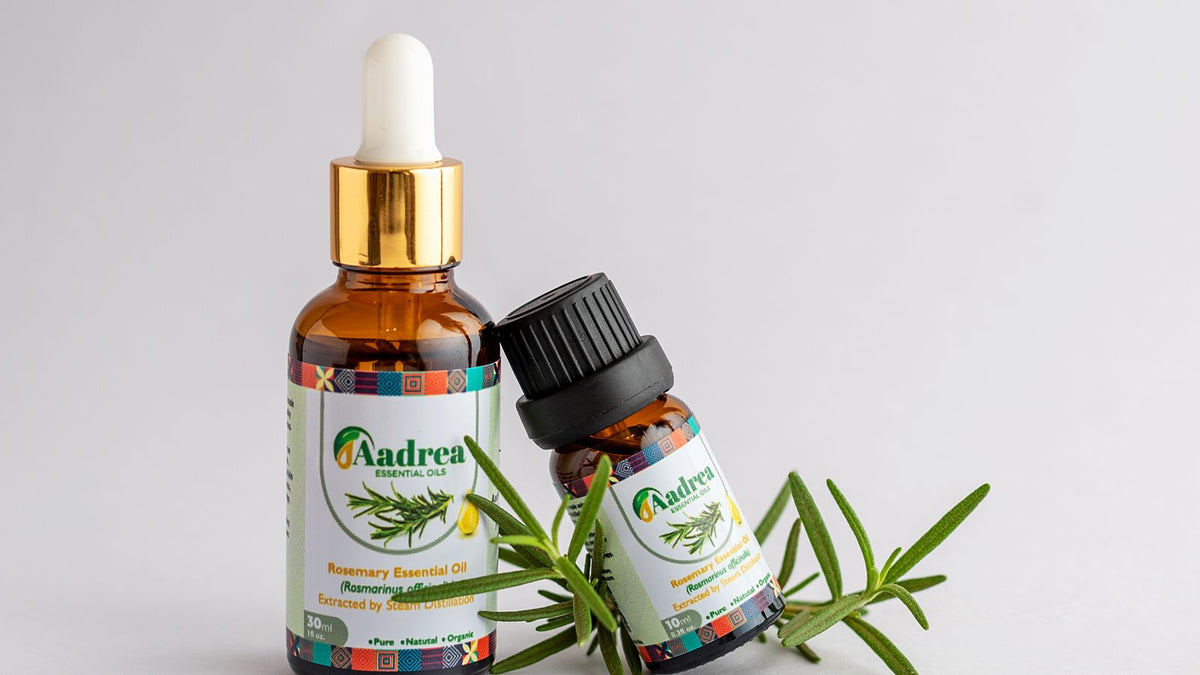
Rosemary essential oil, rosemary leaf extract and rosemary shampoo differ in strength and contact time: the essential oil is a concentrated distilled oil that must be diluted before it touches skin, a leaf extract is a solvent-made ingredient rich in plant antioxidants, and a shampoo holds a small amount of either for a few minutes.
Essential oil is made by distilling the leaves, and the 2026 Kenyan pilot study described later on this page obtained its rosemary oil by hydrodistillation. Leaf extracts are a different product again. A 2023 study in the International Journal of Cosmetic Science analysed 10 commercial rosemary extracts and identified 33 compounds between them. Their make-up varied widely with the solvent and extraction method each supplier used: rosmarinic acid dominated some extracts and carnosic acid dominated others. So the word "rosemary" on two labels can mean quite different chemistry.
A shampoo is a rinse-off product. The Grow Me product page, for example, asks you to leave the lather on the scalp for 3 to 4 minutes before rinsing, which is a very different exposure from an oil massaged in before a wash or a serum left on overnight.
| Form | What it is | Time on the scalp | Main watch-out |
|---|---|---|---|
| Essential oil | A concentrated oil distilled from the leaves | Usually massaged in, then washed out | Never use it neat; irritation and allergy are possible |
| Leaf extract | A solvent extract whose chemistry depends on the maker | In a leave-on serum, until the next wash | Two extracts can contain very different compounds |
| Rinse-off shampoo | A cleanser with rosemary among other ingredients | A few minutes | The least exposure of the three |
| Homemade rosemary water | Leaves steeped in hot water | Seconds to minutes as a final rinse | No set strength, and no trial we found |

For a longer look at rosemary oil on its own, including a six-month way to test it honestly, see our guide to what the evidence says about rosemary oil.
What did the best-known human trial of rosemary oil actually measure?
The best-known human trial of rosemary oil, published in Skinmed in 2015 by Panahi and colleagues, randomly assigned 100 adults with androgenetic alopecia (pattern hair loss) to rosemary oil or to another topical product for six months, and measured hair counts from standardised close-up photographs taken at the start, at three months and at six months.
The team also recorded dry hair, greasy hair, dandruff and scalp itching. Hair counts did not change significantly in either group at three months. The authors concluded that their results supported rosemary oil, and the trial was later included in a 2025 network meta-analysis of male pattern hair loss in the Journal of Cosmetic Dermatology, whose data table gives an average age of about 25 in the rosemary group. Before you read anything into it, weigh the limits:
- Small. Only 50 people used rosemary oil.
- Short. Six months is a brief window for a condition the British Association of Dermatologists (BAD) says tends to progress very slowly, over several years to decades.
- No placebo group. Rosemary was compared with another active product, not with an inactive oil, so the design cannot show how much of any change over six months came from rosemary itself.
- Side effects. Scalp itching was more frequent than at the start in both groups.
- One trial. A single small study is a reason to run better trials, not a body of evidence.
Why we make no claim from this trial
A claim on this page is ours to prove, and quoting a study does not prove it. One small, six-month comparison trial is not strong enough evidence to say that rosemary, or any product containing rosemary, changes how your hair grows, so we do not say it.
A second, older trial came from Aberdeen Royal Infirmary. In 1998 Hay and colleagues asked 86 people with alopecia areata, a different condition from pattern hair loss, to massage their scalp daily for seven months with thyme, rosemary, lavender and cedarwood essential oils in jojoba and grapeseed carrier oils, or with the carrier oils alone. On photographs, 19 of 43 people in the essential oil group were rated as improved, against 6 of 41 in the carrier oil group. The blend held four essential oils, so it cannot tell you what rosemary does alone, and patchy hair loss is a reason to speak to your own GP rather than to mix a home blend.
Reviewers do not all read this evidence the same way. A 2026 review in Dermatology Reports called rosemary leaf extract a promising candidate while asking for more research into its long-term efficacy and safety. The 2025 network meta-analysis was more cautious, noting that many over-the-counter options have not been studied as well as licensed medicines.
What did laboratory and animal studies of rosemary find?
Laboratory and animal studies of rosemary found effects in mice and in test tubes rather than in people: a 2013 Japanese study applied rosemary leaf extract to mice at 2 mg a day, and a 2026 Kenyan pilot tested rosemary oil and castor oil on 15 mice, 3 per group, for 28 days.
The 2013 study, by Murata and colleagues at Kinki University and published in Phytotherapy Research, applied the extract to mice whose hair growth had been interrupted with testosterone and to mice with shaved backs, and reported that the extract promoted hair growth in both. The team also ran enzyme and cell tests in the laboratory and identified a compound called 12-methoxycarnosic acid as one of the active constituents. None of that was measured on a human scalp.
The 2026 pilot, by Mathenge and colleagues at Kabarak University in BioMed Research International, compared rosemary oil, castor oil, a 1:1 mix of the two and untreated controls. Because each group held only 3 mice, the authors present their statistics descriptively and state plainly that findings from a mouse model cannot be directly extrapolated to human use. That caveat applies to the whole animal literature on rosemary.

The laboratory result closest to everyday hair care concerns the hair fibre rather than the follicle. In the 2023 International Journal of Cosmetic Science study, selected rosemary extracts were tested on hair exposed to UV in a weathering machine. Polyphenols such as rosmarinic acid and diterpenes such as carnosic acid were identified as the main compounds that helped protect hair protein from UV damage. That is a cosmetic, surface-level finding about the strands you already have, and a fair reason rosemary turns up in shampoos and serums.
Is rosemary oil safe to put on your scalp?
Rosemary oil is not risk-free on the scalp: a 2014 review by Miroddi and colleagues at the University of Messina found published cases of allergic contact dermatitis linked to both rosemary extracts and the raw plant, and named a compound called carnosol as a common cause of the reaction.
The review describes rosemary allergy as uncommon but probably more frequent than reported, because reactions can be missed, and it discusses cases of cross-reactivity between rosemary and thyme. A 2006 case report in Contact Dermatitis described a 53-year-old man in Spain who had several itchy, red, peeling rashes after applying rosemary alcohol to his chest; skin allergy tests were positive for 3 of the 4 plants from the same family that were tested.
The NHS explains that contact dermatitis makes skin itchy, blistered, dry and cracked, that a reaction usually occurs within a few hours or days of exposure, and that irritants are the most common cause, with allergic reactions less common. DermNet adds that an allergic reaction usually appears 24 to 72 hours after contact and usually settles over several days once the skin is no longer exposed. If you are weighing up other social media trends such as onion juice or the inversion method, our guide to viral hair hacks and when to see a trichologist in Folkestone checks each one against the evidence.
- Always dilute. Never put rosemary essential oil on skin neat. The Aberdeen trial mixed its essential oils into jojoba and grapeseed carrier oils.
- Keep it out of your eyes. Massage with fingertips well back from the hairline, and rinse with plenty of water if any runs down.
- Patch test first. The method is in the next section, and it takes days rather than minutes.
- Mind the herb family. If thyme, lavender or other herbs of the mint family have made your skin react before, skip rosemary oil.
- Stop at the first sign of trouble. The NHS advises seeing a GP if contact dermatitis symptoms are persistent, recurrent or severe.

How do you patch test rosemary oil before using it on your scalp?
Patch testing rosemary oil at home means repeating a small application on the same patch of skin for several days, because DermNet describes a repeat open application test in which a product goes on a 5 cm area of forearm skin twice a day for 5 to 10 days, with no redness or swelling suggesting allergy is unlikely.
- Mix it first. Test the diluted blend exactly as you plan to use it, in the same carrier oil.
- Choose one spot. Use an area of inner forearm about 5 cm across and mark it so you return to the same place.
- Repeat it. Apply a small amount twice a day for 5 to 10 days.
- Watch for delayed signs. Look for itching, redness, swelling or blistering, remembering that allergic reactions can take 24 to 72 hours to show.
- Stop if it reacts. Do not use the blend on your scalp, and speak to a pharmacist or your own GP if the rash does not settle.
A clear arm does not rule out a reaction on the scalp, so start with a small area of scalp too. If you keep reacting to products, your GP can refer you for formal patch testing, which DermNet says involves applying allergens to the skin for 48 hours and reading the result at 96 hours.
How do people use rosemary on their hair, and which method suits which goal?
People use rosemary on their hair in three main ways: a diluted essential oil massaged into the scalp before washing, a leave-on serum containing rosemary extract, or a rinse-off shampoo, and the 1998 Aberdeen trial used the first of those, with daily scalp massage of essential oils blended into jojoba and grapeseed oils.
- Pre-wash oil massage. Dilute, massage into a calm scalp with your fingertips, then shampoo it out properly the same day. Oil suits dry lengths better than a flaky scalp, and our Gillingham guide to whether hair oiling actually helps covers how much to use and when oil makes a scalp worse.
- Leave-on serum. A serum goes straight onto the scalp and stays there. Around 90% of Grow More customers apply it before bed and leave it in overnight, according to the product page.
- Rinse-off shampoo. The simplest option, with the shortest contact. The same contact-time question comes up with caffeine, which our Rochdale guide to caffeine shampoo evidence looks at in detail.

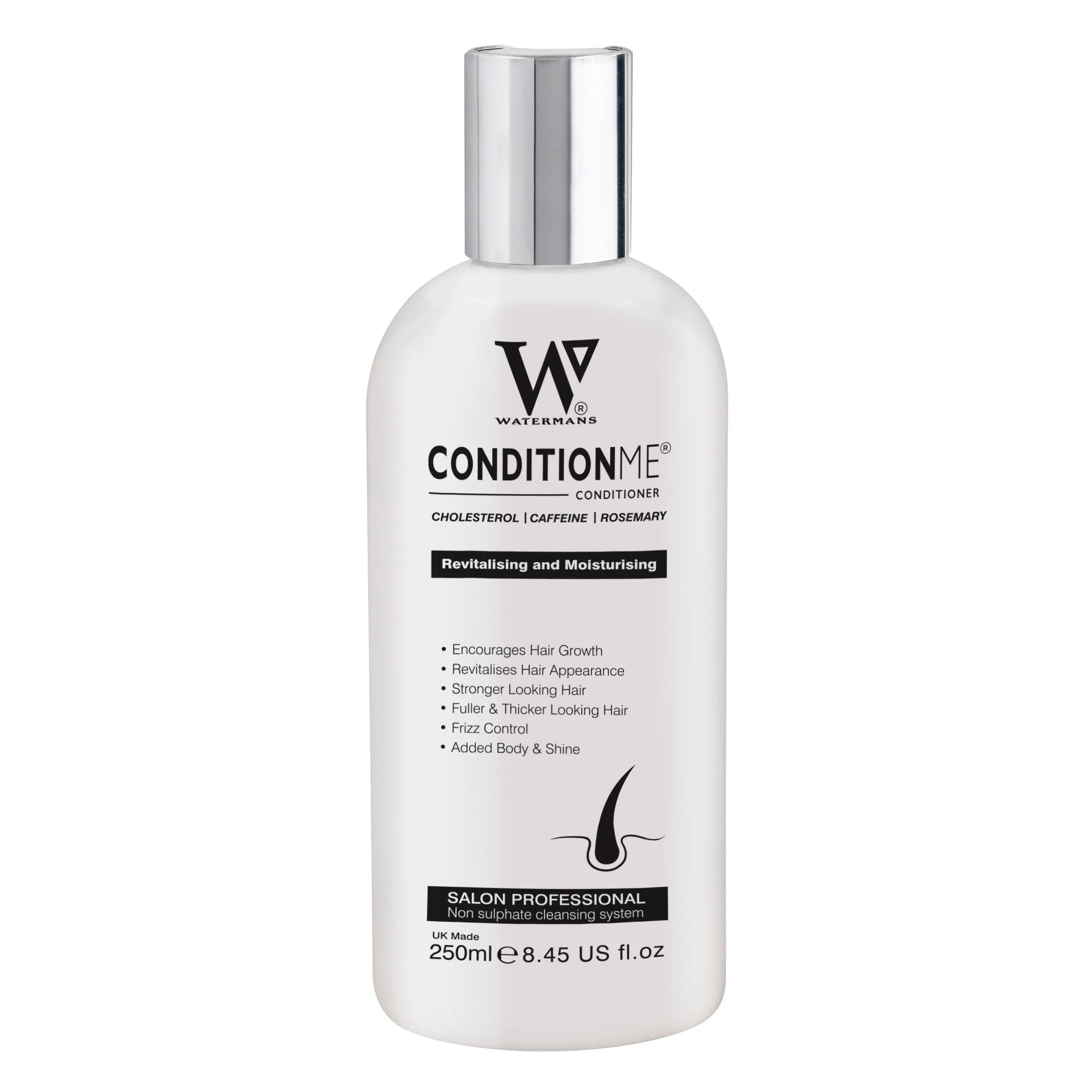
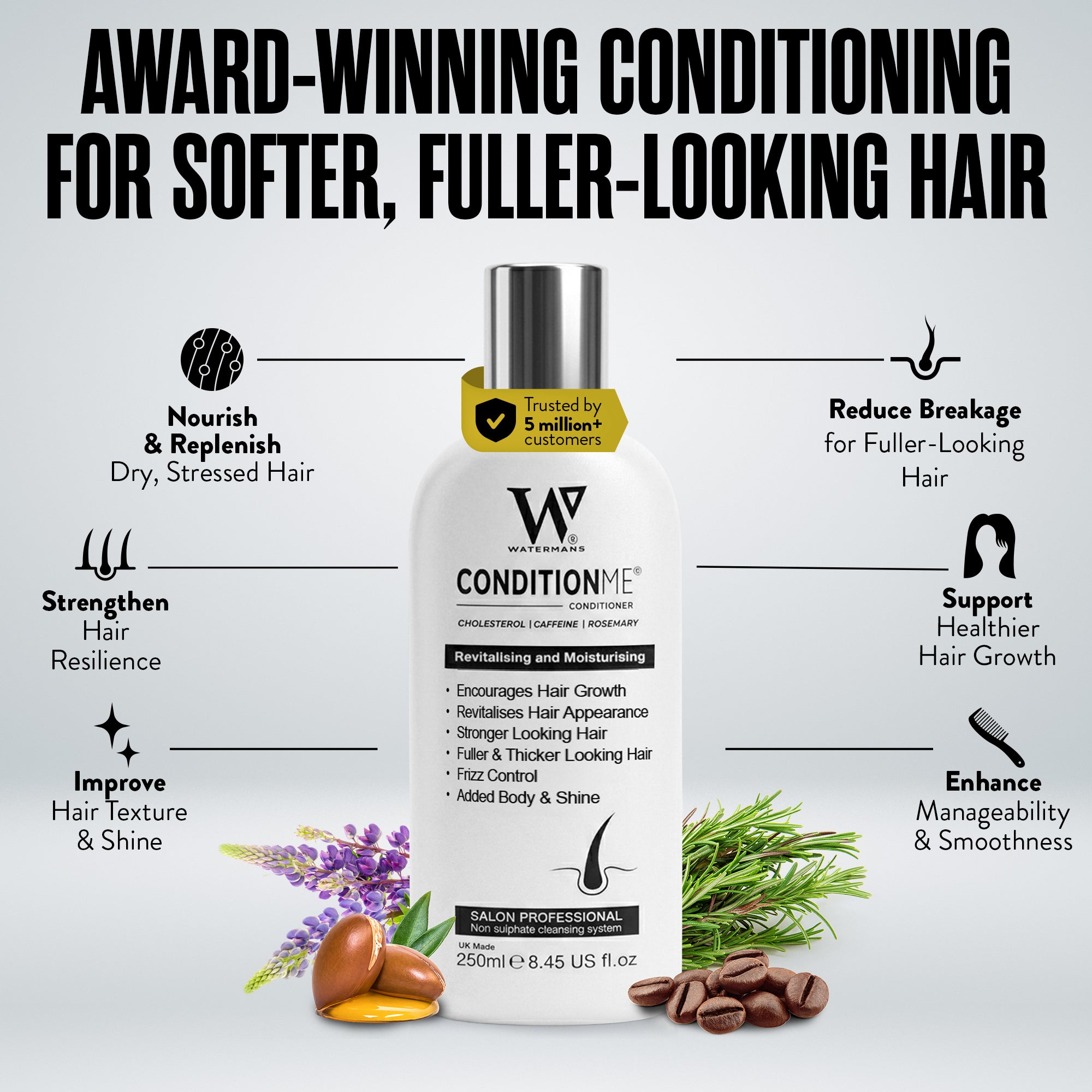
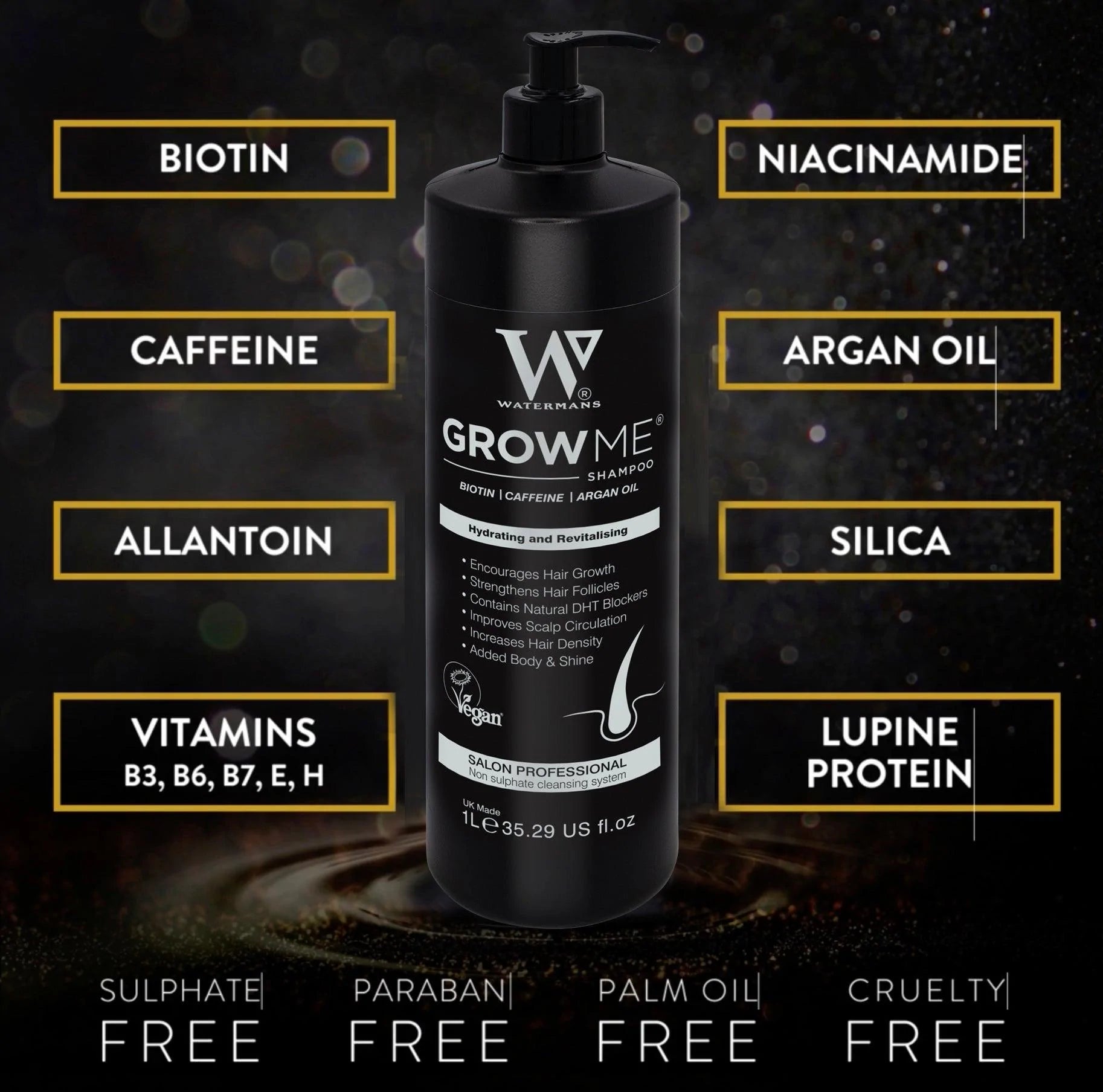
A vegan, sulfate-free shampoo with caffeine, biotin, rosemary, niacinamide, lupine protein and argan oil, £14.95 in September 2026. Leave the lather on the scalp for 3 to 4 minutes before rinsing; it helps reduce breakage-related hair fall and leaves hair looking fuller.

A vegan, non-greasy leave-on scalp serum with rosemary extract, caffeine, biotin and niacinamide, £25.50 in September 2026. Apply a small amount to the scalp at night with no need to rinse; it is a cosmetic serum that cares for the scalp and the hair you have.

Camellia & Black Castor Hair & Body Oil
A vegan hair and body oil with camellia oil and black castor oil, rich in oleic acid and omega 3, 6 and 9, £24.95 in September 2026. A few drops smooth dry lengths or make a simple pre-wash oil, and it supports reduced breakage during blow-drying.

Get a discount on the thinning hair range
Join the Watermans mailing list and we will email a discount code straight to your inbox, so you can try the thinning hair range for less. Vegan, made in the UK, over 6.5 million bottles sold since 2012.
Is your problem hair loss, shedding or breakage?
Hair loss, shedding and breakage are separate problems: hair loss means follicles making finer, shorter hairs or stopping altogether, shedding means more whole hairs than usual leaving at the end of their resting phase, and breakage means the fibre snapping along its length, and both human rosemary trials looked only at forms of hair loss.
- Hair loss. In pattern hair loss, the BAD explains, affected follicles produce hairs that become progressively thinner, shorter and lighter. In women it usually begins in the 50s or 60s, with a parting that widens while the front hairline often stays normal; in men it can start any time after puberty.
- Hair shedding. DermNet says about 15% of scalp follicles are normally resting and losing up to about 100 hairs a day is normal. After a shock to the system, such as illness or childbirth, extra hair fall is noticed 2 to 4 months later and tapers back to normal over 6 to 9 months in most cases.
- Hair breakage. The fibre snaps and the follicle is untouched, which leaves short pieces with no bulb. This is where cosmetic care, including the UV work on rosemary and hair protein, is most relevant.
| What you notice | Most likely | Where rosemary evidence sits | Sensible first step |
|---|---|---|---|
| A widening parting or receding hairline over months | Pattern hair loss | One small 2015 trial; not enough to support a claim | Speak to your own GP |
| More whole hairs in the plughole, 2 to 4 months after illness or stress | Shedding | No trials; shedding usually tapers over 6 to 9 months | GP if it is heavy or keeps going |
| Short snapped pieces with no bulb | Breakage | Cosmetic only: lab work on hair protein and UV | Gentler washing, conditioning and detangling |
| Round patches of missing hair | Needs checking | One 1998 trial of a four-oil blend | Speak to your own GP |
What results can you realistically expect from rosemary?
Realistic results from rosemary are modest and cosmetic: a pleasant scent, a scalp massage habit and, in a shampoo or serum, the feel of a cared-for scalp, while the evidence gives no basis for expecting a change in hair density, and the 2015 trial saw no significant change in hair counts at three months in either group.
Timing matters too. If you start any new routine in the middle of a shedding episode, DermNet's 6 to 9 month taper means the shedding may settle on its own schedule, and whatever you happened to be using gets the credit. If you are tempted to add a supplement at the same time, read our Exeter guide to biotin and hair gummies first, and change one thing at a time so you can tell what made a difference.
A simple three-month log
- Photograph your parting or crown on day one, then once a month, in the same light and from the same angle.
- Note what you used, how often, and any itching, redness or flaking.
- Write down any illness, stress or diet change, since the NHS lists illness, stress, weight loss and iron deficiency among causes of temporary hair loss.
- Take the log with you if you later speak to your GP or a trichologist.
When should you speak to your own GP or a trichologist in Poole instead of trying rosemary?
Speak to your own GP instead of trying rosemary if hair comes out in handfuls or patches, your scalp is sore, red, scaly or weeping, or thinning arrives with other changes in your health, because the NHS advises seeing a GP about the cause of hair loss before a commercial hair clinic, and a trichologist in Poole fits after that.
The NHS says a GP may be able to tell what is causing hair loss by looking at your hair, and that you should mention it if hair loss is affecting your wellbeing. Your registered GP practice is the free place to start. A reaction to a home rosemary blend is a GP matter too, since the NHS advises seeing a GP for contact dermatitis that is persistent, recurrent or severe.
Speak to your GP first if
You have patches of missing hair; your hairline or parting is changing quickly; you are losing handfuls of whole hairs; the scalp is sore, red, scaly or weeping; a rash appeared after using an essential oil; or hair changes come with tiredness, weight loss or other changes in your health.
A trichologist is a private practitioner rather than part of the NHS. A good one takes a detailed history, looks closely at your scalp and hair, and goes through what you already use, including any rosemary oil you have mixed yourself, so take the bottle or its label with you.
How do you check a trichologist in Poole before you pay?
Checking a trichologist in Poole starts with professional registration: the Institute of Trichologists says its register is accredited under the Accredited Registers scheme run by the Professional Standards Authority, so ask which body a practitioner belongs to and confirm it on that body's own website before you pay for anything.
The Institute of Trichologists runs a Find a Trichologist search covering its UK register and describes a two and a half year distance learning Level 5 course, accredited by NCFE. The Trichological Society, the other body you are likely to see listed, says it has provided distance learning courses in trichology for over 25 years. Before you pay, ask:
- Which professional body are you registered with, and can I check that register myself?
- Will you look at what I already use, including any rosemary oil blend, and tell me honestly whether it is worth continuing?
- If this looks medical, will you send me back to my GP?
- Do you sell the products you recommend, and can I keep using my own?
We sell hair care and run no clinics, so weigh our view accordingly. Watermans products are made in the UK, with over 6.5 million bottles sold since 2012, and the three products on this page are vegan. They are cosmetic: they help hair look and feel healthier and reduce breakage-related hair fall, but they do not change how a follicle behaves.
What are the most frequently asked questions about rosemary oil and thinning hair?
Should I try rosemary oil before seeing a trichologist in Poole?
You can try a diluted, patch-tested rosemary oil as a cosmetic step, but do not let it delay a GP visit if hair is coming out in patches or handfuls or your scalp is sore. The human evidence is one small six-month trial and one blend trial, which is not enough to support a claim. A registered trichologist is most useful once your GP has ruled out medical causes. If your question is about products or a routine rather than a medical one, you can talk to Gail Waterman, our co-founder, as an AI avatar on the Watermans homepage.
Is rosemary oil better than a rosemary shampoo?
They do different jobs. A diluted essential oil massaged in before a wash stays on the scalp longer, while a rinse-off shampoo is on for a few minutes. Neither has good trial evidence behind it for hair density, so choose on comfort, scent and how your scalp reacts.
Can I put rosemary essential oil straight onto my scalp?
No. Essential oils are concentrated, so dilute rosemary oil in a carrier oil first. Rosemary can cause allergic contact dermatitis, and DermNet says allergic reactions usually appear 24 to 72 hours after contact, so test the diluted blend on your forearm for several days before it goes on your scalp.
How long should I try rosemary before judging it?
Give any routine at least three months and photograph your hair in the same light each month. In the 2015 trial, hair counts had not changed significantly in either group at three months. If you started during a shedding episode, DermNet says shedding usually tapers over 6 to 9 months anyway, which can make any product look better than it is.
Does rosemary water do the same thing as rosemary oil?
We found no trial of a homemade rosemary rinse. Steeping leaves in hot water makes a weak product of unknown strength, and even commercial rosemary extracts vary widely in their chemistry, as a 2023 study of 10 extracts found. Think of rosemary water as a scented final rinse, not a substitute for the oil used in the trials.
How can I tell hair loss from shedding?
Shed hairs are full length with a small club-shaped root, and the NHS says losing 50 to 100 hairs a day is normal. Short pieces with no root are breakage. A widening parting, a receding hairline or patches point to hair loss, which is a reason to speak to your own GP.
Do Watermans rosemary products change how hair grows?
No. Grow Me shampoo and Grow More Elixir contain rosemary alongside other ingredients, and they are cosmetic products that help hair look fuller and reduce breakage-related hair fall. We make no claim that rosemary, or any product containing it, changes the hair growth cycle.
Sources & references
- NHS, Hair loss
- NHS, Contact dermatitis
- British Association of Dermatologists (skinhealthinfo.org.uk), Male pattern hair loss
- British Association of Dermatologists (skinhealthinfo.org.uk), Female pattern hair loss
- DermNet, Allergic contact dermatitis
- DermNet, Patch tests
- DermNet, Telogen effluvium
- Panahi Y, Taghizadeh M, Marzony ET, Sahebkar A. Rosemary oil in androgenetic alopecia: a randomized comparative trial. Skinmed, 2015
- Hay IC, Jamieson M, Ormerod AD. Randomized trial of aromatherapy in alopecia areata. Arch Dermatol, 1998
- Gupta AK, Bamimore MA, Talukder M. Relative efficacy of conventional monotherapies and select nonconventional, over-the-counter products for male androgenetic alopecia: a network meta-analysis. J Cosmet Dermatol, 2025
- Almutairi AG et al. Review on natural remedies for hair growth promotion with a focus on rosemary. Dermatol Reports, 2026
- Murata K et al. Promotion of hair growth by Rosmarinus officinalis leaf extract. Phytother Res, 2013
- Mathenge A et al. An exploratory preclinical in vivo pilot study evaluating the hair growth-promoting effects of Rosmarinus officinalis and Ricinus communis combination. Biomed Res Int, 2026
- Marsh JM et al. The key phytochemistry of rosemary (Salvia rosmarinus) contributing to hair protection against UV. Int J Cosmet Sci, 2023
- Miroddi M et al. Rosmarinus officinalis L. as cause of contact dermatitis. Allergol Immunopathol (Madr), 2014
- González-Mahave I et al. Rosemary contact dermatitis and cross-reactivity with other labiate plants. Contact Dermatitis, 2006
- The Institute of Trichologists
- The Institute of Trichologists, Find a Trichologist
- The Trichological Society
What is the bottom line on trichologist in Poole?
Rosemary is a pleasant cosmetic ingredient with a small, short evidence base: one six-month comparison trial in 100 adults, one blend trial in alopecia areata and a scattering of mouse and test-tube studies. If you try it, dilute the essential oil, patch test for several days, keep it out of your eyes and stop at the first sign of irritation. Tell shedding and breakage apart from hair loss, speak to your own GP first about patches, handfuls or a sore scalp, and see a registered trichologist in Poole as the next step after that.
If you would rather get your rosemary in an everyday wash than mix your own oil, a sulfate-free shampoo such as Grow Me pairs rosemary with caffeine, biotin and niacinamide and leaves hair looking fuller. As with any new product, stop if your scalp reacts.
Watermans products are 100% cosmetic and do not treat medical hair loss. Individual results may vary.