Chapped Lips: What Causes Them and What Helps
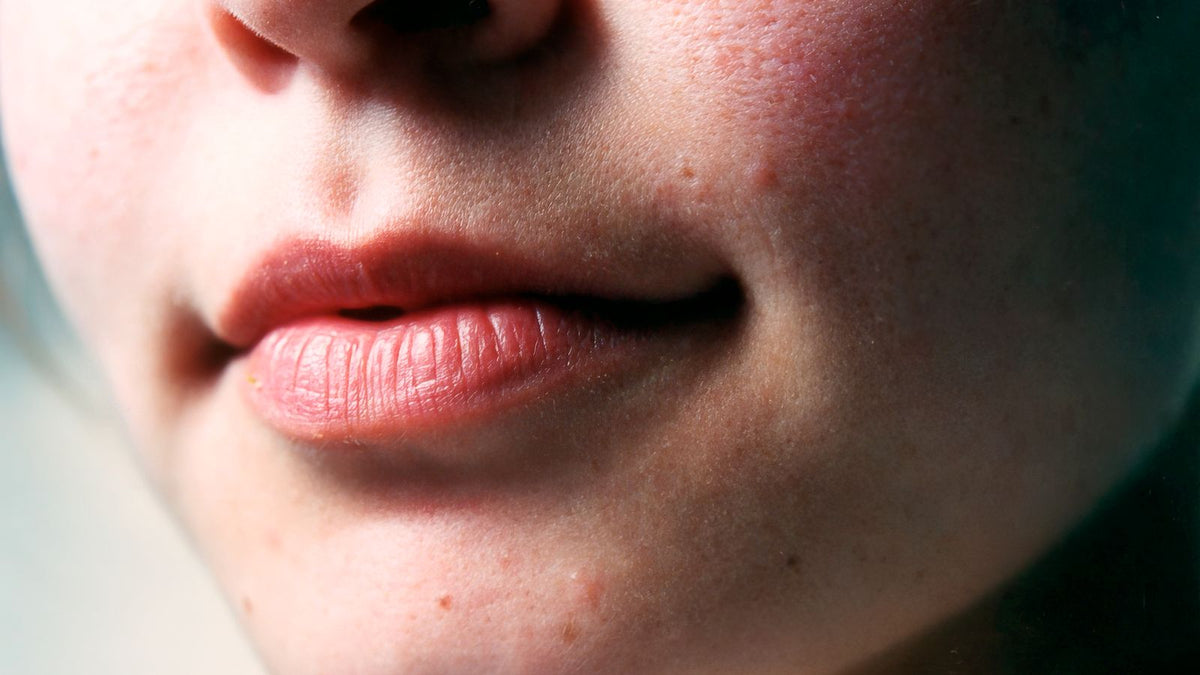
Chapped lips happen because lip skin has almost no barrier of its own. It carries a very thin outer layer, no sweat glands and virtually no oil glands, so it loses water far faster than the skin around it and cannot replace what it loses. Cold wind, dry indoor heating, mouth breathing and habitual licking all accelerate that loss. The fix is to slow the water escaping rather than to keep adding moisture on top.
Key takeaways
- Lip skin has no oil glands, so it cannot self-lubricate the way facial skin does.
- The core problem is water loss, which means occlusive ingredients beat watery ones.
- Licking lips makes it worse: saliva evaporates and takes more water with it.
- Petrolatum, lanolin, shea butter and ceramides are the ingredients with the best track record.
- Menthol, camphor, phenol and strong flavourings commonly aggravate the problem.
- Cracking at the corners, persistent scaling or bleeding that will not settle needs a GP or pharmacist.
What causes chapped lips in the first place?
The direct cause of chapped lips is water leaving the skin faster than it can be replaced, a process dermatologists call transepidermal water loss. Lip skin is structurally unsuited to holding water in: its outer layer is only a few cells thick compared with the rest of the face, and it lacks the sebaceous glands that coat other skin with a natural oily film. Once that thin layer dries, it stiffens, cracks and flakes.
Environment does most of the accelerating. Cold, windy air strips surface moisture; central heating and air conditioning lower indoor humidity through winter; sun exposure damages the tissue directly. Behaviour adds to it: mouth breathing during a cold or at night dries the lips continuously, and licking provides a few seconds of wetness followed by a net loss when the saliva evaporates.
| Cause | How it dries the lips | What helps |
|---|---|---|
| Cold, windy weather | Strips surface moisture and lowers skin temperature | An occlusive balm before going out, and a scarf over the mouth |
| Indoor heating | Reduces indoor humidity for months at a time | A humidifier, and reapplying balm before bed |
| Mouth breathing | Constant airflow across the lips overnight | Address nasal congestion, apply a thick balm at bedtime |
| Lip licking | Saliva evaporates and removes more water than it adds | Break the habit deliberately, keep a balm to hand instead |
| Sun exposure | Damages the thin tissue, especially the lower lip | An SPF lip product year round |
Why do lips dry out faster than the rest of your skin?
Lips dry out faster because of three structural differences. The stratum corneum, the protective outer layer, is markedly thinner on the lips than on the surrounding face. There are no sebaceous glands to produce the oily sebum that slows evaporation elsewhere. And there are no sweat glands, so lips lack the natural moisturising factors that sweat contributes to skin hydration.
There is also less melanin in lip tissue, which is why lips burn more readily and why the lower lip in particular is a common site for long-term sun damage. Put together, this explains why a moisturiser that works on your cheeks does very little on your mouth, and why the products that genuinely work for chapped lips tend to be greasier than people expect.

Which ingredients actually help chapped lips?
The ingredients that help most are occlusives, which form a physical barrier that slows water escaping. Petrolatum is the benchmark and reduces water loss by well over 90 percent in laboratory measurements. Lanolin is close behind and has the added property of holding water within the tissue. Beeswax, shea butter and plant oils work similarly, though generally less completely than petrolatum. Related reading: our guide to is petrolatum bad for hair.
Alongside occlusives, humectants such as glycerin and hyaluronic acid draw water into the outer layer, and emollients such as squalane and ceramides help repair the barrier itself. The most effective balms combine all three. A humectant used alone in dry air can actually make things worse, because it pulls water toward the surface where it then evaporates, which is why glycerin-heavy products need an occlusive layer over them.
| Ingredient type | Examples | What it does |
|---|---|---|
| Occlusive | Petrolatum, lanolin, beeswax, shea butter | Forms a barrier that slows water escaping. The most important category. |
| Humectant | Glycerin, hyaluronic acid, honey | Draws water into the outer layer. Needs an occlusive over it in dry air. |
| Emollient | Squalane, ceramides, plant oils | Smooths and helps repair the skin barrier. |
| Sun filter | Zinc oxide, titanium dioxide | Protects the lower lip, which is prone to long-term sun damage. |
Get a discount on the dry skin range
Join the Watermans mailing list and we will email a discount code straight to your inbox, so you can try the dry skin range for less. Made in the UK, over 6.5 million bottles sold since 2012.
Which lip balm ingredients make chapped lips worse?
Several common balm ingredients aggravate the problem they claim to solve. Menthol, camphor and phenol create a cooling tingle that reads as relief, but they are irritants and can leave the lips drier once the sensation fades. Strong flavourings, particularly cinnamon and peppermint oils, are frequent culprits in allergic contact dermatitis on the lips, as is the fragrance mix used in many scented products.
The pattern to watch for is a balm that feels great briefly and leaves you reaching for it again within the hour. That cycle is usually irritation rather than dependence. DermNet notes that allergic contact dermatitis affecting the lips often traces back to lip products themselves, so if your lips are worse despite diligent balm use, the balm is a reasonable first suspect. Switching to a plain, unscented, unflavoured petrolatum or lanolin product for a fortnight is a straightforward test.
The tingle is not the balm working. Menthol and camphor produce a cooling sensation through nerve receptors, not through any repair of the skin. If a product stings or tingles on already cracked lips, that is irritation, and a bland balm will serve you better.
Is it chapped lips or something else?
Most dryness is simple chapping, but a few patterns point elsewhere and are worth recognising. Cracking and soreness specifically at the corners of the mouth is angular cheilitis, often involving a yeast or bacterial overgrowth where saliva pools, and it usually needs something from a pharmacist or GP rather than a balm. Persistent scaling on one area, or a rough patch on the lower lip that will not settle, should be looked at rather than covered up.
Widespread dryness with itching and redness spreading onto the surrounding skin can be eczema, and dryness that starts soon after a new product suggests contact dermatitis. Ongoing dryness alongside other symptoms can occasionally reflect nutritional deficiency or an underlying condition. See your GP if dryness persists for more than two or three weeks despite sensible care, if the lips bleed repeatedly, or if a sore does not heal.

How do you build a daily routine for chapped lips?
A workable routine has four parts. Apply a bland occlusive balm several times a day, and always before going outside in cold or wind. Apply a thicker layer at bedtime, when there is no eating or drinking to remove it and when mouth breathing does the most damage. Use an SPF lip product during daylight hours, including in winter. And stop licking, which is the single behaviour change that makes the most difference.
Do not pick or peel flaking skin, since that removes living tissue underneath and restarts the cycle. Gentle exfoliation is usually unnecessary and often counterproductive on already damaged lips. Support the whole thing with adequate fluid intake and, through winter, a humidifier in the bedroom.

What about the dry skin around your mouth and hands?
Dryness rarely stops at the lip border. The skin immediately around the mouth is frequently affected too, especially where licking spreads saliva onto it, and hands take a similar battering in cold weather and through frequent washing. Both respond to the same principle as lips: seal in what moisture is there rather than simply wetting the surface. Our guides to dry skin in winter and rescuing dry hands cover those areas properly.
For the surrounding skin, a richer cream with butters and humectants does the job. To be clear, the products below are for the skin around the mouth, the face and the hands rather than for the lips themselves, where a dedicated bland balm remains the right choice.

Moisturise Me Face and Hand Cream 15.00 GBP
A rich cream with cupuacu butter, shea butter, cocoa butter, allantoin and almond oil for the dry, tight skin around the mouth and on the hands through winter. Fast absorbing, so it works under gloves and before bed.

Camellia and Black Castor Hair and Body Oil 24.95 GBP
A lightweight camellia and black castor oil blend for the wider dry patches winter brings, on elbows, shins and cuticles as well as hair. Absorbs without leaving a heavy film.
Frequently asked questions
Why do my lips get chapped even when I use balm constantly?
Usually because the balm contains an irritant such as menthol, camphor or a strong flavouring, or because it is mostly humectant with nothing occlusive over it. Try a plain, unscented petrolatum or lanolin product for two weeks. If nothing improves, the cause may be contact dermatitis or angular cheilitis rather than ordinary chapping.
Does drinking more water fix chapped lips?
It helps if you are genuinely dehydrated, but it will not fix the problem alone. The issue is water escaping through a barrier that cannot hold it, not a shortage of water in the body. Hydration supports the repair, while an occlusive balm does the actual sealing.
Is it bad to peel the flaking skin off?
Yes. Peeling removes living tissue underneath the loose flakes, which creates raw areas, bleeding and a longer recovery. Apply a thick occlusive layer and let the flakes come away on their own as the skin beneath recovers.
Can chapped lips be a sign of a vitamin deficiency?
Occasionally. Deficiencies in B vitamins, iron and zinc are associated with lip and mouth-corner problems, particularly angular cheilitis. It is not the usual cause of ordinary chapping, but persistent symptoms alongside fatigue or other changes are worth a GP conversation and possibly a blood test.
Why are my lips worse at night?
Mouth breathing during sleep dries the lips continuously for hours, and there is no eating or drinking to prompt reapplication. A thicker layer of balm at bedtime helps considerably, and dealing with nasal congestion removes the underlying reason for breathing through the mouth.
Do I need SPF on my lips in winter?
Yes. UVA passes through cloud and is present year round, and the lower lip has little melanin, making it a common site for long-term sun damage. A lip product with a mineral filter used through daylight hours is sensible regardless of season.
Is petroleum jelly safe to use on lips?
Cosmetic-grade petrolatum is refined to remove impurities and is widely regarded as one of the safest and most effective occlusives available. It does not moisturise on its own, so applying it over slightly damp lips or over a humectant gives the best result.
When should I see a GP about chapped lips?
See a GP if dryness lasts beyond two or three weeks despite sensible care, if the corners of the mouth are cracked and sore, if the lips bleed repeatedly, or if a sore, lump or rough patch does not heal. A non-healing area on the lower lip in particular should always be checked. If your question is about products or a routine rather than a medical one, you can talk to Gail Waterman, our co-founder, as an AI avatar on the Watermans homepage.
What is the bottom line on chapped lips?
The bottom line on chapped lips is that lip skin cannot hold water on its own, so your job is to seal it rather than wet it. Use a bland occlusive balm containing petrolatum, lanolin or shea butter, apply it generously before cold weather and at bedtime, add an SPF version for daylight, and stop licking. Avoid menthol, camphor and strong flavourings entirely. If it has not settled in two or three weeks, or the corners of your mouth are cracking, get it looked at rather than buying another balm.
If winter has left the skin around your mouth and on your hands as tight and dry as your lips, a rich hand and face cream is the sensible next step alongside your lip balm. Moisturise Me is our cupuacu and shea butter cream for exactly that, and it absorbs quickly enough to use before bed or under gloves.