Heat Protectant Spray: How to Choose One and Use It Properly
Most heat damage is not caused by the tool. It is caused by using it on the wrong hair, at the wrong setting, and without a heat protectant spray combed through first. This guide covers what to check on the label before you buy, which temperatures matter for your hair type, how to apply a spray so every section is actually covered, and why heat causes breakage rather than hair loss.
A heat protectant spray is a leave-in that coats the hair fibre with polymers and conditioning agents so heat spreads evenly instead of hitting one spot. Used on damp or dry hair before a dryer, straighteners or tongs, it lowers friction, slows moisture loss and keeps the cuticle lying flat. No product makes hair heatproof. What a good one does is reduce the roughness, snapping and split ends that repeated styling causes.
The one we make
Protect Me® Heat Protection Spray, £13.95, is rated to 230C and also helps with colour fade and frizz. Niacinamide, panthenol, caffeine, rosemary and hydrolysed lupine protein. See Protect Me®.
Key takeaways
- Heat protectant and heat protection spray are two names for the same product. There is no legal definition of the category, so check the stated temperature limit on the bottle rather than the word on the front.
- Heat damages the fibre, not the follicle. That means it causes breakage and split ends, never hair loss from the root.
- Coverage beats quantity. A fine, even mist over sectioned hair does more than a heavy spray on the top layer.
- The biggest wins are free: lower the dial, keep the dryer moving, and stop straightening the same section repeatedly.
- Protect Me is rated to 230C, which covers every domestic straightener and tong on a normal setting.
What does a heat protectant spray actually do to your hair?
The spray leaves behind a thin film of film-forming polymers, silicones or natural oils that sits on the cuticle and conducts heat more evenly than bare keratin does. Hair is a poor conductor, so an unprotected strand under a 200C plate develops hot spots where water turns to steam and forces the cuticle scales open. Once those scales lift, the strand loses its smooth surface, catches on its neighbours and snaps more easily when you comb it. If you are weighing a kit instead of a salon, our guide to an at home keratin treatment sets out what to check on the label first.
The second job is slowing water loss. Hair holds roughly 10 to 15 per cent of its weight as water at normal room humidity, and that water is what keeps it flexible. Drive it off too fast and the fibre turns stiff and brittle before it has a chance to cool. A leave-in film slows the rate at which that moisture leaves, which is why protected hair usually feels softer straight after styling rather than dry and squeaky.
Which temperatures actually matter?
Keratin begins to change structurally somewhere around 150C, and the damage rises steeply above 200C. Domestic straighteners commonly run from 150C to 230C, tongs from 120C to 210C, and a hairdryer on its hottest setting sits between 80C and 110C at the nozzle. Most people use far more heat than their hair type needs, which is the single cheapest thing to fix. If the damage is already done, our guide to how to spot heat damage to hair sets out what it looks like on the fibre.
| Tool | Typical range | Sensible starting point | Notes |
|---|---|---|---|
| Hairdryer | 80C to 110C at the nozzle | Medium heat, high airflow | Airflow dries faster than heat does |
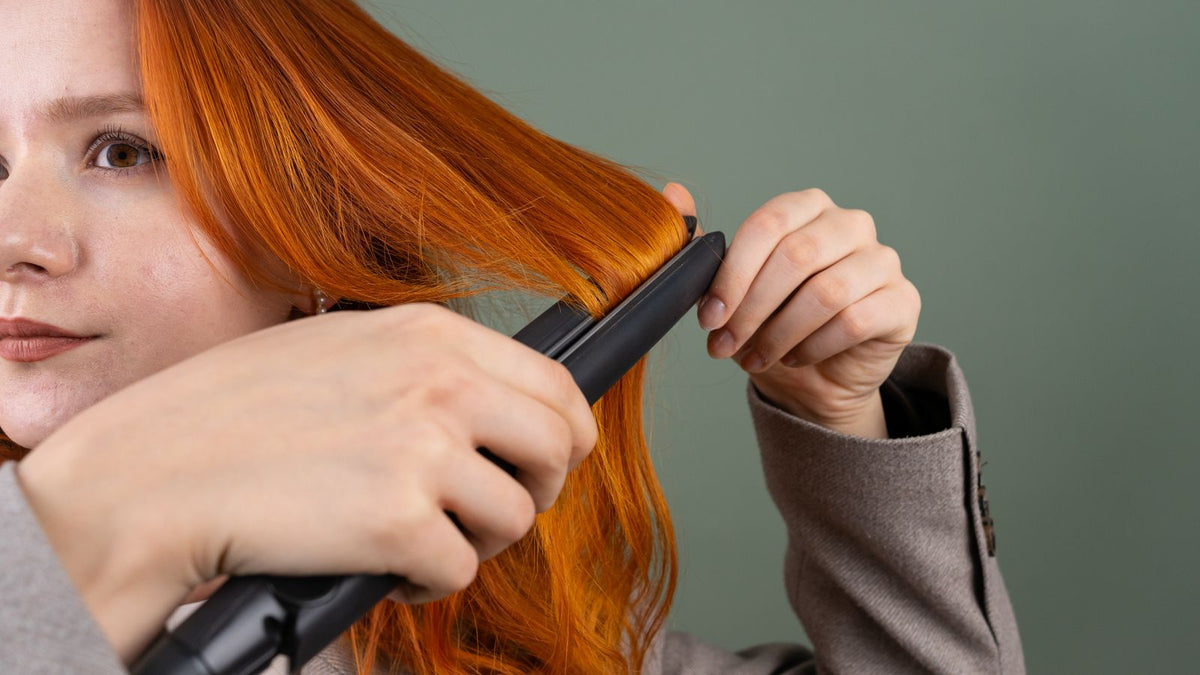
| Straighteners | 150C to 230C | 160C to 180C for fine or coloured hair | One slow pass beats four fast ones |
| Curling tongs | 120C to 210C | 170C for most hair types | Hold time matters as much as the dial |
| Hot brush | 120C to 200C | Medium | Tension plus heat is the breakage combination |
A 2011 study in Annals of Dermatology compared air drying with hairdryers used at different distances and settings. Surface damage was lowest when the dryer was kept moving at roughly 15cm from the hair, and rose as the dryer was held closer, hotter and more still. The practical lesson is that distance and movement matter as much as the temperature you select.

How should you apply a heat protectant spray properly?
Coverage is the whole game, and most people miss it. Work in four sections, hold the bottle about 20cm away, and mist each section from mid-length to ends while the hair is spread across your hand rather than bunched. Comb through immediately so the film is distributed along the strand instead of sitting in patches on the top layer.
Two to four pumps per section suits most shoulder-length hair. More product does not mean more protection: an overloaded strand goes limp and can sizzle when the plates close. If your spray is leaving hair sticky or flat, you are using too much, not the wrong bottle.
Quick test: after spraying and combing, run your fingers down a section. It should feel slightly smoother and very slightly cool, not wet, tacky or coated. If it feels wet, let it dry down before any tool touches it.
Should you spray on damp hair or dry hair?
Both work, but they do different jobs. On damp hair before blow drying, the spray reduces friction against the brush and slows the rate at which water leaves the fibre. On fully dry hair before straighteners or tongs, it forms the barrier that matters most, because that is where the temperatures are highest.
The one rule that is not negotiable: never put straighteners or tongs on hair that is still damp. Trapped water turns to steam inside the fibre and blows the cuticle open from the inside, which is the fastest way to create the rough, frizzy mid-lengths people blame on the product. Blow dry to fully dry first, then reapply if you are going to use a high-heat tool.

How do you choose a heat protectant spray?
Choose a heat protectant spray on four things you can check from the label: a stated temperature limit at or above the setting you actually use, a named film former such as a polysiloxane (a silicone) or a hydrolysed protein, a format that suits your hair, and a finish that combs through without stickiness. A 2015 review of hair cosmetics in the International Journal of Trichology notes that polysiloxane polymers may re-cement lifted cuticle scales and help prevent damage from heat, and that hydrolysed protein deposited on the cuticle helped seal it after flat-iron heating, which is why those two ingredient groups are the ones worth looking for.
| What to check | Look for | Walk away from |
|---|---|---|
| Temperature claim | A number, ideally 200C to 230C, which covers every domestic tool | "Protects from all heat" with no figure, or a figure above anything a home tool reaches |
| Film former | Dimethicone, cyclomethicone, amodimethicone or another polysiloxane; hydrolysed wheat, lupine or keratin protein | A hero botanical on the front with no film former on the back |
| Format | A fine pump mist for sectioned application; a cream or serum if hair is very thick or coily | An oil as the only protection, since most oils do not form an even film |
| Damp or dry hair | Directions that allow both, because blow drying and straightening are different jobs | Anything you have to apply to dry hair only, if your routine starts with a dryer |
| Finish | Combs through, no tackiness, no white cast on dark hair | Heavy fragrance or alcohol high in the list if your scalp is reactive |
| Cost per use | A bottle that lasts about three months at two to four pumps a section | A small luxury bottle that runs out mid-month, so you start rationing coverage |
Where does ours fit? We will not claim Protect Me is the best heat protectant spray, so judge it against the table. It is a pump mist rated to 230C, the label names niacinamide, panthenol, hydrolysed lupine protein and sunflower oil, it goes on damp or dry hair, and the bottle costs £13.95. If your hair is very thick or coily and you prefer a cream, it is not that product.
What should be on the ingredients list?
Useful formulas combine three things: a film former that spreads the heat, a conditioning agent that adds slip, and a humectant that holds a little moisture in place. Look for dimethicone or cyclomethicone, hydrolysed proteins, panthenol and glycerin. Most mainstream sprays are water plus one or two of these, and that is genuinely fine.
Be sceptical of two things. A bottle that leads on a hero botanical without naming a film former is usually a fragranced water. And a claim of protection to a temperature higher than any domestic tool reaches is marketing, not engineering, because nothing you own at home goes past about 230C.
Get a discount on the heat protection range
Join the Watermans mailing list and we will email a discount code straight to your inbox, so you can try the heat protection range for less. Made in the UK, over 6.5 million bottles sold since 2012.
Does a heat protectant replace conditioner or a mask?
No, and treating one as a substitute for the other is a common and expensive mistake. Conditioner and masks work on the hair you already have, smoothing the cuticle and replacing the slip that washing removes. A leave-in barrier works on the hair you are about to heat. You want both, because one protects during styling and the other maintains the fibre between washes.

Protect Me® Heat Protection Spray £13.95
A leave-in spray rated to 230C, with niacinamide, panthenol and hydrolysed lupine protein. It adds slip before a dryer or straighteners and helps with colour fade and frizz.
Does hair type change the setting you need?
Hair type changes almost everything about how much heat is sensible. Fine and chemically lightened hair has a thinner cuticle and fewer layers to lose, so it reaches its limit at a lower temperature and shows damage sooner. Coarse, dense or tightly coiled hair tolerates more heat, but it also takes longer to style, so total exposure time climbs.
Colour-treated hair sits in its own category. Bleaching removes cuticle layers and leaves the fibre more porous, which means it heats faster, dries faster and snaps sooner. If you lighten your hair, drop the dial by roughly 20C from whatever you used before and expect to need a mask more often. Greying hair behaves similarly, because a strand with no pigment is often drier and coarser than the hair it replaced.
Rough guide: very fine or bleached hair, 150C to 170C. Normal, uncoloured hair, 170C to 190C. Coarse or coily hair, up to 200C. If a section is not holding after one slow pass, the problem is usually tension or a damp core, not the temperature.
Which mistakes waste the bottle?
Five habits undo most of the benefit. Spraying only the top layer so the hair underneath is unprotected. Spraying so close that one patch is soaked and the rest is dry. Skipping the comb-through, which leaves the film in stripes. Using a high-heat tool on damp hair. And going over the same section again and again because the first pass was too fast to set the style.
A sixth is subtler: relying on the spray to justify a hotter setting. Protection buys you a margin, not immunity. Someone using 230C with a spray is usually doing more damage than someone using 170C without one.
Is heat causing hair loss, hair shedding or hair breakage?
Heat causes breakage, and only breakage. Hair loss means the follicle stops producing a normal strand, and heat applied to the shaft cannot reach the follicle. Shedding means hairs leaving the scalp at the end of their growth cycle, which is driven by illness, stress, childbirth, thyroid changes or low iron, not by your straighteners. Heat is only one of four routes to a damaged fibre, and what causes hair damage covers the other three.
Breakage is the strand snapping partway along its length. Telling them apart takes one look at a fallen hair: a shed hair has a small pale bulb at one end, while a broken hair is the same thickness at both ends with no bulb. If your hair is getting shorter and rougher but the parting has not widened, the problem is styling, not the follicle. Our guide to reducing hair breakage covers the handling side in detail.

Condition Me® Conditioner £13.95
Breakage defence for hair that gets styled often. Cholesterol, shea butter and hydrolysed lupine protein help strands stay smooth, so you keep the length you grow.

When should you speak to your GP?
Book time with your GP if hair is coming away from the scalp rather than snapping, if the parting is visibly widening, if there are bare patches, or if shedding has been heavy for more than three months. None of those are heat problems, and a blood test for iron, ferritin, thyroid and vitamin D is free and is the sensible first step. If your question is about products or a routine rather than a medical one, you can talk to Gail Waterman, our co-founder, as an AI avatar on the Watermans homepage.
If you use a dryer or straighteners more than twice a week, the single best-value change is a leave-in barrier you actually apply properly. Our heat protection spray is rated to 230C, costs less than a takeaway, and lasts most people around three months.
What is the bottom line on heat protectant spray?
A good spray is worth using every time a hot tool touches your hair, and worth almost nothing if you spray it on the top layer and skip the comb-through. Coverage, fully dry hair before high heat, and a lower dial do more than any single bottle. Heat harms the fibre and not the follicle, so the honest promise is less breakage and smoother ends, not thicker hair.
If you want one bottle that does the job described above, our heat protection spray is a leave-in mist rated to 230C that combs through easily, so you get the full, even coverage that matters far more than the brand on the label, and ends that stay smoother and less prone to breakage.
Frequently asked questions: what else do people ask about heat protectant spray?
What is the best heat protectant spray?
The best one is the spray that states a temperature limit at or above the setting you use, names a film former such as a silicone or a hydrolysed protein, and combs through your hair without tackiness. No single brand suits every hair type, so judge a bottle on those three points rather than on the claims on the front.
Is a heat protectant spray the same as a heat protection spray?
Yes. Heat protectant spray, heat protection spray and heat defence spray are three names for the same type of leave-in product. There is no legal definition of the category in the UK, so the stated temperature limit and the ingredients list matter more than which name a brand uses.
Does heat protection spray really work?
Yes, within limits. A leave-in film spreads heat more evenly and slows moisture loss, which measurably reduces surface roughness and breakage. It does not make hair heatproof, and it cannot undo damage that has already happened.
What temperature should I straighten my hair at?
Start at 160C to 180C for fine, coloured or fragile hair, and 180C to 200C for coarse or very curly hair. One slow, deliberate pass at a moderate setting causes less damage than several fast passes at maximum.
Can I spray it on damp hair?
Yes for blow drying, where it reduces friction and slows water loss. For straighteners or tongs, dry the hair completely first, because trapped water turns to steam and forces the cuticle open.
How much should I use?
Two to four pumps per section on shoulder-length hair, misted from about 20cm and combed through. If hair feels sticky, limp or wet, you have used too much.
Does the spray cause build-up?
It can if you use a lot and wash infrequently. A normal shampoo removes it easily. If hair feels coated after a few days, you are applying more than you need rather than needing a clarifying wash.
Will heat damage make my hair fall out?
No. Heat acts on the strand, not the follicle, so it causes breakage and split ends rather than hair loss. If hair is leaving the scalp with a small white bulb attached, that is shedding and has a different cause.
Is an oil as good as a dedicated spray?
Not usually. Oils add shine and slip but most have a low smoke point and do not form the even film that spreads heat. Use an oil for finishing, and a dedicated spray for protection.
Do I still need one if I only air dry?
No. If no hot tool touches your hair, a heat protectant is not doing anything useful. Spend the money on conditioner or a mask instead.
Sources and references
- International Journal of Trichology: Hair Cosmetics: An Overview (Gavazzoni Dias, 2015)
- Annals of Dermatology: Hair Shaft Damage from Heat and Drying Time of Hair Dryer
- DermNet: Hair loss
- NHS: Hair loss
- British Association of Dermatologists: Female pattern hair loss
- NHS: Blood tests
Watermans products are 100% cosmetic and do not treat medical hair loss. Individual results may vary.