Postpartum Hair Loss: Styling and Timeline Guide
The postpartum hair loss stage is the part nobody warns you about: the shed slows down, and then you are left with a halo of short new hairs that will not lie flat. This page is about that stage. It covers how to cut, style and handle hair while the new growth catches up, what the fluffy hairline actually is, and how long the whole thing realistically takes.
Our hair growth conditioner
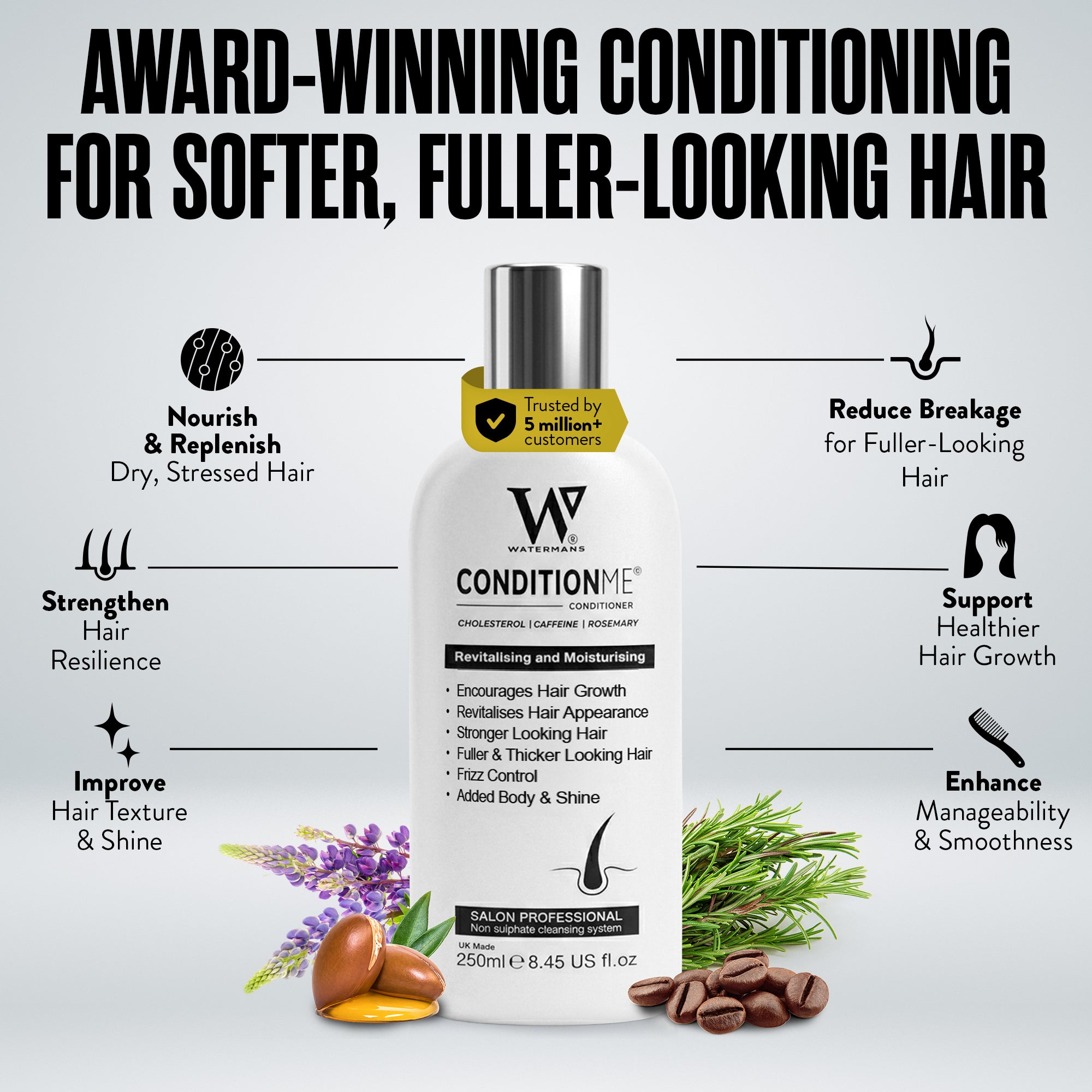
Condition Me® Hair Growth Conditioner, £13.95. Detangles and strengthens the hair fibre so lengths snap less on the brush and look thicker through the ends.
Key takeaways
- Postpartum shedding is telogen effluvium, not hair loss from the follicle. The follicles are paused, not damaged, so density normally rebuilds on its own.
- It usually starts around two to four months after birth, peaks around four months, and settles by six to twelve months. Nothing shortens it, so the sensible goal is to manage it well.
- The fluffy halo at your hairline is new growth, which is good news wearing a very annoying disguise. Do not pull it back hard to hide it.
- A shorter, blunter cut is the single biggest visual win in this phase, because weight at the ends is what makes thinner hair look flatter.
- See your GP if the shed is still heavy past twelve months, if you feel exhausted beyond normal new parent tiredness, or if patches appear.
What is happening during postpartum hair loss?
During pregnancy, raised oestrogen keeps far more hairs than usual in the growing phase, which is why hair often feels thicker and sheds less. After birth those levels fall quickly, all the hairs that were held in place move into the resting phase together, and roughly two to four months later they release at once. That synchronised release is telogen effluvium, and our guide to what causes telogen effluvium covers the same mechanism after other triggers. It looks alarming and it is entirely normal.
The important distinction is that this is hair shedding, not hair loss in the follicular sense. In shedding, whole hairs come away with a small pale bulb at the root, the follicle is intact, and it grows again. In true hair loss, such as androgenetic alopecia, the follicle itself miniaturises and the pattern is fixed rather than a wave. A third possibility is hair breakage, where the strand snaps mid shaft with no bulb attached, which is common in this period because tired parents tie hair back tightly and skip conditioner. Breakage is the only one of the three you can genuinely prevent, and in this phase it is the one that does the visible damage. If you are unsure which of the three you are seeing, our three clue self check for thinning hair walks through it.
For the underlying timeline and causes, see our companion guide to postpartum hair loss and why it happens. This page picks up where that one ends and deals with the practical business of living with it.

How long does the whole thing take?
| Stage | When | What you notice |
|---|---|---|
| Shed begins | 2 to 4 months after birth | Handfuls in the shower, hair on the pillow and on the baby |
| Peak | Around 4 months | Ponytail feels thinner, parting looks wider |
| Shed eases | 6 to 9 months | Less hair coming out, but density still looks low |
| New growth visible | 6 to 12 months | The fluffy halo of short new hairs at the hairline and parting |
| Back to normal | 12 to 18 months | New hairs reach enough length to blend and lie down |
Hair grows at roughly a centimetre a month, so a new hair needs about a year to reach shoulder blade length. That single figure explains most of the frustration in the postpartum hair loss period: the shed is finished long before the evidence of recovery is long enough to see.
What is the fluffy halo at my hairline?
Those short, wiry, upright hairs around your temples and parting are new growth, and they are the single most reliable sign that the shed has turned a corner. They stand up because they are short and have never been weighed down or cut. They are not baby hairs in the sense of being permanently fine, and they are not breakage, although the two can look similar. The tell is the tip: new growth tapers to a soft point, whereas breakage has a blunt or split end.
The instinct is to scrape them back into a tight ponytail. Resist it. Tension at the hairline is exactly how traction damage starts, and the hairline is the slowest area to recover if it is damaged. Work with them instead: a light cream or styling wax smoothed with the palm, a soft headband, or simply a looser style that lets them sit.
Which cuts and styles actually help?
Styling is where you get the fastest visible improvement, because you are changing how light and weight behave rather than waiting on biology.
Take length off
Weight at the ends drags hair flat and makes reduced density obvious at the root. A collarbone length cut or a blunt bob puts the bulk higher and instantly reads as thicker. This is the highest impact change available in the postpartum hair loss phase, and it costs one salon visit.
Ask for a blunt line, not heavy layering
Heavy layers thin out the perimeter, which is the opposite of what you want. A blunt or very softly layered line keeps the ends dense. If your stylist suggests face framing layers, ask them to keep them long and few.
Move your parting
Partings flatten in one direction over years. Switching sides, or going slightly zigzag, lifts the roots and covers a wide parting immediately. It costs nothing and takes five seconds.
Use dry texture rather than heavy product
A light dry shampoo or texture spray at the roots adds grip and lift. Heavy oils and rich leave in creams on the roots do the opposite, so keep those to the midlengths and ends.

Choose loose over tight, every time
A claw clip, a scrunchie, a loose plait or a low loose bun all hold hair off your face without pulling. Tight high ponytails, tight braids and hard elastics are the main avoidable cause of hairline damage in this period, and the damage they do outlasts the shed by years.
Get a discount on the postpartum shedding range
Join the Watermans mailing list and we will email a discount code straight to your inbox, so you can try the postpartum shedding range for less. Made in the UK, over 6.5 million bottles sold since 2012.
How should you wash and handle hair through this phase?
The single most useful mental shift is that you cannot control the shed but you can control the breakage, and breakage is what turns a temporary dip in density into hair that also looks damaged.
Wash as often as suits your scalp. Leaving hair unwashed does not save it, because hairs already released by the cycle come away whenever you next handle your hair. Washing less simply gathers them into one alarming clump on day four. If anything, an unwashed scalp is harder to style with any lift.
Condition every wash, from the midlengths down, and detangle in the conditioner while the hair is slippery. Wet hair is at its weakest, so use a wide tooth comb or a flexible brush and start at the ends, working upwards. Squeeze water out with a microfibre towel or an old t shirt rather than rubbing. Sleep on a satin or silk pillowcase if you can, because friction over eight hours a night adds up. Our list of everyday habits that protect hair covers the rest of the small changes worth making.

Give heat tools a rest where you reasonably can, and use a heat protectant when you do reach for them. Postpone chemical services if you can bear to, and if you cannot, ask your colourist to keep bleach off the fragile new growth at the hairline.
Where do hair products honestly fit?
They fit on the breakage side of the ledger, and nowhere else. No shampoo, conditioner or serum shortens a postpartum shed, because the shed is a hormonal cycle event and it will run its course. What a gentle routine does is stop you losing additional hair to snapping and tension, which is a genuine and measurable difference when you are already down on density.

Condition Me® Conditioner
Detangling is where most avoidable breakage happens, and it is the step tired parents skip first. This improves slip so the comb passes through instead of pulling.

Protect Me® Heat Protection Spray
If you are blow drying to get lift at the roots, this is the one product worth adding. Heat damage on short new growth is particularly unforgiving because there is no length to cut off.
Made in the UK, and over 6.5 million bottles sold since 2012. Watermans products are 100% cosmetic and do not treat medical hair loss. Individual results may vary.
Do supplements help, and are they safe while breastfeeding?
Only if you are actually short of something, which is worth establishing rather than assuming. Iron stores are commonly depleted after birth, particularly after significant blood loss, and low ferritin is a well recognised contributor to a shed that will not settle. A blood test answers that question properly and costs nothing on the NHS.
Taking iron you do not need is not harmless, and high dose vitamin A and some botanical supplements are not appropriate while breastfeeding. Ask your GP, midwife, health visitor or pharmacist before starting anything, and be honest with them about everything you are already taking. A general postnatal multivitamin and vitamin D are the ones most commonly recommended in the UK, and they are recommended for you rather than for your hair.
When should you speak to your GP?
Speak to your GP if heavy shedding is still going at twelve months, if hair comes out in distinct round patches rather than diffusely, if your scalp is sore, scaling or itchy, if you feel exhausted in a way that goes beyond ordinary new parent tiredness, if you are unusually cold, low in mood or your periods have not settled, or if there is any question of thyroid trouble, which is genuinely common after birth. Postpartum thyroiditis affects a meaningful minority of new mothers and is easily missed because every symptom is also a symptom of having a baby.
Ask specifically for ferritin, full blood count and thyroid function. Those three answer most of it.
Frequently asked questions
Can I stop postpartum shedding once it has started?
No, and no product or supplement changes that. The hairs releasing now entered the resting phase months ago and the process runs to completion. What you can change is how much additional hair you lose to breakage and tension while it happens, which is not a small thing when density is already down.
How long does the postpartum hair loss phase last in total?
The shed itself typically runs from two to four months after birth until around six to nine months. Visible new growth follows from six to twelve months, and hair usually looks like itself again somewhere between twelve and eighteen months. Longer hair takes longer simply because a new hair needs more months to reach the same length.
Is the fluffy hair around my face breakage or new growth?
Look at the tip. New growth tapers to a fine soft point because it has never been cut. Breakage ends bluntly or splits. If the short hairs are concentrated where your ponytail sits or where you use straighteners, breakage is more likely. If they are evenly spread across the hairline and parting, that is new growth. There is more on datura for hair growth in a separate guide.
What hairstyles should I avoid?
Tight high ponytails, tight braids and cornrows worn continuously, hard snap elastics, and anything that hurts or leaves a mark. Pain is the signal. If a style is uncomfortable it is pulling on the follicle, and the hairline is the area least able to forgive it.
Will my hair come back exactly as it was?
For most people, yes, in density. Texture sometimes shifts a little after pregnancy, so hair can come back slightly curlier, straighter or coarser, and that change tends to persist. That is a change in your hair rather than a sign anything has gone wrong.
Does breastfeeding make shedding worse or last longer?
There is no good evidence that breastfeeding either causes or prolongs the shed. Timing sometimes makes it look that way, because the shed and the early months of feeding overlap. Nutrition matters for you either way, so eat properly and keep up any supplement your midwife or GP has advised.
Should I cut my hair short?
Not if you do not want to, but a shorter cut is the fastest visual improvement available and many people find it lifts their mood as much as their roots. If you are not ready to commit, ask for a small amount off the ends and a blunter line first and see how it feels.
Is it normal for the shed to start later than four months?
Yes. Two to four months is typical but later starts happen, particularly after a difficult birth, significant blood loss or a period of illness, all of which are triggers in their own right and can stack. If it starts after six months, mention it to your GP so the more ordinary causes such as iron and thyroid can be checked.
Sources and References
- NHS, Hair loss, on causes, what is normal after pregnancy and when to see a GP.
- British Association of Dermatologists, Telogen effluvium, on the shedding mechanism and timeline.
- British Thyroid Foundation, Postpartum thyroiditis, on thyroid changes after birth and how they present.
- NICE CKS, Iron deficiency anaemia, on ferritin testing and postnatal iron depletion.
- NHS, Vitamins and minerals, on what is advised during breastfeeding.
What is the bottom line on postpartum hair loss?
Postpartum shedding is a wave that runs its course whatever you do, so spend your energy on the half you control. Take some length off, keep the line blunt, move your parting, keep everything loose, condition and detangle gently, and let the fluffy new hairline be what it is. The postpartum hair loss phase is slow because hair grows at a centimetre a month, not because anything is going wrong. Take a heavy shed past twelve months, round patches, or exhaustion beyond ordinary tiredness to your GP and ask for ferritin, full blood count and thyroid function. If your question is about products or a routine rather than a medical one, you can talk to Gail Waterman, our co-founder, as an AI avatar on the Watermans homepage.
Before the dryer or the irons go anywhere near it, the Protect Me heat protection spray goes on first. Made in the UK.
Watermans products are 100% cosmetic and do not treat medical hair loss. Individual results may vary.