Frankincense Oil for Hair: Benefits and Safe Use
Frankincense oil for hair is a diluted essential oil made from the resin of the Boswellia tree, used as a scented pre-wash scalp oil rather than as anything medical. It has genuine value as a comfortable, softening oil massage, and its boswellic acids are studied for anti-inflammatory behaviour. What it has never been shown to do, in any human trial, is change how fast hair grows or how dense it becomes.
Our hair and body oil
Camellia & Black Castor Hair & Body Oil, £24.95. Adds hydration and shine to dry lengths and smooths the hair before a blow dry, without weighing fine hair down.
Key takeaways
- Frankincense comes from Boswellia tree resin, and the studied compounds are boswellic acids.
- The anti-inflammatory research is real, but it sits in laboratory and joint health work, not scalp trials.
- There is no human evidence that it changes hair growth speed or density.
- Always dilute to 1 to 2 percent in a carrier oil, and patch test 24 hours first.
- Hair loss, hair shedding and hair breakage are three different problems, and only one of them responds to better everyday care.
What is frankincense oil for hair, and where does it come from?
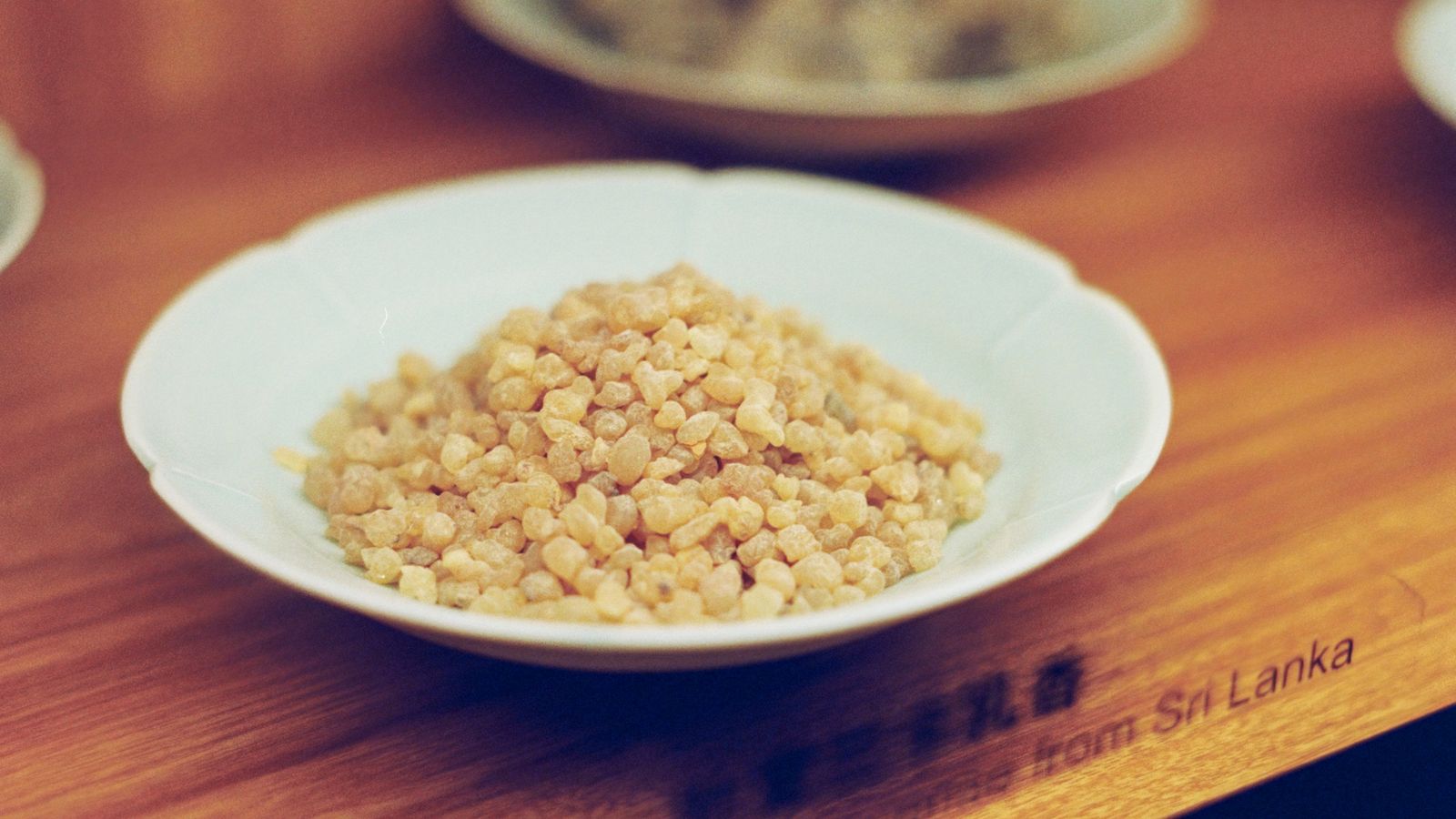
Frankincense is the dried resin of trees in the Boswellia genus, most often Boswellia sacra, Boswellia carterii or Boswellia serrata, which grow across the Arabian Peninsula, the Horn of Africa and parts of India. Harvesters cut the bark, the tree weeps a milky sap, and that sap hardens into the amber coloured tears sold as frankincense. Steam distilling those tears produces the essential oil that ends up in a small amber bottle on your shelf.
The compounds that attract research attention are the boswellic acids. A review in Planta Medica summarised the evidence that these acids interfere with inflammatory signalling pathways, which is why Boswellia extracts have been studied in conditions such as osteoarthritis and inflammatory bowel disease. That work is genuine and worth knowing about. It is also worth being precise about what it is not: it is not scalp research, it was rarely done with a distilled essential oil, and the doses involved were oral rather than topical.
This distinction matters more than it sounds. Steam distillation carries over the volatile aromatic molecules, mainly alpha pinene and limonene, while the heavier boswellic acids largely stay behind in the resin. So the fragrant oil you massage into your scalp is not a concentrated delivery system for the very compounds the research is about.

What can frankincense oil actually do for your scalp?
Frankincense oil offers three honest benefits, and none of them are dramatic. First, it is a pleasant scent, and a scalp massage that you enjoy is a scalp massage you will keep doing. Second, when blended into a carrier oil it helps soften dry, tight scalp skin and loosens flakes so they rinse away instead of sitting in your parting. Third, oil massage before shampooing reduces the mechanical roughness of washing, which matters for anyone whose hair snaps easily.
Notice that the second and third benefits belong mostly to the carrier oil and to the massage itself. If you blended frankincense into camellia oil and compared it against plain camellia oil, the honest expectation is that most of the difference you feel would be the smell. That is not a reason to avoid it. It is a reason not to pay a premium for it or to expect it to solve a problem it cannot touch.
The one claim to walk away from
If a label or an article tells you frankincense blocks the hormones behind pattern thinning, or restores density, it is making a medical claim with nothing behind it. No human trial supports either statement. Ingredients that sound ancient are held to exactly the same evidence standard as everything else.
What does the evidence on frankincense and the scalp really say?
The evidence base for frankincense oil for hair is, to be blunt, close to empty. Searching the published literature turns up laboratory work on boswellic acids and inflammation, a body of research on Boswellia supplements taken by mouth for joint pain, and essentially nothing testing a topical frankincense preparation on human scalps for hair outcomes. There is no randomised trial to summarise, no before and after density counts, and no comparison against a control.
Where good sources do agree is on the wider point that inflammation is relevant to some scalp conditions, and that calming an irritated scalp is a sensible goal. Where they disagree, or more accurately where they simply have not looked, is whether frankincense achieves that on a human head at a cosmetic concentration. Honest reporting means saying so rather than borrowing the credibility of the joint pain research and quietly applying it to hair.
Compare this with hair oiling more broadly, where the picture is better. A study in the Journal of Cosmetic Science measured protein loss from hair after washing and found that certain oils reduced it, with coconut oil performing best because its lauric acid can penetrate the fibre. That is a specific, measured, repeatable finding about oils and hair damage. Nothing of that quality exists for frankincense.

Camellia & Black Castor Hair & Body Oil £24.95
A multi use blend of black castor and camellia oils. Use it as the carrier for your frankincense drops, or on its own as a pre-wash oil to soften the scalp and reduce the roughness of washing on dry lengths.
How do you dilute and apply frankincense oil for hair safely?
Dilution is the whole of the safety story with essential oils, so start there. Keep frankincense to 1 to 2 percent of your blend, which works out at roughly 3 to 6 drops in 30ml of carrier oil. A 2023 review in Contact Dermatitis documented allergic contact dermatitis from essential oils in ordinary consumer products, and the pattern is consistent: reactions cluster around neat or over concentrated use, and around oxidised oils that have been open too long.
- Patch test first. Put a little of the finished blend on your inner forearm, leave it 24 hours, and check for redness, itching or bumps before it goes anywhere near your scalp.
- Choose a carrier. Camellia and jojoba are light and suit fine hair. Castor and coconut are heavier and suit coarse, dry or coily textures.
- Warm it briefly. A few seconds between your palms is enough. Hot oil is a burn risk and does nothing extra.
- Section and apply to the scalp. Part the hair in rows and apply small amounts along the partings, then take what is left through the mid lengths and ends.
- Massage for 3 to 5 minutes with the pads of your fingers, never your nails.
- Leave 20 to 30 minutes, or overnight on a towel if your scalp is comfortable with it.
- Wash it out properly. Shampoo onto the oily scalp before adding water, then rinse and repeat if needed.

If you like the ritual but want the carrier oil to do more of the work, the same logic applies to any infused blend. Our guide on infusing herbs in oil at home covers the ratios and the storage rules that keep a blend from going rancid, and the piece on what argan oil really does is a useful sanity check on how carrier oils are marketed.
Get a discount on the dry scalp range
Join the Watermans mailing list and we will email a discount code straight to your inbox, so you can try the dry scalp range for less. Vegan, made in the UK, over 6.5 million bottles sold since 2012.
Who should avoid frankincense oil?
Several groups should leave this one alone. Anyone with a known fragrance or essential oil allergy should avoid it outright, as should anyone whose scalp is currently broken, weeping, sore or infected. Children have thinner, more permeable skin and a lower tolerance for essential oils, so frankincense is not appropriate for a child's scalp. If you are pregnant or breastfeeding, ask your midwife or GP first, because official guidance on essential oils in pregnancy is deliberately cautious.
There is also a build-up consideration rather than a safety one. Fine, low density hair tends to look flatter and greasier after oiling, and people with an oily scalp often find that heavy pre-wash oils make the following day worse. If that is you, keep the oil to the mid lengths and ends and leave the scalp out of it.
Watermans products are 100% cosmetic and do not treat medical hair loss. Individual results may vary.
Hair loss, hair shedding or hair breakage: which are you dealing with?
These three words get used interchangeably, and that confusion is exactly why people end up buying an essential oil for a problem it was never going to touch. They are different events with different causes.
| What it is | What you notice | What actually helps |
|---|---|---|
|
Hair loss Follicular. The follicle itself is affected, as in pattern thinning or alopecia areata. |
A widening parting, a receding line, visible scalp at the crown, or discrete bald patches. | A GP or dermatology assessment. Cosmetics cannot change what is happening at the follicle. |
|
Hair shedding Cycle related. Too many hairs enter the resting phase at once, as in telogen effluvium. |
Handfuls in the shower two to three months after illness, childbirth, surgery, crash dieting or acute stress. | Time, plus fixing the trigger. Check iron and thyroid with your GP. It usually settles over six to nine months. |
|
Hair breakage Fibre related. The strand snaps along its length rather than leaving the scalp. |
Short broken pieces, frizz along the mid lengths, split ends, hair that will not gain length. | Gentler washing, less heat, less tension, conditioning and pre-wash oiling. This is the one good habits genuinely change. |
Frankincense oil belongs firmly in the third row, and only as a small part of it. If your honest answer is row one or row two, an essential oil is not the tool. Our guides on what causes telogen effluvium and how much daily hair loss is normal will get you further.
What helps more than frankincense oil for hair?
If you want the honest ranking, here it is. The habits that change how much hair you keep on your head sit above any oil, and they are unglamorous: wash gently and often enough that your scalp stays comfortable, condition every single wash, cut heat styling back, stop pulling hair into tight styles, eat enough protein and iron, and get persistent shedding checked rather than self managing it for a year.
A scalp serum designed to sit on the scalp overnight is a more sensible purchase than an essential oil if your concern is density, because it is formulated at cosmetic concentrations for that job. A gentle shampoo matters more still, because it is the product you use most often.

Grow More® Leave-In Hair Density Serum £25.50
A leave-on overnight scalp elixir with caffeine, rosemary, niacinamide and biotin, formulated to support a healthy scalp environment and fuller-looking hair. A more purposeful overnight step than a scented oil blend.

Grow Me® Hair Growth Shampoo £14.95
A sulphate free daily shampoo that cleans without stripping, which is what a dry or flaky scalp actually needs between oiling sessions.

For the wider routine, our guide to keeping your scalp healthy covers the washing and massage side properly, and if you came here from the essential oil rabbit hole, what the rosemary oil evidence actually says is the more interesting read, because there the research does exist.
Frequently Asked Questions
Does frankincense oil for hair make hair grow faster?
No. There is no human trial showing that frankincense oil for hair changes the speed of hair growth. Frankincense is studied mainly for the anti-inflammatory behaviour of its boswellic acids, and almost all of that work sits in laboratory and joint health settings rather than on the scalp. Read any faster-growth promise on a label as marketing, not evidence.
How much frankincense essential oil should I use?
Keep frankincense to a maximum of 1 to 2 percent of the total blend, which is roughly 3 to 6 drops in 30ml of carrier oil. Essential oils are concentrated plant extracts, and going stronger raises the risk of irritation and sensitisation without adding any benefit that has been demonstrated on hair.
Can I put frankincense oil straight onto my scalp?
No, never apply it neat. Undiluted essential oils are a common cause of allergic contact dermatitis, and the scalp is not more robust than facial skin. Always dilute frankincense in a carrier oil such as camellia, castor, jojoba or coconut, and patch test on your inner forearm 24 hours beforehand.
Is frankincense oil for hair safe during pregnancy?
Guidance on essential oils in pregnancy is cautious and inconsistent, so the honest answer is to ask your midwife or GP before using frankincense oil for hair while pregnant or breastfeeding. Skipping it for nine months costs you nothing, because it is a comfort product rather than a necessity.
Will frankincense oil help my dandruff?
Possibly a little, and possibly not at all. Massaging any diluted oil into a dry, flaky scalp softens scale and makes it easier to wash away, so people often report improvement. That effect comes largely from the oil and the massage, not from frankincense specifically. Persistent flaking, itching or soreness deserves a GP or pharmacist visit.
Does frankincense oil block hormones linked to thinning?
There is no credible human evidence that frankincense affects the hormones involved in pattern hair thinning. Any product or article claiming it does is making a medical claim it cannot support. If hormonal thinning is your concern, speak to your GP rather than reaching for an essential oil. If your question is about products or a routine rather than a medical one, you can talk to Gail Waterman, our co-founder, as an AI avatar on the Watermans homepage.
How long should I leave the oil on before washing?
Twenty to thirty minutes is plenty for a pre-wash oil, and overnight is fine if your scalp tolerates it. Longer is not better. Leaving heavy oil on a fine scalp for days tends to cause build-up, itching and limp roots, which is the opposite of what most people want.
Is frankincense oil for hair worth the money?
As a pleasant, well diluted pre-wash oil, it is a reasonable small luxury. As a solution for thinning or shedding, it is not worth prioritising. If your budget is limited, a gentle cleanse and condition routine, less heat and a better protein and iron intake will do far more for your hair.
Sources & References
- Ammon HP. Boswellic acids in chronic inflammatory diseases. Planta Medica, 2006. PubMed 17024588
- Rele AS, Mohile RB. Effect of mineral oil, sunflower oil, and coconut oil on prevention of hair damage. Journal of Cosmetic Science, 2003. PubMed 12715094
- Allergic contact dermatitis from essential oil in consumer products. Contact Dermatitis, 2023. PubMed 37403438
- NHS. Hair loss. nhs.uk
- DermNet. Telogen effluvium. dermnetnz.org
What is the bottom line on frankincense oil for hair?
Frankincense oil for hair is a nice thing, not an effective thing. Diluted properly into a carrier oil it makes a pleasant pre-wash massage, softens a dry scalp and slightly reduces the roughness of washing. It will not change your hair's growth rate or density, and no human trial says otherwise. Use it because you like it, keep it at 1 to 2 percent, patch test first, and put your real effort into gentle cleansing, conditioning, less heat and getting persistent shedding properly checked. If you prefer a rinse to an oil, our guide to using sage on hair explains how to brew one and when to skip it.
Watermans is a British family brand. Grow Me shampoo is vegan. Our products are made in the UK and cruelty free, with over 6.5 million bottles sold since 2012.
For the cosmetic side of a fuller look, Grow Me hair growth shampoo is the step that does the heavy lifting.