How Scalp Absorption Works: What Reaches the Root
How scalp absorption works decides what any leave on product can realistically do, and the honest answer is that skin is very good at keeping things out. The outer layer of the scalp is a barrier built to block water loss and stop substances getting in, so most of what you apply stays on or near the surface. A small fraction crosses, mainly through hair follicles and sweat glands, and that fraction is what everything else depends on.
Key takeaways
- Skin is a barrier first. The stratum corneum exists to keep things out, and it is good at its job.
- Follicles are the shortcut. The scalp has an unusually high follicle density, which is why it behaves differently from the skin on your arm.
- Contact time beats concentration. A rinse off product has ninety seconds. A leave on product has all night.
- Molecule size and solubility matter more than the price. Small, moderately oil loving molecules cross most easily.
- Cosmetics are designed to act on the surface, and in the UK that is a legal distinction, not a marketing one.
How scalp absorption works: the short answer
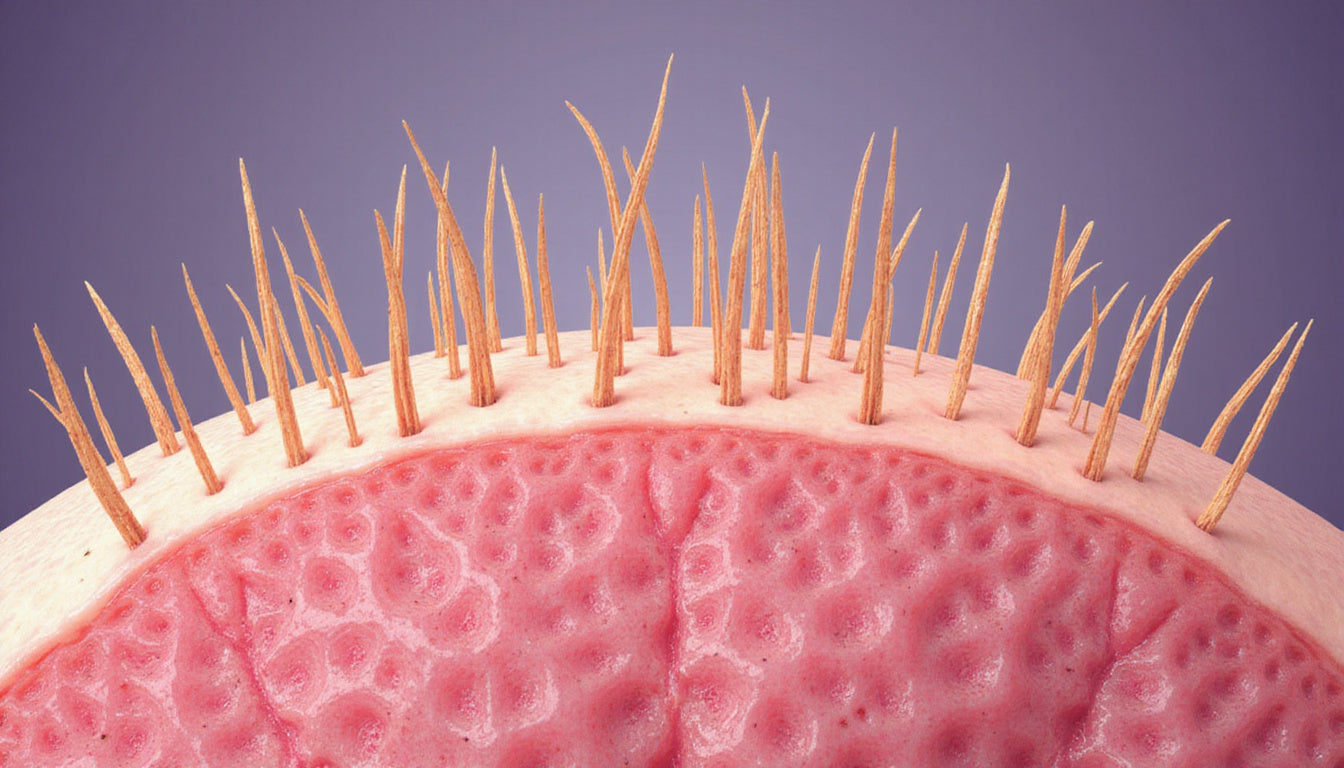
Anything you put on your scalp meets three possible routes. It can sit on the surface and be washed away. It can diffuse slowly through the outer dead cell layer of the skin. Or it can travel down a hair follicle or a sweat duct, bypassing most of the barrier. For the scalp specifically, that third route matters more than it does almost anywhere else on the body, because the scalp carries roughly 100,000 follicles in a small area.
The practical consequence is simple. What reaches anything living is a small percentage of what left the bottle, and it depends far more on how long the product stays there than on how impressive the ingredient list looks.

What is the skin barrier actually stopping?
The stratum corneum is the outermost layer of skin, made of flattened dead cells packed in a lipid matrix. The usual description is a brick wall, with the cells as bricks and the fatty lipids as mortar. Almost everything that gets through has to weave between those bricks through the mortar, which strongly favours small molecules that are comfortable in oil.
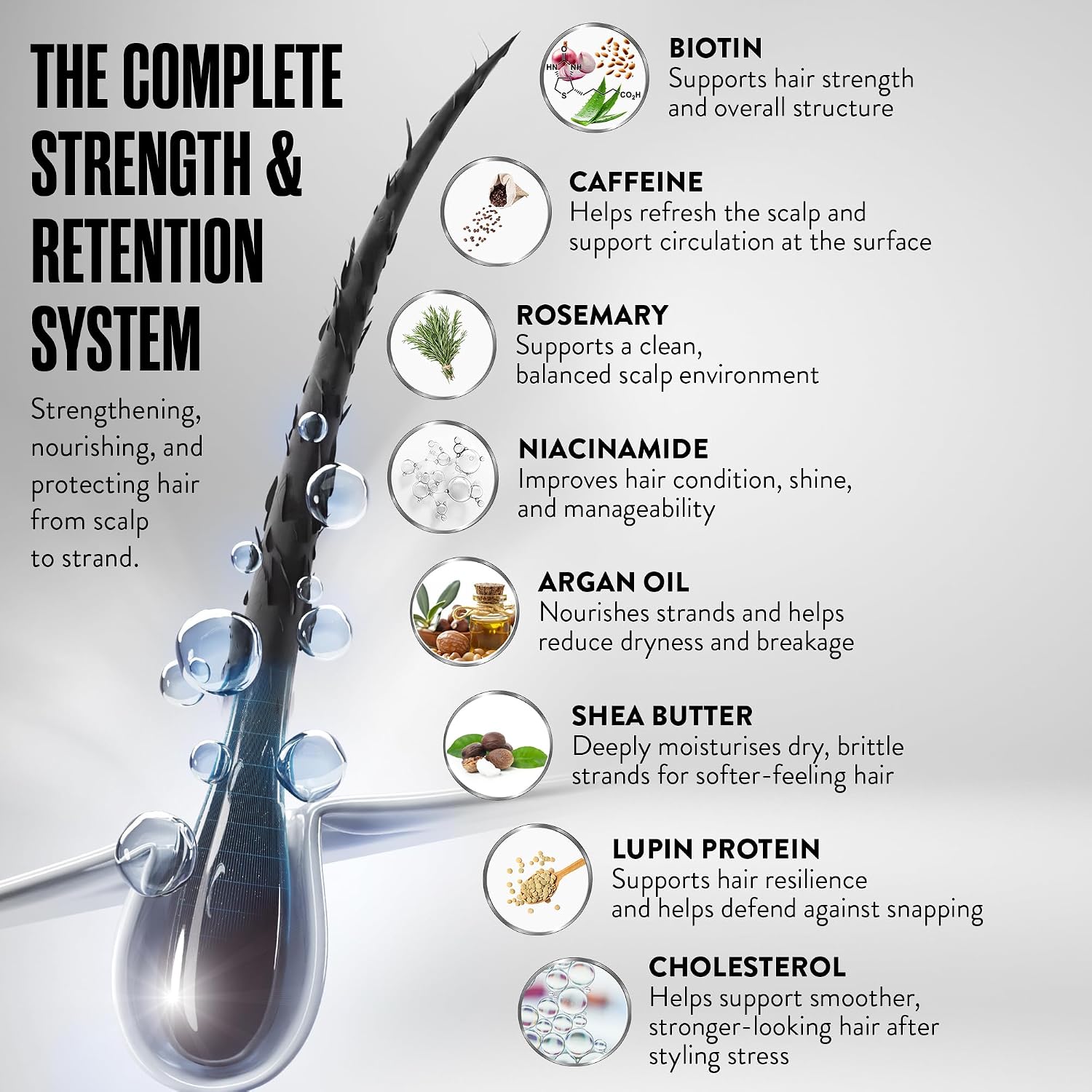
Large molecules struggle. Proteins, most peptides and long chain polymers are simply too big to pass in any meaningful quantity, which is why a protein in a conditioner works by coating and reinforcing the outside of the hair fibre rather than by getting inside your skin. That is not a failure of the formula. It is the formula doing the job it was designed to do, in the place it was designed to do it.
| Property | Crosses more easily | Crosses less easily |
|---|---|---|
| Molecule size | Small, under roughly 500 daltons | Large proteins, polymers, silicones |
| Solubility | Moderately oil loving | Strongly water loving or strongly oily |
| Contact time | Leave on, hours or overnight | Rinse off, one to two minutes |
| Skin condition | Warm, hydrated, freshly cleansed | Cold, heavily coated in product build up |
| Where it lands | Directly on the scalp, at the parting | On the hair length, never reaching skin |
Why do hair follicles matter as a route in?
Hair follicles are tiny open channels that dip well below the surface barrier, so they act as a shortcut past the brick wall. On most of the body they are sparse enough not to matter much. On the scalp they are dense, which is exactly why scalp products behave differently from body lotion, and why a product intended for the scalp should be applied to the scalp rather than smoothed over the hair.
This is the single most common mistake in a home routine. People apply a scalp serum to their hair, where there is no skin at all, and then wonder why nothing happened. Part the hair, apply along the parting, move the parting a couple of centimetres and repeat. Our guide to how much product to use on your scalp covers the technique and the quantity.

What makes one formula reach the skin better than another?
Four things, and none of them is the price on the box.
- Format. A thin liquid or light serum spreads along a parting and stays on skin. A thick cream sits on hair. A shampoo is rinsed off by design.
- The carrier. Alcohols, glycols and light oils change how readily an ingredient leaves the formula and enters the skin. This is why the same ingredient at the same percentage can behave differently in two products.
- Contact time. Overnight beats an hour, and an hour beats ninety seconds in the shower, by a wide margin.
- A clean surface. Heavy build up of styling product and oil adds another layer to get through. This is one of the few good arguments for an occasional clarifying wash.
Understanding how scalp absorption works also explains why irritation and effect tend to travel together. Anything that helps an ingredient cross the barrier also helps the ingredients you did not think about cross it, which is why the strongest smelling, most tingly formulas are also the ones people most often react to.
Where we will argue against our own category: a shampoo has around ninety seconds on the scalp and is then diluted and rinsed away. Whatever the label says about actives, a rinse off product is mainly a cleanser and a conditioner, and any brand implying that its shampoo delivers a meaningful dose deep into the follicle is overselling. That includes ours. Buy a shampoo because it cleans well and leaves your scalp comfortable, and expect the leave on step to be where contact time actually exists.
Does massaging, heat or a derma roller change absorption?
Massage helps a little, mostly by spreading the product evenly onto skin rather than leaving it in three wet patches. It feels pleasant, it is free, and it is worth doing for a minute. Claims that massage meaningfully increases what gets through the barrier are stretched well beyond the evidence.
Warmth increases diffusion modestly, which is one reason applying to a scalp that is warm from a shower can feel more effective. Microneedling devices are a different matter entirely, because they create physical channels through the barrier, and that genuinely changes how much of anything crosses. That is precisely why they need care, clean equipment and sensible spacing between sessions, and why applying a strongly active or fragranced product straight after using one is a poor idea.
Get a discount on your next order
Join the Watermans mailing list and we will email a discount code straight to your inbox. Vegan, made in the UK, over 6.5 million bottles sold since 2012.
What does absorption mean for hair loss, hair shedding and hair breakage?
Very different things, and it is worth being precise.
- Hair loss in the follicular sense, such as androgenetic alopecia, involves the follicle progressively producing finer, shorter hairs. Changing that process requires acting on hormone signalling inside the follicle, which is the territory of prescription medicines and a conversation with a clinician, not of a cosmetic.
- Hair shedding is a hair cycle event, most often telogen effluvium after illness, childbirth, surgery, crash dieting or serious stress. It resolves on its own as the cycle resets. Absorption is largely beside the point here, because there is nothing a surface product needs to reach.
- Hair breakage happens entirely outside the skin, on the hair fibre itself. Nothing needs to be absorbed at all. Conditioning agents, proteins and oils work on the outside of the strand, and that is why breakage is the problem cosmetics genuinely address well.
So the ranking is the opposite of what most marketing implies. The problem cosmetics help most with is the one that needs no absorption whatsoever. Our guide to keeping your scalp healthy covers the surface side properly, and choosing a scalp serum compares the leave on formats.

How does UK law draw the line between a cosmetic and a medicine?
The line is drawn by what a product is intended to do, and by the claims made for it. A cosmetic is intended to clean, protect, perfume or change the appearance of the skin and hair. A medicine is intended to act on a physiological function or to address a condition. A product that claims to change how a follicle behaves has, in effect, claimed to be a medicine, and would then need a licence.
This is why the honest language on cosmetic packaging talks about fuller looking hair, reduced breakage and a comfortable scalp, rather than making claims about follicles. It is also a useful filter when you are reading someone else's marketing. If a shampoo claims to act on a biological process, ask why it is not licensed as a medicine. Our guide to reading a hair product label goes through the back of the bottle in detail.
Which formats make sense given how scalp absorption works?
Match the format to the job. Use the rinse off step to clean well without stripping, and use the leave on step where contact time exists.

Grow More Scalp Elixir
A light leave on elixir designed to be applied along a parting and left overnight, which is the only format in a normal routine that has real contact time. Cosmetic support for a comfortable scalp and fuller looking hair.

Grow Me Shampoo
Sulphate free, so it clears build up and sebum without stripping the barrier you have just read about. Judge it as a cleanser that leaves the scalp comfortable. Vegan, made in the UK, over 6.5 million bottles sold since 2012.
Frequently asked questions
How much of a scalp product is actually absorbed?
For most cosmetic ingredients applied to intact skin, the fraction crossing the barrier is small, often a few percent or less, and it varies enormously with the molecule and the formula. This is normal and expected. Cosmetics are designed to act on the surface.
Should I apply a scalp product to wet or dry hair?
Towel dried or dry is usually better for a scalp serum. Water on the scalp dilutes the product and helps it run off onto your forehead and neck instead of staying where you put it. Follow the specific instruction on the bottle, since carriers differ.
Does how scalp absorption works change with age?
Slightly. Skin becomes a little drier and the barrier a little less efficient with age, which can mean marginally more crossing and also more sensitivity. In practice the difference is small compared with format and contact time.
Will leaving a product on longer help?
Up to a point, yes, which is why overnight leave on formats exist. Beyond overnight there is nothing to gain, and leaving heavy products on for days simply produces build up that makes the next application less effective.
Can a conditioner reach my scalp?
It can, though most conditioners are formulated for the mid lengths and ends and can weigh down roots. If your scalp is dry, choose a product intended for the scalp rather than pushing a length conditioner up to the roots.
Does hot water improve absorption?
Warmth modestly increases diffusion, but hot water also strips lipids and can leave the scalp dry and irritated. Warm rather than hot is the sensible compromise, and the leave on step afterwards matters more.
Why does my scalp tingle with some products?
Usually menthol, peppermint or alcohol acting on nerve endings at the surface. A tingle is a sensory effect and is not evidence that anything useful has been absorbed. Persistent stinging, burning or redness is a reason to stop and rinse.
Is more concentrated always better?
No. Above a certain point the barrier limits how much can cross regardless of concentration, while the risk of irritation keeps climbing. An irritated scalp is a worse platform for hair than a comfortable one.
Sources and references
- MHRA, Borderline products: how to tell if your product is a medicine, for the legal line between a cosmetic and a medicine in the UK.
- British Association of Dermatologists information leaflets, for skin barrier function and contact reactions.
- NHS, Hair loss, for the difference between pattern hair loss and temporary shedding.
- Committees of Advertising Practice, the UK advertising codes, for the evidence standard behind any claim about what a product does.
The short version
How scalp absorption works comes down to a barrier that blocks most things, follicles that offer a shortcut, and contact time that decides how much of that shortcut gets used. Apply scalp products to the scalp along a parting rather than to the hair, favour leave on formats where absorption genuinely matters, keep the surface clean without stripping it, and read tingling as a sensation rather than as proof. And keep the categories straight: breakage is the problem cosmetics solve best, and it needs nothing absorbed at all.
Watermans products are 100% cosmetic and do not treat medical hair loss. Individual results may vary. If your scalp is sore, scaly, painful or changing quickly, please speak to your GP or a dermatologist.