Trichologist in Chester: Do Gels, Waxes and Hairsprays Cause Hair Loss?
Gel before work, hairspray for a day at the Chester races: what styling can and cannot do to your hair.
If you are looking for a trichologist in Chester because you suspect your gel, wax or hairspray is thinning your hair, start with the product itself. Styling products coat the outside of each strand and have no route into the follicle, so they are rarely the cause of true hair loss. The real risks are residue, an itchy or allergic scalp, breakage from brushing stiff hair, and tension from tight slicked-back styles. Itch, redness or patches should go to your own GP first.
Key takeaways
- Cosmetics sold in Great Britain must be checked by a qualified safety assessor and notified to the Office for Product Safety and Standards before they go on sale.
- Gel, wax, clay, mousse and hairspray sit on the outside of the hair. The trouble they cause is breakage, build-up and scalp irritation, not damage to the follicle.
- Tight styles are the exception: the British Association of Dermatologists names tight hairstyles as the commonest cause of traction alopecia, a form of hair loss from constant pulling.
- Pale flakes after heavy styling are often dried product rather than dandruff, and a thorough double wash usually shows which it is.
- Red, swollen, blistered or very itchy skin after a new product is a reason to speak to a pharmacist or your own GP before you contact a trichologist in Chester.
Can gels, waxes and hairsprays actually cause hair loss?
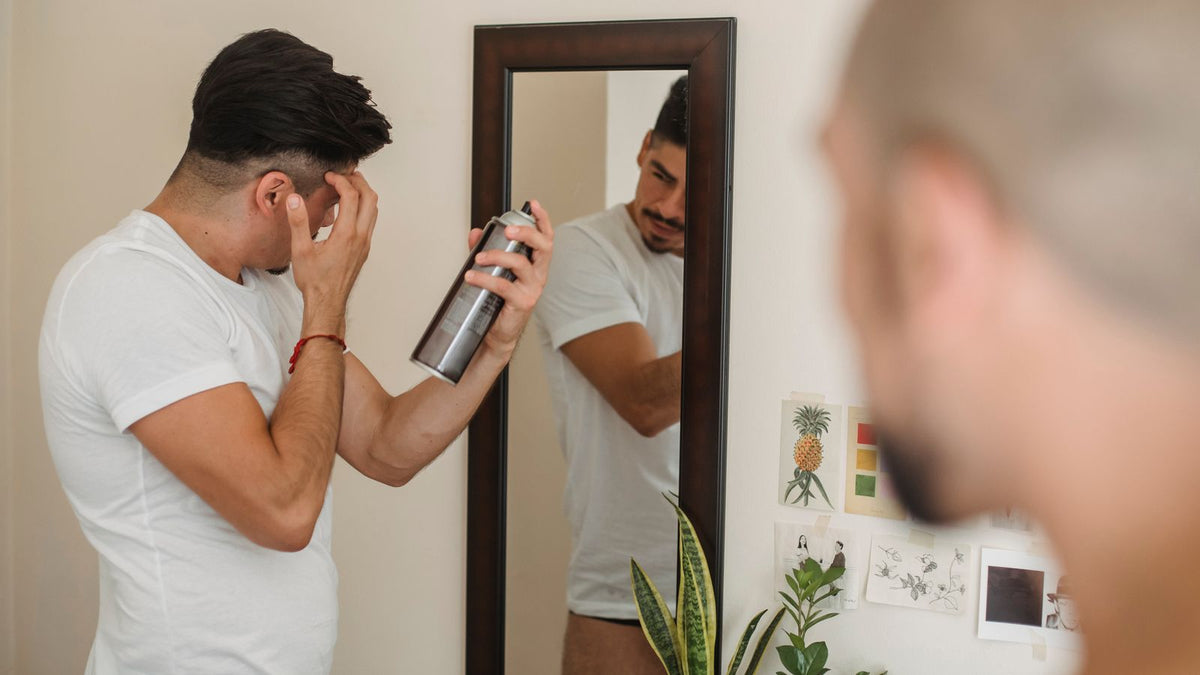
Gels, waxes and hairsprays do not cause hair loss in the usual sense, because the polymers, waxes and resins they contain sit on the outside of the hair shaft and wash away, so any harm they do comes from residue, scalp irritation, breakage or the tight styles they hold in place.
A styling product works by leaving a film on the strand. Gel and hairspray dry into a hard shell that glues neighbouring hairs together, wax and pomade leave a soft, restylable coating, and clay adds grip and a matte finish. None of that reaches the follicle, which sits beneath the skin and is the part that decides how many hairs you grow.
What people notice is hair in the sink or on the brush on styling days. The NHS says it is normal to lose between 50 and 100 hairs a day, often without noticing, and a styled head sheds those hairs at the evening wash all at once, which can look alarming. Experts do not entirely agree on how much to worry about hair products. A 2001 review in the journal Dermatology argued that the health hazards of hair care products had been overemphasised by the media, while a 2025 review in Dermatitis warned that scalp contact dermatitis from personal care products is easily missed because it can show up as hair thinning, itch and eczema-like patches rather than an obvious rash.
Put together, the evidence points to four genuine risks worth checking before you blame the product for thinning:
- Residue. Product that is never fully washed out builds up on the scalp and lengths and can flake like dandruff.
- Irritation or allergy. Fragrance and preservatives are the ingredients most often behind a reaction.
- Breakage. Hair set stiff by gel or spray snaps when a brush is dragged through it.
- Tension. A hard slick-back, a tight bun or a high ponytail pulls on the hairline every day.

If gel is your main product, our guide on whether hair gel is bad for your hair goes through a typical gel ingredient by ingredient, including which alcohols dry the hair and which ones condition it.
What do UK cosmetics rules say about styling product safety?
UK cosmetics rules say every gel, wax, mousse and hairspray sold in Great Britain must be safe for human health, checked by a qualified safety assessor before it goes on sale, and notified to the Office for Product Safety and Standards by a Responsible Person with a UK address, who must also report serious harmful effects.
The GOV.UK guidance, published in October 2021 by the Department for Business and Trade and the Office for Product Safety and Standards, covers England, Scotland and Wales and is based on Regulation (EC) No 1223/2009 on cosmetic products as amended after the UK left the EU. Its main requirements for anyone selling a styling product are:
- A safety report. Each product needs a cosmetic product safety report, part of which is a safety assessment written by a qualified safety assessor.
- A Product Information File. The file describing the product and its safety must be kept for 10 years after the last batch was sold.
- Notification. The Responsible Person must tell the Office for Product Safety and Standards about the product before it is made available to consumers.
- Honest claims. Labelling and advertising must not imply a product has characteristics or functions it does not have, and the Responsible Person must be able to prove the claims made.
Those rules explain why a mainstream hairspray from a high street shop is very unlikely to be quietly damaging your follicles. What a safety assessment cannot do is promise that no individual will react. Allergy is personal: the same fragrance that thousands of people use without trouble can give one person a sore, itchy scalp. So a product can be safety assessed and still be wrong for you, and both facts are true at once.
Is it hair loss, shedding or breakage after heavy styling?
Hair loss, shedding and breakage look alike in a plughole but have different causes: hair loss means follicles producing finer or fewer hairs, shedding means more whole hairs leaving the growth cycle at once, and breakage means strands snapping along their length, which is the one styling habits most often cause.
Sorting out which one you have is the most useful thing you can do before spending money, because each has a different next step.
| Clue | Hair loss | Shedding | Breakage |
|---|---|---|---|
| What you find | Fewer hairs and finer, shorter ones over months | Whole hairs, full length, coming out from the root | Short snapped pieces with no root end |
| Where it shows | Widening parting, crown or receding temples | All over, often noticed at washing | Frizzy, uneven lengths and flyaways on top |
| Common triggers | Genes, hormones, age; constant tension on the hairline | The NHS lists illness, stress, weight loss and iron deficiency | Brushing stiff hair, high heat, rough towelling |
| Can styling play a part? | Only through tight styles | No, but styled hair sheds in a clump at the evening wash | Yes, this is the usual link |
If what you collect is mostly short, blunt pieces, breakage is the likely story, and the fix is in how you handle styled hair rather than in the product label. If it is full-length hairs in larger numbers than your normal, or a parting that is clearly wider than a year ago, the product is probably not the cause and a conversation with your GP comes first.
Could product build-up be mistaken for dandruff?
Product build-up is often mistaken for dandruff, because dried gel, wax and hairspray lift off the scalp as pale flakes, but residue feels waxy or gritty, coats the hair as well as the skin and clears after a thorough wash, whereas dandruff keeps coming back despite regular shampooing.
The American Academy of Dermatology says that if you see flakes in your hair, common reasons could be not shampooing frequently enough, or not using the right conditioner, oil or scalp moisturiser for your hair type. The NHS adds that dandruff is not caused by poor hygiene, although it may be more obvious if you do not wash your hair regularly, and suggests a pharmacy anti-dandruff shampoo for up to 4 weeks.
| Sign | Product residue | Dandruff | Contact dermatitis |
|---|---|---|---|
| Flakes | Clear or white bits, on the lengths as well as the scalp | Small white flakes on the scalp and shoulders | Red, irritated skin; the NHS says it may blister and crack |
| Feel | Waxy, tacky or gritty roots | Can itch | Itchy and uncomfortable |
| After a thorough double wash | Gone until you next style | Back within days | Still red or sore |
| First step | Better wash-out and less product at the roots | Anti-dandruff shampoo for up to 4 weeks | Stop the product; pharmacist or GP |
The NHS dandruff page itself lists red, irritated skin, sometimes with blisters and cracked skin, from a reaction to products such as hair dye, sprays, gels or mousses as a sign of contact dermatitis rather than dandruff. If dry shampoo rather than gel is your main layer, our Woking guide to dry shampoo build-up and an itchy scalp covers that product in detail.
Can a styling product give you an itchy or allergic scalp?
A styling product can give you an itchy or allergic scalp, either through irritant contact dermatitis, where an ingredient directly inflames the skin, or allergic contact dermatitis, where the immune system reacts to something such as a fragrance or preservative, usually within a few hours or days of using it.
The NHS says contact dermatitis is most commonly caused by irritants such as soaps, detergents, solvents or regular contact with water, and that the allergic type is less common and can be triggered by substances found in products such as cosmetics. The British Association of Dermatologists lists fragrances, preservatives and hair dye among the personal care ingredients that commonly cause allergic contact dermatitis, and DermNet names methylisothiazolinone, a preservative used in wash-off hair products, as a frequent cause of an itchy red face.
Fragrance comes up again and again in the research:
- Best-selling products. A 2021 study of best-selling shampoos, conditioners and styling products from three large US retailers found fragrance was the most common allergen in the products marketed for Afro and textured hair, with preservatives such as methylisothiazolinone and formaldehyde releasers among the other notable allergens.
- Styling for braids and wigs. A 2025 review of styling practices around synthetic hair found fragrance was the most common allergen in the styling products surveyed.
- Where reactions show. A 2018 review from a Brussels university hospital noted that reactions to hair products appear on the scalp and also on the back and front of the neck, the forehead, around the eyes and on the cheeks.
That last point matters for hairspray and gel users, because the rash often turns up on the hairline, neck or eyelids rather than under the hair, so people do not connect it with the can on the shelf. Working out the exact trigger takes patch testing, which the British Association of Dermatologists says is carried out in a specialist dermatology department, with the skin checked again after a further 2 days. Your GP can refer you if it is needed.
If your scalp reacts to a new product
Stop using it, wash it out with a gentle shampoo and lukewarm water, and photograph the ingredients list and the skin. Do not swap straight to another heavily fragranced product. If the skin is red, swollen, blistered or cracked, or the itch keeps coming back, speak to a pharmacist or your own GP.
Get a discount on the fine, thinning hair range
Join the Watermans mailing list and we will email a discount code straight to your inbox, so you can try the fine, thinning hair range for less. Vegan, made in the UK, over 6.5 million bottles sold since 2012.
Do slicked-back styles and tight looks put your hairline at risk?
Slicked-back styles and other tight looks can put your hairline at risk when the hair is pulled hard and often, because constant tension on the follicles causes traction alopecia, which the British Association of Dermatologists says shows where the pull is strongest, often the front and sides with a tight ponytail.
The British Association of Dermatologists names tight hairstyles as the commonest cause of traction alopecia and lists tight ponytails, tight buns and tight braids among the usual culprits. DermNet adds cornrows, weaves, hair extensions, chemical relaxers, rollers and even the weight of very long hair, and notes that the condition was first described in 1907 in people in Greenland who had lost hair along the hairline. A 2018 review in Clinical, Cosmetic and Investigational Dermatology estimated that traction alopecia affects one third of women of African descent who wear high-tension styles for long periods, and named tight buns or ponytails, weaves or extensions and tight braids as the highest-risk styles.

The gel is not the problem here; the pulling is. A loose, textured slick-back held with a light cream puts little strain on the hairline, while hair dragged tight against the scalp and set rock hard, day after day, keeps the same follicles under load. The good news from the British Association of Dermatologists is that early traction hair loss can grow back fully once the tight styling stops. The warning is that long-standing pulling can permanently destroy the follicles, so the time to change is when you first notice thinning at the temples or edges.
- Loosen the look. Comb hair back with your fingers rather than a fine-tooth comb pulled flat against the scalp.
- Move the tension. Change your parting and where a bun or ponytail sits, and use soft fabric bands rather than thin elastics.
- Give it nights off. Let the style down before bed so the hairline rests for several hours a day.
- Watch the edges. Small bumps, soreness or broken hairs along the hairline after styling are the early signs.
Does brushing stiff, product-coated hair cause breakage?
Brushing stiff, product-coated hair does cause breakage, because hair set rigid by gel or hairspray cannot flex as a brush drags through it, so the strand snaps along its length instead, leaving short broken pieces on the sink that people often mistake for hair loss.
The American Academy of Dermatology describes wet hair as delicate and recommends a wide-tooth comb rather than a brush to detangle it, and warns that roughly rubbing hair dry with a towel can cause damage. The same principle applies to hair set hard with product: wait until it is completely dry, then scrunch it between your palms to break the cast, or wash it out rather than brushing it out.
Heat is the other half of the breakage story for anyone who blow-dries to get volume before styling. The AAD advises limiting blow-drying and hot tools, using low or medium heat settings and applying a product that protects hair from heat. For fine hair that currently relies on heavy product to look full, a low-heat blow-dry with the roots lifted against the way they fall often gives more lasting volume with far less on the hair.

Protect Me® Heat Protection Spray
A leave-in spray with niacinamide, lupine protein, rosemary and sunflower oil that helps guard hair against heat up to 230°C. Its product page describes it as a lightweight leave-in with no stiffness or build-up, so it suits fine hair before a root-lifting blow-dry. £13.95, vegan and made in the UK according to its product page.
For a fuller routine that cuts snapping from towels, tools and tight bands, see our guide on how to reduce hair breakage at home.
How do you wash styling products out properly?
Washing styling products out properly means brushing out loose residue while the hair is dry, soaking the hair fully, massaging shampoo into the scalp with your fingertips, lathering a second time after wax or heavy gel, rinsing well in lukewarm water and conditioning only the lengths and ends.
The American Academy of Dermatology advises applying shampoo to the scalp rather than the whole length, and washing according to how quickly your hair gets dirty or oily: people with straight hair and an oily scalp may want to shampoo every day, while dry, textured, curly or thick hair can go longer, at least once every 2 to 3 weeks. Anyone styling with gel or wax daily falls into the first group, whatever their scalp is like, because the product needs removing.
- Break the cast first. Scrunch or finger-comb dry, set hair before it gets wet, so you are not dragging a brush through a hard shell.
- Soak thoroughly. Wax and pomade repel water, so give the hair a thorough soak before any shampoo goes on.
- Lather at the scalp. Use your fingertips, not your nails, and let the rinse carry lather through the lengths.
- Go again if it squeaks less than it should. A second lather is normal after wax, clay or a heavy hold gel.
- Condition the ends only. Fine hair only needs conditioner from the mid-lengths down, so roots stay light for styling.
- Clean your tools. Brushes and combs collect product and put it straight back onto clean hair.

Some people like a dedicated clarifying shampoo every week or two for heavy build-up. If you try one, follow the label and condition the ends afterwards, because stronger cleansers can leave lengths feeling dry. After a wedding or other big event set with plenty of hairspray, our Dewsbury guide to big-event hair for fine or thinning hair walks through taking the style down pin by pin before you wash.

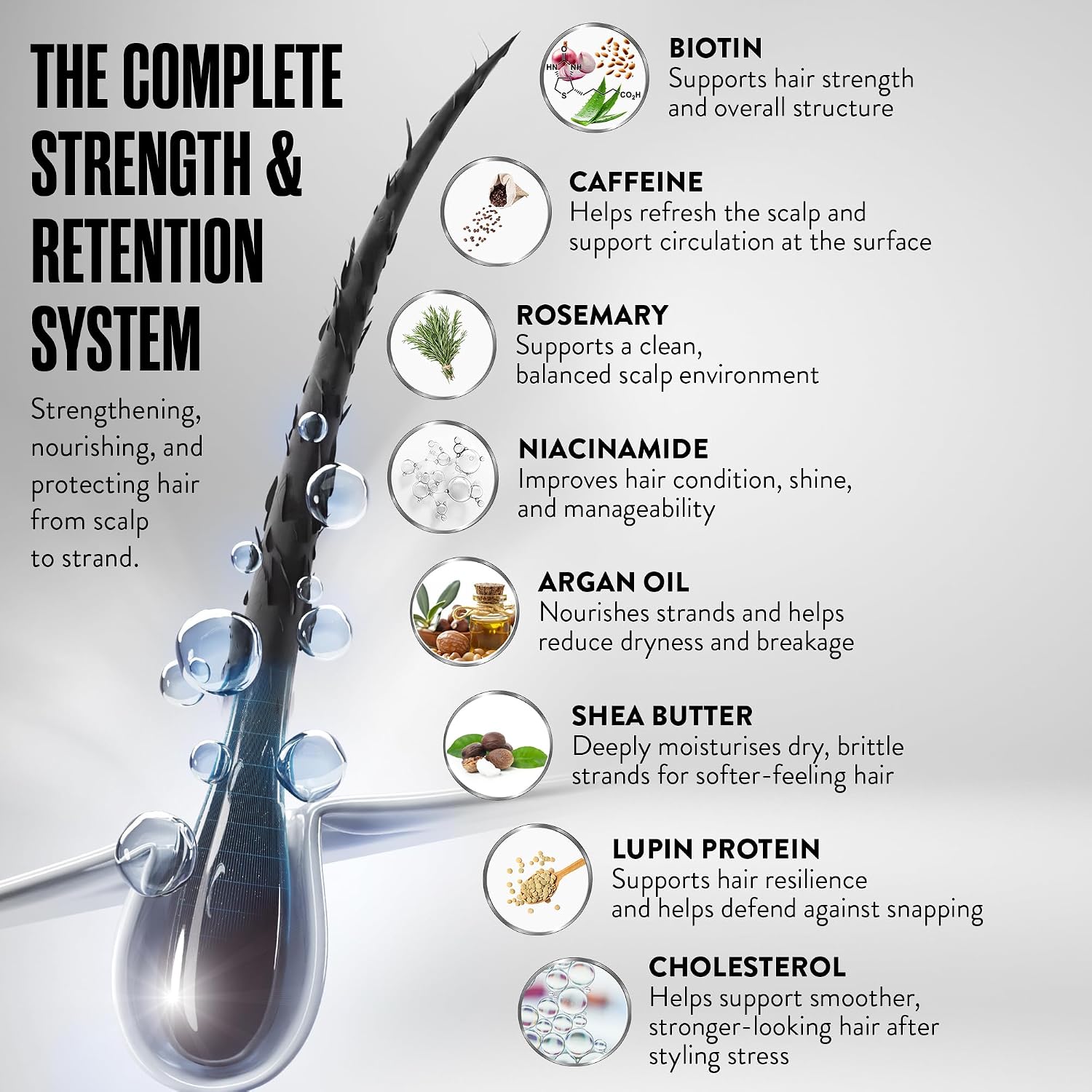
A sulfate-free 250ml shampoo with biotin, caffeine, rosemary and niacinamide, £14.95. Massage it into the scalp, leave it for the 3 to 4 minutes its product page suggests, then rinse well; lather twice after wax or heavy gel. Designed for fine, weak or breakage-prone hair, it helps hair look and feel fuller.
Which styling products suit fine or thinning hair best?
Fine or thinning hair usually looks best with light, flexible products such as mousse, texture spray and a small amount of matte paste or clay, because heavy wax, wet-look gel and glossy pomade clump strands into thick sections and show more scalp between them.
The American Academy of Dermatology advises choosing hair care products made for your hair type, and for fine hair that mostly means less weight and less shine. Start with a small amount, warm it between your palms, and work it through the lengths rather than pressing it onto the scalp.
| Product | Hold and finish | On fine or thinning hair | Washing out |
|---|---|---|---|
| Mousse | Light, flexible, adds body at the root | Usually the kindest choice | Easy with one lather |
| Texture or sea salt spray | Light, matte, piecey separation | Good, but can feel dry on the ends | Easy |
| Matte paste or clay | Medium, matte, restylable | Good in small amounts | Often needs a second lather |
| Gel | Firm, sets hard, can shine | Wet-look gel clumps strands and shows scalp | Straightforward, but never brush it out |
| Wax or pomade | Pliable, glossy | Weighs fine hair down and looks greasy fast | The hardest to remove |
| Hairspray | Surface hold, sets on contact | Fine as a light final mist from arm's length | Easy, but brushing through it snaps hair |
Men with thinning hair on top face the same choices at the barber's chair; our Basildon guide to haircuts and styling for men with thinning hair covers matte products and how to brief your barber.
Where the scalp shows through despite a lighter product, disguising the gaps can do more for how your hair looks than any styling cream. Hair building fibres cling to existing hairs and add visual density without the weight of a heavy wax.

Wool-derived keratin fibres in a 23g tub, £19.95, in a range of shades. Shake them over thin areas of dry, styled hair and pat them in; the product page describes them as resistant to sweat, rain, wind and humidity.
When should itch, redness or patches send you to your own GP first?
Itch, redness or patches should send you to your own GP first when the scalp is red, swollen, blistered or cracked, when flakes survive 4 weeks of anti-dandruff shampoo, when hair comes out in patches or handfuls, or when a reaction keeps coming back, because those signs need a medical opinion rather than a new product.
The NHS advises seeing a GP if dandruff has not improved after at least 4 weeks of anti-dandruff shampoo, if the scalp is very itchy, red or swollen, or if flaky, itchy patches appear on the face or body. For contact dermatitis it recommends a GP for persistent, recurrent or severe symptoms, and says a GP may refer you to a dermatologist for further tests. For hair loss, the NHS advises seeing a GP to get an idea of what is causing it before thinking about going to a commercial hair clinic.
Speak to your own GP first if
Your scalp, hairline, neck or eyelids are red, swollen, blistered, weeping or cracked after using a product; flakes or itch have not settled after 4 weeks of pharmacy shampoo; hair is coming out in round patches or handfuls; the hairline is receding with soreness or bumps where a tight style sits. A pharmacist is a good first stop for a mild rash or flaking.
Getting those checks done first is not a detour. It means that if you do go on to see a trichologist in Chester, you arrive knowing whether allergy, a skin condition or a hormone issue has already been looked at, and the time you pay for goes on your routine rather than on questions only a doctor can answer.
When is a trichologist in Chester worth it for styling-related problems?
A trichologist in Chester is worth it for styling-related problems once your GP or a pharmacist has ruled out skin conditions and allergy, but you still have breakage, residue, a thinning hairline or shedding you cannot explain, and want someone to go through your products and habits in detail.
Most trichologists are hair and scalp specialists rather than doctors, which shapes what a session can realistically offer:
- What a trichologist can do. Take a full history of your products, styling and washing routine, look closely at your scalp and hair, often under magnification, and track change over several months.
- What they cannot do. Arrange blood tests, patch testing or medicines. Anything that needs those goes back to your GP.

Whether you live inside the city walls, in Hoole, Handbridge or Upton, or commute in from Ellesmere Port or across the border in Wales, the checks are the same. Take your products with you, or photos of their ingredients lists, and a note of how often you use each one and how tightly you wear your hair. That turns a general chat into a useful review.
We sell hair care, so weigh our view accordingly. Watermans runs no clinics and cannot look at your scalp or recommend a practitioner. Watermans is a UK hair care brand that has sold over 6.5 million bottles since 2012, and our range is cosmetic: it helps hair look and feel fuller and healthier and reduces breakage, but it cannot change what happens inside the follicle.
How do you check a trichologist in Chester before you pay?
You can check a trichologist in Chester before you pay by searching the Institute of Trichologists' Find a Trichologist register, asking whether they belong to The Trichological Society or another recognised professional body, and asking plainly what the session covers, what it costs and when they would send you back to your GP.
The Institute of Trichologists keeps a UK register that you can search through its Find a Trichologist page. The Trichological Society describes itself as an independent, autonomous professional body for hair and scalp science. Membership of a professional body is the simplest check you can make. For a styling-related problem, four questions tell you a lot:
- Will you go through my styling products, washing routine and the way I wear my hair, not just look at my scalp?
- If this looks like an allergy or a skin condition, will you send me back to my GP?
- How many sessions do you expect, and what does each one cost?
- Are you recommending products you sell, and can I keep using my own?
A good practitioner will welcome those questions and will be comfortable telling you when the answer is simply to change a habit.
What are the most frequently asked questions about styling products and hair loss?
Should I see a trichologist in Chester about hair loss from styling products?
Not straight away. Styling products rarely cause true hair loss, so first check whether you are seeing breakage, residue or a scalp reaction. See a pharmacist or GP for redness, blistering, patches or itch that will not settle. A registered trichologist helps most once medical causes are ruled out and thinning or breakage is still unexplained.
Does hairspray make your hair fall out?
Hairspray does not make healthy hair fall out, because it only coats the outside of the strand. The damage people link to it comes from brushing through a hard set, which snaps hair, and occasionally from an allergic reaction to fragrance or preservatives, which can show on the hairline, neck or eyelids.
Is wax or gel worse for thinning hair?
For thinning hair, heavy wax and wet-look gel both tend to clump strands and show more scalp. Wax is harder to wash out and weighs fine hair down, while gel sets hard and snaps hair if it is brushed out. A small amount of mousse, texture spray or matte paste usually looks fuller.
Why does my scalp itch after using a new gel or mousse?
An itch after a new gel or mousse can be irritation from an ingredient or an allergic reaction, most often to fragrance or a preservative, and it usually appears within hours or days. Stop the product and wash it out. See a pharmacist or GP if the skin is red, swollen, blistered or cracked, or the itch keeps returning.
Can a tight slicked-back style cause a receding hairline?
A slicked-back style worn tight every day can contribute to traction alopecia, hair loss caused by constant pulling, which often shows at the front and sides. The British Association of Dermatologists says early traction hair loss can grow back fully once the tension stops, but long-standing pulling can be permanent, so loosen the style early.
How often should I wash out styling products?
Wash styling products out whenever they have built up, which for daily gel or wax users often means most days. The American Academy of Dermatology says straight hair with an oily scalp may need shampoo daily, and a second lather is normal after wax, clay or a heavy hold gel.
Are styling products sold in the UK safety checked?
Yes. GOV.UK guidance says cosmetic products sold in Great Britain must be safe for human health, checked by a qualified safety assessor, and notified to the Office for Product Safety and Standards before sale. A safety assessment covers the general population, so an individual can still be allergic to a specific ingredient. Nearby in Cheshire, our Winsford guide explains the difference between fine hair and thinning hair.
Sources & references
- GOV.UK (Department for Business and Trade and OPSS), Making cosmetic products available to consumers in Great Britain
- NHS, Hair loss
- NHS, Dandruff
- NHS, Contact dermatitis
- British Association of Dermatologists, Contact dermatitis
- British Association of Dermatologists, Traction alopecia
- DermNet, Traction alopecia
- DermNet, Allergic contact dermatitis
- American Academy of Dermatology, Tips for healthy hair
- Tawfik M et al. Allergen Content of Best-Selling Ethnic Versus Nonethnic Shampoos, Conditioners, and Styling Products. Dermatitis, 2021
- Collins D, Yu J. Contact Sensitization to Allergens in Synthetic Hair and Related Hair Practices: A Review. Dermatitis, 2025
- Tennstedt D, Herman A, Lachapelle JM. Adverse effects of hair care in users (in French). Ann Dermatol Venereol, 2018
- Billero V, Miteva M. Traction alopecia: the root of the problem. Clin Cosmet Investig Dermatol, 2018
- Trüeb RM. The value of hair cosmetics and pharmaceuticals. Dermatology, 2001
- The Institute of Trichologists, Find a Trichologist
- The Trichological Society
What is the bottom line on trichologist in Chester?
Gels, waxes and hairsprays coat the outside of the hair and are safety assessed before sale in Great Britain, so they are rarely the cause of true hair loss. The real risks are residue, fragrance or preservative reactions, breakage from brushing stiff hair and tension from tight styles. Wash product out properly, go lighter on fine hair and loosen tight looks. Take red, blistered or patchy skin to your own GP, and save a trichologist in Chester for thinning or breakage that stays unexplained after those checks.
On the days you style, a sulfate-free shampoo such as Grow Me lifts gel, wax and hairspray from the scalp gently, with biotin, caffeine and rosemary in a 250ml bottle to help fine hair look and feel fuller.
Watermans products are 100% cosmetic and do not treat medical hair loss. Individual results may vary.