Trichologist in Eastbourne: Protecting a Thinning Parting or Scalp From the Sun
A wide parting, a thinning crown or a shaved head all leave bare scalp skin facing straight up at the summer sun.
If you are looking for a trichologist in Eastbourne because a thinning parting, crown or shaved head keeps catching the sun, start with the NHS basics: shade between 11am and 3pm from March to October, a wide-brimmed hat, and a sunscreen of at least SPF 30 with 4 or more stars of UVA protection on any scalp still exposed. Ordinary sunburn usually settles within 7 days. A patch that stays rough, scaly or sore, or starts to change, belongs with your own GP, while a registered trichologist can help with the hair and scalp routine around it.
Our heat protection spray
Protect Me® Heat Protection Spray, £13.95. A leave in spray that shields hair from heat styling, helps control frizz and keeps colour looking fresher for longer.
Key takeaways
- The NHS says you can burn in the UK even when it is cloudy, and that sunscreen should go on the head if your hair is thinning or gone, although a wide-brimmed hat is better.
- Our average of the Met Office's Eastbourne station records for 1991 to 2020 comes to about 1,890 hours of sunshine a year, well above the Met Office's UK-wide figure of about 1,400 hours.
- A 1992 British Journal of Dermatology study found flat caps shaded little beyond the top of the head and forehead, and that brims wider than 7.5 cm were needed to shade the nose and cheeks properly.
- UV also weathers the hair fibre, fading colour and roughening the surface, but that is a separate problem from scalp sunburn and needs different care.
- A rough, scaly scalp patch that lingers, bleeds, grows or changes colour is one for your GP, not for a shop shelf or a trichologist in Eastbourne.
Why does a thinning parting, crown or shaved head burn so easily?
A thinning parting, crown or shaved head burns easily because the hair that normally shades the top of the head is sparse or gone, so the scalp takes the most direct overhead sun of any part of the body, and many people only notice when it stings in the shower that evening.
The British Association of Dermatologists (BAD) lists "any scalp areas without hair", such as those left by balding, among the sun-exposed sites where long-term sun damage shows up, alongside the face, ears, forearms and backs of the hands. The NHS sun-safety page makes the same point from the prevention side: sunscreen belongs on the head if you have thinning or no hair, but a wide-brimmed hat is the better option. For the lengths rather than the skin, our guide to hair sun protection covers what a leave-in can and cannot do.
Fair skin is the most vulnerable. DermNet notes that fifteen minutes of midday sun can burn fair skin, while darker skin may tolerate hours. The NHS asks you to take extra care if you have pale, white or light brown skin, freckles, red or fair hair, many moles, or a family history of skin cancer, and it stresses that people of every skin tone should still avoid burning. A fresh crop, a new close shave or a parting that has widened over a few years all change how much skin the sun can reach, so the habits that worked five summers ago may no longer be enough. If you are weighing up a visit to a trichologist in Eastbourne about thinning, raise sun exposure too, because the two concerns now overlap.

How sunny is Eastbourne, and when is the sun strong enough to burn?
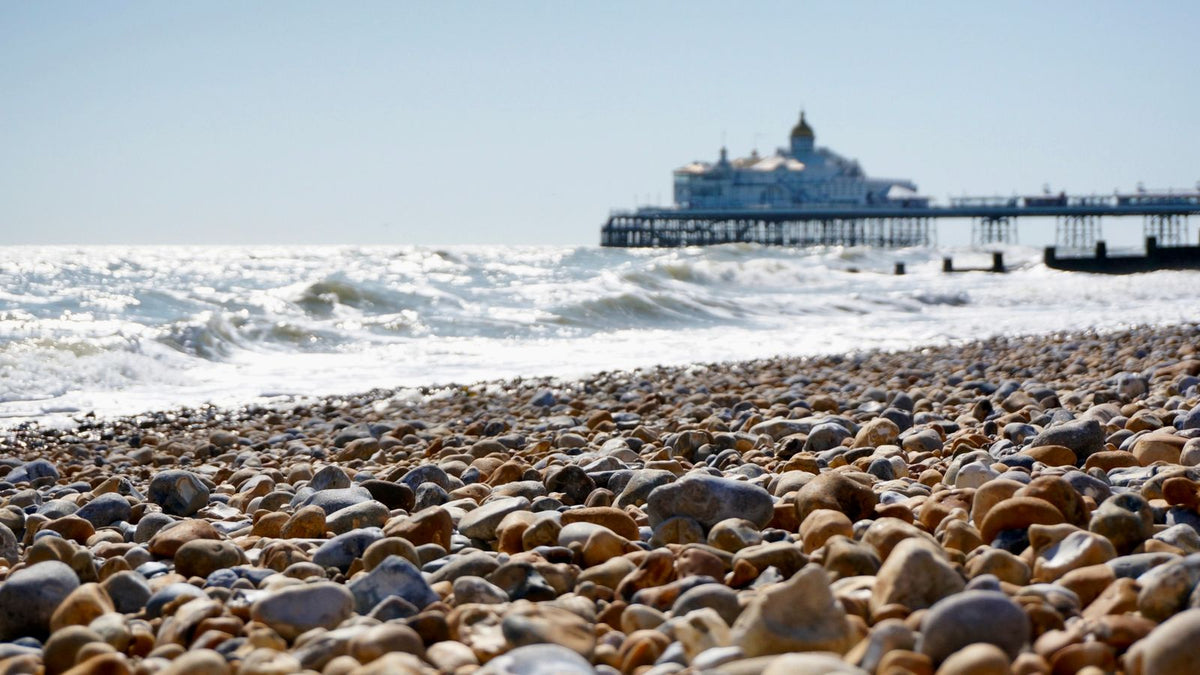
Eastbourne is sunnier than the UK as a whole: averaging the Met Office's published monthly records for its Eastbourne weather station across 1991 to 2020 gives about 1,890 hours of bright sunshine a year, against roughly 1,400 hours for the Met Office's UK-wide series and about 1,670 hours for south-east and central southern England.
Those regional figures are averages across whole areas rather than readings from one station, so read the comparison as a guide, but the gap is wide. The summer months carry most of it, and they are also the months when the midday sun is highest overhead.
| Month | Average bright sunshine at the Eastbourne station, 1991 to 2020 |
|---|---|
| April | About 203 hours |
| May | About 236 hours |
| June | About 239 hours |
| July | About 252 hours |
| August | About 233 hours |
| September | About 172 hours |
Sunshine hours are not the same as UV strength, and here the sources differ slightly. The NHS says the sun is strongest in the UK between 11am and 3pm from March to October, and suggests protecting your skin whenever the UV index on a weather app reads 3 or more. Cancer Research UK puts the damaging season at mid-March to mid-October. DermNet, writing from New Zealand, says sunburn risk usually peaks between 10am and 2pm and suggests limiting time outdoors from about 10am to 4pm in summer. The practical answer is the same either way: the middle of a summer day is when a bare parting is most at risk, and the UV index is a better guide than the temperature.
Cloud and sea breezes fool people. The NHS is clear that you can burn in the UK even when it is cloudy, and that water reflects UV rays, increasing your exposure, while its cooling effect can hide the fact that you are burning. A cool, breezy walk along the seafront can feel completely safe while the top of your head quietly reddens.

What does sunburn on the scalp look and feel like?
Sunburn on the scalp looks and feels like sunburn anywhere else on the body: hot, sore skin that turns red or pink on white skin, may show little colour change on black or brown skin, and often flakes or peels a few days later, which can look like a sudden bout of dandruff.
The timing is predictable. DermNet says redness usually appears 2 to 6 hours after exposure, peaks at 12 to 24 hours and fades over 3 to 7 days, with peeling around 4 to 7 days afterwards. The NHS says sunburn usually gets better within 7 days and that severe sunburn can blister. On the scalp you may also notice tenderness when you brush, a tight feeling along the parting, or soreness under a hat band.
The NHS self-care advice translates easily to the scalp:
- Get out of the sun as soon as you notice, and keep the area covered from direct sunlight until the skin has fully recovered.
- Cool it with a cool shower or a damp towel. On the scalp, rinse with cool to lukewarm water rather than hot.
- Soothe it with an aftersun or an unperfumed moisturiser. Skip fragranced styling sprays, dry shampoo and hot tools while the skin is burnt.
- Drink plenty of water and avoid alcohol, and take paracetamol or ibuprofen for pain if you need to, following the leaflet.
- Leave it alone. No petroleum jelly or ice packs, no picking at the peeling skin, and no tight hat pulled over a burnt scalp.
A pharmacist can suggest suitable products for ordinary sunburn and tell you whether you need to see anyone else.
Get help the same day if, after time in the sun:
- the burnt skin is blistered or swollen
- your temperature is very high, or you feel hot, cold or shivery
- you feel very tired, dizzy or sick
The NHS advises contacting NHS 111 or asking your GP surgery for an urgent same-day conversation, because severe sunburn can lead to heat exhaustion and heatstroke.
What does NHS sun-safety advice mean for your scalp?
NHS sun-safety advice for the scalp comes down to three layers used together: shade between 11am and 3pm from March to October, clothing that includes a wide-brimmed hat, and a sunscreen of at least SPF 30 with at least 4-star UVA protection on any skin a hat leaves exposed, reapplied every 2 hours.
SPF measures protection against UVB, the main cause of reddening, while the star rating, shown on UK sunscreens up to 5 stars, measures UVA protection. The NHS also accepts the letters UVA in a circle as a sign that a product meets the EU standard. Its guidance says not to rely on sunscreen alone, and the BAD leaflet on sun-damaged skin puts it plainly: no sunscreen can offer 100% protection.
- Check the label. SPF 30 or more, 4 or 5 stars of UVA protection, and in date: the open-jar symbol shows how many months it lasts once opened.
- Apply before you go. The NHS suggests applying twice if you will be out long enough to burn, 30 minutes before going out and again just before. The BAD suggests 15 to 30 minutes beforehand.
- Use enough. The NHS guide for adults is around 6 to 8 teaspoons to cover the whole body, and it says most people use too little. On a parting, work along the line with a fingertip rather than relying on one quick mist.
- Reapply. Every 2 hours, and straight after swimming, towel drying or sweating, even with a water-resistant product.
- Remember the edges. Ears, the back of the neck and the hairline burn alongside the scalp, which is why the NHS favours a hat that shades the face, neck and ears.
Shade is the layer most people skip. On a summer day in Eastbourne that can mean timing a seafront walk for the morning or late afternoon, sitting under a parasol or a shelter rather than on open shingle at lunchtime, and keeping the hours around midday for indoor plans.

Which protects a thinning scalp best: a hat, a scalp sunscreen or a new parting?
A wide-brimmed hat protects a thinning scalp best, because a good brim covers the whole top of the head and also shades the face, ears and neck, while sunscreen sprays, lotions or powders are the backup for skin the hat misses, and a change of parting simply moves where the exposed line falls.
The evidence on hats is old but still useful. Diffey and Cheeseman measured UV under different hats on model heads for the British Journal of Dermatology in 1992. Flat caps with a small brim gave negligible protection everywhere except the top of the head and the forehead. Baseball-style caps shaded the nose well but were relatively ineffective elsewhere on the face. Only brims wider than 7.5 cm gave reasonable protection around the nose and cheeks. Any cap covers the patch of scalp it sits on, but the ears and neck are left to fend for themselves.
Fabric matters too. DermNet rates a UV protection factor (UPF) of 30 or more as good protection, notes that tightly woven and darker fabrics let less UV through, and warns that wet material is often less protective, so a hat soaked in a sea swim is doing less than you might think. If you are considering moving the parting itself, our guide to changing your parting covers how to retrain one.
| Option | What it covers | Watch out for |
|---|---|---|
| Wide-brimmed hat, brim over 7.5 cm | Whole scalp, face, ears and neck | Can lift off in a seafront breeze; a chin cord helps |
| Baseball cap | The scalp under it and the nose | Ears, neck and the sides of the face stay exposed |
| Flat cap or small brim | Top of the head and forehead | Negligible protection elsewhere in the 1992 measurements |
| Sunscreen lotion or stick along the parting | Exposed lines of skin a hat cannot reach | Needs SPF 30 or more, 4-star UVA and reapplying every 2 hours |
| Scalp sunscreen spray or mist | Quick cover through the hair | The NHS says most people apply too little sunscreen, and a light mist makes that easy |
| Powder with a stated SPF | Cover without a greasy feel | Only counts if the label shows an SPF and a UVA rating; coverage can be patchy |
| Changing your parting | Moves the exposed line so hair lies over the old one | Protects nothing on its own; still needs a hat or sunscreen |
| Hair building fibres | Make thinning areas look fuller | A cosmetic concealer, not a sunscreen; do not count them as cover |
Sunscreen in the hair is the part people dislike, because lotions can leave fine strands flat and greasy. A practical split is a hat for long days out and sunscreen for the parting line, ears and neck, washed out gently at the end of the day. For whether wearing a hat daily affects the hair itself, see our guide on whether wearing a hat every day is bad for your hair.

How does UV damage the hair fibre, and how is that different from the scalp?
UV damages the hair fibre differently from the scalp: sunlight weathers the non-living keratin of the shaft, fading colour, dulling shine and roughening the surface, whereas scalp sunburn is an inflammatory reaction in living skin that, repeated over years, raises the risk of sun-damaged patches and skin cancer.
A 2015 review by Dario and colleagues in the Journal of Photochemistry and Photobiology B lists colour, mechanical properties, lustre, protein content and surface roughness among the hair properties that sunlight harms. It also notes that there are no regulated efficacy tests for hair sun protection comparable to SPF testing for skin, so a "UV protection" line on a hair product cannot be compared like an SPF number. A 2020 laboratory study by Millington and Marsh found that UVA shone on wet white hair produced significant amounts of hydroxyl radicals, the reactive molecules behind oxidative damage, and pointed out that UVB makes up only 0.3% of the sunlight reaching the ground. The work was done in a lab, but it is one more reason to cover wet hair after a swim. Sunlight is not the only thing in the air that weathers hair; our Scunthorpe guide to dust, traffic fumes and your hair covers the evidence on air pollution.
Grey and white hair can also take on a yellowish tint in strong sun, a process the same team measured as photoyellowing. For the lengths, the answer is conditioning and a physical barrier rather than an SPF: a hat covers the hair as well as the scalp, and a leave-in product on the mid-lengths and ends helps them feel smoother. For keeping colour bright through the summer, see our guide on caring for dyed hair and keeping colour bright, and for salt water, chlorine and swim routines our Portsmouth guide to sea, sun and salt water hair goes deeper on the lengths.

A leave-in spray for mid-lengths and ends with niacinamide, panthenol, lupine protein and sunflower oil, £13.95 in September 2026. Its product page says it helps defend dyed hair from fading caused by styling heat and UV exposure. It conditions the lengths; it is not a sunscreen and does nothing for scalp skin.

Camellia & Black Castor Hair & Body Oil
A 100% natural oil with camellia and black castor oils, £24.95 in September 2026. Smooth a few drops through rough, sun-dried ends after washing to help them look glossier and feel softer, and keep it on the lengths rather than a burnt scalp.
Get a discount on the thinning hair range
Join the Watermans mailing list and we will email a discount code straight to your inbox, so you can try the thinning hair range for less. Vegan, made in the UK, over 6.5 million bottles sold since 2012.
Is it sun damage, breakage, shedding or hair loss?
Sun damage, breakage, shedding and hair loss are four different things: sun damage and breakage affect the hair fibre and leave short, rough or faded pieces, shedding releases whole hairs with a small bulb from across the scalp, and hair loss means the follicles themselves are changing, which is usually why the scalp became exposed in the first place.
- Hair breakage. The shaft snaps partway along its length, often at dry, weathered ends. Sun, salt, heat and rough brushing all add to it, and the follicle is untouched.
- Hair shedding. Whole hairs fall at the end of their growth cycle. The NHS says losing 50 to 100 hairs a day is normal. The BAD explains that about 15% of scalp hair is normally in the shedding phase, rising to 30% or more in telogen effluvium, often around 3 months after a trigger such as illness or major stress on the body, with that phase lasting 3 to 6 months.
- Hair loss. The follicles themselves change, as in male and female pattern baldness, which the NHS says usually runs in the family. That is the process that widens a parting or thins a crown, and it is why the scalp now needs sun protection it never needed before.
| What you see | Breakage | Shedding | Hair loss |
|---|---|---|---|
| What comes away | Short pieces with no bulb | Full-length hairs with a small bulb | Often little; the change shows as more visible scalp |
| Where | Lengths and ends | All over the scalp | Parting, crown or hairline |
| Link to summer sun | Weathered, rough ends snap more easily | Usually a trigger such as illness or stress, per the BAD | The reason more scalp is exposed to the sun |
| First step | Gentler handling, conditioning, a hat on long days | Usually settles; your GP if heavy or lasting | Speak to your own GP; a trichologist for routine and fibre checks |
If your main worry is the thinning itself, our guide to the early signs of a thinning crown is the deeper read. On the everyday side, a gentle shampoo that helps reduce breakage makes the most of the hair you already have.

A sulfate-free shampoo with caffeine, biotin, rosemary, niacinamide, lupine protein and argan oil, £14.95 in September 2026. It helps reduce breakage-related hair fall and leaves hair looking fuller. Wait until any sunburn has fully settled, because its caffeine and rosemary give a noticeable scalp tingle.
When does a sore, scaly or changing patch on the scalp need your GP?
A patch on the scalp needs your own GP when it is new, feels rough or scaly and does not settle, bleeds, grows, changes colour, becomes tender or develops into a lump, or when any area hurts, itches, bleeds, crusts or scabs for more than 4 weeks, which is the point NHS guidance sets.
The most common sun-related patch on a balding scalp is an actinic keratosis, also called a solar keratosis. The NHS describes these as dry, scaly patches of sun-damaged skin, usually 1cm to 2cm across, that can feel like sandpaper and range from skin-coloured to pink, red or brown. The BAD says they come from sun exposure over many years, are more common in older and fair-skinned people who burn easily, and usually appear several at a time. Both bodies are reassuring: the NHS says they are not usually serious, and the BAD describes the risk of one progressing to a type of skin cancer as very small. The NHS still asks you to get new or changing patches checked, in case something more serious is behind them.
Non-melanoma skin cancer is most common on sun-exposed skin, and the NHS names ultraviolet light as its most common cause and says it is more common in older people. Its symptoms page describes a growth or unusual patch that may be raised and smooth, bumpy, crusty, or flat and discoloured. A new mole, or a change in an existing one, may be a sign of melanoma. Cancer Research UK estimates that up to 9 in 10 melanoma cases in the UK could be prevented by staying safe in the sun and avoiding sunbeds. Finding skin cancer early makes it easier to deal with, the NHS says, so the habit that matters most is looking.
How to keep an eye on a scalp you cannot see
- Check every few months, as the BAD suggests, with a hand mirror and a bathroom mirror, or a phone photo of your crown and parting taken in the same light each time.
- Ask a partner, hairdresser or barber to tell you if they notice a rough, scaly, crusty or bleeding spot.
- Note the date you first saw a patch, so you can tell your GP how long it has been there.
- Tell your GP if you or your family have had skin cancer before, as the NHS asks.
At the surgery, the NHS explains, the GP may ask how much time you spend in the sun, look closely at the area and ask to take a photograph to send to a skin specialist. Being referred on is common and does not mean something is definitely wrong.
When should you see a pharmacist, your GP or a trichologist in Eastbourne?
In Eastbourne, match the person to the problem: a pharmacist for ordinary mild sunburn, NHS 111 or an urgent GP conversation for blistering, swelling or feeling unwell, your own GP for a scalp patch that lingers or changes, and a trichologist in Eastbourne for thinning, breakage and the everyday scalp care around them.
| Who | When | What they can do |
|---|---|---|
| Pharmacist | Mild, sore sunburn | Suggest aftersun and pain relief, and tell you if you need a GP |
| NHS 111 or an urgent GP conversation | Blistering, swelling, a high temperature, dizziness or sickness after sun | Same-day advice; severe sunburn can lead to heatstroke |
| Your GP | A patch that is new, scaly, bleeding, growing or changing, or sore for over 4 weeks | Look at it, photograph it for a skin specialist and arrange next steps |
| Registered trichologist | Thinning, breakage or a dry, flaky scalp once any burn has settled | Look at scalp and hair under magnification and review your routine and hat habits |
Eastbourne has an older population than most of England. The ONS census profile for 2021 puts the town's median age at 45, against 40 for England, and 12.1% of residents were aged 65 to 74 compared with 9.8% nationally. That matters here, because the BAD and the NHS both say sun-damaged patches and non-melanoma skin cancer are more common in older people. A long summer afternoon on the seafront is exactly when a bare crown is most exposed, whatever your age.
Trichologists are not medical doctors, so anything on the skin itself goes to a GP first. Where a trichologist in Eastbourne earns the fee is the hair side: working out whether you are seeing breakage, shedding or thinning, and building a routine that includes sun protection you will actually use. Check membership before you pay. The Institute of Trichologists runs a Find a Trichologist search, and the Trichological Society is the other main UK body; widen the search along the coast if nobody is listed close by. Three questions are worth asking first:
- Which register are you on, and where can I look you up?
- What will you do if you spot a scaly or changing patch on my scalp?
- Will you tell me which parts of my routine to keep, not just what to buy?
We make hair care and run no clinics, so we cannot look at your scalp, and you should weigh our view with that in mind. Watermans has sold over 6.5 million bottles since 2012 and makes its products in the UK. They are cosmetic: they help hair look and feel healthier and reduce breakage, but none of them is a sunscreen, and none replaces a hat or your GP.
What are the most frequently asked questions about protecting a thinning scalp from the sun?
Can a trichologist in Eastbourne look at a sunburnt or scaly scalp?
A trichologist is not a medical doctor, so an active burn goes to a pharmacist, and a scaly, bleeding or changing patch goes to your GP. Once the skin has settled, a registered trichologist can look at your scalp and hair under magnification and help with thinning, breakage and a routine that includes sun protection.
Can your scalp burn in the UK when it is cloudy?
Yes. The NHS says you can burn in the UK even when it is cloudy, and that the sun is strongest between 11am and 3pm from March to October. Check the UV index on a weather app and protect your scalp whenever it reads 3 or higher.
What sunscreen should go on a thinning parting?
The NHS recommends at least SPF 30 with at least 4-star UVA protection, applied generously and reapplied every 2 hours and after swimming or towel drying. It also says sunscreen should go on the head if your hair is thinning or gone, but that a wide-brimmed hat is better.
Does a baseball cap protect a bald or thinning head?
Only partly. In a 1992 British Journal of Dermatology study, flat caps shaded the top of the head and forehead but little else, and baseball caps shaded the nose but were relatively ineffective elsewhere on the face. A cap covers the scalp under it, but the ears and neck stay exposed.
Do hair fibres or root powders protect the scalp from the sun?
Not as sun protection. Hair building fibres are a cosmetic concealer that makes thinning areas look fuller, not a sunscreen. Only count a powder as protection if its label gives an SPF and a UVA rating, and still wear a hat on long days out.
How long does scalp sunburn take to settle?
The NHS says sunburn usually gets better within 7 days. DermNet describes redness peaking 12 to 24 hours after exposure and peeling around 4 to 7 days later, which on the scalp can look like dandruff. Get same-day help for blistering, swelling or feeling unwell.
Is a rough, scaly patch on a bald scalp serious?
Usually not, but it should be checked. A rough, scaly patch on sun-exposed skin is often an actinic keratosis, which the NHS says is not usually serious but carries a small chance of becoming skin cancer. See your GP if a patch is new, bleeds, grows, changes colour or becomes tender. If your question is about products or a routine rather than a medical one, you can talk to Gail Waterman, our co-founder, as an AI avatar on the Watermans homepage.
Does the sun damage hair as well as the scalp?
Yes, in a different way. A 2015 review found sunlight harms hair colour, mechanical properties, lustre, protein content and surface texture. That is weathering of the fibre, not a skin injury, so conditioning and a hat help the lengths, while shade, a hat and SPF look after the scalp.
Sources & references
- NHS, Sunscreen and sun safety
- NHS, Sunburn
- NHS, Actinic keratoses (solar keratoses)
- NHS, Symptoms of non-melanoma skin cancer
- NHS, Causes of non-melanoma skin cancer
- NHS, Hair loss
- British Association of Dermatologists, Actinic keratoses
- British Association of Dermatologists, Telogen effluvium
- British Association of Dermatologists (skinhealthinfo.org.uk), Sun awareness
- DermNet, Sunburn
- DermNet, Sun protection
- Cancer Research UK, Sun, UV and cancer
- Met Office, Eastbourne historic station data (monthly sunshine, averaged by us for 1991 to 2020)
- Met Office, UK areal sunshine series
- Met Office, England south-east and central south areal sunshine series
- Office for National Statistics, How life has changed in Eastbourne: Census 2021
- Diffey BL, Cheeseman J. Sun protection with hats. Br J Dermatol, 1992
- Dario MF, Baby AR, Velasco MV. Effects of solar radiation on hair and photoprotection. J Photochem Photobiol B, 2015
- Millington KR, Marsh JM. UV damage to hair and the effect of antioxidants and metal chelators. Int J Cosmet Sci, 2020
- The Institute of Trichologists, Find a Trichologist
- The Trichological Society
What is the bottom line on trichologist in Eastbourne?
A thinning parting, crown or shaved head needs the same sun care as your face, and in a town as sunny as Eastbourne that matters from spring to autumn. Use shade in the middle of the day, a hat with a brim wider than 7.5 cm, and SPF 30 with 4-star UVA on anything the hat misses. Look after sun-weathered lengths separately from the scalp. Take a sore, scaly or changing patch to your own GP, and save a trichologist in Eastbourne for the thinning, breakage and routine questions once the skin has settled.
For sun-faded, colour-treated lengths on seafront days, a leave-in heat protection spray such as Protect Me conditions the ends, while your hat and sunscreen look after the scalp.
Watermans products are 100% cosmetic and do not treat medical hair loss. Individual results may vary.