Trichologist in Sutton Coldfield: When Hair Worry Takes Over
Checking the mirror again, counting hairs in the plughole, scrolling symptoms at 2am? There is a calmer way through.
If you are searching for a trichologist in Sutton Coldfield because worry about thinning hair or shedding has started to take over, begin with two steps: keep a calm, dated record of what is really happening, and speak to your own GP about your hair and your mood together. In England you can also refer yourself to NHS talking therapies. A trichologist can examine your scalp, but cannot replace medical or emotional support.
Our hair growth shampoo
Grow Me® Hair Growth Shampoo, £14.95. A sulphate free daily shampoo that supports a healthy scalp environment and helps reduce breakage, so lengths hold on and look fuller.
Key takeaways
- The NHS says losing your hair is not usually anything to be worried about, but it can be upsetting, and advises telling your GP if it is affecting your wellbeing.
- Losing 50 to 100 hairs a day is normal according to the NHS; the British Association of Dermatologists gives a wider range of 30 to 150.
- Checking, counting and late-night searching tend to feed worry. The NHS Every Mind Matters service suggests a set daily "worry time" instead.
- Adults in England can refer themselves to NHS talking therapies without seeing a GP first, and the service covers constant health worry and body dysmorphic disorder.
- A registered trichologist in Sutton Coldfield can look closely at your scalp and routine, but cannot give you medicines or stand in for your GP.
- If you feel unable to keep yourself safe, call 999. Samaritans are free to call on 116 123, day or night.
Why does thinning hair hit confidence so hard?
Thinning hair hits confidence hard because hair is tied up with how people recognise themselves, and any change is visible every day in mirrors, photos and other people's glances, so a slow, uncertain process becomes a constant, public reminder that something feels out of your control.
The NHS puts it simply: losing hair can be upsetting, and for many people their hair is an important part of who they are. Feeling knocked by it is an understandable reaction, not vanity.
Research backs that up. A 2023 meta-analysis in JAMA Dermatology pooled 37 studies of people with alopecia areata, the autoimmune condition behind sudden patchy hair loss. It found depressive symptoms in about 37% and anxiety symptoms in about 34%, while depressive or anxiety disorders affected 7% to 17%. The authors described those symptoms as warning signs worth keeping an eye on, because they can develop into something more.
Gradual thinning carries a weight of its own. In a 2024 study of 202 women with female pattern hair loss in Korea, quality of life, depression and anxiety scores were all most affected by how severe the hair loss was. The British Association of Dermatologists makes a similar point in its alopecia areata leaflet, noting that a UK study found higher rates of depression and anxiety in people with the condition, and encouraging people to talk about the social and emotional side with a healthcare professional.
Uncertainty adds to the load. Stress-related shedding can start around three months after a trigger, according to the British Association of Dermatologists, so by the time you notice more hair in the brush, the cause is often already in the past. The gap between noticing and knowing is exactly where worry grows.
What does hair loss anxiety look like day to day?
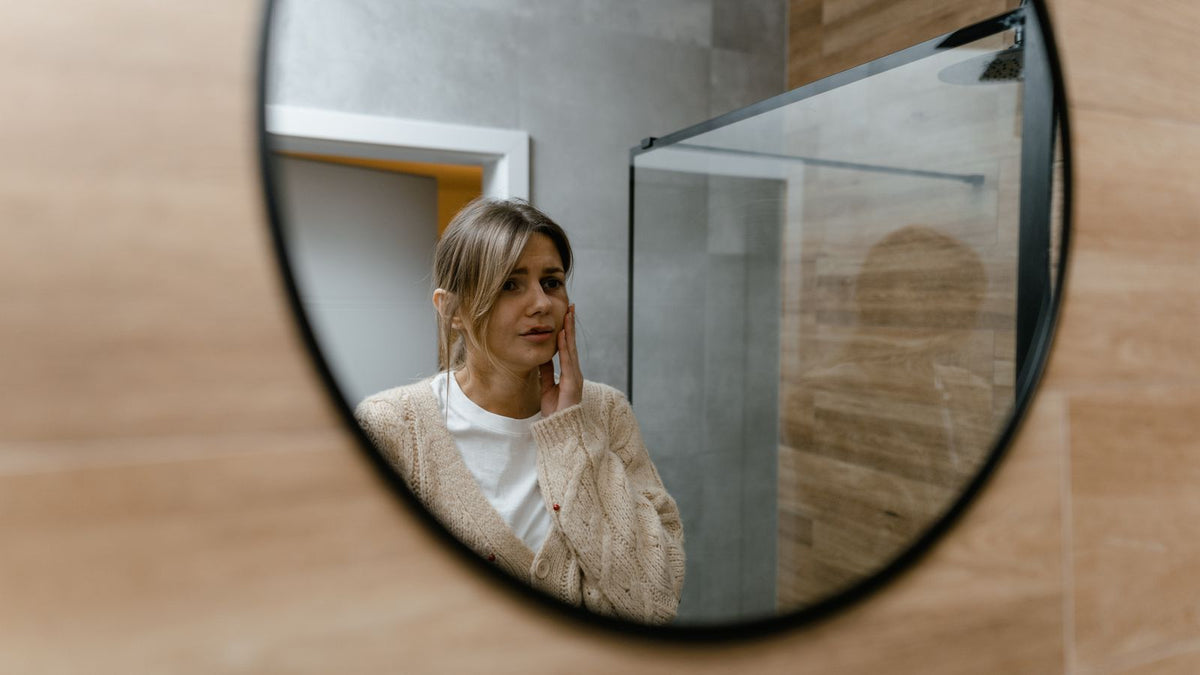
Hair loss anxiety day to day usually looks like repeated checking, such as studying your parting in every mirror, counting hairs in the shower, photographing the crown, avoiding photos or social plans, and searching symptoms late at night, with each check bringing brief relief followed by more worry.
- Mirror and camera checks. Several times a day, often under harsh overhead bathroom light that shows more scalp than daylight does.
- Counting and collecting. Gathering hairs from the brush, pillow or plughole and trying to work out whether today was worse than yesterday.
- Quietly changing plans. Skipping swimming, the hairdresser, windy walks or any event where photos will be taken.
- Late-night searching. Hours of reading that tends to land on worst-case stories rather than the common, temporary causes.
- Comparison. Measuring your hair against friends, colleagues and strangers online.
The NHS Every Mind Matters service describes anxiety as something everyone experiences at times, which becomes a problem when it feels intense or starts to interfere with daily life or relationships. Common symptoms it lists include feeling tired, restless or irritable, being unable to concentrate, and worrying that something bad will happen.
It also notes that avoiding situations, or relying on habits we think will keep us safe, might actually make anxiety worse. Checking is one of those habits. It feels protective, but it trains your attention onto your hair and keeps the worry switched on.

Is it hair loss, shedding or breakage?
Hair loss, hair shedding and hair breakage are three different things: loss means the follicle itself is changing and producing finer or fewer hairs, shedding means more whole hairs than usual are falling out from the root, and breakage means the hair fibre is snapping somewhere along its length.
| Type | What you might notice | Typical pattern | Where to start |
|---|---|---|---|
| Hair loss | A wider parting, more scalp showing, or smooth round patches | Gradual over months or years, or sudden patches | Your own GP |
| Hair shedding | Full-length hairs with a small pale bulb, from all over the scalp | Often starts around 3 months after illness, stress or a big life change | Your GP if it is heavy or lasts beyond 6 months |
| Hair breakage | Short snapped pieces with no bulb, frizz and uneven ends | Linked to heat, colour, tight styles and rough handling | A gentler routine |
Some shedding is completely normal. The NHS says we can lose between 50 and 100 hairs a day, often without noticing, while the British Association of Dermatologists gives a wider range of 30 to 150. The two sources simply draw the line in different places, so a single high count on wash day is not a reason to panic.
The British Association of Dermatologists explains that about 15% of scalp hairs are normally in the shedding phase, rising to 30% or more in telogen effluvium, the medical name for stress or illness-related shedding. It says the heavy shedding usually lasts 3 to 6 months, after which new hair starts to grow, although it can take many months for hair to return to its normal volume, and shedding lasting more than 6 months is considered long term.
If a stressful spell or burnout came first, our Milton Keynes guide to stress shedding and burnout explains that link in detail. Smooth, round bald patches are different again, and our Croydon guide to bald patches and who to see first explains why those need your GP before anyone else.
How can you get a calm, factual picture of what is happening?
You can get a calm, factual picture by swapping constant checking for a simple record kept on a schedule: photos once a month in the same light, a note of possible triggers such as illness or stress, and an occasional wash-day count, so change is measured over weeks rather than felt minute by minute.
Our Basingstoke guide to tracking hair changes at home sets out exactly how to take photos you can compare, measure a ponytail and count shed hairs, so there is no need to repeat it here. What matters on this page is how you use that record: it is there to replace checking, not to add another layer of it.
Hair changes slowly, so daily comparisons mostly measure the lighting, the humidity and your mood that morning. A monthly set, taken on the same day each month, gives you something far more honest, and it is exactly what a GP or trichologist will want to see.
Try a worry window
Every Mind Matters suggests setting a daily "worry time" if worry is taking over your day. Give your hair a short slot at a set time: look at your notes, write down what you are worried about, then close the notebook. When the urge to check comes up outside that window, jot it down for later and let it pass. Every Mind Matters also says a diary of what you are doing and how you feel may help you understand why you are anxious.

How do you talk to your GP about your hair and how you are feeling?
Talking to your GP works best when you raise both things in the same visit: say what has changed with your hair and for how long, then say plainly how much it is affecting your mood, sleep or social life, because the NHS specifically advises telling your GP if hair loss is affecting your wellbeing.
The NHS says a GP may be able to tell what is causing hair loss just by looking at your hair, and that if hair loss is causing you distress, your GP may be able to help you get some counselling. It also advises seeing a GP to get an idea of the cause before thinking about going to a commercial hair clinic, which is sound advice before contacting a trichologist in Sutton Coldfield too.
Many people mention the hair and leave the feelings out, because saying it aloud feels embarrassing. It is worth pushing past that. Low mood and anxiety are part of everyday general practice, and naming them is what opens the door to support.
What you might say
- "My hair has been shedding more since about March, and I have photos from each month."
- "I am checking it many times a day, and it is affecting my sleep and whether I go out."
- "Could we look at possible causes, and can we also talk about how I am feeling and what support there is?"
Bring your record: the monthly photos, a list of any illness, weight change, new medicines or stressful events in the months before it started, and any family history of thinning. Ask what checks might be useful, and ask directly about talking to someone. If you do not feel ready to say it out loud, write it down and hand the note over; GPs are used to that. Your GP can talk you through the options for your mood as well as your hair.
Get a discount on the thinning hair range
Join the Watermans mailing list and we will email a discount code straight to your inbox, so you can try the thinning hair range for less. Made in the UK, over 6.5 million bottles sold since 2012.
How can you refer yourself to NHS talking therapies?
You can refer yourself to NHS talking therapies for anxiety and depression online, without seeing a GP first, if you live in England and are aged 18 or over, or 16 or 17 in some areas, and the NHS is clear that you do not need a formal label for what you are feeling to do so.
The NHS finder asks for the name of your GP surgery so it can point you to the service covering your area, which means someone living in Sutton Coldfield is directed to the service linked to their own surgery. The service then contacts you, tells you how long the wait for a first session may be, and explains what information will be shared with your GP.
The NHS lists the kinds of difficulty these services can help with, and several fit hair worry closely: persistent low mood, feeling very anxious about lots of different things, worrying constantly about your health, fearing social situations, and body dysmorphic disorder.
- Guided self-help. A workbook or online course based on cognitive behavioural therapy (CBT) principles, with support from a therapist.
- CBT. A therapist helps you change how you think and act, with practice between sessions.
- Counselling. Talking through your thoughts, feelings and experiences so you can find your own way forward.
Sessions can be in person, by video or phone, or through an online course, and may be one-to-one or in a group. If you are not sure whether the service is right for you, the NHS suggests speaking to a GP first. Talking therapies are also sometimes available through employers, universities or local charities, and if you pay privately, the NHS advises choosing a therapist registered with an organisation accredited by the Professional Standards Authority.
When might constant checking be something more?
Constant checking might be something more when worry about how your hair looks takes up hours of each day, focuses on flaws other people cannot really see, and starts to limit work, friendships or going out, because those are features the NHS describes in body dysmorphic disorder, often shortened to BDD.
The NHS describes BDD as a mental health condition where a person spends a lot of time worrying about flaws in their appearance that are often unnoticeable to others. Signs it lists include comparing your looks with other people's, looking in mirrors a lot or avoiding them altogether, and going to a lot of effort to conceal flaws, for example by spending a long time combing your hair.
Two things are worth holding onto. The NHS says having BDD does not mean you are vain or self-obsessed, and that you have nothing to feel ashamed or embarrassed about when you ask for help. It also says to see a GP if you think you might have BDD, and that you can refer yourself directly to NHS talking therapies. For practical coverage options while you work things out, see wigs, toppers and hair fibres compared.
Reading a list like this is not a reason to put a label on yourself. Plenty of people with real, visible thinning check more than usual for a while. The point is simply that if the worry feels bigger than the hair, that deserves attention in its own right. The NHS also points to the BDD Foundation, which keeps a directory of local and online BDD support groups.
Where can you get urgent help if things feel too much?
If things feel too much, get urgent help straight away: call 999 or go to A&E if you cannot keep yourself safe, use NHS 111 online or call 111 and choose the mental health option for urgent advice, or call Samaritans free on 116 123 at any time, day or night.
Help, right now
- 999 or A&E: if someone's life is at risk, or you do not feel you can keep yourself or someone else safe.
- NHS 111: online or by phone, choosing the mental health option. 111 will tell you the right place to get help, and you may be able to speak to a trained mental health professional.
- Samaritans: call 116 123, free from landlines and mobiles, any time, day or night.
- Shout: a free, confidential, 24/7 text service on 85258.
- Your GP surgery: ask to be seen urgently about your mental health.
The NHS is clear that a mental health emergency should be taken as seriously as a physical one, and that you will not be wasting anyone's time. No hair worry is too small to talk about if it has brought you to this point.
Which support organisations can help with hair worry?
Support organisations that can help with hair worry include Alopecia UK for peer support around any type of hair loss, Mind for mental health information, the BDD Foundation for appearance-focused anxiety, and Samaritans or Shout when you need someone to talk to straight away, with NHS pages pointing people towards several of them. For the wider picture of coping while hair changes, our guide to hair loss and mental health covers what genuinely helps.
| Organisation | What it offers | How to reach it |
|---|---|---|
| Alopecia UK | Local and online support groups led by people with personal experience of alopecia; the NHS hair loss page links to them | alopecia.org.uk |
| Mind | Mental health information and an Infoline | 0300 123 3393, mind.org.uk |
| BDD Foundation | Information on body dysmorphic disorder and a directory of support groups | bddfoundation.org |
| Samaritans | Free, confidential listening from trained volunteers, day or night | 116 123 |
| Shout | Free, confidential, 24/7 mental health text support | Text 85258 |
Alopecia UK is careful to say that its support group leads are not professional counsellors. The groups offer practical peer support from people who live with hair loss day to day, and for many people that is exactly what helps: hearing from someone further along the same road that life carries on, and that the first months are often the hardest.
Friends and family count too. Telling one person you trust what you have been checking, and how often, takes some of the secrecy out of it, and secrecy is a large part of what keeps anxiety going. If you are the friend or relative in that picture, our Shrewsbury guide to choosing a kind gift for thinning hair covers how to raise the subject gently.

What practical steps can ease hair worry day to day?
Practical steps that ease hair worry day to day include a haircut that suits your hair as it is now, a simple and gentle wash routine, firm limits on checking, less time on image-heavy social media, and regular movement, sleep and time with people, which the NHS lists among the things that support mental wellbeing.
- Talk to a hairdresser you trust. A shorter or layered cut, a softer or moved parting, or a little texture at the roots can make thinner areas far less obvious. Tell them what worries you; a good stylist will have seen it many times before.
- Keep the routine simple and gentle. Wash as often as your scalp needs, use lukewarm water, pat rather than rub, and keep heat low. Breakage makes hair look thinner than it is, and it is the one part of the picture you can influence at home.
- Put limits on checking. Choose one mirror and one time of day, use daylight rather than the harsh bathroom bulb, and keep scalp photos in a single album that you only add to once a month.
- Curate your feed. The NHS lists spending a lot of time comparing your looks with other people's as a sign of BDD. Mute or unfollow accounts that leave you feeling worse, especially filtered before-and-after posts, and notice how you feel after scrolling.
- Move, sleep and see people. The NHS names regular exercise, enough sleep, getting together with friends or family, and relaxation and breathing exercises among the things that help mental wellbeing.
- Judge change over months, not days. Hair follows a slow cycle, so give any new routine several months before deciding whether it has made a difference.


A sulfate-free 250ml shampoo with caffeine, biotin, rosemary and niacinamide, £14.95. Simple, gentle everyday care: lather it at the scalp, rinse well and keep the rest of your routine calm. It helps hair look and feel fuller and reduces breakage, but it will not change what is happening at the follicle.
Can cosmetic camouflage help while you wait for answers?
Cosmetic camouflage can help while you wait for answers by making visible scalp less obvious on the days that matter most, and the British Association of Dermatologists notes in its alopecia areata leaflet that hair fibres or cosmetics can help camouflage areas of hair loss, alongside wigs and hairpieces.
Some people find that being able to cover a thin area takes the edge off the urge to check, because the moments they dread most, a group photo, a windy day, an overhead light, feel less exposed. Others prefer not to bother. Either choice is fine, and camouflage is never a reason to put off speaking to your GP.
For more extensive hair loss, wigs are an option. The NHS says some wigs are available on the NHS, although you may have to pay unless you qualify for financial help, and that synthetic wigs last 6 to 9 months while real-hair wigs last 3 to 4 years.
For a step-by-step look at fibres, partings, powders and toppers, see our Plymouth guide to covering thin areas while you wait.

A 23g cosmetic concealer, £19.95, in shades including dark brown, made to disguise visible scalp and thin areas so hair looks fuller for the day. Some people find it reassuring to have on hand while they wait for answers. It covers what shows; it does not change the cause.
What can a trichologist in Sutton Coldfield help with, and what can they not?
A trichologist in Sutton Coldfield can help by taking a detailed history, examining your scalp and hair closely, often under magnification, and suggesting practical changes to styling and routine, but cannot give you medicines, stand in for your GP, or provide the mental health support that talking therapies and your GP offer.
People in Sutton Coldfield look for one for different reasons. Some want a longer, unhurried look at their scalp than a short GP visit allows. Some want a second opinion after normal GP checks. Some simply want a professional to tell them, calmly and with evidence, whether the change they fear is real.
Checking who you see matters, because a trichologist is a private practitioner. The Institute of Trichologists runs a Find a Trichologist register with a UK section. It says all its registrants have completed education programmes to qualify, subscribe each year and follow its code of professional practice and ethics. Ask which body anyone belongs to and check the register before you pay.
| A registered trichologist can | A trichologist cannot |
|---|---|
| Look closely at your scalp and hair, often under magnification | Give you medicines or arrange NHS blood tests |
| Go through your products, styling and routine in detail | Refer you into NHS dermatology, which goes through your GP |
| Compare your photos over time and tell you calmly what they show | Offer therapy for anxiety, low mood or BDD |
| Suggest you speak to your GP when something needs medical input | Promise that hair will change on a set timescale |
Watermans runs no clinics and cannot look at your scalp; we make cosmetic hair care, so weigh our view with that in mind. For hair loss anxiety, the most useful thing a trichologist in Sutton Coldfield can often give you is a clear, measured answer, and if what they see needs medical input, a good one will send you back to your GP.
What are the most frequently asked questions about hair loss anxiety?
Should I see a trichologist in Sutton Coldfield if I am anxious about my hair?
Start with your own GP, who can check possible causes and talk with you about how you are feeling. A registered trichologist can add a close look at your scalp and routine once medical causes have been considered, but cannot give you medicines or replace mental health support.
How many hairs a day is it normal to lose?
The NHS says we can lose between 50 and 100 hairs a day, often without noticing. The British Association of Dermatologists gives a wider range of 30 to 150. Hairs that loosen between washes tend to come out together, so one high count on wash day is not a reason to panic.
Can I refer myself for support if worry about my hair is taking over?
Yes, if you live in England and are 18 or over, or 16 or 17 in some areas. NHS talking therapies for anxiety and depression accept self-referral online without a GP visit, and the NHS lists constant health worry, social anxiety and body dysmorphic disorder among the difficulties they can help with.
Is checking my hair all the time a sign of body dysmorphic disorder?
Not necessarily, as many people check more while their hair is changing. The NHS describes BDD as spending a lot of time worrying about flaws others often cannot see, with signs such as frequent mirror checking and comparing your looks. If that sounds familiar, speak to your GP or refer yourself to NHS talking therapies.
Can stress make my hair shed?
Yes. The British Association of Dermatologists lists stressful or major life events among the triggers of telogen effluvium, a type of shedding that can start around three months later. The heavy shedding usually lasts 3 to 6 months, after which new hair starts to grow, although full volume can take many months to return.
Can hair fibres help my confidence while I wait for answers?
Some people find them reassuring. The British Association of Dermatologists notes that hair fibres or cosmetics can help camouflage areas of hair loss. They are purely cosmetic: they cover what shows for the day and do nothing to the cause, so they are never a reason to put off speaking to your GP.
Who can I talk to right now if I feel overwhelmed?
Call Samaritans free on 116 123, day or night, or use Shout's free 24/7 text service on 85258. For urgent advice, use NHS 111 online or call 111 and choose the mental health option. If you cannot keep yourself safe, call 999 or go to A&E.
Sources & references
- NHS, Hair loss
- NHS, Talking therapies
- NHS, Find NHS talking therapies for anxiety and depression
- NHS, Body dysmorphic disorder (BDD)
- NHS, Where to get urgent help for mental health
- NHS, When to use NHS 111 online or call 111
- NHS Every Mind Matters, Anxiety
- British Association of Dermatologists (skinhealthinfo.org.uk), Telogen effluvium
- British Association of Dermatologists (skinhealthinfo.org.uk), Alopecia areata
- Lauron S et al. Prevalence and Odds of Depressive and Anxiety Disorders and Symptoms in Children and Adults With Alopecia Areata: A Systematic Review and Meta-analysis. JAMA Dermatol, 2023
- Hwang HW et al. The Quality of Life and Psychosocial Impact on Female Pattern Hair Loss. Ann Dermatol, 2024
- Samaritans, Contact us
- Shout 85258
- Mind
- Alopecia UK, Support groups information
- BDD Foundation
- The Institute of Trichologists, Find a Trichologist
What is the bottom line on trichologist in Sutton Coldfield?
The bottom line on trichologist in Sutton Coldfield searches driven by worry is that the first steps are gentle ones: swap checking for a monthly record, tell your GP about your hair and your mood together, refer yourself to NHS talking therapies if the worry is taking over, and lean on support groups and camouflage for the days in between.
A registered trichologist can add a close, calm look at your scalp once medical causes have been considered, and hair shedding, breakage and loss each have their own answers. If you ever feel unable to keep yourself safe, call 999, or call Samaritans free on 116 123.
If a gentle everyday shampoo would help your routine while you wait for answers, Grow Me is a sulfate-free shampoo that cleans the scalp gently and helps hair look and feel fuller. There is no rush, and it is never a substitute for speaking to your GP. If your question is about products or a routine rather than a medical one, you can talk to Gail Waterman, our co-founder, as an AI avatar on the Watermans homepage.
Watermans products are 100% cosmetic and do not treat medical hair loss. Individual results may vary.