Sunscreen for Men: How to Choose and Use It (UK Guide)
Sunscreen for men is chemically identical to any other sunscreen; what differs is how it gets used. UK guidance is at least SPF 30 for UVB and at least 4 UVA stars, applied generously and reapplied every two hours outdoors. The gaps that show up most often in men are the scalp on a thinning or shaved head, the ears, the back of the neck and the tops of the feet, and using roughly half the amount the SPF number on the bottle was tested at. Hair itself is a separate question, and our guide to hair sun protection covers what helps the lengths.
Key takeaways
- Buy sunscreen for men at SPF 30 or above with at least 4 UVA stars. The SPF number only describes UVB protection.
- A teaspoon for the face and neck, and about six to eight teaspoons for a whole adult body, is the tested amount.
- Most people apply around half of that, which drops a bottle labelled SPF 30 to real-world protection nearer SPF 10 to 15.
- The scalp is the single most-missed area in men, and a parting or a shaved head has no natural shading at all.
- UV in the UK is strong enough to burn from roughly late March to September, including on overcast days.
What should men look for on a sunscreen label in the UK?
Men should look for two separate numbers on a UK sunscreen label: an SPF of at least 30 and a UVA rating of at least 4 stars. They measure different things. SPF describes protection against UVB, the wavelength that causes sunburn. The UVA star rating, used on UK and Boots-standard labelling, describes protection against the longer wavelength that drives photoageing and contributes to skin cancer risk. A high SPF with a low UVA rating leaves half the job undone.
| On the label | What it actually means | What to buy |
|---|---|---|
| SPF 15 / 30 / 50+ | UVB protection only. SPF 30 filters about 97% of UVB; SPF 50 about 98% | At least SPF 30; SPF 50+ for a long day outdoors or fair skin |
| UVA stars (0 to 5) | UVA protection expressed as a ratio to the SPF, so it is relative, not absolute | At least 4 stars, ideally 5 |
| UVA in a circle | The EU marker meaning UVA protection is at least a third of the labelled SPF | Acceptable minimum, but the star rating tells you more |
| Water resistant | Tested to retain protection after immersion, never waterproof | Reapply after swimming or heavy sweating regardless |
The stars are a ratio, not a score
A 4-star SPF 15 gives less absolute UVA protection than a 4-star SPF 50, because the stars describe UVA protection relative to that product's own SPF. Read the two numbers together rather than picking on stars alone.
Does sunscreen for men need to be different from women's?
Sunscreen for men does not need different filters, but formulation preferences and skin behaviour genuinely differ. Male skin is on average around 20 to 25 per cent thicker, tends to produce more sebum, and is frequently shaved, which removes a layer of surface cells and leaves the skin more reactive for a day or so. Those three facts push most men towards lighter, non-greasy textures and away from heavily fragranced formulas on freshly shaved skin.
The more consequential difference is behavioural rather than biological. Men are less likely to use a daily moisturiser with SPF built in, more likely to work or exercise outdoors for long stretches, and far less likely to reapply. Cancer Research UK's sun safety guidance makes the same point from the other end: melanoma incidence in UK men has risen faster than in women, and men are more often diagnosed at a later stage. The fix is not a different product, it is using the product properly.
Which sunscreen for men suits oily, dry or shaved skin?
Texture is what determines whether a sunscreen actually gets used, so it is worth matching it to your skin rather than buying on SPF alone. Mineral filters such as zinc oxide and titanium dioxide sit on the surface, start working immediately and suit reactive or freshly shaved skin, but can leave a white cast. Organic filters absorb UV within the skin, feel lighter and disappear on application, but need a few minutes before exposure. Hybrid formulas combine both. Related reading: our guide to hybrid hair treatment.
| Skin type or situation | What tends to work | What to avoid |
|---|---|---|
| Oily or acne-prone | Fluid or gel textures, labelled non-comedogenic, matte finish | Heavy creams and rich balms that sit on the surface |
| Dry or tight after shaving | Cream or lotion textures with humectants, mineral or hybrid filters | High alcohol content sprays and strong fragrance |
| Shaved head or thinning crown | Non-greasy lotion, or a mineral stick for a quick top-up | Anything that runs into the eyes with sweat |
| Beard or stubble | Fluid or spray applied and worked in with fingertips | Thick creams that sit visibly on facial hair |
Get a discount on the skin and scalp care range
Join the Watermans mailing list and we will email a discount code straight to your inbox, so you can try the skin and scalp care range for less. Made in the UK, over 6.5 million bottles sold since 2012.
How much sunscreen do men actually need to apply?
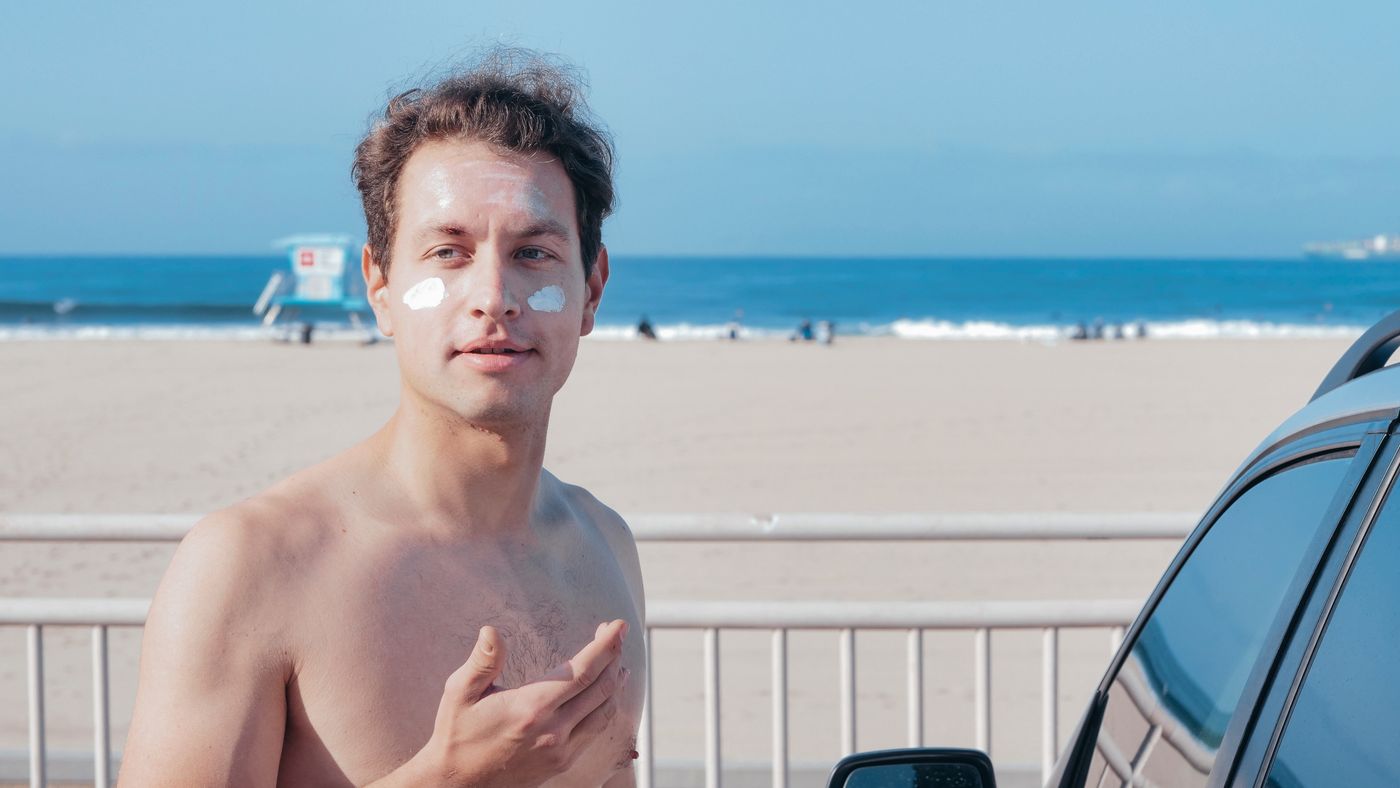
The tested amount is 2mg of sunscreen per square centimetre of skin, which works out at roughly a teaspoon for the face and neck and six to eight teaspoons for a whole adult body in shorts and a t-shirt. Study after study finds real-world application at about a quarter to a half of that, and because the relationship is not linear, applying half the amount does not give you half the SPF, it gives you considerably less.

Two practical habits close most of the gap:
- Apply twice. A thin layer, then a second thin layer a couple of minutes later, gets far closer to the tested thickness than one attempt at a thick coat, and it feels better on the skin.
- Reapply on a timer, not on feel. Every two hours outdoors, and immediately after swimming or heavy sweating. Sunscreen does not announce that it has worn off, and you will not notice until the burn appears hours later.
The spots men miss most
Ears and the rims of the ears, the back of the neck below the hairline, the scalp along a parting or on a shaved head, the tops of the feet in sandals, and the lower lip. The ear and the scalp are the two where sun damage most often shows up later.
Why is the scalp the spot men miss most?
The scalp is missed most because hair normally does the protecting, and men are the group most likely to lose that cover. A full head of hair provides meaningful shading. A widening parting, a receding hairline, a thinning crown or a shaved head all remove it, and the crown in particular sits at close to the worst possible angle to midday sun. It is also the one area you cannot inspect in a mirror.

Three workable options, in order of how reliably they get used:
- A hat with a brim. The most effective and the one that needs no reapplying. A peaked cap leaves the ears and neck exposed, so a brim all round is better.
- A non-greasy lotion worked along the parting. Part the hair in sections and apply along the scalp line rather than trying to cover the whole head.
- A mineral stick. Easiest for a mid-afternoon top-up and least likely to end up in your eyes.

If the reason your scalp is newly exposed is that your hair is thinning, why hair starts thinning covers the common causes, and how to keep your scalp healthy covers looking after the skin itself.
Does sunlight damage hair as well as skin?
Sunlight does damage hair, though by a different mechanism and with a different consequence. UV degrades the keratin proteins and the lipid layer in the hair shaft, and it oxidises melanin, which is why hair lightens over a summer. The practical result is a rougher cuticle, more tangling and a fibre that snaps more easily, particularly at the mid-lengths and ends that have had years of exposure.
This is breakage, not hair loss, and the distinction is worth holding onto. Hair breakage is the fibre snapping along its length, so you find short broken pieces with no white bulb at the root. Hair shedding is hairs releasing from the follicle on schedule, which is what a stressful few months or an illness produces. Hair loss is the follicle itself changing, as in pattern hair loss. Sun exposure causes the first and has no established role in the other two. what actually causes hair damage goes into the rest.
Salt water and chlorine make it worse by swelling and roughening the cuticle before UV gets to it. Rinsing with plain water before a swim, and again afterwards, measurably reduces how much either one absorbs.

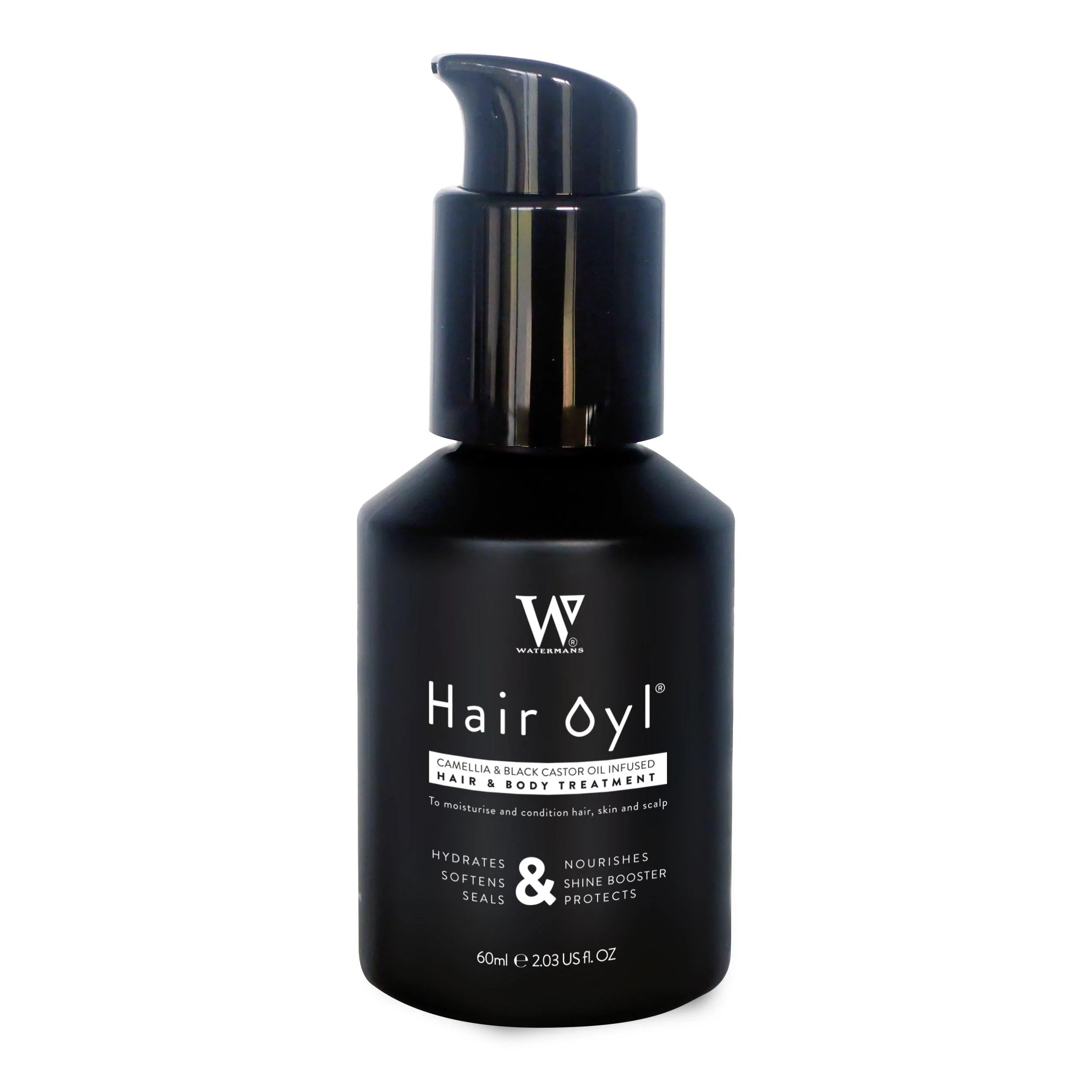
Camellia & Black Castor Hair & Body Oil
A camellia and black castor oil blend for hair, scalp and body. Useful as a pre-swim barrier on the lengths and as an after-sun conditioning step on hair left dry and rough by salt, chlorine and UV.
How do you fit sunscreen into a two minute routine?
A workable routine takes under two minutes and has three steps: cleanse, moisturise, then sunscreen as the final layer before you leave the house. Sunscreen goes on last of the skincare steps because anything applied over it dilutes and disturbs the film. Give it a couple of minutes to settle before dressing if you are using an organic filter.
After a day outdoors the priority flips to rehydration. Sun exposure, wind and salt all pull water out of the skin barrier, and skin that is tight and flaking the next morning is dehydrated rather than damaged beyond repair. A plain, unfragranced moisturiser applied to slightly damp skin does more than any specialist after-sun marketing.

Plumping Moisturise Me® Face & Hand Cream
A cupuacu, shea and cocoa butter cream with allantoin and almond oil. Straightforward rehydration for face and hands after a day in the sun or wind. Cosmetic moisturiser, not an after-sun medicine.
When do you actually need sun protection in the UK?
You need sunscreen for men in the UK from roughly late March to the end of September, when the UV index regularly reaches 3 or above, and on any day the forecast UV index is 3 or higher regardless of month. The UV index, not the temperature and not the brightness, is the number that matters, and it is included in most UK weather apps.
- Cloud is not protection. A substantial share of UV passes through light cloud, which is why overcast days catch people out.
- Altitude and reflection raise exposure. UV rises with altitude, and water, sand and snow reflect it back at you from below, where a hat brim does not help.
- Glass filters UVB but not all UVA. A long drive or a desk by a window still carries UVA exposure, which is the ageing wavelength.
- 11am to 3pm is the window that matters most in UK summer, when the sun is highest and the scalp and shoulders take the steepest angle.
What does sunscreen not do?
Sunscreen for men does not make sun exposure risk-free, and treating it as permission to stay out longer is the most common way people end up worse off. The NHS is explicit that sunscreen should be used alongside shade and clothing rather than instead of them. No product filters 100 per cent of UV, real-world application is always thinner than tested, and protection degrades with sweat, water and time.
Get a mole checked rather than watched
Any mole that changes size, shape or colour, has an irregular or blurred edge, is more than one colour, is itching, crusting or bleeding, or simply looks different from your others, should be shown to a GP. Melanoma found early is far more manageable than melanoma found late, and a GP would much rather look at ten harmless moles than miss one. Do not wait for it to hurt.
Frequently asked questions
Is SPF 50 much better than SPF 30 for men?
The difference in UVB filtered is small, around 97 per cent against 98 per cent, but SPF 50 leaves more margin for the thin application almost everyone applies in practice. For a long day outdoors or fair skin, choose 50.
Does sunscreen for men need to be a separate product?
No. The filters are identical and a product marketed to men offers no extra protection. Buy on texture, finish and whether you will actually reapply it, then check SPF 30 or above with at least 4 UVA stars.
Can I use face sunscreen on my scalp?
Yes, and on a shaved head that is the simplest answer. On hair, a face fluid or a mineral stick applied along the parting is less greasy than a body lotion and less likely to leave the hair looking flat.
Does sunscreen block vitamin D?
In real-world use it reduces vitamin D synthesis far less than laboratory studies suggest, largely because application is thin. UK advice is to consider a daily 10 microgram vitamin D supplement from October to March rather than to skip sunscreen in summer.
Do I need sunscreen on a cloudy UK day?
If the UV index is 3 or above, yes. Light cloud lets a large proportion of UV through, and overcast days in June routinely reach index 5 or 6 in the UK.
How long before going outside should I apply it?
Mineral filters work on contact. Organic filters need roughly 15 to 20 minutes to form an even film, so apply before you leave rather than on the doorstep.
Does sunscreen damage hair if it gets on it?
It will not harm the hair fibre, though some formulas leave a residue that looks greasy or, on very light hair, can pick up a slight tint. Rinsing with a gentle shampoo at the end of the day deals with it.
Is last year's bottle still usable?
Check the period-after-opening symbol, usually 12M. An opened bottle stored in a hot car boot or in direct sun degrades faster than the date suggests, and a separated or smelly product should be replaced.
What is the bottom line on sunscreen for men?
The bottom line on sunscreen for men is that the product choice matters far less than the habit. Buy SPF 30 or above with at least 4 UVA stars in a texture you will genuinely reapply, use roughly a teaspoon on the face and neck, and go again every two hours outdoors. Cover the four places men consistently miss: ears, back of the neck, the scalp along a parting or a shaved head, and the tops of the feet. Use shade and a brimmed hat alongside it rather than relying on the bottle, watch the UV index rather than the temperature, and show any changing mole to a GP without waiting.
For the skin afterwards, a plain face and hand cream applied to damp skin does more for next-day tightness and flaking than any specialist after-sun claim.
Watermans products are 100% cosmetic and do not treat medical hair loss. Individual results may vary.