Androgen Sensitivity and Hair: Why Follicles React
Follicle reactivity, not hormone level, is what separates two people with identical blood results.
Androgen sensitivity describes how strongly an individual hair follicle responds to male type hormones circulating in everyone, regardless of sex. It is inherited, it varies between follicles on the same head, and it explains why two people with identical blood results can have completely different hairlines. Because this trait is written into the follicle rather than the bloodstream, no ordinary blood test measures it and no cosmetic product changes it.
Our hair growth shampoo
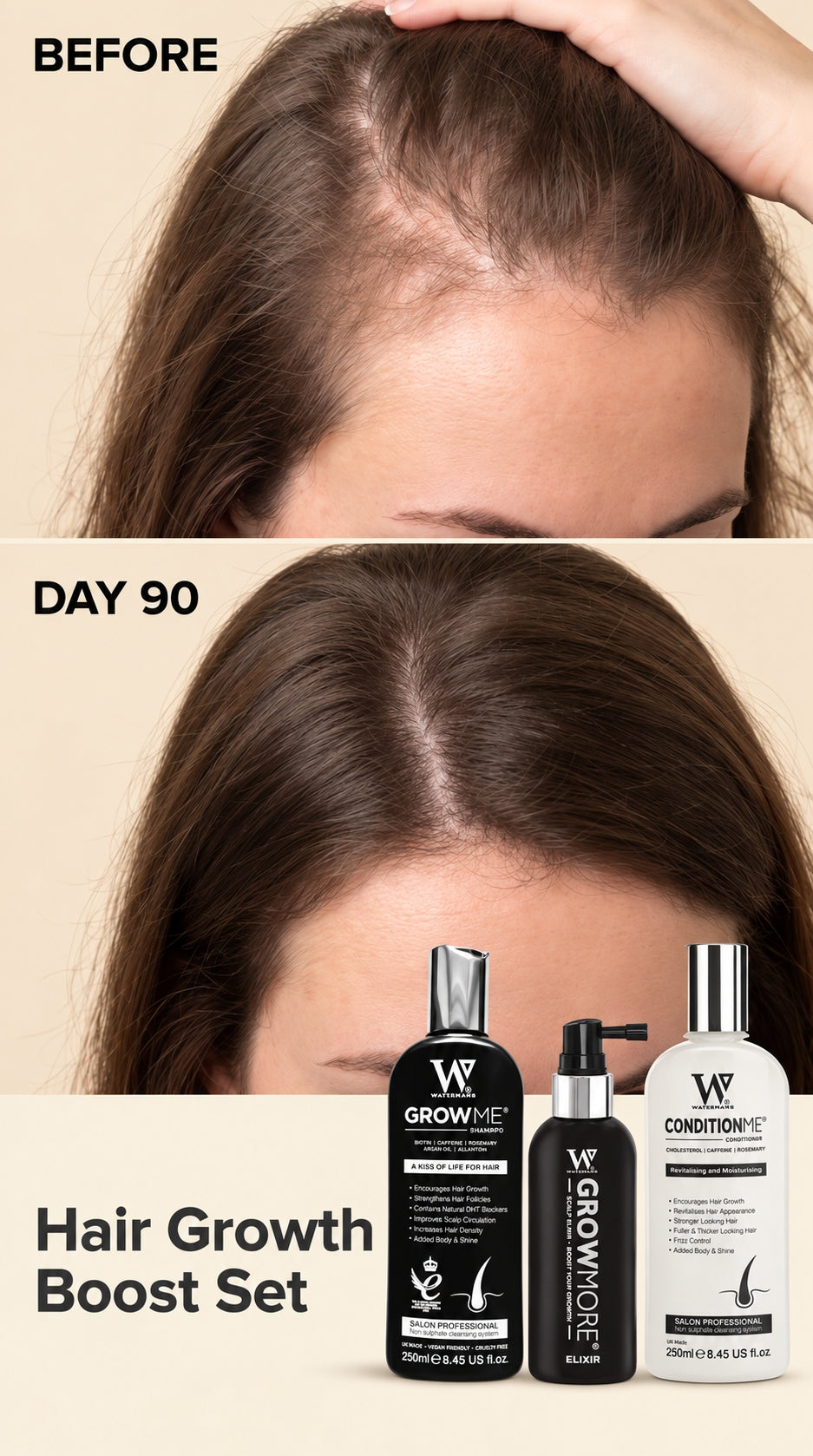
Grow Me® Hair Growth Shampoo, £14.95. A sulphate free daily shampoo that supports a healthy scalp environment and helps reduce breakage, so lengths hold on and look fuller.
Key takeaways
- Androgen sensitivity is about how follicles react, not how much hormone is present.
- It is why hormone blood tests usually come back normal in pattern hair loss.
- Scalp follicles at the temples and crown are the sensitive ones. Beard and body follicles react in the opposite direction.
- It is inherited from both sides of the family, not just the mother's father.
- It is not the same as high testosterone, and it is not something shampoo can change.
What is androgen sensitivity?
Androgen sensitivity is the degree to which a follicle reacts to androgens, the group of hormones that includes testosterone and its more potent derivative dihydrotestosterone. Follicles carry androgen receptors, and the number and behaviour of those receptors is set largely by genetics. A highly reactive follicle responds to an ordinary hormone level with a change in its growth programme. How many of those receptors a follicle makes is a separate question, and we cover it in our guide to androgen receptor expression and your hair.
What that change looks like is miniaturisation. Over successive cycles the follicle shortens its growing anagen phase and produces a finer, shorter, lighter hair each time, until the hair it makes is a barely visible vellus hair. Density on the scalp has not changed much, but coverage has, because the hairs themselves have shrunk. This is the mechanism behind pattern hair loss in both men and women.
Why does it affect scalp hair but not beard hair?
The same hormone produces opposite results in different places because follicles in different body regions carry a different genetic programme. Scalp follicles at the temples and crown respond to androgens by miniaturising. Beard, chest and body follicles respond to the same hormones by growing thicker and longer. It is one signal read two ways by two populations of cells.
This regional difference is why a receding hairline and a thick beard sit happily on the same face, and why hair transplant surgery works at all. Follicles taken from the back and sides of the scalp keep their own low reactivity when moved to the top, which is the entire basis of the procedure. Our guide to FUE and FUT explains the surgical side.

Follicle reactivity is inherited from both sides of the family, not only the mother's side.
Does this trait run in families?
Yes, and the popular version of the rule is wrong. Pattern hair loss is polygenic, meaning many genes contribute, and they come from both parents. The old saying that you should look only at your maternal grandfather is a simplification of one real finding, that a gene on the X chromosome is involved, and it ignores the many other genes that are not.
The practical consequence is that a full head of hair on your father tells you very little on its own. Look at the pattern across the whole family, on both sides, across generations, and expect the onset age to matter more than the final outcome. Early onset in close relatives is the strongest everyday signal.
How do you know if androgen sensitivity is behind your thinning?
The pattern gives it away, not a test. Androgen driven thinning is gradual, symmetrical and predictable: temples recede and the crown opens in men, the central parting widens while the front hairline holds in women. It takes years, not weeks. The hairs in the affected area are visibly finer and shorter than those at the back of the head. If you have had bloods done and they did not explain anything, our guide to testosterone and hair loss covers why levels and sensitivity are different questions.
Compare that with the alternatives. Sudden diffuse shedding two to three months after an illness, operation, crash diet or childbirth points to telogen effluvium. Smooth circular bald patches point to alopecia areata. A sore, scaly or scarred scalp points to something that needs a GP. Our three clue self check and our guide to telogen effluvium walk through each pattern.
| Clue | Points towards androgen driven thinning | Points somewhere else |
|---|---|---|
| Speed | Years of slow change. | Weeks of heavy shedding. |
| Pattern | Temples and crown, or a widening parting. | All over the head, or circular patches. |
| Hair calibre | Affected hairs are finer and shorter than those at the back. | Affected hairs are the same thickness, just fewer. |
| Family | Similar pattern in relatives on either side. | No family pattern at all. |
| Scalp | Looks and feels normal. | Sore, flaking, scarred or itchy. |
Get a discount on the thinning hair range
Join the Watermans mailing list and we will email a discount code straight to your inbox, so you can try the thinning hair range for less. Vegan, made in the UK, over 6.5 million bottles sold since 2012.
Can a blood test measure follicle reactivity?
No standard blood test measures androgen sensitivity, because the trait sits in follicle receptors rather than in circulating hormone. This is why people with textbook pattern hair loss so often get normal hormone results back and feel dismissed. Normal results are the expected finding, not a contradiction.
Blood tests are still worth having when other features are present, and a GP will decide what is appropriate. Iron studies and thyroid function are the common and genuinely useful ones in diffuse shedding. In women with irregular periods, acne or unwanted facial hair, a GP may look further, since polycystic ovary syndrome raises androgen levels and can add a hormonal push on top of inherited reactivity. Our PCOS hair loss guide covers that overlap.
What normal results actually mean
A normal testosterone result does not rule out androgen driven thinning, and a high one does not prove it. The hormone level and the follicle response are two separate things, which is exactly why the pattern on your head is better evidence than the number on the form.
How does this show up differently in women?
In women the same mechanism produces a different picture. The frontal hairline usually stays intact while the central parting widens progressively, which dermatologists grade with the Ludwig scale. Total baldness is rare. Because the change is diffuse rather than patterned in the male sense, it is often mistaken for shedding and chased with the wrong products for years.
Midlife adds a second layer. As oestrogen falls around menopause, the balance shifts and follicles that were always somewhat reactive can begin to show it. That is a change in context rather than a change in the follicle. The Ludwig scale guide and our honest look at menopausal thinning cover the midlife picture.

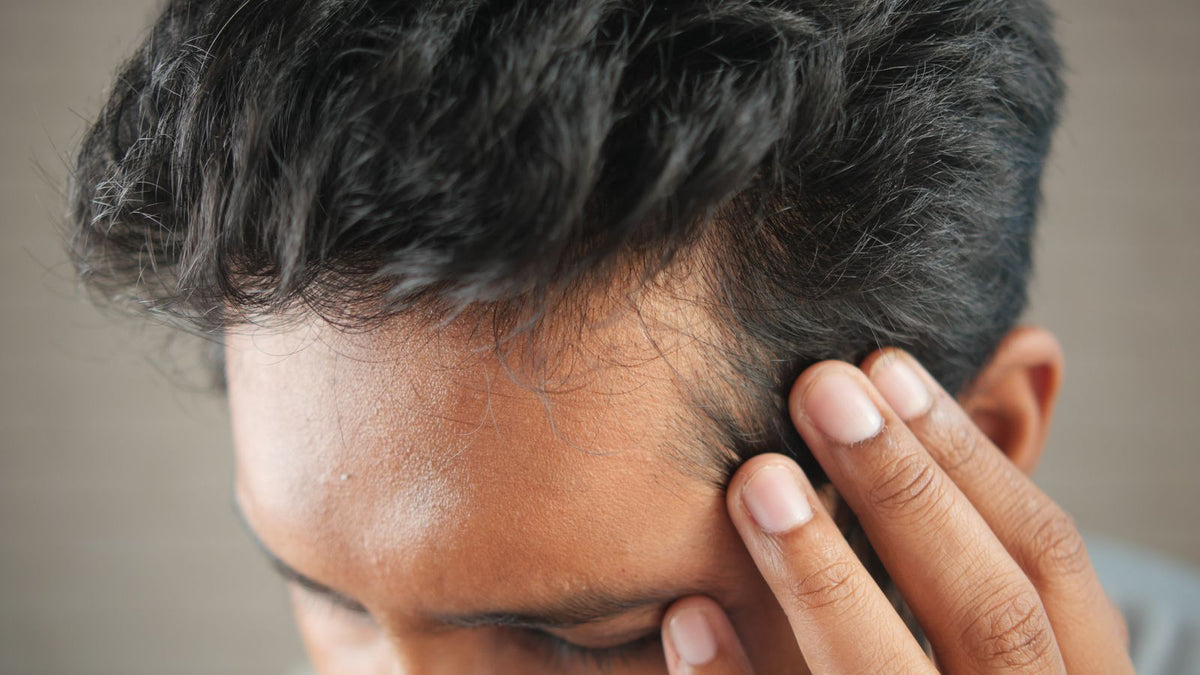
Finer, shorter hairs in the affected area are the visible fingerprint of a reactive follicle.
Is this hair loss, hair shedding or hair breakage?
This trait causes hair loss in the strict sense, meaning follicle miniaturisation, and it is worth separating that from the two problems it gets confused with. Hair shedding is normal hairs leaving at the root in greater numbers, which is a cycle problem. Hair breakage is the fibre snapping along its length, which is a fibre problem caused by heat, tension, friction and chemistry.
Check the brush. Shedding produces full length hairs with a small pale bulb. Breakage produces short, blunt or split fragments with no bulb. Losing 50 to 100 hairs a day is normal, as the NHS notes. Most people with genuine androgen driven thinning also have a layer of breakage on top, and the breakage is the part that responds quickly to a change in routine.
What can you actually do about it?
Nothing available over the counter changes an inherited receptor, and any product implying otherwise is overselling. What is genuinely within reach falls into three honest groups. Medical options exist and are a matter for a GP or a dermatologist, not for a blog. Procedural options such as transplant surgery move unreactive follicles and are permanent and expensive. Cosmetic care does not touch the follicle at all, and instead protects the hair you still grow.
That third group is the one we sell into, and it is worth being precise about what it does. A gentler wash, proper conditioning, less heat and less tension mean fewer hairs snap, so more length survives and coverage looks better. On a head where hairs are already becoming finer, protecting them matters more, not less, because a fine hair snaps more easily than a coarse one.

Scalp serums sit on the surface. They support the scalp environment rather than altering follicle reactivity.

Grow Me® Hair Growth Shampoo £14.95
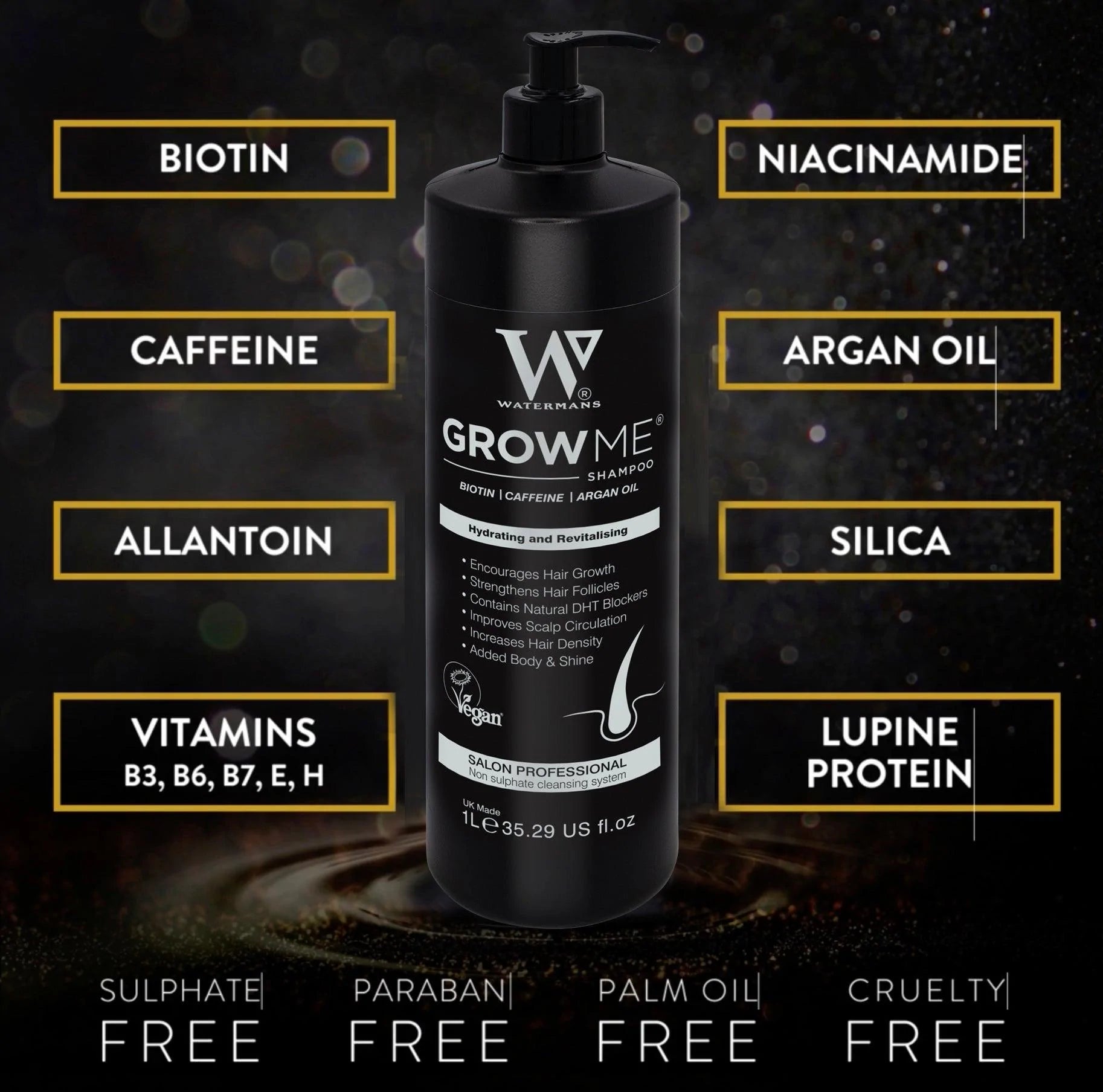
Sulfate free daily shampoo with caffeine, rosemary, niacinamide, biotin and hydrolysed lupine protein. Cleanses without stripping and reduces breakage, so hair looks fuller along the lengths.
Grow Me is a sulfate free daily shampoo with caffeine, rosemary, niacinamide, biotin and hydrolysed lupine protein. It is cosmetic: it cleanses without stripping and reduces breakage for fuller looking hair, and it does not alter hormones or receptors.

Grow More® Leave In Scalp Elixir £25.50
Overnight leave on scalp serum with caffeine, rosemary, niacinamide and hydrolysed lupine protein, for lower density areas such as the parting and temples.
Where the visible problem is a widening parting or thinning temples, Grow More is a leave on scalp elixir applied to those areas overnight. Again, it supports a healthy scalp environment rather than changing how a follicle reads a hormone. If your hormone levels have swung back up after a period of suppression, our guide to androgen rebound and the shedding that follows maps the usual timeline. If you are wondering whether that sensitivity can be measured, see our guide to androgen receptor testing.
Frequently asked questions about androgen sensitivity
Is androgen sensitivity the same as high testosterone?
No, and that is the most common misunderstanding on this subject. The trait is how strongly follicles react to hormones that are present at perfectly ordinary levels. Most people with pattern hair loss have normal hormone results. High testosterone is a separate finding that a GP may investigate for its own reasons.
Can follicle reactivity be tested privately?
Genetic risk panels are sold privately, but they estimate probability across a population rather than telling you what your own scalp will do, and they do not change what is available to you afterwards. The pattern of thinning on your head, plus family history, gives you nearly all of the same information for nothing.
Do women have androgens too?
Yes. Testosterone and dihydrotestosterone are present in everyone, at lower concentrations in women, and scalp follicles respond according to their inherited reactivity. That is why female pattern hair loss exists at all, and why it can appear without any abnormal hormone result.
Does it get worse with age?
The receptor trait does not change, but its effect accumulates, because each hair cycle produces a slightly finer hair than the last. Falling oestrogen around menopause can also unmask reactivity that was previously balanced out, which is why many women first notice a widening parting in their late forties and fifties.
Can diet or supplements change it?
No. Diet cannot rewrite a receptor gene. Nutrition matters for hair in a different way: genuine deficiency, most often iron, causes shedding, and NHS guidance on vitamins and minerals is the sensible reference. If deficiency is suspected, ask a GP for a blood test rather than guessing with supplements. If your question is about products or a routine rather than a medical one, you can talk to Gail Waterman, our co-founder, as an AI avatar on the Watermans homepage.
Does shaving or cutting hair affect it?
No. Cutting acts on the fibre above the skin, while receptor reactivity acts on the follicle below it. Shaving does not change thickness, density or the rate of miniaturisation. It can change the appearance of coverage, which is a styling decision rather than a biological one.
If it cannot be changed, why bother with hair products at all?
Because two different things determine what you see in the mirror: how much hair the follicles produce, and how much of it survives washing, drying, brushing and styling. Cosmetic care owns the second half entirely, and on finer hair that half counts for more.
What is the bottom line on androgen sensitivity?
Androgen sensitivity is an inherited follicle trait, not a hormone problem, which is why blood tests come back normal and why the pattern on your head is better evidence than any number. It cannot be changed by a shampoo, a supplement or a diet. What can be changed is how much of the hair you still grow survives to be seen, and that is worth doing well, especially once individual hairs are getting finer.
If the thinning is gradual and patterned, read what triggers androgenic alopecia. If it came on fast, read our guide to sudden hair loss instead, because the answer is completely different.
The single most useful change is the daily wash. A sulfate free hair growth shampoo cleans without stripping and reduces the breakage that makes fine hair look thinner than it is.
Sources & references
- DermNet, Male pattern hair loss, on androgen receptors, follicle miniaturisation and the temple and crown pattern
- DermNet, Female pattern hair loss, on the widening parting, preserved frontal hairline and Ludwig grading
- NHS, Hair loss, on normal daily shedding of 50 to 100 hairs and when to see a GP
- NHS, Polycystic ovary syndrome, on raised androgen levels and associated hair changes
- NHS, Hirsutism, on androgens producing coarser hair on the face and body
- NHS, Vitamins and minerals, on when supplementation is and is not useful
- The Institute of Trichologists, public register of qualified trichologists in the UK
Watermans products are 100% cosmetic and do not treat medical hair loss. Individual results may vary.