How to Wash a Woman's Hair Properly: A Step-by-Step Guide
The short version of how to wash a woman's hair is this: brush it out dry, wet it thoroughly with lukewarm water, shampoo the scalp only with your fingertips, rinse for longer than feels necessary, condition from ear level to the ends, rinse cool, then squeeze the water out rather than rubbing. The scalp gets cleaned, the lengths get conditioned, and neither gets the other. Almost every washing mistake is a version of doing it the other way round. The product side of the same routine is covered in how to use hair cleanser, step by step.
Our hair growth shampoo
Grow Me® Hair Growth Shampoo, £14.95. A sulphate free daily shampoo that supports a healthy scalp environment and helps reduce breakage, so lengths hold on and look fuller.
Whether you are learning how to wash a woman's hair for a partner, in a salon basin, helping someone who cannot easily lift their arms, or simply want to stop losing length at the ends, the method below is the same. It is written for long and mid length hair, and it flags where curly, coily, fine or colour lightened hair needs a different call.
Key takeaways
- Shampoo is for the scalp. Conditioner is for the lengths. Reversing this is the most common cause of both greasy roots and dry ends.
- Wet hair is weaker and swells, so it tangles and snaps more easily. Detangle before you wet it, never during.
- Lukewarm water throughout. Hot water increases swelling and friction, which is what actually damages hair, not the washing itself.
- Rinse for at least a minute. Most people under rinse, and leftover product is a bigger cause of dull, limp hair than any shampoo.
- Squeeze dry with a microfibre towel or cotton t shirt. Rubbing with a terry towel is a leading cause of frizz and mid length breakage.
- The hair you see in the drain is normal shedding collected up, not hair the wash pulled out.
Why does washing technique matter more than the products?
A hair fibre is a keratin rod wrapped in overlapping cuticle scales, like roof tiles. Those scales are the entire reason hair looks shiny, feels smooth and combs easily. When hair absorbs water it swells, the scales lift slightly, and the friction between neighbouring hairs rises sharply. That is the state hair is in for the whole time you are washing it.
Work published in the Journal of Cosmetic Science measuring breakage during combing found that the amount of hair that snaps depends heavily on whether it was combed wet or dry and whether a conditioner had been applied, with conditioning agents substantially reducing breakage on damaged hair. In other words, the single biggest variable in the bathroom is not which bottle you buy, it is how much mechanical force you apply while the fibre is wet and swollen.
That is why a careful routine with an ordinary shampoo beats a careless routine with an expensive one. Read our guide to the four things that actually damage hair if you want the fuller picture on heat, chemistry, mechanics and environment.
How often should hair actually be washed?
Most advice on how to wash a woman's hair skips frequency entirely, and it is the part that matters most. Frequency is set by the scalp, not by the ends. Sebum is produced at the root and travels down the shaft, so a scalp that produces a lot of oil needs washing more often regardless of how dry the ends feel. The ends are then looked after separately with conditioner and masks.
| Hair and scalp type | Typical wash frequency | What to prioritise |
|---|---|---|
| Fine, oily scalp | Daily to every other day | Light conditioner on ends only, no heavy oils at the root |
| Normal, medium density | Every 2 to 3 days | Standard shampoo and conditioner, mask weekly |
| Thick, coarse or wavy | Every 3 to 4 days | Generous conditioner, detangle in sections |
| Curly or coily | Once or twice a week | Co-washing between washes, never comb dry |
| Bleached or highlighted | Every 3 to 5 days | Sulphate free wash, protein and moisture balance, heat protection |
If you are unsure whether a sulphate free formula is worth switching to, we covered the evidence honestly in our look at whether sulphate free shampoo is really better.
What do you need before you start?
The kit for how to wash a woman's hair is short, and nothing on it is expensive.
- A wide tooth comb or a flexible detangling brush
- Shampoo suited to the scalp, not the ends
- Conditioner, and a mask if the ends are dry or lightened
- A microfibre towel or a clean cotton t shirt
- A jug or a shower head you can control, if you are washing someone else's hair over a basin
- Lukewarm water, tested on the inside of your wrist
How to wash a woman's hair: what is the step by step method?
Step 1: Detangle while the hair is dry
Start at the ends and work upwards in short sections, holding the hair above where you are combing so you are not pulling from the scalp. Every knot you remove now is a knot that will not become a snapped hair in three minutes' time. For curly or coily hair, do this with a little conditioner or oil on damp hair instead, because dry combing curls is its own kind of damage.
Step 2: Wet it properly with lukewarm water
Properly means to the scalp, everywhere, for at least thirty seconds. Half wet hair makes shampoo concentrate in patches, so some areas get scrubbed hard and others do not get cleaned at all. If you are working over a basin, ask about the temperature rather than guessing, because a scalp that has been sunburnt or is flaky feels heat differently.

Step 3: Shampoo the scalp only
Emulsify a ten pence sized amount between your palms first, then apply to the scalp in sections: front hairline, crown, sides, nape. Use the pads of your fingers in small circles, never your nails. Two minutes of that is a genuine scalp massage and does more for scalp comfort than any single ingredient. The lengths get cleaned by the shampoo running down them during the rinse, which is enough.

A sulphate free daily shampoo with caffeine, biotin, rosemary and niacinamide. It cleanses the scalp without stripping, so it suits frequent washing and colour treated lengths. Cosmetic care for fuller-looking hair.
Step 4: Rinse for longer than you think
A full minute, lifting the hair at the nape and behind the ears where product hides. Under rinsing is the quiet cause of hair that looks dull and goes limp by the afternoon. Run a finger over the scalp: if it still feels slippery, keep going.
Step 5: Condition from ear level to the ends
Squeeze the excess water out first, because conditioner cannot bond to a fibre that is already saturated. Apply from roughly ear level down, then use your fingers or a wide tooth comb to distribute it, which is also the gentlest moment in the whole process to remove any remaining tangles. Leave it for two to three minutes while you do something else.

Condition Me® Conditioner, £13.95
A breakage defence conditioner with hydrolysed lupine protein, shea butter and rosemary. It improves slip so combing does less damage, and leaves strands looking stronger and easier to manage.
Step 6: Final rinse, slightly cooler
Rinse the conditioner out until the water runs clear and the hair squeaks slightly at the roots but still feels slippery at the ends. A cooler final rinse helps the cuticle lie flat and feels good on the scalp. It is a small effect, not a transformation, and anyone selling it as more than that is overselling.
Step 7: Dry it gently
Squeeze sections of hair between the palms of a microfibre towel. Do not rub, do not twist it into a tight turban for an hour, and do not brush it while it is dripping. Let it air dry to around 70 percent before any heat goes near it, then use a dryer on medium with the nozzle pointing down the hair shaft rather than up into it.


Protect Me® Heat Protection Spray, £13.95
A leave-in heat protection spray rated to 230C, with panthenol, niacinamide and rosemary. Worth using every time a dryer or straightener comes out, because heat on damp hair is where most avoidable damage happens.
Get a discount on the hair breakage range
Join the Watermans mailing list and we will email a discount code straight to your inbox, so you can try the hair breakage range for less. Made in the UK, over 6.5 million bottles sold since 2012.
Is the hair in the drain hair loss, hair shedding or hair breakage?
Wash day is when most people first worry about their hair, so it is worth separating three different things that all look the same in a plughole.
Hair shedding is the normal end of the growth cycle. Between 50 and 100 hairs a day finish their resting phase and release. They stay loosely held in the follicle until brushing or washing dislodges them, so washing twice a week concentrates several days of shedding into two dramatic looking clumps. A shed hair has a small pale bulb at the root end and a tapered tip. Telogen effluvium is the same process at higher volume after a stressor, and the British Association of Dermatologists notes it typically follows the trigger by around three months and settles on its own.
Hair loss is follicular and gradual. In pattern hair loss the follicle miniaturises over years, so the change you notice is not hairs in the drain but a widening parting or finer, wispier hair overall. Volume in the plughole stays about the same while the hair growing back gets thinner. That is a very different signal, and it is worth a GP conversation rather than a change of shampoo. If your question is about products or a routine rather than a medical one, you can talk to Gail Waterman, our co-founder, as an AI avatar on the Watermans homepage.
Hair breakage is mechanical and is the one washing technique directly affects. Broken hairs are short, blunt ended and of varying lengths, and they collect in the towel as much as the drain. If you find a lot of one to five centimetre fragments, that is not shedding, it is fibre snapping under friction, heat or tension, and the routine above is the fix. Our guide to the habits that stop split ends goes further on the mechanical side.
A quick test
Hold a fallen hair up to the light and look at the root end. A tiny white or pale bulb means it was shed from the follicle and had completed its cycle. No bulb, and a blunt squared off end, means it broke. A towel full of blunt ends is a technique problem, and technique is free to fix.
How do you wash someone else's hair, in a basin or in bed?
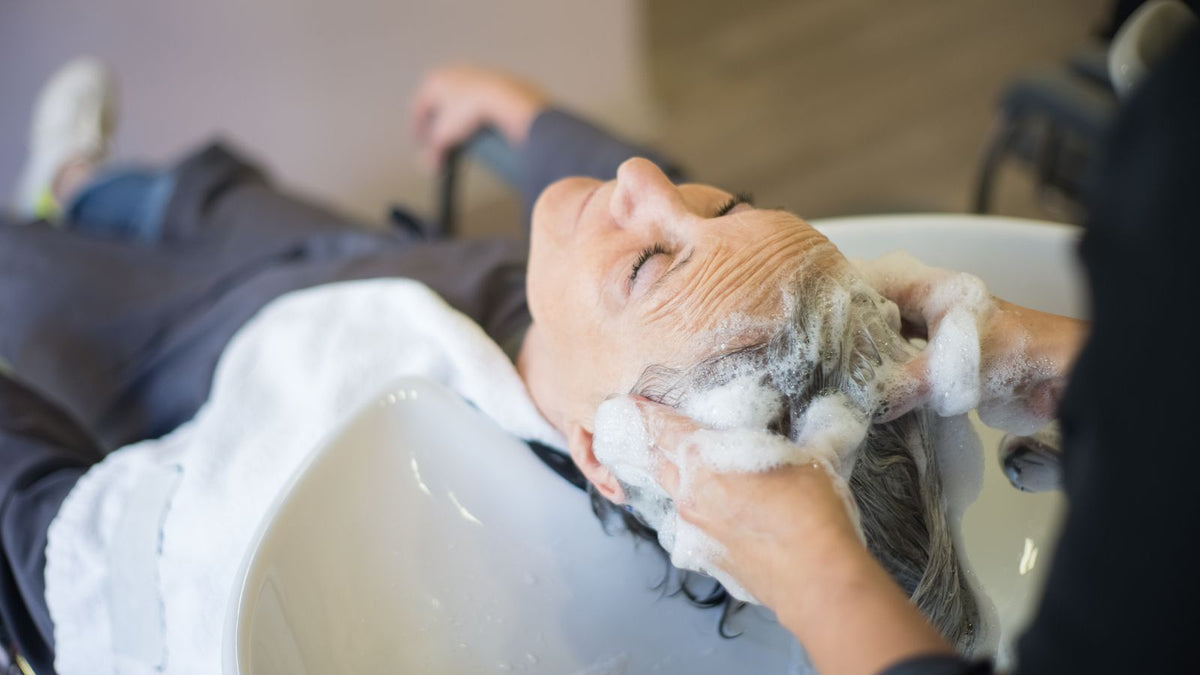
Everything above about how to wash a woman's hair still applies when you are washing it for someone else, with two changes. First, you cannot feel the water temperature on their scalp, so test it and then ask, every time. Second, you cannot feel how hard you are pressing, and it is very easy to be either too tentative to clean or hard enough to hurt. Ask for feedback at the start of the massage and adjust.
Over a salon basin, support the neck and keep the head tilted back so water runs away from the face. If you are helping someone who is unwell or recovering from surgery and cannot get to a basin, a jug, two towels and a large bowl on a bed table work fine: wet, shampoo the scalp, rinse in stages with the jug, then condition only the lengths so you have less to rinse out.

What aftercare matters between washes?
Knowing how to wash a woman's hair is only half the job, because most of what preserves length happens on the days you are not washing. Sleep on a silk or satin pillowcase, or plait long hair loosely, so it is not dragged across cotton for eight hours. Use a soft fabric tie rather than an elastic with a metal join. Keep straighteners below 185C and never use them on damp hair. A deep conditioning mask once a week does more for dry, snapping ends than switching shampoo again.
If your conditioner routine feels like guesswork, our step by step on how to use conditioner properly covers quantity, timing and the difference between a rinse out and a leave-in.
Important: Watermans products are 100% cosmetic and do not treat medical hair loss. Individual results may vary.
Frequently asked questions
How often should a woman wash her hair?
There is no universal number. Fine or oily hair often needs washing every one to two days, normal to thick hair every two to three, and coarse, coily or chemically lightened hair often does better at once or twice a week. The scalp sets the frequency and the lengths set the conditioning. If the scalp is itchy, flaky or greasy at the roots, you are washing too rarely for your scalp, not too often for your hair.
Should you shampoo once or twice?
Twice only when the first wash barely lathers, which usually means heavy oil, dry shampoo build up or styling product. The first pass lifts the film, the second actually cleans. On a scalp washed every day, once is plenty and a second pass just strips more oil than you need to.
What water temperature is best?
Lukewarm, roughly body temperature. Hot water feels good and makes hair swell and tangle more, which raises friction at exactly the moment the fibre is weakest. A cooler final rinse is not magic for shine, but it does help the hair lie flatter and feel smoother, and it is more comfortable on an irritated scalp.
Should conditioner go on the scalp?
Usually not. Conditioner is designed to sit on the fibre, and most scalps produce enough oil of their own. Apply from about ear level down, concentrating on the ends, which are the oldest and most damaged part of the hair. The exception is a very dry, tight or coily scalp, where a light conditioner at the roots can be genuinely helpful.
Is it bad to wash long hair every day?
Not inherently. Daily washing is a problem when the water is hot, the product strips heavily, and the hair is then rubbed dry with a towel and blow dried without protection. Those three things do the damage, not the water. A gentle sulphate free wash, lukewarm water and careful drying can be repeated daily on most hair.
Why does so much hair come out when I wash it?
Because washing is when you collect several days of normal shedding at once. Everyone loses roughly 50 to 100 hairs a day, and if you wash twice a week most of them arrive in the drain on those two days. It looks alarming and usually is not. Persistent handfuls, a widening parting or a change in hair calibre are worth a GP visit.
Should you brush hair before or after washing?
Before, always, and gently. Detangling dry or damp hair with a wide tooth comb removes the knots while the fibre is at its strongest. Dragging a brush through soaking wet, tangled, conditioner free hair is one of the most reliable ways to snap it. It is the rule in how to wash a woman's hair that people break most often.
How should you dry hair after washing?
Squeeze, do not rub. Press the water out with a microfibre towel or an old cotton t shirt, let the hair air dry to about 70 percent, then use a dryer on medium heat with a heat protection spray if you need it smooth. Rough towel rubbing lifts the cuticle and causes the frizz people then try to iron out.
Does washing hair cause hair loss?
Washing does not cause hair loss. It reveals shedding that has already happened, because a hair that has finished its cycle stays loosely lodged until something dislodges it. Skipping washes does not save those hairs, it just postpones the moment you see them.
Sources & references
- Hair breakage during combing III: the effects of bleaching and conditioning on short and long segment breakage by wet and dry combing tresses. Journal of Cosmetic Science, 2007. PubMed 17728947
- Rele AS, Mohile RB. Effect of mineral oil, sunflower oil and coconut oil on prevention of hair damage. Journal of Cosmetic Science, 2003. PubMed 12715094
- British Association of Dermatologists. Telogen effluvium, public information leaflet. bad.org.uk
- NHS. Hair loss. nhs.uk
What is the bottom line on how to wash a woman's hair?
Knowing how to wash a woman's hair properly comes down to six habits: detangle dry, keep the water lukewarm, shampoo only the scalp, rinse longer than feels necessary, condition only the lengths, and squeeze rather than rub. None of it costs anything, and together they save more length than any product on a shelf.
Watermans makes hair care in the UK and has sold over 6.5 million bottles since 2012. Our products are cosmetic: they support the condition of the hair you have and the comfort of your scalp.
If you take one thing from this, make it the wash step, and Grow Me hair growth shampoo is built for exactly that. Vegan, made in the UK.