Transitioning to Grey Hair With Highlights: A Blending Guide
Transitioning to grey hair with highlights means blurring the line between your natural grey roots and your coloured lengths, rather than waiting for a hard demarcation line to grow out. A colourist weaves fine lightened pieces through the top sections so the grow-out line softens into a gradient. Expect nine to eighteen months, three or four salon visits, and far less awkwardness than growing it out cold.
Our weekly hair mask
Masque Me® Hair Mask, £24.95. A deep conditioning weekly mask for dry, stressed lengths, adding gloss and hydration where heat and colour have taken their toll.
Key Takeaways
- Highlights work because they break up the hard line where grey roots meet dyed hair, turning a border into a blend.
- Most transitions take nine to eighteen months, depending on your starting colour, hair length and how much grey you have.
- The bigger the gap between your dyed shade and your natural grey, the more sessions the blend needs.
- Babylights, fine foils and root shadowing blend better than chunky highlights or a full bleach.
- Lightening always costs the fibre something. Grey hair is coarser and more porous, so conditioning is not optional.
- A cut is the most underrated tool. Removing dyed length shortens the transition more than any colour service.

Why does hair turn grey in the first place?
Hair turns grey because the pigment cells in the follicle stop delivering colour. Each follicle holds a reserve of melanocyte stem cells, which mature into melanocytes and feed melanin into the growing hair shaft. Over time that reserve depletes and the melanocytes are not replaced, so new hair emerges with less pigment and eventually with none. If the grey arrived early, in your twenties or thirties, our Huddersfield guide to premature grey hair covers what is behind it and when a GP check makes sense.
A hair with no melanin is not actually grey. It is white, and the grey you see is an optical blend of white hairs mixed among pigmented ones. As the proportion shifts, the overall head reads as grey and then as silver or white. Timing is largely genetic, which is why a parent going grey at 30 tells you far more than any lifestyle factor.
White hair also behaves differently. Without melanin the fibre is often coarser, drier and more wiry, the cuticle sits differently, and it takes and reflects light in a way that shows every bit of dullness. That is why a grey transition is as much a conditioning project as a colour one.
Why use highlights to grow out grey?
Transitioning to grey hair with highlights solves the one problem that makes people give up: the line. When you stop colouring, you get a sharp horizontal border between natural root and dyed length, and it advances down your head at about a centimetre a month. It reads as neglect rather than as a choice, and it is the reason most people reach for the box dye again around month four.
Weaving fine lightened pieces through the top sections lifts some of the dyed hair closer to your natural grey, and drops some brightness into the root area. The border stops being a line and becomes a gradient. Practically, that means you can go out and about at every stage of the transition without it looking like a halfway house.
There is a second, quieter benefit. Highlights are applied to sections rather than to the whole head, so your scalp and the bulk of your hair take far less chemical exposure than a full head of permanent colour every five weeks. Over an eighteen month transition that adds up.

Which highlight techniques blend grey best?
Fine and frequent beats bold and chunky. Grey hair is naturally variegated, with white, silver and pigmented strands sitting side by side, so the techniques that mimic that variation disappear into it.
| Technique | What it does | Best for |
|---|---|---|
| Babylights | Very fine woven strands, barely visible individually | The softest blend, and the safest place to start |
| Root shadow or root smudge | A soft toner melted through the root area | Killing a hard line fast, between full appointments |
| Balayage | Freehand painting, softest at the root | Longer hair, and stretching time between visits |
| Lowlights | Adds darker pieces back in | Heavily grey hair that has gone flat and needs depth |
| Chunky foils or full bleach | High contrast, heavy lift | Generally the wrong call here. Contrast is what you are trying to remove |
Most colourists combine two or three of these. A common pattern is babylights through the top and hairline where grey shows most, lowlights through the under sections for depth, and a root shadow to soften the join.
Get a discount on the grey and highlighted hair range
Join the Watermans mailing list and we will email a discount code straight to your inbox, so you can try the grey and highlighted hair range for less. Made in the UK, over 6.5 million bottles sold since 2012.
How do you choose the right shade for your grey?
Match the highlights to your natural grey, not to the colour you have been dyeing. That sounds obvious and it is the single most common mistake, because people bring a photo of their old colour to the appointment.
Two things guide the choice. First, how much grey you actually have. Under about 30 percent, lowlights and a few soft babylights usually do more than heavy lightening. Over about 70 percent, you are blending towards silver and the highlights should be cool and pale. Second, your skin undertone. Cool undertones sit well with ash and silver toners, warmer undertones usually need a touch of beige or a soft champagne so the grey does not read as sallow against the skin. After the grow-out is done, caring for grey hair is mostly about brassiness, dryness and strength.
Ask for a strand test
Grey and previously dyed hair lift unpredictably, especially where box dye or henna has built up over the years. A strand test on a hidden section tells your colourist how the hair actually behaves before they commit a whole head to it. Any good salon will do one without being asked twice.
Brassiness is the usual complaint. Lightened dark hair passes through orange and yellow tones on the way to pale, and grey hair shows yellowing from sun, minerals in hard water and styling products. A purple or blue toning shampoo used once a week, not every wash, keeps it cool. Used daily, purple shampoo tends to leave hair looking dull and slightly lilac.
How does transitioning to grey hair with highlights work, step by step?
- Start with a consultation, not a colour service. Bring photos of the grey you want to end up with. Say plainly that the goal is to stop colouring, because it changes every decision your colourist makes.
- Session one, blend the line. Usually babylights through the top and hairline plus a root shadow. This is the appointment that makes the transition liveable.
- Months two to four, live with it. Use a toning shampoo weekly and condition hard. Resist the urge to colour over it, which resets the clock.
- Session two, at around three to four months. More fine highlights closer to the new root, and often the first real cut into the dyed length.
- Cut, repeatedly. Every centimetre of dyed hair you remove is a centimetre you never have to blend. A shorter style shortens the whole project dramatically.
- Sessions three and four, tapering off. Toner only, or a light refresh. By now the grey is a significant share of what people see.
- Finish on maintenance. A toner every couple of months and a good conditioning routine, and the colour service stops entirely.
How should you care for hair while transitioning to grey hair with highlights?
Grey hair is drier, coarser and more porous than pigmented hair, and lightening it makes all three more pronounced. Anyone transitioning to grey hair with highlights is therefore looking after the most conditioning-hungry hair they will ever have. Two things matter most: put moisture and protein back in, and stop taking it out with heat.
- Deep condition weekly. Not fortnightly. A mask with proteins and emollients is the single highest value habit during a transition.
- Always use heat protection. Porous, lightened hair takes heat damage faster than virgin hair, and grey shows the resulting dullness clearly.
- Tone weekly, not daily. Once a week with a purple or blue shampoo, alternating with a gentle everyday shampoo.
- Filter or counter hard water. Mineral deposits are a major cause of yellowing on white hair. A chelating wash monthly helps if you live in a hard water area.
- Trim every eight to ten weeks. This both removes dyed ends and keeps split ends from travelling up the shaft.


Masque Me® Hair Mask £24.95
An 8-in-1 conditioning mask with argan oil, panthenol, hydrolysed lupine protein and rosemary. Weekly use is the habit that keeps coarse, lightened grey hair looking glossy rather than wiry.

Protect Me® Heat Protection Spray £13.95
Heat protection to 230 degrees, plus colour and frizz protection. Porous grey hair takes heat damage faster, so this is genuinely the non-negotiable step in a transition.

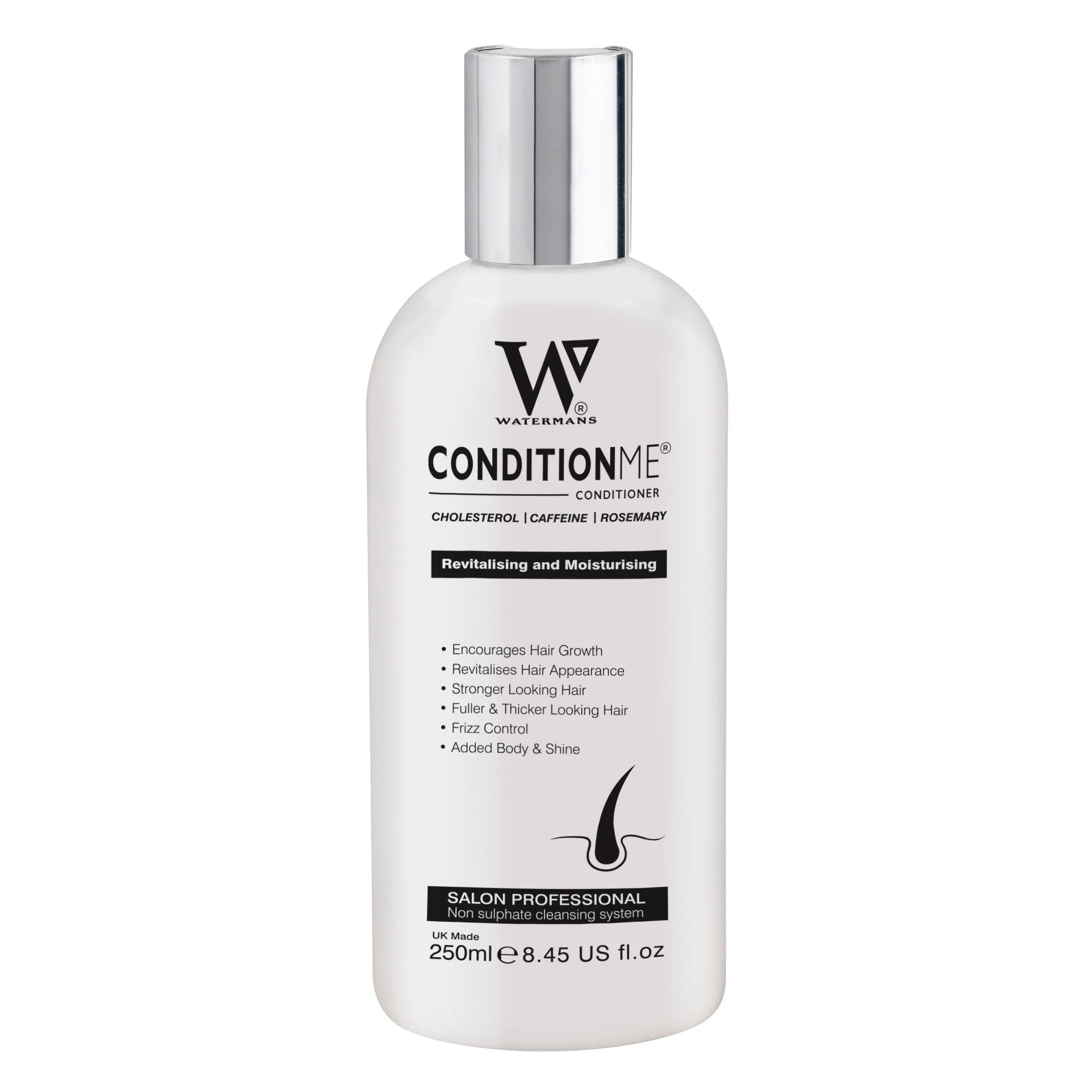
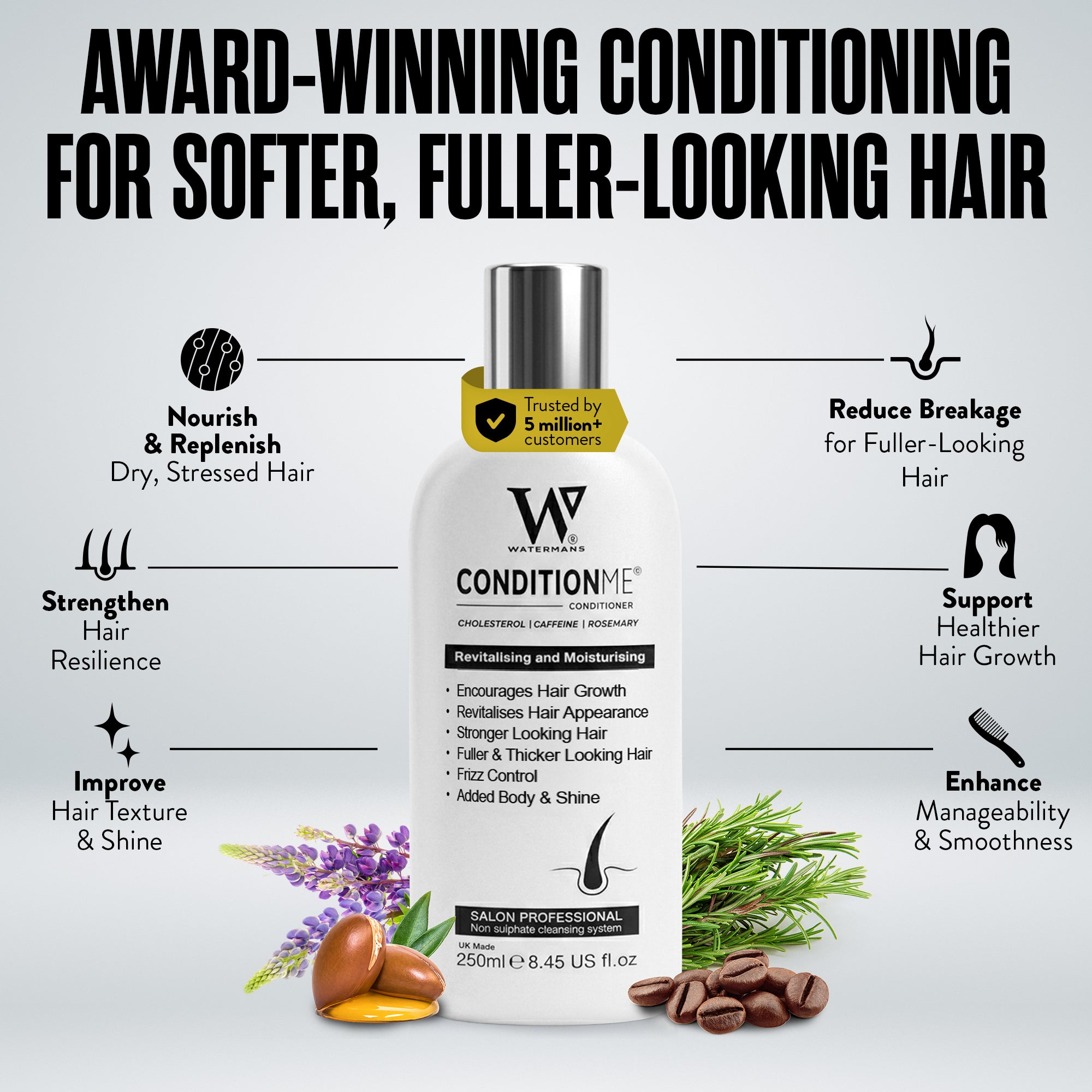
Condition Me® Hair Growth Conditioner £13.95
The everyday conditioner, for slip on wash days between masks. Detangling coarse grey hair without slip is where most avoidable breakage happens.
Watermans is a British brand. Everything we make is made in the UK, and we have sold over 6.5 million bottles since 2012.
Important: Watermans products are 100% cosmetic and do not treat medical hair loss. Individual results may vary.
What are the most common grey transition mistakes?
- Going cold turkey with long dark hair. The contrast is at its most extreme and the line at its most visible. This is exactly the case where highlights earn their money.
- Reaching for box dye at month four. Understandable, and it undoes the entire blend. Book a root shadow instead, which is quicker and cheaper than a full colour.
- Refusing to cut. Keeping every centimetre of dyed length can add a year to the project.
- Daily purple shampoo. Overtoning leaves hair flat, dull and faintly violet.
- Skipping conditioner to keep volume. Grey hair needs more conditioning, not less. Adjust where you apply it rather than whether you use it.
- Confusing grey with thinning. These are unrelated. Greying is a pigment change and does not affect how much hair you have.
That last point deserves a moment. Going grey and hair getting thinner often happen in the same decade, which makes people assume they are connected. They are not. If your parting is widening or your ponytail is thinner, that is a separate matter covered in what causes thinning hair, and worth a conversation with your GP rather than with your colourist. Breakage from over-processing is a third, different thing again, and it shows as short snapped pieces and split ends rather than as a widening parting. Our guides to what causes hair damage and preventing split ends cover that side.

For the everyday routine that suits mature hair generally, see our guide to what mature hair actually needs from a shampoo, and our four step routine for dry hair.
Sources & References
- Harris ML et al., A direct link between MITF, innate immunity, and hair graying, PLoS Biology (2018), for melanocyte stem cell loss as the mechanism behind greying.
- Melanocyte stem cells: biology and current aspects, Medical Science Monitor (2012), for how the follicular pigment reserve works.
- Dias MFRG, Hair Cosmetics: An Overview, International Journal of Trichology (2015), for what lightening does to the hair fibre and why porosity rises.
- NHS, Hair dye reactions, for patch testing and the risks of PPD sensitivity.
One honest caveat on the science. The melanocyte stem cell account of greying is well supported, but the popular claim that stress turns hair grey is on much softer ground: animal work points to a plausible mechanism while human evidence remains limited and largely anecdotal. We have described the mechanism and left the stress claim where the evidence leaves it, which is unresolved. If you want the science behind the change first, why hair loses its pigmentation covers what is happening at the follicle.
Frequently asked questions
How long does transitioning to grey hair with highlights take?
Most people spend nine to eighteen months transitioning to grey hair with highlights. The length depends on your starting colour, how long your hair is and how willing you are to cut. Shorter hair and regular trims can bring it down to six or eight months.
Will highlights damage my grey hair?
Any lightening costs the fibre something, because it opens the cuticle to remove pigment. Fine babylights on sections are far gentler than a full head of bleach, and weekly deep conditioning plus consistent heat protection keeps the damage manageable.
Can I transition to grey without highlights?
Yes. You can grow it out cold, use a shorter cut to speed things up, or wear the line deliberately. Highlights simply make the in-between months look intentional rather than neglected, which is why most people choose them.
Should I use purple shampoo every day?
No. Once a week is plenty for most people. Daily purple shampoo overtones the hair, leaving it flat, dull and faintly lilac. Alternate it with a gentle everyday shampoo and a weekly conditioning mask.
Why does my grey hair look yellow?
Yellowing on white hair usually comes from sun exposure, minerals in hard water, smoke, and residue from styling products. A weekly toning shampoo handles the tone, and a monthly chelating wash handles the mineral build-up if you live in a hard water area.
Does going grey mean my hair is thinning?
No. Greying is a pigment change in the follicle and has nothing to do with how many hairs you have. The two commonly happen in the same decade, which is why people link them. If your parting is widening, speak to your GP. If your question is about products or a routine rather than a medical one, you can talk to Gail Waterman, our co-founder, as an AI avatar on the Watermans homepage.
Why is my grey hair coarse and wiry?
Hair without melanin often has a different cuticle structure and holds less moisture, so it feels coarser and drier. It is not damage in itself. Weekly deep conditioning and a leave-in product make a substantial difference to how it feels and behaves.
Can I use henna or box dye during the transition?
Better not. Both build up unpredictably and make future lightening difficult to control, which is exactly what a colourist needs to be able to do during a blend. Tell your colourist about any henna in your history, even from years ago.
What is the bottom line on transitioning to grey hair with highlights?
Transitioning to grey hair with highlights is the least painful way to stop colouring, because it replaces a hard border with a gradient you can live with in public. Match the highlights to your natural grey rather than to your old dye, keep them fine, cut more than feels comfortable, condition weekly and tone once a week rather than daily. Give it a year, and the reward is hair that needs a fraction of the upkeep it used to.
The two products we would not skip are Masque Me for the weekly deep condition and Protect Me before any heat.