Vitamin K2 for Hair: What the Evidence Really Says
The honest answer on vitamin K2 for hair is that no good human study has shown it grows hair, thickens hair or slows hair loss. Vitamin K2 is a genuinely important nutrient with well established roles in bone and cardiovascular health, and a plausible but unproven indirect link to the scalp. Anyone selling it as a hair supplement is extrapolating far beyond the evidence, and you deserve to know that before you spend anything.
Our hair, skin and nails gummies
GrowPro® Hair, Skin & Nails Gummies, £22.95. Sugar free daily gummies for people who would rather chew than swallow a tablet, supporting hair care from the inside out.
Key takeaways
- There is no direct evidence. Searches of the human literature turn up no trial testing vitamin K2 as a hair intervention. Claims otherwise are marketing.
- K1 and K2 are not interchangeable. K1 comes from leafy greens and goes mostly to the liver. K2 comes from fermented foods and animal products and reaches other tissues.
- Its real jobs are elsewhere. K2 activates proteins that direct calcium into bone and keep it out of arterial walls. That is where the good evidence sits.
- Deficiency is uncommon in the UK. Most people eating a varied diet get enough, so a supplement is unlikely to change anything about your hair.
- Other nutrients matter far more. Iron, vitamin D, zinc and protein have real, documented links to hair shedding. Start there.
- Check first if you take blood thinning medication. Vitamin K affects clotting, so speak to your GP or pharmacist before supplementing.
What is vitamin K2, and how does it differ from K1?
Vitamin K is not one molecule but a family. Vitamin K1, phylloquinone, is the form in green leafy vegetables and makes up the large majority of what most people eat. Vitamin K2, menaquinone, is the form produced by bacterial fermentation and found in fermented foods and some animal products. Both are fat soluble and both feed into the same enzymatic pathway, but they behave very differently once absorbed. Many supplement powders are bulked out with fast carbohydrate, which is covered in the evidence on maltodextrin.
The practical difference is where they end up. K1 is taken up efficiently by the liver, where it supports the clotting factors, and comparatively little reaches other tissues. The longer chain menaquinones, particularly MK-7, stay in circulation far longer, with a half life measured in days rather than hours, and so reach bone, blood vessels and other peripheral tissue in meaningful amounts. That distribution difference is the entire reason anyone discusses vitamin K2 for hair separately from K1 at all: a nutrient that never reaches the scalp cannot plausibly do anything there.

Is there any real evidence for vitamin K2 for hair?
No, and it is worth being precise about what that means. There is no published randomised controlled trial in humans testing a vitamin K2 supplement against placebo with hair density, hair diameter or shedding as an outcome. There is no cohort study linking dietary K2 intake to hair outcomes. The evidence base is genuinely empty rather than merely thin.
What does exist is a chain of reasoning, and it goes like this. Hair follicles are metabolically demanding and depend on a dense network of tiny blood vessels. Vitamin K2 activates matrix Gla protein, which helps stop calcium depositing in soft tissue including vessel walls. Therefore, the argument runs, adequate K2 might help maintain healthy microcirculation to the follicle. Each individual step there is defensible. The conclusion still is not, because nobody has measured it, and plenty of biologically plausible chains turn out to be wrong when tested.
You will also see a widely repeated claim connecting vitamin K2 to a rare genetic condition where calcification and hair changes occur together. That syndrome is real, but it is a rare inherited disorder, and generalising from it to healthy adults with ordinary thinning is not sound. Where the reasoning and the evidence disagree, the evidence wins.
What does vitamin K2 genuinely do in the body?
The established biology is worth understanding, partly because it is interesting and partly because it makes clear why the hair claims are a stretch.
Vitamin K acts as a cofactor for an enzyme that carboxylates specific proteins, switching them from inactive to active. Two of those proteins matter most. Osteocalcin, made by bone building cells, binds calcium into the bone matrix once carboxylated. Matrix Gla protein, found in vessel walls and cartilage, inhibits calcium depositing where it should not. Without adequate vitamin K, both stay partly inactive, and the result is calcium in the wrong compartment: less in bone, more in arteries.
That has generated real research interest in bone density and cardiovascular health, and reviews have examined how vitamins D and K work together in that system. It is a serious area of nutritional science. It is also entirely separate from the follicle, which is why searching for vitamin K2 for hair specifically returns supplement marketing rather than research.
Which foods contain vitamin K2?

Food first is the sensible approach with any nutrient that has no specific hair evidence behind it. K2 is concentrated in fermented foods and in animal products from animals that have been eating green forage.
| Food | Main form | Notes |
|---|---|---|
| Natto (fermented soybeans) | MK-7 | By a wide margin the richest source known. An acquired taste. |
| Hard and aged cheeses | MK-8, MK-9 | Gouda, Edam and aged Parmigiano are among the better sources. |
| Egg yolk | MK-4 | Modest amounts; higher in pasture raised eggs. |
| Liver and organ meats | MK-4 | Also very high in vitamin A, so do not eat daily. |
| Butter and full fat dairy | MK-4 | Content depends heavily on the animal's diet. |
| Sauerkraut, some fermented foods | Mixed MK | Variable, depends entirely on the bacterial culture used. |

The NHS advises that most adults get the vitamin K they need from a varied diet, and clinically apparent deficiency is uncommon in healthy UK adults. If you eat cheese, eggs and green vegetables reasonably regularly, the odds that a K2 shortfall is behind your hair changes are low.
Get a discount on the thinning hair range
Join the Watermans mailing list and we will email a discount code straight to your inbox, so you can try the thinning hair range for less. Vegan, made in the UK, over 6.5 million bottles sold since 2012.
Should you take a vitamin K2 supplement for hair?
On the current evidence, taking vitamin K2 for hair specifically is not a decision we can support, because there is nothing to support it with. There are perfectly reasonable grounds to take K2 for bone or cardiovascular reasons, particularly alongside vitamin D, and if your GP or a registered dietitian has suggested it then that guidance stands. Hair is simply not one of the outcomes anyone has demonstrated.
If you do supplement, a few practical points are worth knowing. MK-7 is the form used in most supplements because its long half life gives steadier blood levels than MK-4. It is fat soluble, so it absorbs better taken with a meal containing some fat. Doses in common products sit in the region of 90 to 180 micrograms daily.
Important safety point. Vitamin K is directly involved in blood clotting. If you take prescription blood thinning medication, a change in your vitamin K intake can interfere with how well it works. Speak to your GP or pharmacist before starting any vitamin K supplement, and do not change your dose on your own.
Which nutrients genuinely matter for hair?
If nutrition is what you want to work on, there are several nutrients with real, documented links to hair shedding, and they deserve your attention long before vitamin K2 for hair does.
| Nutrient | Strength of the hair link | Worth acting on? |
|---|---|---|
| Iron (ferritin) | Strong, especially in women of menstruating age | Yes, ask your GP for a blood test rather than guessing |
| Protein | Strong; hair is largely keratin protein | Yes, particularly after rapid weight loss |
| Vitamin D | Moderate; low levels common in UK winters | Yes, UK guidance suggests a winter supplement anyway |
| Zinc | Moderate where intake is genuinely low | Only if a shortfall is confirmed; excess causes harm |
| Biotin | Weak in people who are not deficient | Marginal; true deficiency is rare |
| Vitamin K2 | None demonstrated in humans | Not for hair reasons |
Our separate guides to what biotin actually does for hair and how niacinamide works on the scalp apply the same evidence first approach to two other popular ingredients.
Where a supplement and a topical routine actually fit

Sugar free vegan gummies with biotin, zinc, MSM, bamboo silica and vitamins C, D3 and B12. These are nutrients that contribute to the maintenance of normal hair, which is a more honest basis than a K2 claim nobody has tested.

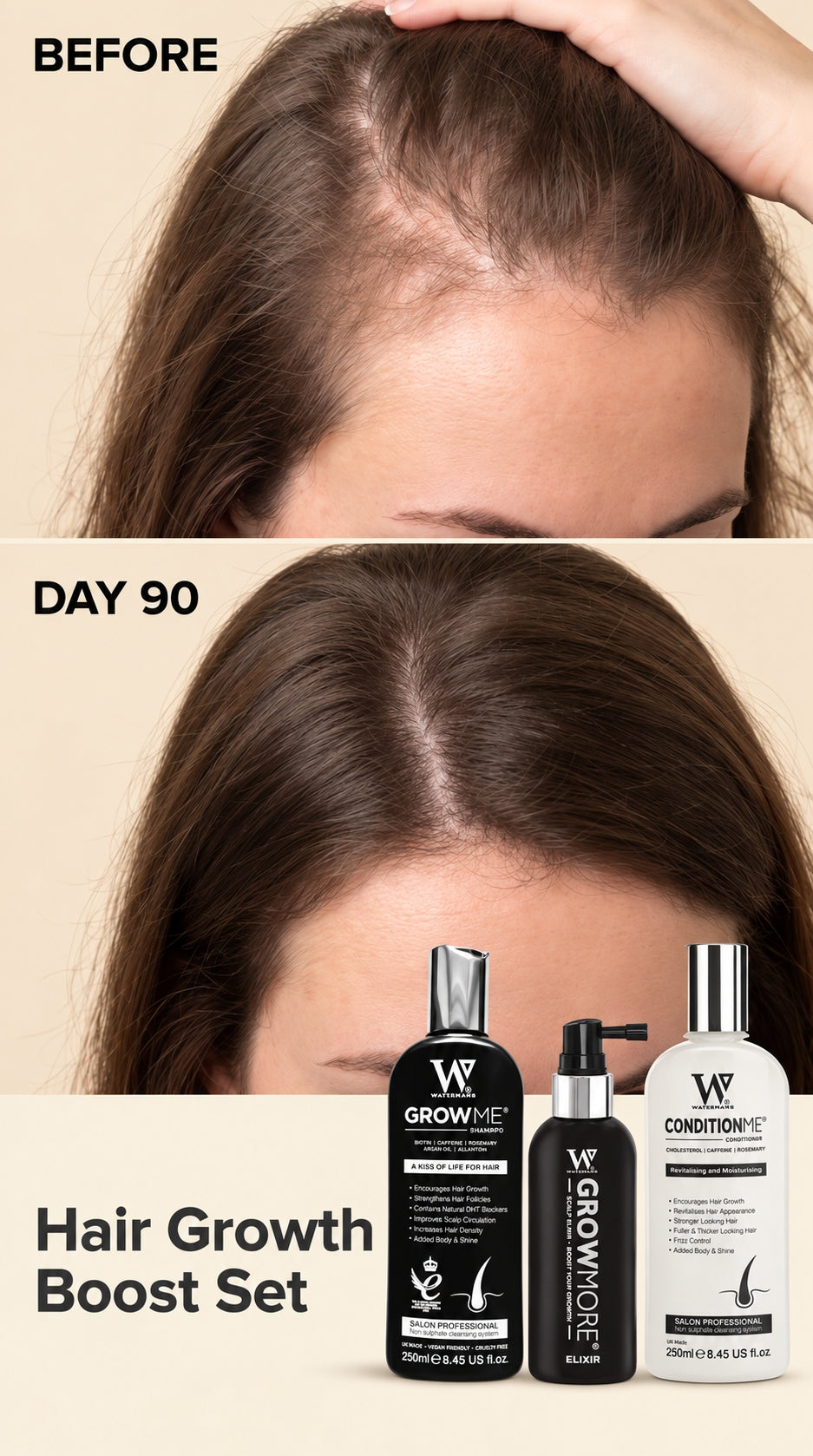
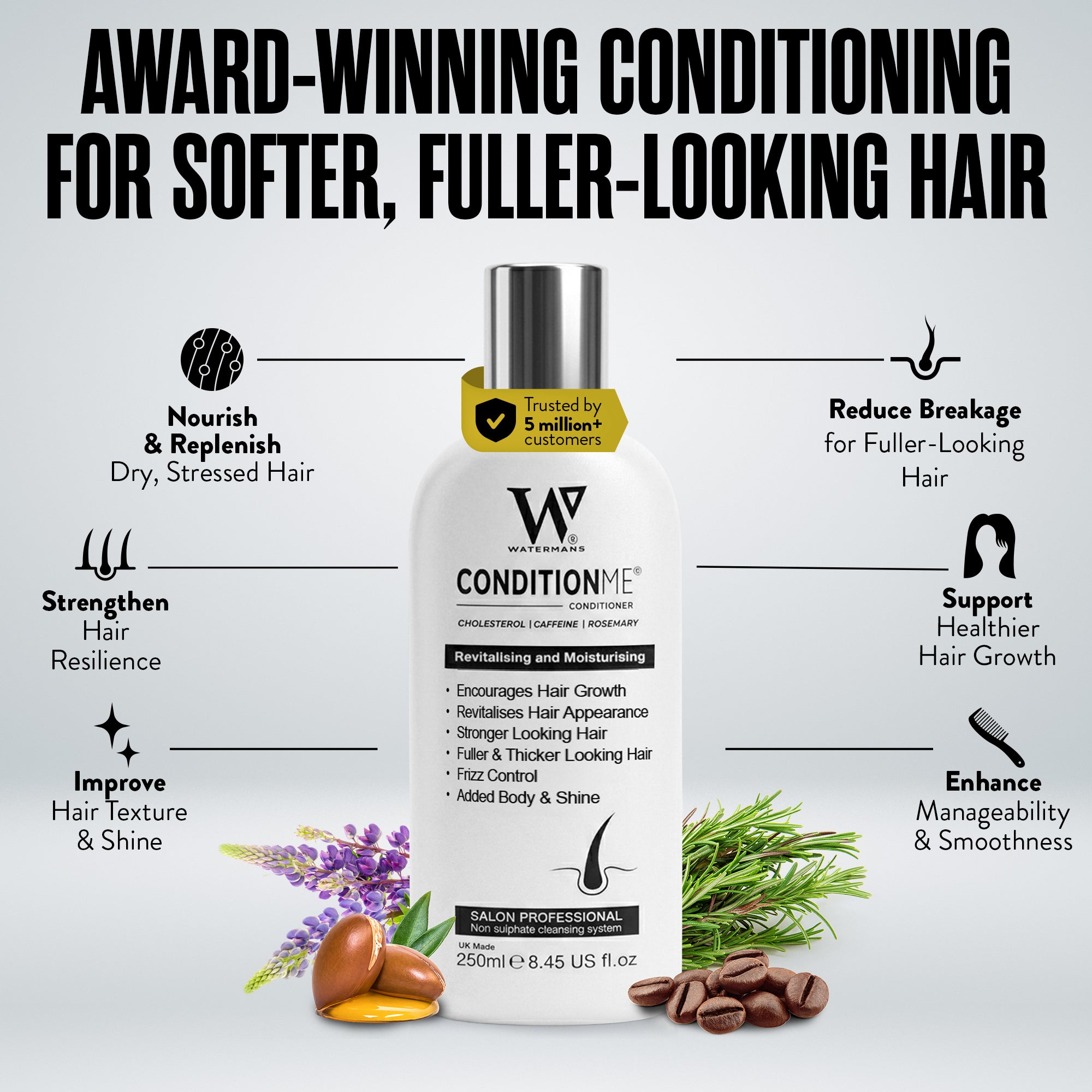
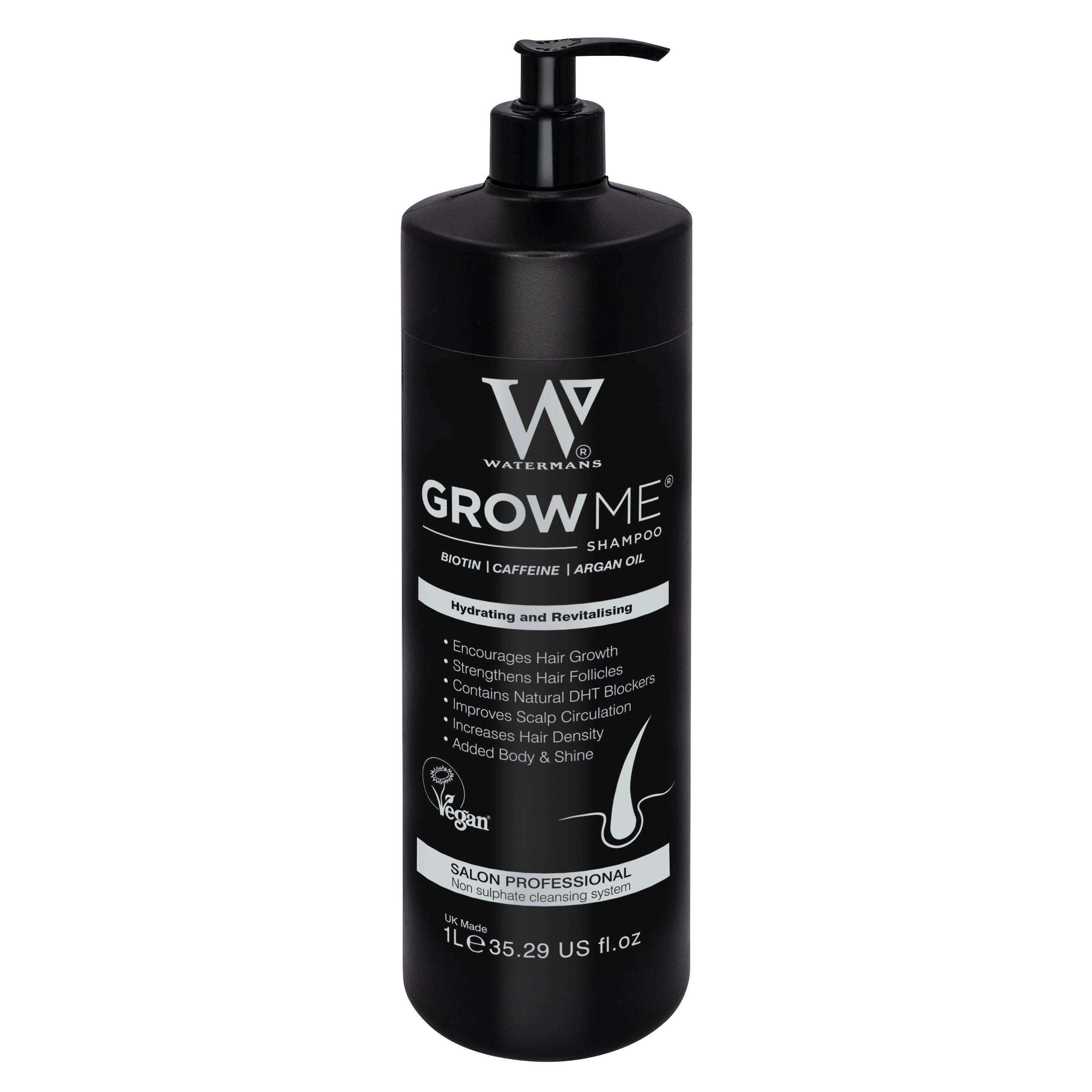
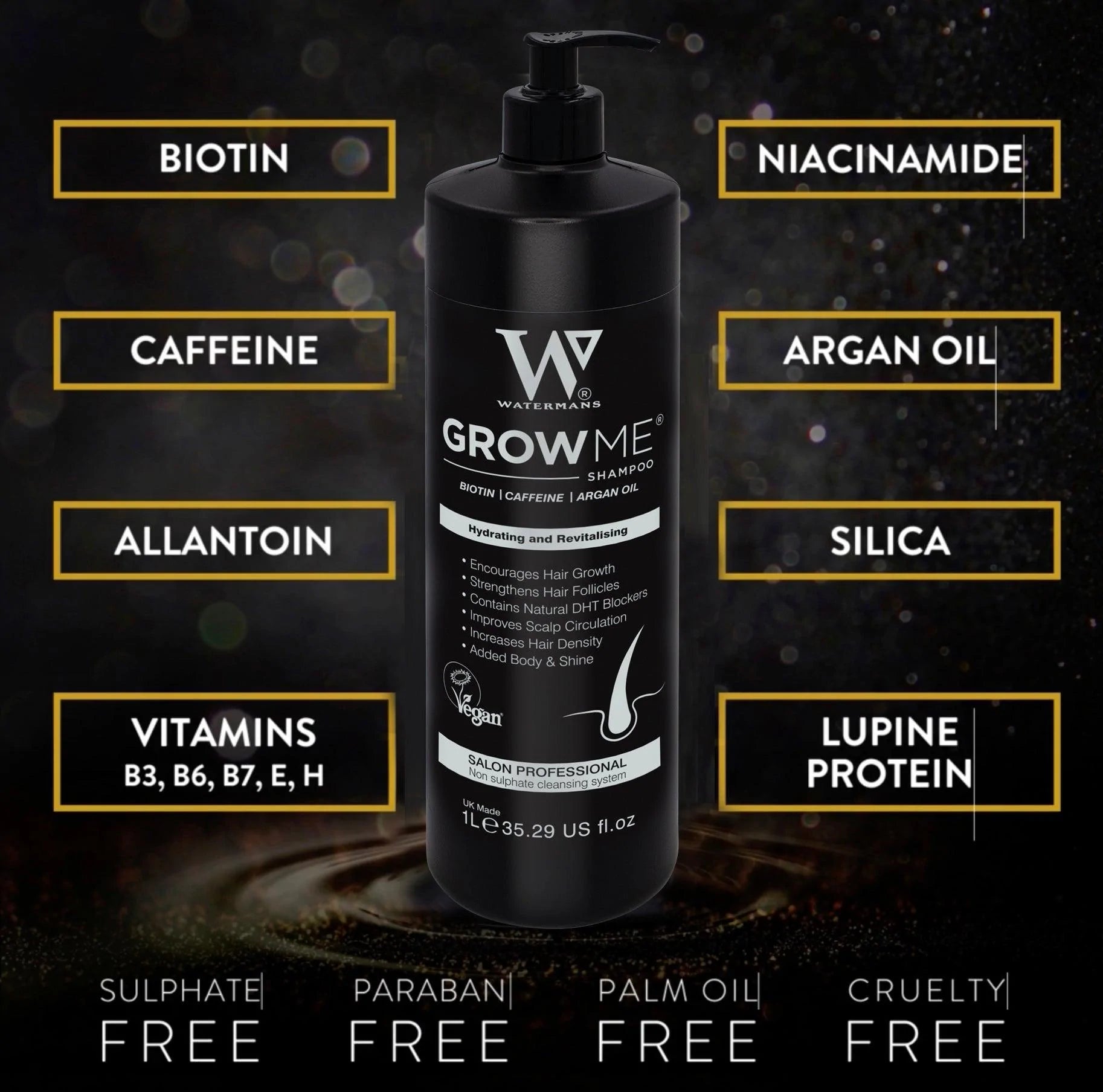
Sulfate free daily shampoo with biotin, caffeine, rosemary and niacinamide. It supports a healthy scalp environment and reduces the breakage that costs you visible thickness. Cosmetic, not medical.
Grow Me shampoo is vegan, Watermans is made in the UK, and we have sold over 6.5 million bottles since 2012.
Hair loss, hair shedding and hair breakage: which one are you asking about?
Nutrition questions are usually prompted by one of three quite different problems, and a nutrient can only plausibly help with one of them.
- Hair loss means follicles are producing progressively finer hairs, as in pattern hair loss, or have been damaged by an autoimmune or scarring process. Nutrition is not the driver, and no supplement changes it.
- Hair shedding means an unusually large share of follicles entered the resting phase together and released their hairs. This is where nutrition genuinely can matter: low iron, very low protein intake and rapid weight loss are recognised triggers.
- Hair breakage means the shaft is snapping partway along. This is mechanical and chemical, caused by heat, bleach, friction and over manipulation. It is fixed by handling and conditioning, not by anything you swallow.
If you are unsure which applies, our guide to telogen effluvium triggers and timelines and the three mechanisms behind thinning hair set out the distinction in detail.
Frequently asked questions
Does vitamin K2 for hair growth actually work?
There is no human evidence that it does. No randomised trial has tested vitamin K2 for hair growth, and no observational study has linked dietary K2 to hair outcomes. Products marketed on that basis are extrapolating from K2's established roles in bone and vascular health, which is not the same as evidence.
Can a vitamin K deficiency cause hair loss?
Clinically significant vitamin K deficiency is uncommon in healthy UK adults and its recognised signs involve bleeding and bruising rather than hair. There is no established deficiency picture in which hair loss is a feature, so it is an unlikely explanation for hair changes.
What is the difference between MK-4 and MK-7?
Both are forms of vitamin K2 with different side chain lengths. MK-4 is found in animal products and clears from the blood within hours. MK-7 comes mainly from bacterial fermentation, notably natto, and stays in circulation for days, which is why most supplements use it.
Can I get enough vitamin K2 without eating natto?
Yes. Hard and aged cheeses, egg yolks, butter from pasture fed animals and some fermented foods all contribute. Natto is by far the richest source but it is not the only one, and most people eating a varied diet reach adequate intakes without it.
Should I take vitamin K2 with vitamin D?
The two are often paired because vitamin D increases calcium absorption while vitamin K helps direct that calcium into bone rather than soft tissue, and reviews have examined this interplay for bone and cardiovascular health. That is a bone and vascular rationale, not a hair one.
Is vitamin K2 safe to take long term?
Vitamin K2 has a good safety record at the doses used in supplements, and no upper limit has been set for it in the way it has for some other fat soluble vitamins. The one genuine caution is the interaction with blood thinning medication, which is a conversation for your GP or pharmacist rather than a comment section.
Are there topical products containing vitamin K2 for hair?
A few exist, but there is no published work showing that vitamin K2 applied to the scalp is absorbed in useful amounts or does anything to the follicle. If a scalp product appeals to you, choose it on the strength of ingredients that have been studied on hair rather than on a K2 claim.
What should I do instead if my hair is shedding?
Ask your GP for a blood test covering ferritin, full blood count, thyroid function and vitamin D, since those cover the nutritional and hormonal causes with real evidence behind them. Alongside that, look honestly at the past three months for illness, weight loss or major stress, because shedding usually starts two to three months after the trigger. If your question is about products or a routine rather than a medical one, you can talk to Gail Waterman, our co-founder, as an AI avatar on the Watermans homepage.
What is the bottom line on vitamin k2 for hair?
Vitamin K2 is a legitimate and somewhat underappreciated nutrient, and the science on its role in bone and cardiovascular health is genuinely interesting. Vitamin K2 for hair, however, is a claim without a study behind it, and we would rather say so than sell you something on a hunch. If your hair is shedding, get your ferritin, thyroid and vitamin D checked, make sure you are eating enough protein, and look after the hair fibre itself with gentle handling and good conditioning. Those steps are backed by something. A K2 capsule bought for your hair is not.
If you would rather cover the basics from the inside too, the GrowPro hair growth gummies take two a minute a day. Vegan and made in the UK.
Watermans products are 100% cosmetic and do not treat medical hair loss. Individual results may vary.
Sources & References
- NHS. Vitamins and minerals: Vitamin K. UK guidance on intake, sources and sufficiency.
- Halder M et al. Vitamin K: Double Bonds beyond Coagulation, Insights into Differences between Vitamin K1 and K2. International Journal of Molecular Sciences.
- van Ballegooijen AJ et al. The Synergistic Interplay between Vitamins D and K for Bone and Cardiovascular Health. International Journal of Endocrinology.
- StatPearls, NCBI Bookshelf. Physiology, Hair. Hair cycle phases and fibre composition.
- NHS. Hair loss. Recognised causes and when to see a GP.