Thinning Hair Men: Why Your Scalp Shows and What Helps
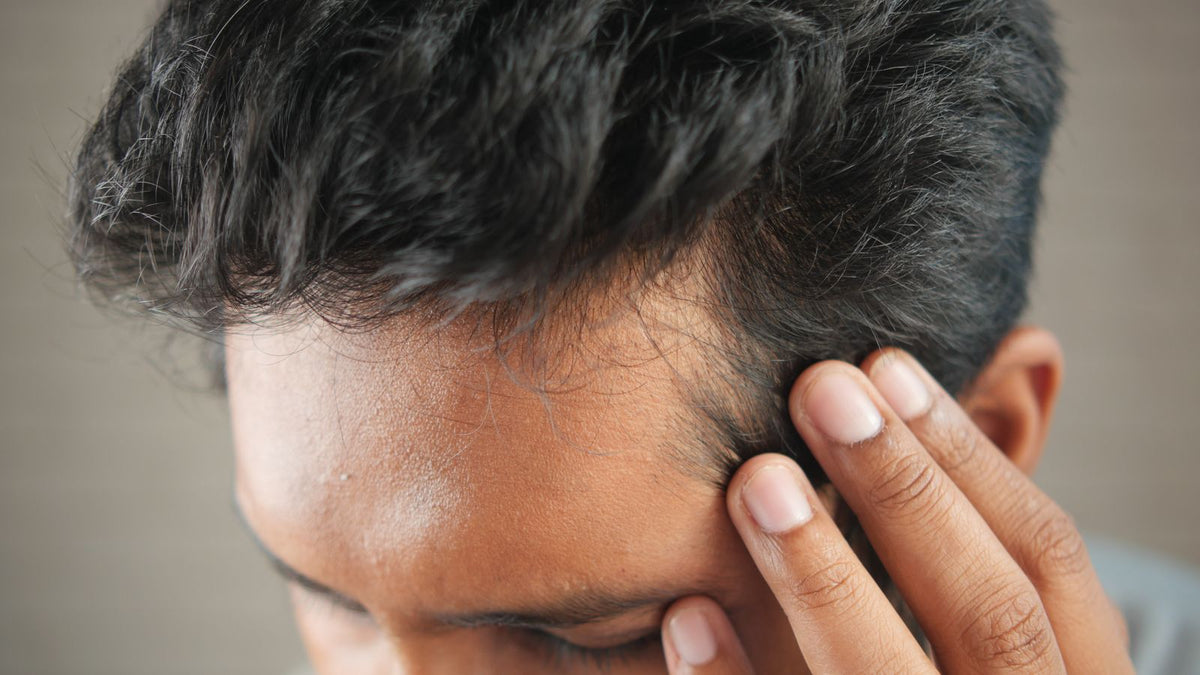
The thinning hair men notice first, at the crown or along the parting under bright overhead light, is one of the earliest and most common changes, and it usually shows as a visible scalp through hair male thinning pattern. It is normally a density change rather than bald skin: hairs are getting finer and fewer per square centimetre, so more light reaches the scalp. Wet hair, harsh lighting and a tight side parting all exaggerate it.
Our hair growth shampoo
Grow Me® Hair Growth Shampoo, £14.95. A sulphate free daily shampoo that supports a healthy scalp environment and helps reduce breakage, so lengths hold on and look fuller.
Key takeaways
- Density, not baldness. With the thinning hair men see most often, the scalp shows because individual hairs have miniaturised, not because follicles have vanished.
- Three different things get confused. Hair loss, hair shedding and hair breakage have different causes and different timelines. Work out which one you have before you change anything.
- Lighting lies. Overhead downlights and wet hair can make coverage look dramatically worse than it is. Judge in diffuse daylight, dry.
- Your haircut is the fastest lever. Shorter, more uniform lengths reduce contrast between hair and scalp far more effectively than any bottle.
- Cosmetics work on appearance, not biology. Fibres, styling and good scalp care change how visible the scalp looks. They do not change what is happening inside the follicle.
- See a GP if it is fast, patchy or itchy. Sudden or patchy changes deserve a medical opinion, not a shopping trip.
What does a visible scalp through hair male pattern actually mean?
A visible scalp through hair male pattern means the amount of light passing between your hairs has increased. Healthy adult scalps carry roughly 100,000 follicles, and coverage depends on three variables: how many hairs are actively growing, how thick each individual fibre is, and how the hair sits on the head. Change any one of the three and the scalp starts to show.
The most common driver in men is progressive miniaturisation. Under the influence of androgens, susceptible follicles at the crown and temples produce a slightly thinner, slightly shorter hair with each growth cycle. The follicle is still there and still working, but a fibre that was once 70 microns across might now be 40. Twenty thousand thinner hairs simply block less light than twenty thousand thick ones, and the scalp beneath becomes easier to see. If you are in the North East, our guide to hairline and crown assessments in Newcastle upon Tyne explains what a trichologist visit involves.
This matters because it changes what is realistic. A scalp that shows through because hairs have thinned behaves very differently from one that shows through because hair has snapped off mid-shaft, and the two respond to completely different things.

Why do thinning hair men see their scalp first at the crown?
The thinning hair men see at the crown comes first because the follicles there are the most sensitive to androgens, and several distinct mechanisms make the scalp show, often more than one at once. The list below separates them by what is physically happening to the hair.
Androgen driven miniaturisation
The classic pattern: recession at the temples, thinning at the crown, and a mid-scalp that gradually loses density while the back and sides stay dense. It is gradual, usually painless, and strongly familial. Our guide to the stages of pattern hair loss and what drives them covers how this progresses over years rather than months.
Telogen effluvium, a shedding surge
Roughly two to three months after a significant stressor, such as illness, surgery, rapid weight loss, a high fever or a period of poor sleep and low intake, a larger than usual share of follicles shift into the resting phase together and release their hairs at once. Shedding is diffuse across the whole head rather than patterned, and it typically settles within six to nine months once the trigger has passed.
Breakage at the fibre
Here the follicle is perfectly healthy but the hair snaps partway along its length. Heat styling, aggressive towel drying, tight caps and hats worn daily, bleach and repeated colour all weaken the cuticle. Breakage leaves short broken ends of uneven length, and it can thin the apparent bulk of the hair enough that the scalp shows even though nothing has been lost at the root.
Scalp condition
Flaking, redness and persistent itch change how hair sits and how light scatters off the scalp. Research on scalp condition and hair retention has linked an inflamed, oxidatively stressed scalp environment to poorer hair quality and retention, which is one reason scalp care is worth attention in its own right.
Simple optics
Not every cause is biological. A parting worn in the same place for years flattens the hair either side of it. Wet hair clumps into strands and exposes scalp between them. A single overhead downlight throws the harshest possible shadow onto the crown. Many men first notice a visible scalp through hair male pattern in a badly lit changing room or a phone camera flash, not because anything changed that week.
What is the difference between hair loss, hair shedding and hair breakage?
Confusing these three is the single most common reason men buy the wrong thing. Each has a different signature, and you can usually tell them apart at the bathroom sink in under a minute.
| Hair loss (follicular) | Hair shedding (cycle) | Hair breakage (fibre) | |
|---|---|---|---|
| What is happening | Follicles produce progressively finer hairs | More follicles than usual rest and release at once | The shaft snaps; the follicle is unaffected |
| What you find | Fewer, wispier hairs in one area | Full length hairs with a white bulb at the root | Short, uneven, bulb free fragments |
| Distribution | Patterned: crown, temples, mid scalp | Diffuse across the whole head | Wherever heat, friction or chemistry is worst |
| Timeline | Years | Starts 2 to 3 months post trigger, settles in 6 to 9 | Improves within weeks of removing the cause |
| What helps | Medical advice; cosmetic camouflage and cut | Addressing the underlying trigger; patience | Gentler handling, conditioning, heat control |
If you are unsure which you are dealing with, the three clue self-check for thinning hair walks through the same distinction step by step.
How can you judge how far along it is?
Three checks, done properly, tell you more than a month of worrying.
- The daylight photo. Once a month, dry hair, near a window with no direct overhead light, take the same three shots: crown from above, parting from the front, hairline straight on. Same spot, same time of day. Month to month comparison is far more reliable than memory, which is unreliable and pessimistic.
- The parting test. Part your hair in its usual place, then part it 2cm to one side. If the new parting looks noticeably denser, some of what you are seeing is a flattening habit rather than density loss.
- The pull test. Take about 50 hairs between finger and thumb and draw gently along the length. Two or three coming away is normal. Six or more, repeated across several areas, suggests active shedding rather than gradual thinning.
Men often describe a hairline that has moved back slightly and evenly as thinning when it is a normal maturing change. What a mature hairline is and how to style it is worth reading before you assume the worst.
Get a discount on the thinning hair range
Join the Watermans mailing list and we will email a discount code straight to your inbox, so you can try the thinning hair range for less. Made in the UK, over 6.5 million bottles sold since 2012.
Which haircuts suit thinning hair men best?

The haircuts that suit thinning hair men best are short and uniform, because the cut is the single most effective and cheapest lever available, and most men get it wrong by growing hair longer to compensate. Longer hair is heavier, separates into strands and increases the contrast between dark hair and pale scalp. Shorter and more uniform almost always reads as denser.
| Cut | Best for | Why it works |
|---|---|---|
| Short textured crop | Crown and mid scalp thinning | Even short length removes the strand separation that exposes scalp |
| Buzz cut, grade 2 to 4 | Advanced or diffuse thinning | Minimises contrast entirely; density stops being readable |
| Crew cut with soft fade | Temple recession | Blurs the boundary between hairline and skin |
| Textured crop with fringe forward | Frontal thinning | Brings weight forward instead of exposing the hairline |
| Long comb over | Nothing, honestly | Creates high contrast strands and fails in wind or rain |
Two styling rules go with the cut. Dry hair with the airflow pointed against the direction of growth, which lifts the root and casts shadow onto the scalp rather than off it. And use matte products, not shine: a matte clay or paste diffuses light, while a wet look pomade separates hair into distinct strands and does exactly what you do not want. For a related angle, see our guide to is pomade bad for your hair.
What everyday care actually helps?

Everyday care will not alter the genetics behind a visible scalp through hair male pattern, and any product promising otherwise is overselling. The thinning hair men can actually protect is the hair they already have: keep it from breaking, keep the scalp comfortable, and make the fibre look and feel thicker. Given that breakage is often layered on top of thinning, that is not a trivial contribution. We look at hair care for genetic thinning separately, with the practical steps.
- Wash often enough. Men frequently under wash a scalp that produces plenty of oil, then blame flaking on the shampoo. A comfortable, clean scalp is the baseline.
- Turn the heat down. A hairdryer on maximum, held close, is a common cause of the breakage that thins apparent bulk. Medium heat at a hand's distance is plenty.
- Stop the friction. Rubbing hair dry with a towel, sleeping on rough cotton and wearing a tight cap all day are three of the easiest wins available.
- Condition the mid lengths. Conditioner is not just for long hair. It reduces the snapping that shortens fibres and costs you visual density.
Our wider guide to seven everyday habits that reduce breakage goes further into the mechanical side.
Products thinning hair men can use every day

Sulfate free daily shampoo with biotin, caffeine, rosemary and niacinamide. Cleanses without stripping and supports a healthy scalp environment, so the hair you have is in better condition day to day.

Grow More® Leave-In Scalp Elixir
A leave on serum for lower density areas such as the crown and parting. Applied to a dry scalp at night, it targets exactly the zones where light gets through first.

Purely cosmetic camouflage. Keratin fibres cling statically to existing hairs and thicken them visually, cutting the contrast between hair and scalp within seconds. They wash out, and they change appearance only.
Watermans is made in the UK, and has sold over 6.5 million bottles since 2012.
How do concealing cosmetics work, and what are their limits?
Building fibres, tinted scalp sprays and coloured powders all solve the same optical problem: pale scalp showing between darker hairs. Fibres cling to the hair shaft and fatten it; sprays and powders darken the scalp so the contrast drops. Both work immediately and both are genuinely effective in photographs and normal daylight.
Their limits are worth stating plainly. They need some existing hair to cling to, so they perform well on diffuse thinning and poorly on smooth skin. They are not waterproof in heavy rain unless set with a fixing spray. And they are cosmetics: they change what an onlooker sees today and nothing about what the follicle does tomorrow. Used with that expectation they are one of the most cost effective options available. Used as a substitute for medical advice on a rapidly changing scalp, they simply delay the useful conversation.
When should you see a GP or a trichologist?
Most gradual thinning is not urgent. Some presentations are, and a cosmetic routine is the wrong response to them. Speak to your GP if any of the following apply.
- Hair comes out in discrete round patches rather than thinning evenly.
- The change happened quickly, over weeks rather than years.
- The scalp is sore, scaly, scarring or persistently itchy, or the skin looks shiny and smooth where hair was.
- You also have fatigue, weight change, or altered heat tolerance, which may point to thyroid or iron issues worth a blood test.
- You are under 21 and losing hair noticeably.
- It is affecting your mood or confidence. That is a legitimate reason to seek help, not a vanity issue.
A registered trichologist is a useful second route for hair and scalp specific assessment, and you can find one through a professional register rather than a search advert. Watermans does not run clinics and offers no medical opinion; we make cosmetic hair care. If you want to know what a specialist visit involves, our guide to what happens at a hair loss consultation sets out how to prepare. If your question is about products or a routine rather than a medical one, you can talk to Gail Waterman, our co-founder, as an AI avatar on the Watermans homepage.
Frequently asked questions
Is thinning hair men notice in their twenties normal?
Yes. Male pattern thinning commonly starts in the twenties and progresses slowly over years, usually at the temples and crown first. Noticeable loss under 21, sudden loss over weeks, or patches rather than even thinning are the signs worth a GP visit, as listed above.
Is a visible scalp through hair male thinning always permanent?
No. Whether it recovers depends entirely on the mechanism. Scalp visibility caused by a shedding surge after illness or stress usually recovers over six to nine months once the trigger has resolved. Scalp visibility caused by breakage improves within weeks of gentler handling. Androgen driven miniaturisation, by contrast, is progressive and long term, which is why identifying which one you have matters more than any product choice.
At what point is it normal to see some scalp?
Everyone shows some scalp at the parting and crown under direct overhead light, and always has. The meaningful question is not whether you can see scalp at all but whether the area over which you can see it is expanding month on month. That is what the monthly daylight photo is for.
Does wearing a hat or cap make it worse?
A normally fitting hat does not cause androgen driven thinning. A tight cap worn for long periods every day can contribute to mechanical breakage along the band line and to a hotter, sweatier scalp environment, so it can make things look worse without changing follicle biology. Loosen it and let the scalp breathe.
Why does my scalp look so much worse when my hair is wet?
Wet hair loses volume and clumps into thick separated strands, opening gaps that dry hair covers. Almost everyone looks thinner wet. Never judge your density in the shower or immediately after it.
Can shampoo make my hair thicker?
Shampoo cannot change the number of follicles you have or undo miniaturisation, and any product claiming otherwise is making a claim it cannot support. What a well formulated shampoo can do is keep the scalp clean and comfortable, reduce the breakage that costs you visible bulk, and leave the fibre feeling thicker. That is a real but cosmetic benefit.
Is stress really a cause?
Significant physiological stress, meaning serious illness, surgery, major weight loss or prolonged sleep deprivation, is a well recognised trigger for telogen effluvium. Ordinary day to day work stress is a much weaker signal. The tell is timing: effluvium starts two to three months after the event, not during it.
Do hair building fibres damage your hair?
Used as directed they sit on the outside of the hair shaft and wash out with normal shampooing, so they do not damage the fibre or block follicles. The practical caution is simply to wash them out rather than layering fresh fibres on unwashed hair for days at a time.
Should I shave it all off?
A grade 1 or 2 buzz removes the contrast that makes thinning readable, and many men find it looks better and takes less effort than managing a thinning longer style. It is a legitimate choice rather than a surrender, and it is entirely reversible: hair grows back at roughly 1cm a month if you change your mind.
What is the bottom line for thinning hair men?
The bottom line for thinning hair men is that a visible scalp is usually about density rather than bare skin, and the practical path forward is the same for most: work out whether you are dealing with thinning, shedding or breakage, cut the hair shorter and more uniformly, control heat and friction, keep the scalp comfortable, and use cosmetic camouflage if you want an immediate visual change. Do all that and you have addressed everything within your control. If the change is fast, patchy, itchy or distressing, that is the point at which a GP or registered trichologist adds something no shampoo can.
For an event or a photograph, the Watermans hair building fibres are the instant cosmetic answer.
Watermans products are 100% cosmetic and do not treat medical hair loss. Individual results may vary.
Sources & References
- NHS. Hair loss. Overview of causes, patterns and when to see a GP.
- Endotext, NCBI Bookshelf. Male Androgenetic Alopecia. Mechanism of follicular miniaturisation and pattern distribution.
- StatPearls, NCBI Bookshelf. Physiology, Hair. Hair cycle phases, follicle density and fibre structure.
- Trüeb RM et al. Scalp Condition Impacts Hair Growth and Retention via Oxidative Stress. International Journal of Trichology.
- Dias MFRG. Hair Cosmetics: An Overview. International Journal of Trichology. Cosmetic mechanisms, breakage and fibre handling.
- NHS. Register with a GP surgery.