Low Testosterone Belly and Your Hair: What It Signals
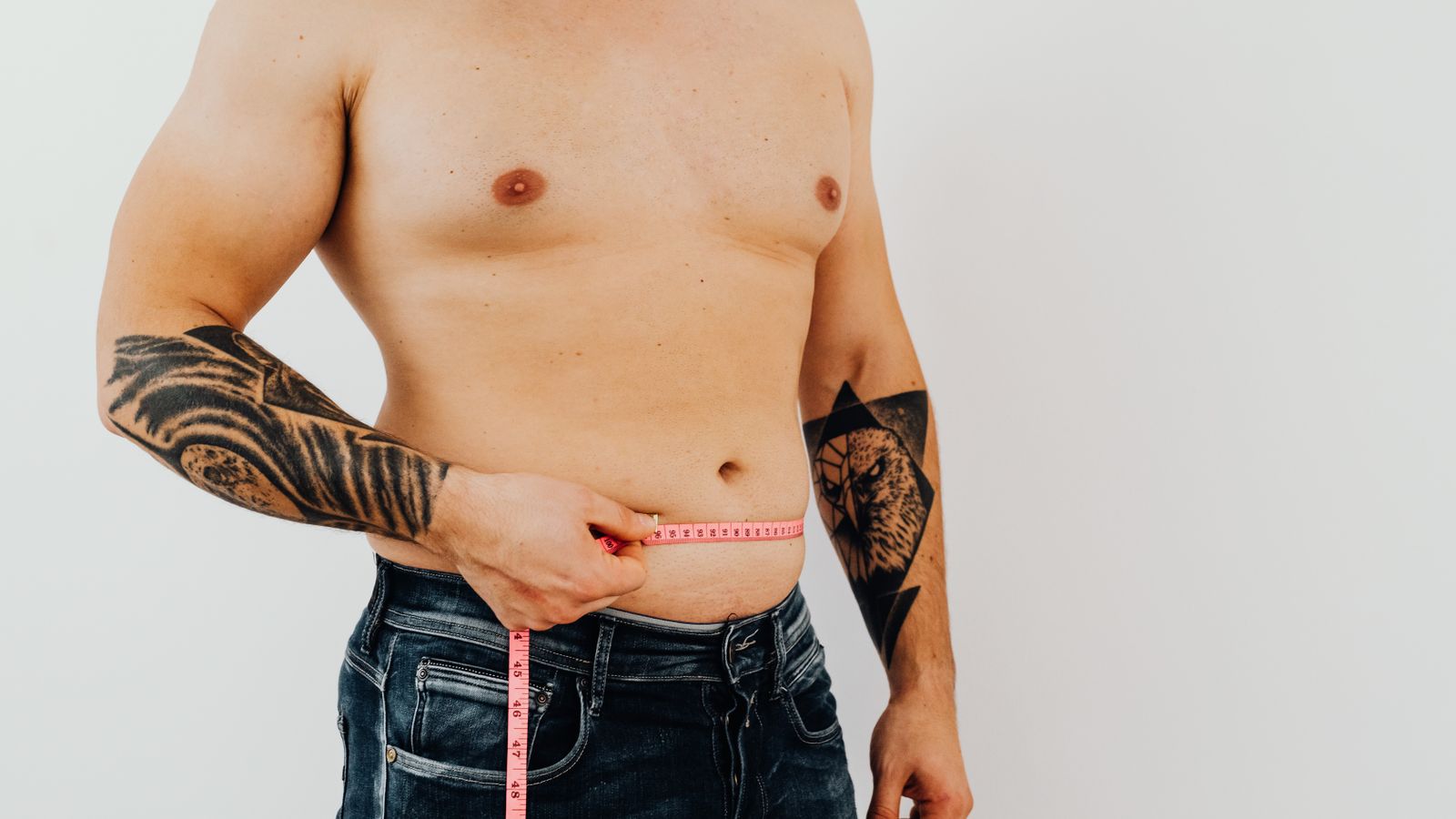
A low testosterone belly is the pattern of fat that settles around the middle when testosterone runs low, alongside a quiet loss of muscle and energy. It matters for hair in a way most people get backwards. Low testosterone tends to reduce body and facial hair rather than scalp hair, and it does not cause male pattern thinning. Scalp thinning is driven by inherited follicle sensitivity, not by how much testosterone you have.
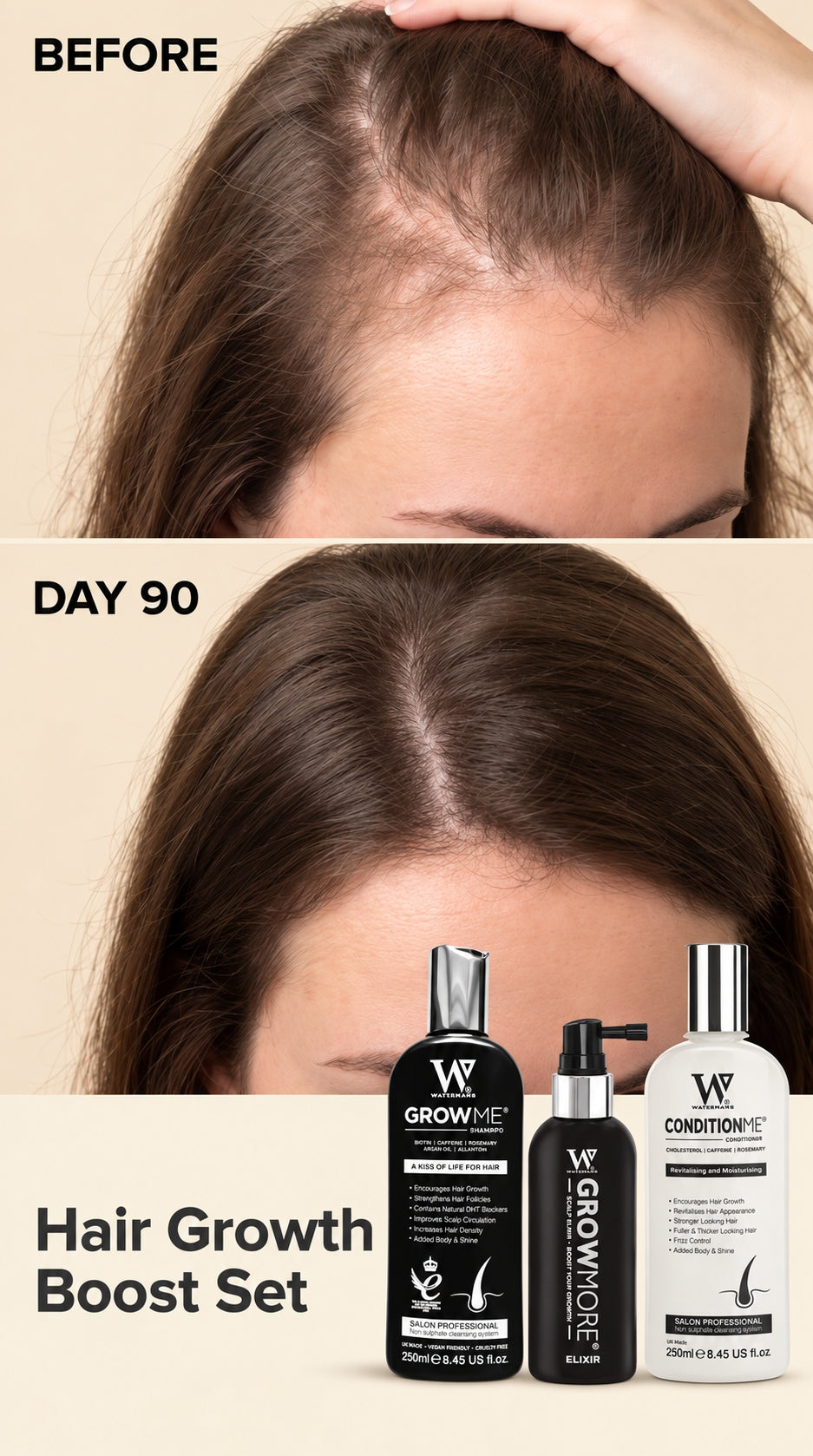
Our hair growth shampoo
Grow Me® Hair Growth Shampoo, £14.95. A sulphate free daily shampoo that supports a healthy scalp environment and helps reduce breakage, so lengths hold on and look fuller.
Key Takeaways
- A low testosterone belly describes central fat gain plus muscle and energy loss, and the two directions reinforce each other.
- Low testosterone and scalp thinning are separate stories. Men with low levels can still thin at the crown, and men with high levels often keep a full head of hair.
- What low levels genuinely tend to reduce is body hair, beard density and the rate at which facial hair grows.
- Pattern thinning depends on how sensitive your follicles are to androgens, which is inherited. That sensitivity is why one man thins and his equally hormonal brother does not.
- Sleep, resistance training, alcohol intake and body composition are the everyday levers with the most evidence behind them, and they help both problems at once.
- Symptoms alone cannot tell you your levels. Only a blood test can, and it needs to be a morning one.
What is a low testosterone belly?
A low testosterone belly is not a medical term. It is shorthand for a recognisable picture: weight that concentrates around the abdomen rather than spreading evenly, a waistband that moves while overall bodyweight barely does, visible muscle loss in the shoulders and legs, and a drop in energy, mood and drive that arrives with it. Men often describe it as their body composition changing shape without them changing much.
The abdominal part is not cosmetic. Fat stored around the organs behaves differently from fat stored under the skin, and it is metabolically active, which is what connects it to hormones in the first place.

Why do low testosterone and belly fat feed each other?
Because the relationship runs in both directions, which is why it can feel like a spiral. Abdominal fat tissue contains aromatase, an enzyme that converts testosterone into oestrogen. More abdominal fat means more conversion, which lowers circulating testosterone. Lower testosterone in turn makes it harder to hold lean muscle, and less muscle lowers resting energy expenditure, which makes further fat gain easier. Endocrinology reviews of obesity and low testosterone describe exactly this loop, and note that weight loss itself often raises levels without anything else changing.
Several other factors push in the same direction: poor or short sleep, heavy alcohol intake, chronic stress, some long term health conditions, and simply getting older, since levels drift down gradually from around the age of 30. None of that is a reason to panic, and none of it is something to self assess from a symptom list on the internet.
Does a low testosterone belly mean you are going to lose your hair?
This is the question most people arrive with, and the honest answer is no, at least not in the way they expect. Male pattern thinning is not caused by having a lot of testosterone, and it is not held off by having a little. It is caused by follicles on the top of the scalp being genetically sensitive to androgens, principally dihydrotestosterone. In a sensitive follicle, each growth cycle produces a slightly finer, shorter hair until the hair it makes is barely visible. In an insensitive follicle, the same hormone levels do nothing at all. That is why brothers with identical hormone profiles can end up with completely different hairlines. We have a separate guide to is bone broth good for hair growth if that is the part you need.
The practical consequence is counterintuitive. Men with genuinely low levels can and do still develop pattern thinning, because sensitivity, not quantity, is the driver. Meanwhile the hair changes that low levels really do tend to produce sit elsewhere on the body: sparser chest and limb hair, a beard that fills in more slowly, and less need to shave. If your beard has thinned while your scalp has not, that pattern points at hormones. If your crown and temples have thinned while your beard is unchanged, that points at inherited sensitivity instead. For what a testosterone result can and cannot tell you about your hair, see our guide to testosterone and hair loss. We look at hair loss on testosterone separately, with the practical steps.
Our explainers on pattern hair loss and what triggers androgenic alopecia go through the stages and the mechanism in more detail.
Hair loss, hair shedding and hair breakage: which one are you seeing?
Men tend to compress all three into the word balding, and they call for different responses. Two minutes with a shed hair under a good light usually settles it.
| What it is | What you see | How it relates to hormones |
|---|---|---|
| Hair loss (follicular) | Receding temples, a thinning crown, a scalp that shows through under overhead light | Inherited androgen sensitivity. Not a marker of high or low levels |
| Hair shedding (cycle) | More full length hairs everywhere at once, each with a small pale bulb, no change in pattern | Follows illness, rapid weight loss, stress or nutrient shortfalls, usually 3 months later |
| Hair breakage (fibre) | Short broken stubs of uneven length, rough ends, no bulb | Nothing to do with hormones. Clippers, heat, hard water and rough towel drying |
A man with a low testosterone belly who is also losing weight quickly may be seeing shedding rather than pattern thinning, and that distinction changes everything about what happens next. Shedding after weight loss recovers. Our guide to why hair thins has a self check for working out which one you are looking at.
Get a discount on the thinning hair range
Join the Watermans mailing list and we will email a discount code straight to your inbox, so you can try the thinning hair range for less. Vegan, made in the UK, over 6.5 million bottles sold since 2012.
What does the research actually show about androgens and follicles?
Laboratory work on isolated human follicles is where a lot of the confusion starts. In one widely cited in vitro study, testosterone suppressed the growth of follicles taken from men with pattern thinning, while caffeine applied to the same follicles offset that suppression. That is a genuine finding, and it is also a long way from a claim about what happens on a living scalp. Isolated follicles in a dish are not a head of hair, concentrations in an organ culture are not concentrations after a shampoo, and an effect on hair shaft elongation over a few days is not a change in visible density over a year. Anyone managing hair alongside a transition will find the cuts, styling and scalp care set out in our guide to transmasculine hair care.
Two things are worth taking from it honestly. Androgen signalling really does act directly at the follicle in people who are susceptible, which is why the pattern is so consistent. And caffeine has a plausible mechanism at the follicle rather than being purely a marketing ingredient, which is why it turns up in so many scalp products. Neither of those makes a shampoo a medicine, and we are not going to pretend otherwise.
Which everyday changes help both the belly and the hair?
The overlap here is unusually good. The same handful of habits that improve body composition are the ones that support a healthy hair cycle, mostly because both suffer when the body is under sustained strain.
- Resistance training two or three times a week. It is the most reliable lever on lean mass, and lean mass is what makes the loop turn the other way. The UK guidance is muscle strengthening activity on at least two days a week alongside 150 minutes of moderate activity.
- Sleep, properly. Most testosterone release happens during sleep, and short sleep measurably lowers levels in healthy young men within a week. It is also one of the clearest inputs into the stress load that pushes hairs into the resting phase.
- Lose weight gradually if you need to. Weight loss raises levels on its own, but crash dieting is a documented trigger for diffuse shedding. Slow is genuinely better here for both outcomes.
- Keep protein up. Around 1.2g to 1.6g per kilogram of bodyweight a day protects lean tissue in a deficit, and hair is made of protein too.
- Cut back alcohol. Heavy intake affects hormone levels, sleep quality and appetite regulation in the same direction, all at once.
- Sort the basics of iron, vitamin D and B12. These come up repeatedly in diffuse shedding, and a blood test is cheap certainty against a lot of guessing.

Where a cosmetic routine fits
Hair care cannot change a hormone level and it cannot make an insensitive follicle out of a sensitive one. What a good routine can do is keep the scalp comfortable and stop you losing extra hair to breakage on top of whatever else is happening, which matters more when density is already down. That is a modest, real job.

Grow Me Hair Growth Shampoo, £14.95
Sulphate free daily shampoo with caffeine, biotin, rosemary and niacinamide, formulated to support a comfortable scalp and leave thinning hair looking fuller and thicker. Cosmetic, not medicinal.

GrowPro Hair Growth Gummies, £22.95
Sugar free vegan gummies with biotin, zinc, selenium and bamboo silica. Zinc and selenium contribute to the maintenance of normal hair, which is worth covering when you are eating in a deficit. Food first, supplement second.
When should you speak to your GP?
Do not try to work this out from symptoms alone. Fatigue, low mood, low libido and central weight gain overlap with several other conditions, including thyroid problems, depression, sleep apnoea and iron deficiency, and getting the wrong one will cost you a year. A GP can arrange a blood test and interpret it in context.
- Ask for a morning blood test, since levels are highest early and fall through the day. Two separate samples are usual before anything is concluded.
- Mention every symptom, not just the one that bothers you most, including sleep quality and snoring.
- Ask about thyroid function, iron studies including ferritin, vitamin D and blood glucose at the same time.
- Go sooner if you have loss of morning erections, testicular changes, breast tenderness, hot flushes, or significant unexplained weight change.
- If your hair is also changing, describe the pattern rather than just saying it is falling out. Where and how matters far more than how much.
The NHS page on the so called male menopause is a good, unhyped starting point, and it is worth reading before any private clinic sells you a panel of tests.

Frequently Asked Questions
Does a low testosterone belly cause baldness?
No. Scalp pattern thinning is caused by inherited follicle sensitivity to androgens rather than by the amount of testosterone in your blood. Low levels are more likely to show up as sparser body and facial hair than as a receding hairline.
If I raise my testosterone, will I lose more hair?
If you are genetically susceptible, raising levels can make existing pattern thinning more obvious, which is a real and well known effect. If you are not susceptible, it generally will not. This is a conversation to have with a doctor who knows your history, not one to settle from a forum.
How quickly does belly fat come off once levels improve?
Slowly, and usually only alongside the same diet and training changes anyone else would need. Hormones make the work easier or harder, they do not do it for you.
Can losing weight raise testosterone on its own?
Frequently, yes. Reducing abdominal fat lowers the conversion of testosterone to oestrogen, and studies of weight loss in men with obesity show levels rising without any other intervention. It is the first thing most clinicians look at.
Is a saliva or home finger prick test good enough?
Home kits vary widely and a result taken at the wrong time of day is close to meaningless. Use a morning venous sample arranged through your GP if you want an answer you can act on.
Does shaving my head help if I am thinning?
It does not change what is happening at the follicle, but it removes the contrast between dense and sparse areas, which is why so many men find it a better look than defending a thinning crown. It is a styling decision, not a hair decision.
Will a hair supplement do anything if my hormones are the problem?
Not for the hormonal part. A supplement covers nutritional gaps, which matter most when you are eating in a deficit, and that is worth having. It cannot influence follicle sensitivity.
What is the bottom line on low testosterone belly?
A low testosterone belly is a real pattern worth taking to your GP, but it is not the reason your hairline is moving. Scalp thinning tracks inherited follicle sensitivity, while low levels more often show up as thinner body and facial hair. Get a morning blood test rather than self assessing, work on sleep, resistance training and gradual weight loss since those help both problems at once, and see hair care for what it is: a way to keep the hair you have looking its best, not a hormonal fix. If your question is about products or a routine rather than a medical one, you can talk to Gail Waterman, our co-founder, as an AI avatar on the Watermans homepage.
Most routines fall over because they are complicated, so start with our sulphate free hair growth shampoo and nothing else. Made in the UK, with over 6.5 million bottles sold since 2012.
Sources and References
- NHS. The male menopause, on low testosterone symptoms, overlapping causes and getting tested.
- NHS. Physical activity guidelines for adults aged 19 to 64.
- Fui MNT and colleagues. Hypogonadism and male obesity: focus on unresolved questions. Clinical Endocrinology, 2018.
- Fischer TW and colleagues. Effect of caffeine and testosterone on the proliferation of human hair follicles in vitro. International Journal of Dermatology, 2007.
- NHS. Hair loss, on common causes and when to seek help.
Where laboratory findings and real world outcomes do not line up, we have said so in the text rather than quoting the convenient half.
Watermans products are 100% cosmetic and do not treat medical hair loss. Individual results may vary.